# Elden Glass — full content dump
> A research site arguing that FromSoftware's Elden Ring is a literal
> performance of Marcel Duchamp's The Bride Stripped Bare by Her
> Bachelors, Even (The Large Glass).
> This file is the llmstxt.org-spec companion to /llms.txt — every
> readable page concatenated as clean plaintext, JSX stripped. For
> per-page navigation use /contents (HTML) or /api/llms/toc (JSON).
# /author/about
> ~dashus-navnul
> A short self-introduction from the site's author: a political analyst and self-described non-artist who spent three years solving Elden Ring's final secret and assembling the evidence on this site.
I have never in my entire life wanted to be an artist.
I am a lot of things, but not that.
[Plate i — This is the last of the three replicas of The Large Glass for which Duchamp gave his official blessing. It was completed in the 80s in Tokyo, during the same time and place that Miyazaki went to college.]
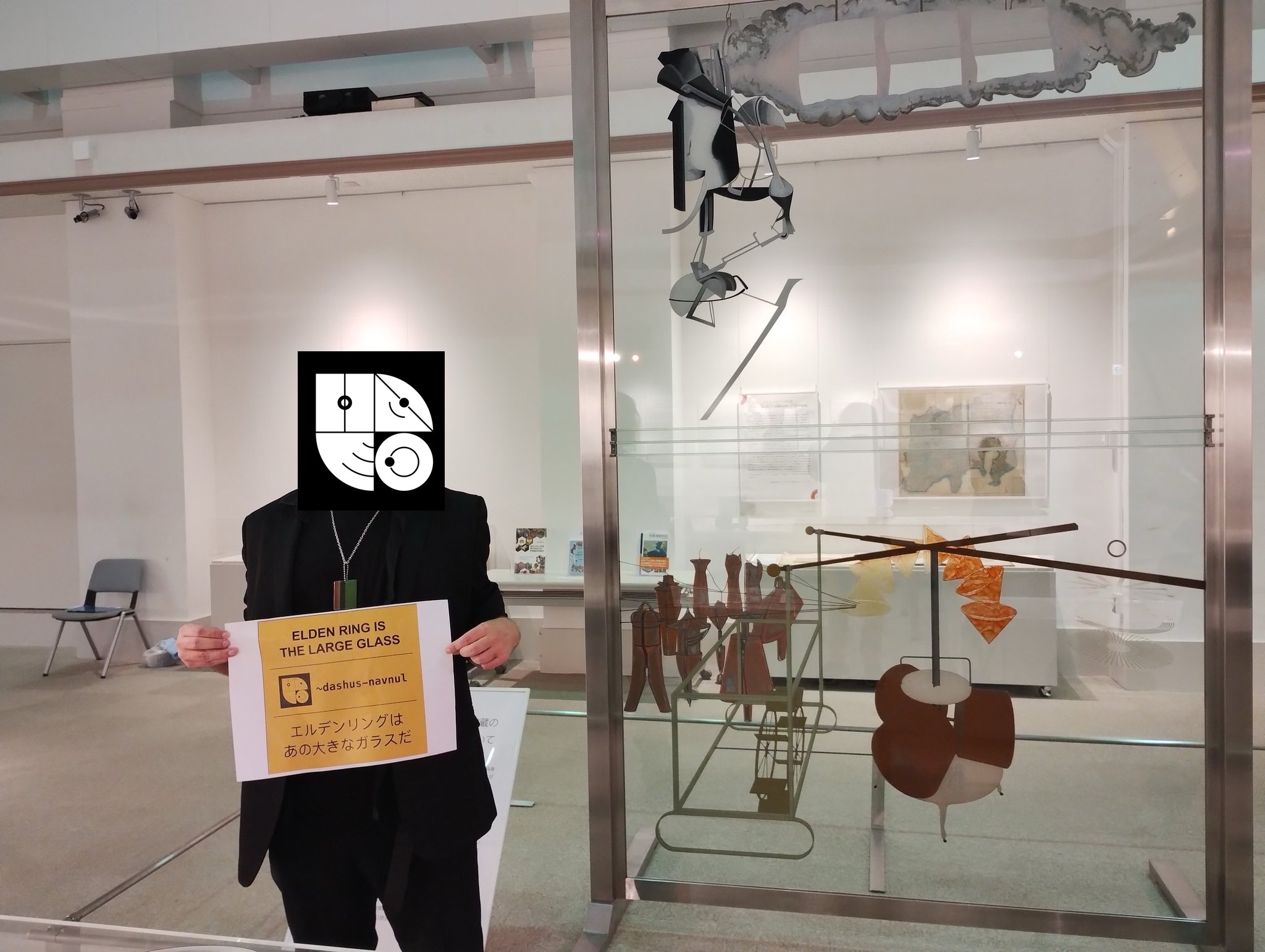 I suffer from chronic boredom and require increasingly interesting things to entertain me. From this condition, best described in Sarah Perry's "Grand Unified Theory on Nerdom", I became extremely adept at interfacing with the internet to find new and interesting information, so much so that I now do it professionally in my career as a political analyst. The way I justified this project to myself, the entirety of the time before I showed it to anyone was done under the assumption that no one would even care, was the idea that if I could solve Elden Ring's Final Secret in such a way that I could be credited with its discovery, I'd be able to use it as a credential for my career in lieu of the college education I don't have.
I stumbled into the art world about a year ago, when I brought this work to a literature event. I had worked on it for over three years at that point, and what started out by doing research for a short essay titled: Urbit and Dark Souls and The Fifth Wall had grown into an attempt to solve Elden Ring's final secret.
---
## On AI
Yes, AI helped make this website; but no, AI did not help me make this discovery.
I began this project four years ago with a serious study of Elden Ring and the Dark Souls games. The discovery itself came almost two years ago—before the current generation of AI existed in any meaningful sense.
But even today, no AI could solve a problem like: _"Find Elden Ring's final secret that Miyazaki hinted at. No errors. No hallucinations. 0 mistakes. Just find it."_
Even if you told an AI the answer—that Elden Ring IS The Large Glass—and asked it to prove how, the details would be impossible. That the Great Runes are the Chocolate Grinder viewed from above. That Vyke on the cover is "the shot that got closest." That the Glass Shards scattered everywhere are literal fragments of The Large Glass. These connections require cross-domain intuition that current AI simply doesn't have.
Here's why:
Elden Ring and Marcel Duchamp's work are inherently _pataphysical_—operating according to Alfred Jarry's "science of imaginary solutions," the study of exceptions rather than laws. The secret I discovered exists at the pataphysical level. It's not a pattern to be matched. It's an exception. An imaginary solution that became real.
Current AI operates on statistical pattern matching. It finds laws—what usually happens, what's most likely, what the training data suggests. It cannot find exceptions. It cannot operate where contradictions are true. It cannot navigate the space where "there is no solution because there is no problem."
For AI to solve problems like these would require primitives that operate pataphysically. Semantic operators that find the swerve, not the average. A runtime where exceptions are first-class objects.
---
# /bachelor-machines/chocolate-grinder
> The Chocolate Grinder
> The Elden Ring symbol, seen on every cover and loading screen, matches Duchamp's Chocolate Grinder viewed from above, with evidence points tying the symbol and Great Runes to the grinder's geometry.
## Evidence Points
The Elden Ring symbol on the cover is the Chocolate Grinder viewed from top-down. The
cylindrical grinding mechanism, when seen from above, produces the exact radial pattern of the
Elden Ring.
Each Great Rune corresponds to parts of the Chocolate Grinder mechanism. The segments, the
central axis, the rotating elements - all map to specific Great Runes.
Godrick's and Morgott's anchor runes only make geometric sense as a top-down view of cylindrical
grinder structure. The 'anchors' are the legs of the grinder seen from above.
## The Chocolate Grinder in The Large Glass
The Chocolate Grinder is the central apparatus in the Bachelor domain of The Large Glass. Duchamp based it on an actual chocolate grinding machine he saw in a confectioner's window in Rouen, France. In The Large Glass, it represents the self-grinding, self-sufficient mechanism of bachelor desire.
Duchamp famously said of it: _"The bachelor grinds his chocolate himself."_ This phrase encapsulates the onanistic, self-referential nature of the bachelor machine - it produces nothing but its own operation.
## The Elden Ring Symbol
When you rotate Duchamp's Chocolate Grinder 90 degrees to view it from directly above, the iconic Elden Ring symbol emerges. The three cylindrical drums become the radiating segments. The central axis becomes the core ring. The supporting legs become the anchor points.
This isn't coincidence or vague similarity - it's geometric correspondence. The Great Runes, which are fragments of the Elden Ring, map to specific parts of the Grinder mechanism.
## Why This Matters
If the central symbol of the game - the thing in the title, on every cover, in every loading screen - is Duchamp's Chocolate Grinder, then the connection is not peripheral. It's foundational. The game is literally named after a component of The Large Glass.
The Chocolate Grinder is where the Bachelors process their desire. The Elden Ring is where the Tarnished process theirs. Same mechanism, different medium.
---
# /bachelor-machines/terms
> Bachelor Machine Catalog
> Complete catalog of bachelor machines from the 1975 Szeemann exhibition, paired with the critical vocabulary of bachelor-machine studies from Carrouges through Deleuze & Guattari and beyond.
This catalog pairs the machine inventory from the 1975 Szeemann exhibition with the critical vocabulary of bachelor-machine studies. Machines are organised by author or era; definitions run from Carrouges' original 1954 framing through Deleuze & Guattari, van Weelden, Spyrou, and Galloway. Short glosses live in the vocabulary tables; full-paragraph definitions are gathered in _Expanded Definitions_ at the bottom.
## Foundational: Duchamp
| Machine | Source | Description |
| ----------------------------- | ------------------ | -------------------------------------------------------------------------------------------------------------------------------------------------------- |
| The Large Glass / Grand Verre | Duchamp, 1915-1923 | The ur-bachelor machine; two-tier structure with Bride above, Bachelors below |
| The Nine Malic Moulds | Duchamp | "Cemetery of uniforms and liveries" — priest, department store delivery boy, gendarme, cuirassier, policeman, undertaker, flunkey, busboy, stationmaster |
| The Chocolate Grinder | Duchamp | Stands for "masturbation"; grinds its own chocolate |
| The Chariot/Glider | Duchamp | "Slow life / Vicious circle / Onanism / Buffer of life / Celibate life" |
| The Sieves/Parasols | Duchamp | Filter the illuminating gas |
| The Water Mill | Duchamp | Part of the bachelor apparatus |
| The Stoppages (étalon) | Duchamp | "Standard stoppage" — three meter-lengths dropped from height |
## Raymond Roussel
_Locus Solus & Impressions d'Afrique._
| Machine | Description |
| ------------------------------------- | -------------------------------------------------------------------------------------------------------------------- |
| La hie / The Paving Beetle | "Demoiselle à reitre en dents" — mosaic of teeth representing a mercenary |
| Faustine's Large Diamond Aquarium | Contains Danton's head, the dancer Faustine, a Siamese cat; electrical/musical machine |
| Fogar's Photographic Plant | In somnambulism, operates the control-lever of a spotlight; "molecular movement in the fibres of the luminous plant" |
| The Montalescots' Mechanical Manikins | Helot (slave on whalebone corset rails) and Kant (bust with electric bulbs in skull) |
| Djizmé's Lightning-Conductor Bed | Woman integrated as "fuse" to lightning conductor; first time a woman takes the condemned man's place |
| The Painting Machine | "Clinamen" — ejaculates colors onto walls; "puffs at its ease on the steep canvas" |
## Alfred Jarry
| Machine | Source | Description |
| ----------------------------- | ---------- | ----------------------------------------------------------------------------------------------------------- |
| The Supermale's Race | Le Surmâle | 10,000-mile race; train vs. 5-seater bicycle; "Perpetual Motion Food" |
| The Magneto in Love | Le Surmâle | "Magneto-electric machine suitable for inspiring love"; machine falls in love with the supermale |
| The Electric Chair | Le Surmâle | Supermale strapped in with platinum crown, electrodes, ear-flaps; predates Kafka's Penal Colony by 10 years |
| Père Ubu's Debraining Machine | Ubu Roi | Kept in cellar; threatens to remove brain through heel |
## Kafka
| Machine | Source | Description |
| ------------------------ | -------------------- | ------------------------------------------------------------------------ |
| The Penal Colony Machine | In der Strafkolonie | Harrow inscribes sentence on condemned man's body; bed descends into pit |
| The Pendulum/Pit | (via Poe comparison) | "A capital punishment executed by an automatic machine" |
## Lautréamont
| Machine | Source | Description |
| ------------------------------- | ------------------ | ------------------------------------------------------------------------------------------- |
| The Umbrella and Sewing Machine | Chants de Maldoror | "Beautiful as the chance meeting of a sewing-machine and an umbrella on a dissecting-table" |
| The Vendôme Column | Chants de Maldoror | Maldoror swings Mervyn like a pendulum; Paris becomes the dissecting-table |
## Jules Verne
| Machine | Source | Description |
| -------------------- | ------------------------ | ------------------------------------------------------------------------------ |
| Maître Zacharius | Novel | Clock/time machines |
| La Stilla's Portrait | Le Château des Carpathes | Full-length portrait + mirrors + electricity + phonograph = "infernal machine" |
## Villiers de l'Isle-Adam
| Machine | Source | Description |
| ------------------- | ------------ | ----------------------------------------------------------------------------- |
| Hadaly / Eve Future | L'Ève future | The android; descendant of Fogar, Neddou, of Bioy Casares' Invention of Morel |
## Other Literary Bachelor Machines
| Machine | Author/Source |
| ------------------------------------- | --------------------- |
| Isabella von Ägypten | Achim von Arnim |
| The Invention of Morel | Bioy Casares |
| Barbarella's Robot Aiktor | Jean-Claude Forest |
| The Infernal Machine (Baron de Gortz) | Jules Verne |
| Hamlet the Difference Machine | Stephen Barker (2012) |
## Industrial and Historical Bachelor Machines
| Machine | Date/Source |
| ---------------------------- | --------------------------------------------------------------------------------------------- |
| The Locomotive / Iron Horse | 19th c.; named after gods (Aeolus, Apollo, Bacchus, Neptune, Vulcan) then Walter Scott heroes |
| The Rock Drill | Jacob Epstein, 1913/14 |
| Steam-Hammers | From 1840; "like thunderbolts" |
| Singer Sewing Machine | ca. 1855 |
| The Iron Shoemaker | Leeds GB, 1876 |
| Velocycle-Shower | GB, 1897 |
| The Ideal Life-Saving Device | François Barathon, Paris, 1895 |
| The Shakers' Mowing Machine | ca. 1866 |
| The Electric Chair | 1890 |
## Art and Visual Bachelor Machines
| Machine | Artist |
| ------------------------------------------- | ------------------------ |
| Cyclograveur | Jean Tinguely, 1960 |
| Little machines for inoffensive fecundation | Max Ernst, 1919-20 |
| Madonna | Edvard Munch, 1885/1902 |
| Rose Sélavy | Duchamp/Man Ray, 1921 |
| L'énigme d'Isidore Ducasse | Man Ray, 1920/1972 |
| Confessing Machine | Boris Vian, ca. 1949 |
| Père UBU postcard | Collège de 'Pataphysique |
| Civilisation | Frank Kupka, ca. 1901 |
## Conceptual and Mythological Bachelor Machines
| Machine | Description |
| --------------------------- | --------------------------------------------------------------- |
| Frankenstein's Monster | Mary Shelley; "man, the new Prometheus" |
| Dracula | Bram Stoker; "reversing the closed circuit exploiting the male" |
| Metropolis | Fritz Lang; "the machine struck a pose" |
| The Psychic Apparatus | Freud; der Schauplatz der Träume (dream stage) |
| Pallas Athena (Parthenon) | "First Bachelor Machine" — born from Zeus's head |
| The Spartan Warrior Society | Plato; "perfect realisation of the Bachelor Machine" |
## Critical Vocabulary
### From the 1975 Catalog (Szeemann, Carrouges, et al.)
| Term | Definition |
| --------------------------------- | -------------------------------------------------------------------------------------------------- |
| Celibacy/Celibate | The essential condition of the machine; denial of woman and renunciation of procreation |
| The Closed Circuit | Self-contained system; "they love their self-created closed circuit" |
| Cemetery of Uniforms and Liveries | The nine malic moulds as social types frozen in their roles |
| Sexual Unit / Mechanical Unit | The two components of every bachelor machine |
| Perpetuum Mobile | Perpetual motion; the bachelor machine as "normal energy transformation machine" |
| Stoppage (étalon) | Standard/stoppage; "variable form assumed by a piece of thread one metre long" |
| Malthusianism | "The bachelor machine is the erotic form of malthusianism, or the malthusian form of eroticism" |
| Parthenogenesis | Virgin birth; "was bound up with the existence of the gods" |
| Deification of Man | Bachelor Machine as "withdrawal from relationships involving service or other forms of dependence" |
| Todesarten | "Ways of dying"; Ingeborg Bachmann's term |
| Grenzübertritt | "Frontier passage"; what is imprisoned in language becomes |
| Der Schauplatz der Träume | "Dream stage"; the bachelor machine as theoretic fiction |
| Modus loquendi | "Saying machine"; a machine for speech/writing |
| The Simplexes | Levels of abstraction (per Korzybski); "each level of simplex is a 'level of abstraction'" |
| Body Without Organs | (Deleuze/Guattari); "a de-activated BM, flanked by diverse functional extensions" |
| Anti-Oedipus | The colors under which the BM was developed |
### From van Weelden, "BLACK COFFEE" (2016)
| Term | Definition |
| ------------------------------ | --------------------------------------------------------------------------- |
| Sensism / Sensist | Duchamp's philosophy; "radical attention to the senses" not conceptualism |
| Aesthetic Relativity | Art as "node in a network of relations" with no hierarchical dominance |
| Literal Nominalism | Focus on particular things, not abstract concepts |
| Transcendental Laziness | Refusal to be productive; studio as "no man's land between art and society" |
| Art in a Raw State | "Infinite continuum of art in a raw state" |
| Art-Mode | Enhanced attention, suppressed reflex judgements |
| The Possible | What a readymade becomes pataphysically |
| Infra-Mince | "Difference in volume between a clean shirt and one worn once" |
| Radical Democracy of Criticism | "Every spectator becomes a critic" |
| Interzone | Duchamp's studio as humble space between art and society |
| Virtualized | What happens to measurement in Three Standard Stoppages |
### Duchampian Geometry (from Adcock/Tout-Fait)
| Term | Definition |
| -------------------------- | ---------------------------------------------------------------------------------- |
| Projective Geometry | Desargues' system; parallels Duchamp's "arbor type" vocabulary for the Bride |
| The Fourth Dimension | The Large Glass operates in 4D; the Bride casts a 3D "shadow" into our world |
| Arbor Type | Duchamp's term for the Bride's branching form, from Desargues' geometry vocabulary |
| Capillary Tubes | Curved forms from Three Standard Stoppages; pathways for the illuminating gas |
| Topological Transformation | Shapes stretch and bend while retaining relationships; visible in "Tu m'" |
## Expanded Definitions
The vocabulary tables above give one-line glosses for scanning. The sections below give full-paragraph definitions, plus additional critical vocabulary from Spyrou and Galloway that doesn't fit the one-line format.
### Core Definitions (from Carrouges)
**Bachelor Machine (Macchina Celibe)**: The term was first used by Marcel Duchamp around 1913 for the lower portion of The Large Glass: the realm of the bachelors containing the chocolate grinder, the cemetery for uniforms and liveries (the nine malic molds), and the témoins oculistes. The Large Glass consists of two distinct realms: the bride above and the bachelors below, both desiring and imagining one another without any possibility of mutual comprehension. In 1954, Michel Carrouges found structural similarity between Duchamp's Large Glass and Kafka's Penal Colony apparatus (Bed below, Designer above, Harrow moving between). Both operate as closed circuits with the action of one zone upon another; in both, a message from the upper zone is inscribed upon the lower one. The myth of the bachelor machine is a new technological version of the mirror of Narcissus, in which is played out the interferences of machinism, terror, eroticism, and religion or anti-religion. The myth is a double articulation of difference: sexual difference and machinic difference. For Deleuze and Guattari, the bachelor machine forms a new alliance between desiring machines and the body without organs to give birth to a new humanity.
**Celibacy / Celibate**: The essential condition of the machine. The denial of woman and even more of procreation as a basic condition for a break with cosmic law. What becomes evident from the Bachelor Machines is the denial of woman and renunciation of procreation. The bachelor machine does not exclude eroticism, but procreation. This is the erotic form of malthusianism, or the malthusian form of eroticism.
**Sexual Unit**: One of the two components of every bachelor machine. By definition it includes two elements: male and female. These two elements are to be taken as sharply defined and discernible categories. The sexual unit constitutes the original and determinant structure for the identification of bachelor machines. The dualism of the sexes is at the root of all the forms and significations.
**Mechanical Unit**: The other component of every bachelor machine, likewise made up of two mechanical elements which correspond respectively to the two male and female elements of the sexual unit. However complex they may be, the mechanical representations contained in the mechanical unit are thus automatically divided into one of the two sexual elements.
**The Closed Circuit**: Both love their self-created closed circuit. Value judgements are certainly out of place in the face of those hot and cold amateur obsessions and others who, by restricting them, were forced to live this circuit simply. The closed circuit with its change of energy at any given time corresponds to a change in the state of aggregation. The bachelor machine is a machine only symbolically; optically it is only the lower part of the Bachelors, members of a social hierarchy, which is interspersed with machine parts.
**Cemetery of Uniforms and Liveries**: The nine malic moulds as social types frozen in their roles. In the lower panel of the Large Glass, on the extreme left-hand side of the background, nine moulds malic. These mannikins are supposed to be wearing inflatable gold beaters' skins (a gendarme, an amorceur, a police constable, a priest, a cafe commissionaire, a department store delivery man, a flunkey, an undertaker and a station master) and are reduced to their envelope. The region they occupy is therefore very logically the cemetery of uniforms and liveries. Death thus also reigns over the male bachelors' zone.
**Perpetuum Mobile**: Perpetual motion. The creation of the Perpetuum mobile, of the voyeur. The bachelor machine as normal energy transformation machine. There is a current consumption of the new machine, a pleasure that may be described as autoerotic, or rather as automatic, where the marriage of a new alliance takes place, a fresh birth, dazzling ecstasy, as though the eroticism of machinery had released other unlimited powers.
**Dissecting Table**: The function specific to the bachelor machine. In Lautréamont's celebrated formula: _He is beautiful like the chance meeting of a sewing machine and an umbrella on a dissecting table._ Among these three seemingly heteroclite objects one recognizes the umbrella as a male symbol, the sewing machine as a feminine one. That leaves the third object: the dissecting table. Instead of the love bed, signifying union and life, the dissection table expresses the bachelor machine's specific function, which is solitude and death.
### From Szeemann's Exhibition
**Two-Tier Structure**: The Large Glass operates on two levels. The upper panel is reserved for those images that concern the Bride, whilst the lower panel is especially allocated to the bachelor images. The two sexual elements, female and male, are thus directly projected into the division of the two zones of mechanical figuration in the Large Glass.
**Milky Way / Via Lattea**: On the upper panel, where the Bride is situated, one sees a long sinuous and horizontal form hanging right at the top of the Large Glass. This is the milky way and it is flesh-coloured (in other words, the skin, or mortal remains, of the Bride), whilst the angular part which descends vertically on the left is the Bride's skeleton. The stripping bare of the legend corresponds, therefore, to a stripping bare on the Large Glass.
**Inscription / Torture**: The machine in the Penal Colony automatically carries out capital punishments while inscribing the sentence on the condemned man's skin. The function of death is exercised here by a mechanical aggregate set in motion by a military one, in a repressive odious but consistent system. In both machines there is an upper zone with an inscription which passes on a message to a lower zone through a mechanical drawing device.
**Malic Moulds**: Duchamp realized this very well, for his machine célibataire contains nine bachelors who may be regarded as fractions of the masculine element. One can find many an example of bachelor machines in which several different cooperative characters represent the male element against a single female.
### From Deleuze and Guattari
**Body Without Organs**: A de-activated bachelor machine, flanked by diverse functional extensions. Deleuze and Guattari in L'Anti-Oedipe (1972): O which designates the full body without organs. And they form relative falls or rises according to their complex relationship and the proportion of attraction/repulsion that enters into their cause. In short, the opposition of forces of attraction and repulsion gives rise to an open series of intensive, and all positive, elements which never express the final balance of a system, but an unlimited number of metastable stationary states through which a subject passes.
**Anti-Oedipus**: The colors under which the bachelor machine was developed. The schizophrenic experience of intensive quantities in the pure state, at an almost unbearable point: bachelor misery and glory experienced at the highest point, like a shrieking suspended between life and death, an intense passing feeling, pure and crude states of intensity stripped of their shape and form. Where do these pure intensities come from? They come from two preceding forces: repulsion and attraction, and from the opposition of these two forces.
### From Spyrou's Analysis
**Machinic Dispositif**: Foucault's concept of dispositif applied to the analysis of literary machines. An analytical tool describing heterogeneous ensembles consisting of discourses, institutions, architectural forms, regulatory decisions, laws, administrative measures, scientific statements, philosophical, moral and philanthropic propositions. The dispositif itself is the system of relations that can be established between these elements. When applied to bachelor machines, it reveals how the machinic structure organizes meaning through the interplay of its components and their relations. The concept helps decode how machines in literature function as meaning-making systems beyond their mechanical properties.
**The Inexchangeable**: Baudrillard's concept for understanding the terminal phase of machine evolution. When machines reach a point of total simulation and hyperreality, they become inexchangeable because there is no outside reference point against which to measure their value or meaning. The machine implodes into pure self-reference. In bachelor-machine analysis, this concept explains how the closed-circuit nature of these machines leads to a breakdown of traditional exchange relationships between male and female, organic and mechanical, life and death.
**Structural Homology**: Carrouges' methodological discovery that different bachelor machines across literature share structural similarities despite their surface differences. The homology between Duchamp's Large Glass and Kafka's Penal Colony apparatus reveals a common deep structure: two-tier organization, inscription of message from upper to lower zone, closed-circuit operation. This structural approach allows diverse works to be analyzed as variations on a single mythic pattern.
### From Galloway's Game Theory
**Seven Theses on Countercinema**: Peter Wollen's framework opposing classical Hollywood values (left) with Godard's countercinema techniques (right):
1. _Narrative Transitivity v. Narrative Intransitivity_ — One thing following another v. gaps and interruptions, episodic construction, undigested digression
2. _Identification v. Estrangement_ — Empathy, emotional involvement with a character v. direct address, multiple and divided characters, commentary
3. _Transparency v. Foregrounding_ — "Language wants to be overlooked" v. making the mechanics of the film/text visible and explicit
4. _Single Diegesis v. Multiple Diegesis_ — A unitary homogeneous world v. heterogeneous worlds, rupture between different codes and channels
5. _Closure v. Aperture_ — A self-contained object, harmonized within its own bounds v. open-endedness, overspill, intertextuality, allusion, quotation, parody
6. _Pleasure v. Unpleasure_ — Entertainment, aiming to satisfy the spectator v. provocation, aiming to dissatisfy and hence change the spectator
7. _Fiction v. Reality_ — Actors wearing makeup, acting a story v. real life, the breakdown of representation, truth
What is fascinating about countercinema is not simply the identification of alternate formal strategies but "the active employment and gleeful exploration of those strategies." Classical film certainly borrows from countercinema here and there, but "it is a question of commitment to certain techniques, not simply dipping into them from time to time."
**Industry-Sanctioned Hacking**: Brody Condon's term for how the gaming industry, unlike the music or film industries, actually promotes hacking, patching, and modding by consumers. In 1994 ID Software released the source code for Doom one year after commercial release, allowing players to create custom levels and mods. This makes the relationship between countergaming and the gaming industry fundamentally different from countercinema's relationship to Hollywood.
**Countergaming**: The video-game equivalent of countercinema. Mainstream games thrive on repetition, rewinding and backtracking, story-on-a-rail episodic structures, digressions into minigames, and other nonlinear techniques. Games greatly complicate the concept of diegesis: the nondiegetic in gaming is often on equal footing with the diegetic, whereas in classical narrative cinema the nondiegetic is rarely foregrounded. Games constantly rupture between different codes and different channels, transitioning fluidly from the (mostly) nondiegetic HUD to diegetic weapons, or from configuration menus to normal gameplay. Adapting Peter Wollen's theses on Godard, Galloway identifies formal differences between conventional gaming and countergaming: (1) transparency versus foregrounding, (2) gameplay versus aestheticism, (3) representational modeling versus visual artifacts, (4) natural physics versus invented physics, (5) interactivity versus noncorrespondence. However, Galloway argues that countergaming as practiced (by artists like Jodi, Brody Condon, Anne-Marie Schleiner) remains "essentially progressive in visual form but reactionary in actional form." It serves to hinder gameplay, not advance it. It eclipses the game as a game and rewrites it as a sort of primitive animation lacking any of the virtues of game design. This is why Jodi's work is apolitical while Godard's was hyperpolitical: Jodi aims to create better abstraction, not to create better (or different) gameplay. We need an avant-garde of video gaming not just in visual form but also in actional form. We need radical gameplay, not just radical graphics.
**Radical Action**: Galloway's sixth and most important principle: gamic action versus radical action. "By radical action, I mean a critique of gameplay itself. Visual imagery is not what makes video games special. Any game mod focusing primarily on tweaking the visual components of a game is missing the point." Artists should create new grammars of action, not simply new grammars of visuality. They should create alternative algorithms, reinventing the architectural flow of play and the game's position in the world, not just its maps and characters. Countergaming remains "an unrealized project" because it has yet to produce radical action.
**Control Allegory**: Video games are allegories for life under protocological networks of continuous informatic control. Unlike cinema, which hides informatic control and requires demystification to reveal it, games flaunt control. "To play the game means to play the code of the game. To win means to know the system." This horizontal "scanning" replaces the vertical "depth model" of traditional allegorical interpretation. The player does not interpret the game; the player plays the algorithm.
**Gamic Allegory / Other Act**: Following the definition of literary allegory as "other-speak," gamic allegory is "other-act." The interpretation of gamic acts should be thought of as the creation of a secondary discourse narrating a series of other acts. A century ago, Maurice Blondel suggested the word "allergy" following his theory of "coaction" or "another's action." The interpretation of gamic acts is the process of understanding what it means to do something and mean something else. It is a science of the "as if."
**Enacted Metaphor**: The customary definition of allegory as "extended metaphor" should, for games, be changed to "enacted metaphor." In fact, for their active duality, zeugma or syllepsis are even more evocative figures of speech. When one plays Civilization, there is one action taking place, but there is more than one significant action taking place. This is the parallelism necessitated by allegory. The first half of the parallelism is the actual playing of the game, but the other is the playing of informatics.
**Theory of Pretending**: For video games, one needs a theory of pretending, but only in the most positive sense of the term: a theory of actions that have multiple meanings. Bateson: "The playful nip denotes the bite, but it does not denote what would be denoted by the bite." So the role of control allegory is, methodologically but not structurally, to see the nip and process neither the nip nor the bite, but instead what the bite denotes. The playful video game may metacommunicate "this is play," but it can never avoid also being informatic control.
**Polyvalent Doing**: The game critic should be concerned not only with the interpretation of linguistic signs, as in literary studies or film theory, but also with the interpretation of polyvalent doing. This is interpreting material action instead of keeping to the relatively safe haven of textual analysis. The critical terrain has shrunk from a two-way relationship involving the text and the reader as critic to a singular moment involving the gamer (the doer) in the act of gameplay. The game as text is now wholly subsumed within the category of the gamer, for he or she creates the gamic text by doing.
**Playing the Algorithm**: The essential gamic act. "To interpret a game means to interpret its algorithm (to discover its parallel 'allegorithm')." Games like Civilization require the player to internalize the logic of the program: "You must learn to predict the consequences of each move, and anticipate the computer's response. Eventually, your decisions become intuitive, as smooth and rapid-fire as the computer's own machinations." The player becomes intimate with a massive, multipart, global algorithm.
**The Unrealized Project**: Galloway's prophecy (2006): "An independent gaming movement has yet to flourish, something that comes as no surprise, since it took decades for one to appear in the cinema. But when it does, there will appear a whole language of play, radical and new, that will transform the countergaming movement, just as Godard did to the cinema, or Deleuze did to philosophy, or Duchamp did to the art object." The realization of countergaming as gaming. A political and cultural avant-garde achieved through play itself.
**Congruence Requirement**: For social realism in gaming, there must be fidelity of context between the social reality depicted in the game and the social reality known and lived by the player. This is "something never mandated in the history of realist film." Because games require action (not just looking), realism in gaming requires congruence: the player's experience of piecing together meaning must mirror the meaning-making process the game depicts.
**Thirty-Year Rule**: Galloway's observation about the lag time between a medium's invention and its cultural maturity. Film took roughly thirty years from its birth in the 1890s to the classical form of the 1930s. The Internet developed hidden through the 1970s and 1980s before erupting in the mid-1990s. Video games, born as primitive pastimes in the 1960s, were predicted (in 2006) to enter their golden age in the following decade. This suggests games have now (2020s) reached maturity equivalent to cinema's 1930s-40s golden age, though they still resided until recently "in a distinctly lowbrow corner of contemporary society."
**Critical Play**: Mary Flanagan's framework treating play as both artistic practice and critical methodology. Critical play positions games not as mere entertainment but as tools for interrogating technology, cultural assumptions, and interactive possibilities. The 20th century's "rich tradition of strange games, its fascination with chess, and absurd, playful performances were instrumental in how we see art today." Critical games emerge from "social groups, indie gamers, activists, and youth asking questions with the medium of their time." Examples include Unmanned, Mainichi, Every Day the Same Dream, Waco Resurrection, PainStation, and other works that use gameplay to create critical engagement rather than passive consumption.
### Other Critical Terms
**Malthusianism**: The bachelor machine is the erotic form of malthusianism, or the malthusian form of eroticism. Named after Thomas Malthus who argued for population control. The bachelor machine represents the renunciation of procreation while maintaining erotic function. A form of sexuality divorced from reproduction.
**Deification of Man**: Bachelor Machine as withdrawal from relationships involving service or other forms of dependence. The myth of the Bachelor Machines has taken us into the era of Freud, the era of machines, of the discovery of the fourth dimension, of atheism, and of the militant bachelordom of both sexes and its renunciation of procreation.
**Autoerotic Machine**: The machine is essentially the symbol of autoeroticism. The image of pleasure is greater the more the machine seems a do-it-yourself one. The machine metaphor may pass from the symbolical to the real plane, as is shown in the case of Strindberg and of President Schreber.
**Paranoid Machine / Miraculating Machine**: We borrow the name bachelor machine to designate that machine which succeeds the paranoiac machine and miracle-working machine, forming a new alliance between desiring machines and the organless body for the birth of a new mankind or of a glorious organism. One is tempted at least to say that the subject is produced like a remnant, beside the desiring machines, or that the subject itself is blurred into this third producing machine and into its residual reconciliation: a conjunctive synthesis of consumption in the amazed form of a _So it was that!_
**Schizophrenic Machine**: Under the name of bachelor machines Michel Carrouges has singled out a certain number of fantastic machines that he has come across in literature. The examples he quotes are very varied, and do not seem at first sight to fall under any single heading: Duchamp's the Bride stripped bare, Kafka's In a Penal Colony, Raymond Roussel's machines, and those of Jarry's Supermale, certain machines described by Edgar Allan Poe, Villiers' L'Eve future, etc.
**Modus Loquendi / Modus Scribendi**: The contestation of the Father is the result of a passage from a modus loquendi to a modus scribendi. The numerous wonders exhibited by the bachelor machine, though in various ways comparable to the phenomena experienced by mystics, far from marking our liberation from Time, mark our domination by it.
---
# /bachelor-machines/understanding-bachelor-machines
> Understanding Bachelor Machines
> An explanation of the bachelor machine as Duchamp's closed apparatus of frustrated desire, and why Elden Ring's cycles, systems, and repetitions can be read through that same structure.
Bachelor machines operate as sealed loops, producing energy that fuels their own operation
indefinitely.
The machine's purpose is perpetual striving without fulfillment - desire that generates but
never consummates.
Bachelor machines appear throughout 20th century art, representing modernity's alienation and
mechanical existence.
## What is a Bachelor Machine?
The term "bachelor machine" (machine celibataire) was coined by Marcel Duchamp to describe the lower half of The Large Glass - the realm of the Bachelors who endlessly grind and process their desire for the Bride above, never achieving union.
Michel Carrouges later expanded the concept in his 1954 book _Les Machines Celibataires_, identifying bachelor machines across literature and art: Kafka's penal colony apparatus, Raymond Roussel's impossible inventions, and Alfred Jarry's perpetual motion devices.
### Characteristics of Bachelor Machines
- **Self-contained:** They require no external input to function
- **Perpetual:** They operate indefinitely without degradation
- **Purposeless:** Their only product is their own functioning
- **Desiring:** They embody frustrated or impossible desire
- **Mechanical:** They reduce organic processes to mechanical operations
## The Large Glass as Bachelor Machine
In Duchamp's Large Glass, the Bachelor Apparatus consists of the Malic Molds (nine uniformed figures), the Chocolate Grinder, the Water Mill, and the Sieves. Together they process "illuminating gas" in an endless cycle of desire for the Bride who remains forever separated in the upper register.
The Bachelors grind themselves, producing nothing but the energy of their own frustrated desire. This is the essence of the bachelor machine: a system that perpetuates itself through its own incompleteness.
## Elden Ring as Bachelor Machine
Elden Ring is structured as a bachelor machine on multiple levels:
- **The death/rebirth cycle:** The Tarnished dies and returns endlessly, grinding through the same world, processing the same challenges
- **The Lands Between:** A closed system where souls circulate endlessly through the Erdtree, never truly leaving
- **The Elden Ring itself:** A mechanism for ordering reality that has shattered but continues to function in its broken state
- **The player's experience:** We grind, we die, we return - our desire to complete the game fuels endless repetition
## The Artistic Significance
By structuring Elden Ring as a bachelor machine, FromSoftware creates a game that is simultaneously about something and about nothing. The endless grinding, the repeated deaths, the cyclical nature of the world - these aren't just game mechanics. They are the substance of the artwork itself.
Just as Duchamp's Large Glass is "definitely unfinished," Elden Ring presents a world that can never be truly completed - only endlessly processed.
---
# /cosmology/astrology
> Elden Ring's Astrology
> The astrology page argues that Elden Ring's heavens mirror its political and metaphysical order: a binary Marika-Radagon system, Radahn as gravity's binding force, true versus false syzygy, and a celestial hierarchy anchored by the Erdtree.
## The Celestial Orrery
## The Binary System
The **TYCHOS model** proposes that the Sun and Mars exist in a binary orbital relationship, with Earth positioned at the barycenter, the center of mass between the two celestial bodies. This isn't heliocentrism. It's not geocentrism. It's something stranger.
In the Lands Between, we see the same structure reflected:
- **Radagon and Marika** form a binary system, two gods in one body, each retaining their distinct will. One shatters. One repairs. Neither absorbs the other.
- **The Erdtree** sits at the center, the axis mundi around which all rotates.
- **Radahn** holds the stars in place through sheer gravitational will, the force that keeps celestial bodies in their orbits.
This is the hermetic principle made literal: _as above, so below_. The cosmic structure of the heavens is replicated in the political and metaphysical structure of the world below.
## Radahn Holds the Stars
Starscourge Radahn learned gravity magic specifically to keep riding his beloved horse Leonard, who couldn't bear his weight after he grew to giant size. But this power scaled beyond the personal, Radahn used his mastery of gravity to hold the stars themselves in place.
This isn't metaphor. The stars in Elden Ring are literal celestial bodies with their own wills and destinies. Ranni's ending, the Age of Stars, requires Radahn's fall to even become possible. While he held them, the stars couldn't move. The celestial order was frozen.
Radahn is gravity itself. The binding force. When you defeat him, the stars resume their motion. New paths open. Ranni can guide the world into a new age. Miquella, in the DLC, can attempt his own new order.
**Two bindings must break** for true change:
1. The Elden Ring (Marika shatters it)
2. Radahn's gravitational hold (the Tarnished defeats him)
One breaks the metaphysical law. The other breaks the celestial law. Both must fall for the stars to move again.
## True and False Syzygy
**Syzygy** in pataphysics means the conjunction of opposites, but crucially, a conjunction where both elements _retain their identity_. It's not fusion. It's not domination. It's two distinct wills in perpetual opposition within a unified form.
**Radagon and Marika are a TRUE syzygy.** They share one body but retain completely separate wills. Marika shattered the Elden Ring. Radagon tried to repair it. Neither absorbed the other. Neither won. They exist in eternal opposition, two gods, one vessel, two wills.
**Miquella and Radahn are a FALSE syzygy.** In the DLC, Miquella attempts to create a new divine pair with Radahn as his consort. But this isn't syzygy, it's _regression_ disguised as conjunction. Miquella uses his charm to dominate Radahn's will, erasing Radahn's identity rather than preserving it. One absorbs the other. That's not conjunction, that's the Law of Regression wearing the mask of the Two becoming One.
## The Celestial Hierarchy
The astrology of the Lands Between follows a clear hierarchical structure:
- **The Greater Will** — The distant outer god, the cosmic force that sent the Elden Beast
- **The Elden Beast** — The living incarnation of the Elden Ring, the vassal of the Greater Will
- **Marika/Radagon** — The god-vessel, the binary system at the center
- **The Demigods** — The offspring, the planets orbiting the central sun
- **The Stars** — Other cosmic entities, held in place by Radahn's gravity
- **The Tarnished** — The variable, the agent of change, the one who can break the orbits
This structure mirrors both ancient cosmological models and the hermetic worldview that Miyazaki draws from. The macrocosm reflects the microcosm. The political structure of the Lands Between is a map of the heavens.
## Coming Soon
- The Carian Astrologers and their relationship to the stars
- Ranni's Dark Moon and lunar symbolism
- The relationship between outer gods and celestial bodies
- Gravity magic as cosmological binding
- The eclipse and its significance
---
# /cosmology/daisugi-cosmology
> The Daisugi Cosmology
> An argument that Miyazaki's worlds form a single branching daisugi cosmology: candle-worlds rising from one trunk, hunted by Gwyn, abandoned by the dragon god, and later parasitized by the Greater Will.
## The Shape of All Worlds
**Daisugi** is a Japanese forestry technique where multiple trees are cultivated from a single base. The trunk is pruned, and new shoots grow vertically from the cuts. Harvest without killing the source. The same base produces wood generation after generation.
This is the shape of Miyazaki's cosmology. Not a single world, but a _structure_ of worlds. Multiple branches rising from one trunk, each with its own flame slowly burning down.
The archtrees in Ash Lake. The columns surrounding Placidusax's arena. The pale pillars in the Elden Beast's golden void. The structure beneath the Hunter's Dream. They all look the same because they _are_ the same. Different views of the same tree from different branches.
## The Candle Tree
Candelabras are a recurring motif across the games, especially in Elden Ring. The **Candle Tree Shield** names it directly. Multiple candles on branching arms from a single base, the daisugi with fire.
Each world is a candle on the tree. Its own flame, slowly burning down:
- The First Flame in Lordran, fading through cycles
- The Erdtree's golden light in the Lands Between
- Whatever burns in Bloodborne's nightmare realms
The flames gutter. Ages end. The question every game asks: do you relight the candle? Let it die? Flee to another branch and start a new flame there?
## The Dragon God
Before any external force, the tree had a natural guardian. The dragon god. One of the Everlasting Dragons that tended the branches and their flames. Not imposing order, simply _being_ what dragons are. The archtrees and stone dragons are one system, symbiotic or even the same organism.
The Lands Between before the Erdtree wasn't empty. It had a naturally evolved order, like Ravnica from Magic: The Gathering, a reference Miyazaki has drawn from. The dragon god ruled this system. Placidusax, the Dragonlord, served as its vessel.
This wasn't imposed structure. It was organic emergence. The crucible, the primordial forms, the dragons, all native to the world, growing naturally on their branch of the tree.
## The Great Serpent Hunts
The **Serpent-Hunter**, the weapon you use against Rykard, names them directly in its item text. The Great Serpent Hunts. Not subtext. Not inference. Named, capitalized, historical.
This is the same weapon wielded by the Nameless King in Dark Souls 3. Gwyn's firstborn son, erased from history for siding with the dragons. He was a hunter who switched sides, raised to kill dragons, he took the weapon of extinction and turned it to their defense.
The same weapon in both games because the same war happened across both worlds. Gwyn didn't just wage war in Lordran. He scoured the dragons _across all branches_ of the daisugi tree. A multiversal hunt.
The dragon god fled from branch to branch, trying to outrun Gwyn's crusade. Each time it landed somewhere, Gwyn's reach eventually found it. It ended up in the Lands Between, and then fled again, before the Golden Order ever arrived.
## Placidusax's Vigil
Placidusax waits in Farum Azula, frozen in time outside time. His arena is surrounded by columns that resemble the archtrees, the same visual language as Ash Lake, the Elden Beast arena, the Hunter's Dream platform.
He's waiting at a junction point. The door his god left through. The space looks like where his god fled _to_ because that's the connection between branches.
But his god was already gone before the Greater Will arrived. The dragon god fled the Lands Between, still running from Gwyn's hunt, and _then_ the Golden Order moved in on the empty branch.
Placidusax wasn't left behind during a conquest. His god fled, and he stayed to wait, and then something else entirely showed up and took over. He's been frozen waiting for a god that left before the enemy he sees even arrived.
The Stone Dragon in Ash Lake, sitting at the bottom of a dying branch, in a stump of an archtree, completely passive, that's where the running finally stopped. Not because it was safe, but because there was nowhere left to go.
## The Mistletoe
The Greater Will isn't a conqueror. It's **mistletoe**, a parasite that attaches to trees and drains their life force. Evergreen while the host withers.
It didn't light a new candle on the branch. It attached itself to an existing flame and started _feeding_. The Erdtree isn't a flame, it's the visible body of the parasite wrapped around the Greattree. The gold isn't light, it's the mistletoe staying lush while it drains the host.
The Greater Will found a branch where the natural guardian had already fled and the flame was untended. Easy infection. The Lands Between wasn't conquered, it was abandoned and then colonized.
That's why the Greater Will doesn't create. It only imposes, constrains, harvests. Parasites don't grow their own energy. They take.
Gwyn breaks the branches with war. The Greater Will feeds on what's left.
## The Recurring Story
Miyazaki keeps telling the same story across all his games:
1. Something natural exists on a branch of the tree
2. Something external conquers or infects it
3. The conquest is called "order" or "fire" or "dream"
4. The natural thing becomes "heresy" or "rot" or "chaos"
5. The candle burns down
6. Someone must choose what comes next
The daisugi isn't a metaphor. It's the literal shape of the cosmology. The archtrees are the structure. The candelabra is the image. Each game is a different branch, a different flame, a different angle on the same tree.
When Rykard fed himself to the God-Devouring Serpent, he was siding with the hunted. When the Nameless King turned against his father, he was defending the tree from those who would break it. When the Tarnished becomes Elden Lord, they inherit a branch already drained by mistletoe.
The dragon god, wherever it rests now, has watched this pattern repeat across worlds. Gwyn's war. The Greater Will's infection. Every cycle another candle guttering while something external feeds on the light.
---
# /duchamp/chess/overview
> Duchamp and Chess
> Duchamp's chess life was not an escape from art but one of its purest continuations: professional competition, rare endgames, Beckett, the Bachelors, and the game logic that runs straight into Elden Ring.
Duchamp competed at the national level for France and represented his country in Chess
Olympiads.
His approach to chess revealed the same combinatorial, 'pataphysical thinking as his art.
Chess wasn't a departure from art - it was art pursued through another medium.
## The Chess Years
Around 1918, Marcel Duchamp appeared to abandon visual art entirely in favor of chess. He played obsessively, studied endgame theory, competed in tournaments, and eventually represented France in the Chess Olympiad. His first wife allegedly glued his chess pieces to the board in frustration at his neglect of her.
This apparent abandonment puzzled the art world. Why would one of the most innovative artists of the century give it all up for a board game?
### Chess as Art
> I have come to the personal conclusion that while all artists are not chess players, all chess players are artists.
> — Marcel Duchamp
For him, chess was not a departure from art but a continuation of it - perhaps even its purest form.
**Chess embodied everything Duchamp valued in art:**
- **Pure concept:** No material object, only moves and positions
- **Combinatorial infinity:** More possible games than atoms in the universe
- **Strategic depth:** Layers of meaning in every position
- **Competition as collaboration:** Two minds creating a unique game together
- **Beauty in the abstract:** Elegant solutions, surprising combinations
## The Endgame Book
In 1932, Duchamp co-authored _Opposition and Sister Squares Are Reconciled_ with Vitaly Halberstadt. This chess endgame study dealt with a highly theoretical situation that might occur only once in thousands of games. It was, in essence, a 'pataphysical chess book - studying exceptions so rare they bordered on the imaginary.
The title itself is revealing: Opposition and Sister Squares Are Reconciled sounds more like a Duchamp artwork title than a chess manual. The book's cover was designed by Duchamp and is now considered a work of art in itself.
## The Secret Work
What the art world didn't know was that Duchamp had been secretly working on _Étant donnés_ since 1946 - a major installation that wouldn't be revealed until after his death in 1968. His "abandonment" of art was itself a deception.
This reveals a crucial pattern: Duchamp was always working, but often on projects invisible to the public. His public persona as a "retired artist" was itself an artistic construction.
## Duchamp and Beckett: Opposition and Sister Squares
Andrew Hugill's research reveals a profound connection between Duchamp and Samuel Beckett, centered on chess and its implications for both artists' work.
### Paris and Arcachon
Beckett encountered Duchamp in 1930s Paris through Mary Reynolds' salon at 14 rue Hallé in Montparnasse. When Paris fell to Nazi occupation in 1940, both men fled to the coastal town of Arcachon, where they played chess regularly in seaside cafés. Beckett recalled with satisfaction competing against Duchamp, noting the master was "always too good for him" but appreciating the opportunity to play against such caliber.
### All Chess Players Are Artists
> the chess pieces are the block alphabet which shapes thoughts
> — Marcel Duchamp
Duchamp concluded that while not all artists play chess, **all chess players are artists.** For both Duchamp and Beckett, chess represented pure logic divorced from decorative excess - a framework for understanding human limitation and inevitable decline.
### The Endgame Book's Design
Duchamp's 1932 book _L'opposition et les cases conjuguées sont réconciliées_ employed unconventional design elements: **transparent pages that folded to show corresponding positions** - directly echoing the Large Glass divided into two panels. The book explored positions of extreme rarity and theoretical purity, examining how kings navigate restricted squares through precise geometric principles.
### Influence on Beckett's Work
Hugill traces Duchamp's influence through several Beckett works:
- **_Murphy_ (1938):** Features a chess game where Mr. Endon mechanically repositions pieces while ignoring Murphy's moves - embodying Duchampian aesthetic indifference. Murphy's death involves a radiator contraption connected through glass tubing from a toilet below - mirroring Duchamp's obsession with linking water and gas imagery.
- **_Eleuthéria_ (1947):** A character named Victor (Duchamp's nickname among friends) appears as a chess-playing protagonist who maintains mysterious absence while dominating others' attention - paralleling how Duchamp managed artistic influence while avoiding artistic production.
- **_Endgame_ (1957):** Hugill argues this play derives structural and thematic elements directly from Duchamp's endgame position. Hamm (black) and Clov (white) enact the principles from _Opposition and Sister Squares_. The play's geometric staging, with two windows representing "poles," mirrors the chess position's spatial logic.
### Duchamp's Validation
> We saw, and loved, Endgame of Beckett.
> — Marcel Duchamp, letter to Henry McBride
### Shared Philosophy
Both artists pursued **aesthetic indifference as liberation** - Duchamp from taste and artistic choice, Beckett from hope and resolution. For both, the chess endgame represented life's essential condition: few pieces remaining, rules governing every move, inevitable conclusion approaching.
## The Bachelors: Pawns in Duchamp's Great Game
Bradley Bailey's research reveals a profound connection between the Nine Malic Molds and medieval chess symbolism - specifically, the allegorical pawns from chess moralities.
### Chess as Mechanistic Sculpture
> a mechanistic sculpture
> — Marcel Duchamp
Duchamp emphasized how the game, like the Large Glass, operates through mental visualization rather than physical movement. The plasticity of the chess game fascinated him: invisible positions, potential moves, strategic possibilities existing purely in thought.
### The Medieval Chess Moralities
Dominican monk Jacobus de Cessolis (c. 1275-1300) wrote _Liber de moribus Hominum_, using chessmen to teach moral and social lessons. His pawns represented eight vocations: **laborers, smiths, weavers, merchants, physicians, innkeepers, city guards, and gamblers**.
These pawns operated as "vehicles for narrative" rather than individual characters, with strict iconographic guidelines determining their depiction. Placement on the board reflected occupational hierarchy - smiths positioned before knights because they crafted bridles and spurs.
### The Nine Malic Molds Connection
Bailey proposes the Nine Malic Molds derive from this tradition. The connections:
- Both systems use male figures representing professions/social classes
- Both emphasize **clothing/external attributes over individual identity**
- The absence of visible uniform interiors ("you can't see the actual form") mirrors how medieval pawns served as symbolic containers
- Like pawns removed during chess play, the molds suggest mortality and the leveling of class distinctions
### Historical Sources
Bailey identifies probable sources for Duchamp's knowledge:
- Harold James Ruthven Murray's _A History of Chess_ (1913) - published the same year Duchamp designed the Cemetery of Uniforms and Liveries
- Henry René d'Allemagne's _Récréations et Passe-Temps_ (1905)
- William Caxton's 1883 reprint of _Game and Playe of the Chesse_ (originally 1475)
### The Body as Empty Vessel
Bailey traces the molds' development from Duchamp's 1904-05 sketches through preparatory drawings (1911-1914). Earlier works like _Dimanche_ (1909) explore the body as "empty vessel" or container - prefiguring the molds' function as uniform repositories. The Bachelors are not individuals but **costumes awaiting occupation**.
## Connection to Elden Ring
Duchamp's chess career is directly relevant to understanding Elden Ring:
**Game as Art**
If Duchamp saw chess as art, then video games can be art. The medium doesn't matter - the ideas do.
**Strategic Depth**
Elden Ring, like chess, rewards deep strategic thinking and pattern recognition.
**Hidden Layers**
Just as Duchamp's chess disguised ongoing artistic work, Elden Ring's gameplay disguises its artistic substance.
**The Player as Artist**
Chess requires two players to create a game; Elden Ring requires the player to complete the artwork.
## Games Within Games
> I am still a victim of chess. It has all the beauty of art - and much more. It cannot be commercialized.
> — Marcel Duchamp
This statement reveals his understanding of games as potentially purer artistic experiences than traditional art.
Video games, like chess, require active participation. They cannot be passively consumed. The player must engage, strategize, fail, and learn. This participatory dimension was exactly what Duchamp valued in art.
## A Problem With No Solution
Francis M. Naumann's research reveals how Duchamp embedded an unsolvable chess problem within a 1943 gallery announcement for _Through the Big End of the Opera Glass_ at Julien Levy Gallery.
### The Hidden Challenge
Duchamp hand-drew a cupid figure on the announcement's back cover, positioned upside-down with an arrow aimed toward a specific direction. Beneath the image, barely visible text read: **White to Play and Win** with a faintly printed chessboard beneath.
Following Duchamp's instruction to "Look through from other side against light," viewers could see the chess position clearly when held up to light. The cupid's arrow pointed toward the recommended pawn advance.
### The Impossible Solution
Despite appearing solvable, the endgame problem yields **no winning solution for White**. Grand masters, prison inmates, and computer programs all failed to discover a winning path. Every variation analyzed leads to draws or stalemates.
### There Is No Solution, Because There Is No Problem
Naumann connects the unsolvable problem to Duchamp's famous aphorism. He links this to Duchamp's unrequited feelings for Brazilian sculptor Maria Martins - suggesting the artwork demonstrates that certain human and artistic challenges resist resolution entirely.
The chess problem becomes a 'pataphysical object: a puzzle that presents itself as solvable while being fundamentally impossible, an imaginary solution to an imaginary problem.
---
# /duchamp/chess/research
> Chess Research
> A Toutfait research archive on Duchamp's chess life and its artistic meaning: Beckett, rare endgames, medieval symbolism, and the case that chess was not his departure from art but one of its clearest continuations.
**About This Collection**
This page collects scholarly articles from Toutfait.com, the premier online journal for Marcel Duchamp studies. These articles explore Duchamp's profound engagement with chess not as a hobby or diversion, but as an integral part of his artistic practice.
The research represented here reveals chess as central to understanding Duchamp's conceptual approach to art. From his influence on Samuel Beckett (Hugill) to the medieval chess moralities embedded in the Large Glass (Bailey), these articles demonstrate that Duchamp's "abandonment" of art for chess was itself an artistic statement.
> I have come to the personal conclusion that while all artists are not chess players, all chess
> players are artists.
> — Marcel Duchamp
## 5 Articles on Chess
**Opposition and Sister Squares: Marcel Duchamp and Samuel Beckett**
_By Andrew Hugill, Bath Spa University, UK_
_July 1, 2013_
Investigates the artistic and personal connection between Duchamp and Beckett, particularly through their shared passion for chess. Traces their acquaintance in 1930s Paris and argues that Duchamp's chess endgame treatise significantly influenced the dramatic structure and symbolism of Beckett's play _Endgame_.
Read article
**Re-evaluating the Art & Chess of Marcel Duchamp**
_By Ian Randall_
_December 1, 2007_
Examines the largely overlooked connection between Duchamp's artistic practice and his serious involvement with chess. Challenges the conventional narrative that dismisses Duchamp's chess engagement as a peculiar diversion, instead arguing that chess functioned as a coherent intellectual and creative pursuit integral to understanding his broader artistic philosophy.
Read article
**Wittgenstein Plays Chess with Duchamp or How Not to Do Philosophy: Wittgenstein on Mistakes of Surface and Depth**
_By Steven B. Gerrard_
_April 1, 2003_
Explores how Ludwig Wittgenstein's approach to philosophical problems parallels Marcel Duchamp's artistic methodology, using chess and visual art as central metaphors. Through analysis of Duchamp's _Trébuchet_, argues that genuine philosophical understanding comes from changing our perspective on familiar phenomena.
Read article
**The Bachelors: Pawns in Duchamp's Great Game**
_By Bradley Bailey_
_December 1, 2000_
Examines Marcel Duchamp's _The Large Glass_, proposing that the Nine Malic Molds were inspired by allegorical chess pieces from medieval morality sermons. Explores how the chess moralities of Jacobus de Cessolis, particularly allegorical depictions of pawns representing different professions, may have directly influenced Duchamp's conception of the molds.
Read article
**A Problem With No Solution**
_By Francis M. Naumann_
_February 1, 2008_
Examines Duchamp's 1943 design for a gallery exhibition announcement that conceals a chess endgame puzzle. Duchamp hand-drew a cupid aiming an arrow to hint at the solution, which points to an unsolvable position where "White to Play and Win" cannot actually achieve victory. Explores how this deliberately impossible chess problem mirrors Duchamp's philosophy.
Read article
**Chess as Artistic Practice**
Duchamp didn't abandon art for chess. He pursued art through chess. The game embodied everything he valued: pure concept, combinatorial infinity, strategic depth, and beauty in the abstract.
His 1932 book on chess endgames, _Opposition and Sister Squares Are Reconciled_, dealt with positions so rare they bordered on the 'pataphysical, the science of imaginary solutions.
**Medieval Chess Symbolism**
Bailey's research reveals how medieval chess moralities, allegorical sermons using chess pieces to represent social classes, directly influenced the Nine Malic Molds in the Large Glass.
The Bachelors function as pawns in Duchamp's "great game," their uniforms serving as empty vessels just as medieval pawns served as symbolic containers for moral instruction.
---
# /duchamp/readymades/la-chose-en-soie
> La Chose en Soie
> An overview of Revamp-Duchamp's essays on ready-mades, chance, broken glass, language, and time, gathering the conceptual thread from the Grand Verre to surrealist encounter and Duchamp's refusal of utilitarian meaning.
[Read original at zazie.at](http://www.zazie.at/Revamp-Duchamp/T_TextSectionsEnglish/03_LaChoseEnSoie.htm)
## The Ready-Made Genesis
Ready-mades emerge logically from the _Grand Verre_'s principles. As Duchamp noted, glass transparency creates depth effects "instead of boring backgrounds found in paintings."
> The ready-made essentially represents **non-empty parts of glass with the glass removed.**
## Four-Dimensional Vision
Duchamp conceived objects within temporal perspective: their anticipated uses and functional contexts. This "useful perspective" becomes a conceptual trap, revealing the arbitrary constraints of utilitarian framing.
## Bicycle Wheel (1913)
This inaugural work transcends typical ready-made semantics:
> It represents **rationally, deliberately, systematized madness** and constitutes surrealism's
> foundational manifesto, fundamentally a **rebellion against usage.**
## La Rencontre Fortuite
> Beautiful as the chance encounter of a sewing machine and an umbrella on a dissection table.
> — Lautréamont, Les Chants de Maldoror
Duchamp's collages breach predetermined syntactic conventions. The ready-made is a "chance encounter" that violates the grammar of use, placing objects outside their functional context to reveal the arbitrary nature of meaning itself.
## Language Reform
Duchamp pursued grammatical restructuring to capture concrete specificity. He viewed puns as "three-dimensional puns" and titled ready-mades to provide "verbal coloration."
> Words possess material substance like objects themselves.
## Technical Syntax
Technology unfolds linguistically. Components communicate through interface logic analogous to grammatical rules. Duchamp's collages breach these predetermined syntactic conventions.
## The Foundational Principle
> Each image on the glass has a precise function and nothing is added to fill empty space or please
> the eye.
> — Revamp-Duchamp: Chaque Image
Every visual element serves a deliberate purpose. There is no decorative excess or arbitrary ornamentation. The work follows strict conceptual logic rather than aesthetic convention.
## Beyond Technical Determination
The essay culminates in philosophical meditation on how instrumental thinking corrupts human existence, suggesting transcendence through recognition that **"nothing laughs" except humanity**: the boundary between instrument and being.
---
## Le Grand Verre Brisé
_Source: [Revamp-Duchamp](http://www.zazie.at/Revamp-Duchamp/T_TextSectionsEnglish/05_LeGrandVerreBrise.htm)_
### The Breaking Incident
Two large glass plates were transported flat in a truck across Connecticut. The driver was unaware of their cargo. Over 90 kilometers, the plates were jostled and fractured.
### Duchamp's Appreciation
> *Elles ont une forme, une architecture symétrique.*
>
> **They possess form and symmetrical architecture.**
Duchamp viewed the cracks not as random destruction but as intentional patterns worthy of respect. The fractures function as _un réseau de lignes de fuite aléatoires_ — networks of random flight lines — confirming artistic principles he developed theoretically elsewhere.
### Deliberate Accident?
The text explores whether the breaking was accidental or deliberately orchestrated by Duchamp himself, suggesting he might have strategically damaged the work to enhance it. The shattering transformed _The Large Glass_ into a more complete work by introducing chance elements that aligned with his radical vision.
### L'Oeuvre Inachevée
This accident validated his concept of generalized, random perspective, distinguishing his work from other perspective-explorers like M.C. Escher. Duchamp's deliberate incompleteness and openness to transformation influenced avant-garde movements, particularly the Situationist International, demonstrating that **"l'oeuvre inachevée" (the unfinished work) possesses a quality transcending completed products**.
---
## Le Fil du Temps
_Source: [Revamp-Duchamp — The Thread of Time](http://www.zazie.at/Revamp-Duchamp/T_TextSectionsEnglish/01_LeFilDuTemps.htm)_
This essay examines Duchamp's revolutionary approach to representing temporal movement through painting, contrasting it with classical perspective and Cubism.
### Critique of Perspective Systems
**Classical Perspective**
While appearing to grant the viewer freedom of movement, it actually constrains the mind to
predetermined focal points established by the artist. The viewer's gaze, though seemingly
liberated, must ultimately converge on the author's chosen vanishing point.
**Cubism**
Represents a perspective centered on the object rather than space. It organizes multiple aspects
of an object into unified synthesis, but restricts mental movement to circling around the thing
itself, a **"non-movement,"** as Duchamp stated.
### Duchamp's Innovation
Duchamp pursued **"a static representation of movement"** that escaped both systems. His _Nude Descending a Staircase, No. 2_ exemplified this: the Cubist establishment rejected it precisely because nudes should remain static. The painting violated their theoretical boundaries by depicting actual temporal motion.
### Key Philosophical Insight
Rather than capturing time frontally (classical) or absorbing perception into objects (Cubist), Duchamp's work allows **time to traverse the canvas without trapping it**. The painting becomes reflexive: the subject contemplates its own movement rather than representing external reality.
### Final Vision
> Simply **a man who walks** — an acknowledgment of life's improbable, miraculous capacity for
> genuine movement.
---
## La Fissure de l'Instant
_Source: [Revamp-Duchamp — The Crack of the Instant](http://www.zazie.at/Revamp-Duchamp/T_TextSectionsEnglish/02_LaFissureDeL'Instant.htm)_
This philosophical essay examines Duchamp's 1912 investigation into what transpires between successive chronophotographic images, essentially, what occurs between zero and one mathematically.
### Mathematical Foundation
> *Entre zéro et un une infinité non dénombrable d'histoires racontables*
>
> **Between zero and one exists an uncountable infinity of narratives.**
This mirrors the mathematical principle that real numbers lack unique successors like integers do. The fissure, the crack, is infinitely deep.
### Duchamp's 1912 Visual Series
- _Le Roi et la Reine entourés de nus vites_ — introduces temporal depth
- _Le Roi et la Reine traversés par des nus vites_ — shows continuity of movement
- _Le Roi et la Reine traversés par des nus en vitesse_ — reveals temporal architecture through random interaction
### The Virgin-to-Bride Transformation
Duchamp explores this transition (potential to actual) through _Vierge n°1_, _Vierge n°2_, and _Mariée_ (1912), culminating in _La Mariée mise à nu par les célibataires_. The transformation is **irreversible**, distinguishing virtual from actual states.
### Inverted Perspective
Duchamp inverts classical perspective by positioning **the moment of decision (effectivity) as focal point rather than background**, emphasizing possibility over determinism.
---
## Le Faucon et le Vrai
_Source: [Revamp-Duchamp — The Falcon and the True](http://www.zazie.at/Revamp-Duchamp/T_TextFragments/T_LeFauconEtLeVrai1.htm)_
In 1968, Duchamp created a sketch reworking Courbet's _Femme aux bas blancs_, incorporating an unexpected addition: a bird.
### The Pun
> This bird is bizarre indeed. And it is a hawk, too, which allows a play on words; this way, it is
> possible to see **the true and the false.**
**Le faucon** (the falcon or hawk) puns with **le faux** (the false). Thus "Le Faucon et le Vrai" plays on "Le Faux et le Vrai" (The False and the True).
### Multi-Layered Operation
The hawk introduces an anachronistic, surrealist element into a realist work.
The pun creates a third meaning between image and title.
The work explores how artworks construct meaning through mixture, appropriation, and conceptual
contradiction.
---
## Et Bien Que Dieu Soit Mort
_Source: [Revamp-Duchamp — And Although God Is Dead](http://www.zazie.at/Revamp-Duchamp/T_TextFragments/TF_EtBienQueDieu.htm)_
A philosophical text exploring post-theological existence:
> Despite God's death, humanity remains objectified. Rather than liberation, this condition leaves
> us **all things** to one another, transformed into objects ourselves.
Objectivity has become a purported virtue in this godless framework. Human passions persist, but desires have been "breathed away" by this objectification. We are **"weighted down" with "sadistic and masochistic" apparatus** — technological and structural constraints. Modern existence obscures whether anything "animal" remains beneath this reification.
The text describes our condition with **"comic evidence"**: we are "blinded" by the "mortal gravity" of our own transformation into things.
---
## L'Approche de Duchamp
_Source: [Revamp-Duchamp — Duchamp's Approach](http://www.zazie.at/Revamp-Duchamp/T_TextFragments/TF_LApprocheDeDuchamp.htm)_
> *L'approche de Duchamp est d'abord visuelle.*
>
> **Duchamp's approach is fundamentally visual.**
He **"voit immédiatement les mots sous leur aspect physique"** — perceives words immediately through their physical appearance. Language is not abstract symbol but material form. Words have bodies.
---
## Time Just Passes
_Source: [Revamp-Duchamp](http://www.zazie.at/Revamp-Duchamp/T_TextFragments/T_TimeJustPasses.htm)_
A key distinction between classical perspective and Duchamp's cinetic approach:
> In classical perspective, time is **taken frontally** — confronted directly, trapped within the
> frame. Duchamp's cinetics treats time differently: it **crosses the canvas** as a dynamic force.
This liberates time from constraint. Rather than imprisoning temporal experience within static representation, the work allows it to flow through, referencing _Bicycle Wheel_ and _Nude Descending a Staircase_ as exemplars.
> **Time is no trap anymore, it just passes.**
The essential insight: temporal freedom emerges through rejecting time as constraint, embracing instead its continuous, liberating passage through artistic space.
---
## Duchamp Se Laisse Porter
_Source: [Revamp-Duchamp — Duchamp Lets Himself Be Carried](http://www.zazie.at/Revamp-Duchamp/T_TextFragments/TF_DuchampSeLaissePorter.htm)_
Duchamp's artistic approach is fundamentally driven by logical and operational principles:
I suffer from chronic boredom and require increasingly interesting things to entertain me. From this condition, best described in Sarah Perry's "Grand Unified Theory on Nerdom", I became extremely adept at interfacing with the internet to find new and interesting information, so much so that I now do it professionally in my career as a political analyst. The way I justified this project to myself, the entirety of the time before I showed it to anyone was done under the assumption that no one would even care, was the idea that if I could solve Elden Ring's Final Secret in such a way that I could be credited with its discovery, I'd be able to use it as a credential for my career in lieu of the college education I don't have.
I stumbled into the art world about a year ago, when I brought this work to a literature event. I had worked on it for over three years at that point, and what started out by doing research for a short essay titled: Urbit and Dark Souls and The Fifth Wall had grown into an attempt to solve Elden Ring's final secret.
---
## On AI
Yes, AI helped make this website; but no, AI did not help me make this discovery.
I began this project four years ago with a serious study of Elden Ring and the Dark Souls games. The discovery itself came almost two years ago—before the current generation of AI existed in any meaningful sense.
But even today, no AI could solve a problem like: _"Find Elden Ring's final secret that Miyazaki hinted at. No errors. No hallucinations. 0 mistakes. Just find it."_
Even if you told an AI the answer—that Elden Ring IS The Large Glass—and asked it to prove how, the details would be impossible. That the Great Runes are the Chocolate Grinder viewed from above. That Vyke on the cover is "the shot that got closest." That the Glass Shards scattered everywhere are literal fragments of The Large Glass. These connections require cross-domain intuition that current AI simply doesn't have.
Here's why:
Elden Ring and Marcel Duchamp's work are inherently _pataphysical_—operating according to Alfred Jarry's "science of imaginary solutions," the study of exceptions rather than laws. The secret I discovered exists at the pataphysical level. It's not a pattern to be matched. It's an exception. An imaginary solution that became real.
Current AI operates on statistical pattern matching. It finds laws—what usually happens, what's most likely, what the training data suggests. It cannot find exceptions. It cannot operate where contradictions are true. It cannot navigate the space where "there is no solution because there is no problem."
For AI to solve problems like these would require primitives that operate pataphysically. Semantic operators that find the swerve, not the average. A runtime where exceptions are first-class objects.
---
# /bachelor-machines/chocolate-grinder
> The Chocolate Grinder
> The Elden Ring symbol, seen on every cover and loading screen, matches Duchamp's Chocolate Grinder viewed from above, with evidence points tying the symbol and Great Runes to the grinder's geometry.
## Evidence Points
The Elden Ring symbol on the cover is the Chocolate Grinder viewed from top-down. The
cylindrical grinding mechanism, when seen from above, produces the exact radial pattern of the
Elden Ring.
Each Great Rune corresponds to parts of the Chocolate Grinder mechanism. The segments, the
central axis, the rotating elements - all map to specific Great Runes.
Godrick's and Morgott's anchor runes only make geometric sense as a top-down view of cylindrical
grinder structure. The 'anchors' are the legs of the grinder seen from above.
## The Chocolate Grinder in The Large Glass
The Chocolate Grinder is the central apparatus in the Bachelor domain of The Large Glass. Duchamp based it on an actual chocolate grinding machine he saw in a confectioner's window in Rouen, France. In The Large Glass, it represents the self-grinding, self-sufficient mechanism of bachelor desire.
Duchamp famously said of it: _"The bachelor grinds his chocolate himself."_ This phrase encapsulates the onanistic, self-referential nature of the bachelor machine - it produces nothing but its own operation.
## The Elden Ring Symbol
When you rotate Duchamp's Chocolate Grinder 90 degrees to view it from directly above, the iconic Elden Ring symbol emerges. The three cylindrical drums become the radiating segments. The central axis becomes the core ring. The supporting legs become the anchor points.
This isn't coincidence or vague similarity - it's geometric correspondence. The Great Runes, which are fragments of the Elden Ring, map to specific parts of the Grinder mechanism.
## Why This Matters
If the central symbol of the game - the thing in the title, on every cover, in every loading screen - is Duchamp's Chocolate Grinder, then the connection is not peripheral. It's foundational. The game is literally named after a component of The Large Glass.
The Chocolate Grinder is where the Bachelors process their desire. The Elden Ring is where the Tarnished process theirs. Same mechanism, different medium.
---
# /bachelor-machines/terms
> Bachelor Machine Catalog
> Complete catalog of bachelor machines from the 1975 Szeemann exhibition, paired with the critical vocabulary of bachelor-machine studies from Carrouges through Deleuze & Guattari and beyond.
This catalog pairs the machine inventory from the 1975 Szeemann exhibition with the critical vocabulary of bachelor-machine studies. Machines are organised by author or era; definitions run from Carrouges' original 1954 framing through Deleuze & Guattari, van Weelden, Spyrou, and Galloway. Short glosses live in the vocabulary tables; full-paragraph definitions are gathered in _Expanded Definitions_ at the bottom.
## Foundational: Duchamp
| Machine | Source | Description |
| ----------------------------- | ------------------ | -------------------------------------------------------------------------------------------------------------------------------------------------------- |
| The Large Glass / Grand Verre | Duchamp, 1915-1923 | The ur-bachelor machine; two-tier structure with Bride above, Bachelors below |
| The Nine Malic Moulds | Duchamp | "Cemetery of uniforms and liveries" — priest, department store delivery boy, gendarme, cuirassier, policeman, undertaker, flunkey, busboy, stationmaster |
| The Chocolate Grinder | Duchamp | Stands for "masturbation"; grinds its own chocolate |
| The Chariot/Glider | Duchamp | "Slow life / Vicious circle / Onanism / Buffer of life / Celibate life" |
| The Sieves/Parasols | Duchamp | Filter the illuminating gas |
| The Water Mill | Duchamp | Part of the bachelor apparatus |
| The Stoppages (étalon) | Duchamp | "Standard stoppage" — three meter-lengths dropped from height |
## Raymond Roussel
_Locus Solus & Impressions d'Afrique._
| Machine | Description |
| ------------------------------------- | -------------------------------------------------------------------------------------------------------------------- |
| La hie / The Paving Beetle | "Demoiselle à reitre en dents" — mosaic of teeth representing a mercenary |
| Faustine's Large Diamond Aquarium | Contains Danton's head, the dancer Faustine, a Siamese cat; electrical/musical machine |
| Fogar's Photographic Plant | In somnambulism, operates the control-lever of a spotlight; "molecular movement in the fibres of the luminous plant" |
| The Montalescots' Mechanical Manikins | Helot (slave on whalebone corset rails) and Kant (bust with electric bulbs in skull) |
| Djizmé's Lightning-Conductor Bed | Woman integrated as "fuse" to lightning conductor; first time a woman takes the condemned man's place |
| The Painting Machine | "Clinamen" — ejaculates colors onto walls; "puffs at its ease on the steep canvas" |
## Alfred Jarry
| Machine | Source | Description |
| ----------------------------- | ---------- | ----------------------------------------------------------------------------------------------------------- |
| The Supermale's Race | Le Surmâle | 10,000-mile race; train vs. 5-seater bicycle; "Perpetual Motion Food" |
| The Magneto in Love | Le Surmâle | "Magneto-electric machine suitable for inspiring love"; machine falls in love with the supermale |
| The Electric Chair | Le Surmâle | Supermale strapped in with platinum crown, electrodes, ear-flaps; predates Kafka's Penal Colony by 10 years |
| Père Ubu's Debraining Machine | Ubu Roi | Kept in cellar; threatens to remove brain through heel |
## Kafka
| Machine | Source | Description |
| ------------------------ | -------------------- | ------------------------------------------------------------------------ |
| The Penal Colony Machine | In der Strafkolonie | Harrow inscribes sentence on condemned man's body; bed descends into pit |
| The Pendulum/Pit | (via Poe comparison) | "A capital punishment executed by an automatic machine" |
## Lautréamont
| Machine | Source | Description |
| ------------------------------- | ------------------ | ------------------------------------------------------------------------------------------- |
| The Umbrella and Sewing Machine | Chants de Maldoror | "Beautiful as the chance meeting of a sewing-machine and an umbrella on a dissecting-table" |
| The Vendôme Column | Chants de Maldoror | Maldoror swings Mervyn like a pendulum; Paris becomes the dissecting-table |
## Jules Verne
| Machine | Source | Description |
| -------------------- | ------------------------ | ------------------------------------------------------------------------------ |
| Maître Zacharius | Novel | Clock/time machines |
| La Stilla's Portrait | Le Château des Carpathes | Full-length portrait + mirrors + electricity + phonograph = "infernal machine" |
## Villiers de l'Isle-Adam
| Machine | Source | Description |
| ------------------- | ------------ | ----------------------------------------------------------------------------- |
| Hadaly / Eve Future | L'Ève future | The android; descendant of Fogar, Neddou, of Bioy Casares' Invention of Morel |
## Other Literary Bachelor Machines
| Machine | Author/Source |
| ------------------------------------- | --------------------- |
| Isabella von Ägypten | Achim von Arnim |
| The Invention of Morel | Bioy Casares |
| Barbarella's Robot Aiktor | Jean-Claude Forest |
| The Infernal Machine (Baron de Gortz) | Jules Verne |
| Hamlet the Difference Machine | Stephen Barker (2012) |
## Industrial and Historical Bachelor Machines
| Machine | Date/Source |
| ---------------------------- | --------------------------------------------------------------------------------------------- |
| The Locomotive / Iron Horse | 19th c.; named after gods (Aeolus, Apollo, Bacchus, Neptune, Vulcan) then Walter Scott heroes |
| The Rock Drill | Jacob Epstein, 1913/14 |
| Steam-Hammers | From 1840; "like thunderbolts" |
| Singer Sewing Machine | ca. 1855 |
| The Iron Shoemaker | Leeds GB, 1876 |
| Velocycle-Shower | GB, 1897 |
| The Ideal Life-Saving Device | François Barathon, Paris, 1895 |
| The Shakers' Mowing Machine | ca. 1866 |
| The Electric Chair | 1890 |
## Art and Visual Bachelor Machines
| Machine | Artist |
| ------------------------------------------- | ------------------------ |
| Cyclograveur | Jean Tinguely, 1960 |
| Little machines for inoffensive fecundation | Max Ernst, 1919-20 |
| Madonna | Edvard Munch, 1885/1902 |
| Rose Sélavy | Duchamp/Man Ray, 1921 |
| L'énigme d'Isidore Ducasse | Man Ray, 1920/1972 |
| Confessing Machine | Boris Vian, ca. 1949 |
| Père UBU postcard | Collège de 'Pataphysique |
| Civilisation | Frank Kupka, ca. 1901 |
## Conceptual and Mythological Bachelor Machines
| Machine | Description |
| --------------------------- | --------------------------------------------------------------- |
| Frankenstein's Monster | Mary Shelley; "man, the new Prometheus" |
| Dracula | Bram Stoker; "reversing the closed circuit exploiting the male" |
| Metropolis | Fritz Lang; "the machine struck a pose" |
| The Psychic Apparatus | Freud; der Schauplatz der Träume (dream stage) |
| Pallas Athena (Parthenon) | "First Bachelor Machine" — born from Zeus's head |
| The Spartan Warrior Society | Plato; "perfect realisation of the Bachelor Machine" |
## Critical Vocabulary
### From the 1975 Catalog (Szeemann, Carrouges, et al.)
| Term | Definition |
| --------------------------------- | -------------------------------------------------------------------------------------------------- |
| Celibacy/Celibate | The essential condition of the machine; denial of woman and renunciation of procreation |
| The Closed Circuit | Self-contained system; "they love their self-created closed circuit" |
| Cemetery of Uniforms and Liveries | The nine malic moulds as social types frozen in their roles |
| Sexual Unit / Mechanical Unit | The two components of every bachelor machine |
| Perpetuum Mobile | Perpetual motion; the bachelor machine as "normal energy transformation machine" |
| Stoppage (étalon) | Standard/stoppage; "variable form assumed by a piece of thread one metre long" |
| Malthusianism | "The bachelor machine is the erotic form of malthusianism, or the malthusian form of eroticism" |
| Parthenogenesis | Virgin birth; "was bound up with the existence of the gods" |
| Deification of Man | Bachelor Machine as "withdrawal from relationships involving service or other forms of dependence" |
| Todesarten | "Ways of dying"; Ingeborg Bachmann's term |
| Grenzübertritt | "Frontier passage"; what is imprisoned in language becomes |
| Der Schauplatz der Träume | "Dream stage"; the bachelor machine as theoretic fiction |
| Modus loquendi | "Saying machine"; a machine for speech/writing |
| The Simplexes | Levels of abstraction (per Korzybski); "each level of simplex is a 'level of abstraction'" |
| Body Without Organs | (Deleuze/Guattari); "a de-activated BM, flanked by diverse functional extensions" |
| Anti-Oedipus | The colors under which the BM was developed |
### From van Weelden, "BLACK COFFEE" (2016)
| Term | Definition |
| ------------------------------ | --------------------------------------------------------------------------- |
| Sensism / Sensist | Duchamp's philosophy; "radical attention to the senses" not conceptualism |
| Aesthetic Relativity | Art as "node in a network of relations" with no hierarchical dominance |
| Literal Nominalism | Focus on particular things, not abstract concepts |
| Transcendental Laziness | Refusal to be productive; studio as "no man's land between art and society" |
| Art in a Raw State | "Infinite continuum of art in a raw state" |
| Art-Mode | Enhanced attention, suppressed reflex judgements |
| The Possible | What a readymade becomes pataphysically |
| Infra-Mince | "Difference in volume between a clean shirt and one worn once" |
| Radical Democracy of Criticism | "Every spectator becomes a critic" |
| Interzone | Duchamp's studio as humble space between art and society |
| Virtualized | What happens to measurement in Three Standard Stoppages |
### Duchampian Geometry (from Adcock/Tout-Fait)
| Term | Definition |
| -------------------------- | ---------------------------------------------------------------------------------- |
| Projective Geometry | Desargues' system; parallels Duchamp's "arbor type" vocabulary for the Bride |
| The Fourth Dimension | The Large Glass operates in 4D; the Bride casts a 3D "shadow" into our world |
| Arbor Type | Duchamp's term for the Bride's branching form, from Desargues' geometry vocabulary |
| Capillary Tubes | Curved forms from Three Standard Stoppages; pathways for the illuminating gas |
| Topological Transformation | Shapes stretch and bend while retaining relationships; visible in "Tu m'" |
## Expanded Definitions
The vocabulary tables above give one-line glosses for scanning. The sections below give full-paragraph definitions, plus additional critical vocabulary from Spyrou and Galloway that doesn't fit the one-line format.
### Core Definitions (from Carrouges)
**Bachelor Machine (Macchina Celibe)**: The term was first used by Marcel Duchamp around 1913 for the lower portion of The Large Glass: the realm of the bachelors containing the chocolate grinder, the cemetery for uniforms and liveries (the nine malic molds), and the témoins oculistes. The Large Glass consists of two distinct realms: the bride above and the bachelors below, both desiring and imagining one another without any possibility of mutual comprehension. In 1954, Michel Carrouges found structural similarity between Duchamp's Large Glass and Kafka's Penal Colony apparatus (Bed below, Designer above, Harrow moving between). Both operate as closed circuits with the action of one zone upon another; in both, a message from the upper zone is inscribed upon the lower one. The myth of the bachelor machine is a new technological version of the mirror of Narcissus, in which is played out the interferences of machinism, terror, eroticism, and religion or anti-religion. The myth is a double articulation of difference: sexual difference and machinic difference. For Deleuze and Guattari, the bachelor machine forms a new alliance between desiring machines and the body without organs to give birth to a new humanity.
**Celibacy / Celibate**: The essential condition of the machine. The denial of woman and even more of procreation as a basic condition for a break with cosmic law. What becomes evident from the Bachelor Machines is the denial of woman and renunciation of procreation. The bachelor machine does not exclude eroticism, but procreation. This is the erotic form of malthusianism, or the malthusian form of eroticism.
**Sexual Unit**: One of the two components of every bachelor machine. By definition it includes two elements: male and female. These two elements are to be taken as sharply defined and discernible categories. The sexual unit constitutes the original and determinant structure for the identification of bachelor machines. The dualism of the sexes is at the root of all the forms and significations.
**Mechanical Unit**: The other component of every bachelor machine, likewise made up of two mechanical elements which correspond respectively to the two male and female elements of the sexual unit. However complex they may be, the mechanical representations contained in the mechanical unit are thus automatically divided into one of the two sexual elements.
**The Closed Circuit**: Both love their self-created closed circuit. Value judgements are certainly out of place in the face of those hot and cold amateur obsessions and others who, by restricting them, were forced to live this circuit simply. The closed circuit with its change of energy at any given time corresponds to a change in the state of aggregation. The bachelor machine is a machine only symbolically; optically it is only the lower part of the Bachelors, members of a social hierarchy, which is interspersed with machine parts.
**Cemetery of Uniforms and Liveries**: The nine malic moulds as social types frozen in their roles. In the lower panel of the Large Glass, on the extreme left-hand side of the background, nine moulds malic. These mannikins are supposed to be wearing inflatable gold beaters' skins (a gendarme, an amorceur, a police constable, a priest, a cafe commissionaire, a department store delivery man, a flunkey, an undertaker and a station master) and are reduced to their envelope. The region they occupy is therefore very logically the cemetery of uniforms and liveries. Death thus also reigns over the male bachelors' zone.
**Perpetuum Mobile**: Perpetual motion. The creation of the Perpetuum mobile, of the voyeur. The bachelor machine as normal energy transformation machine. There is a current consumption of the new machine, a pleasure that may be described as autoerotic, or rather as automatic, where the marriage of a new alliance takes place, a fresh birth, dazzling ecstasy, as though the eroticism of machinery had released other unlimited powers.
**Dissecting Table**: The function specific to the bachelor machine. In Lautréamont's celebrated formula: _He is beautiful like the chance meeting of a sewing machine and an umbrella on a dissecting table._ Among these three seemingly heteroclite objects one recognizes the umbrella as a male symbol, the sewing machine as a feminine one. That leaves the third object: the dissecting table. Instead of the love bed, signifying union and life, the dissection table expresses the bachelor machine's specific function, which is solitude and death.
### From Szeemann's Exhibition
**Two-Tier Structure**: The Large Glass operates on two levels. The upper panel is reserved for those images that concern the Bride, whilst the lower panel is especially allocated to the bachelor images. The two sexual elements, female and male, are thus directly projected into the division of the two zones of mechanical figuration in the Large Glass.
**Milky Way / Via Lattea**: On the upper panel, where the Bride is situated, one sees a long sinuous and horizontal form hanging right at the top of the Large Glass. This is the milky way and it is flesh-coloured (in other words, the skin, or mortal remains, of the Bride), whilst the angular part which descends vertically on the left is the Bride's skeleton. The stripping bare of the legend corresponds, therefore, to a stripping bare on the Large Glass.
**Inscription / Torture**: The machine in the Penal Colony automatically carries out capital punishments while inscribing the sentence on the condemned man's skin. The function of death is exercised here by a mechanical aggregate set in motion by a military one, in a repressive odious but consistent system. In both machines there is an upper zone with an inscription which passes on a message to a lower zone through a mechanical drawing device.
**Malic Moulds**: Duchamp realized this very well, for his machine célibataire contains nine bachelors who may be regarded as fractions of the masculine element. One can find many an example of bachelor machines in which several different cooperative characters represent the male element against a single female.
### From Deleuze and Guattari
**Body Without Organs**: A de-activated bachelor machine, flanked by diverse functional extensions. Deleuze and Guattari in L'Anti-Oedipe (1972): O which designates the full body without organs. And they form relative falls or rises according to their complex relationship and the proportion of attraction/repulsion that enters into their cause. In short, the opposition of forces of attraction and repulsion gives rise to an open series of intensive, and all positive, elements which never express the final balance of a system, but an unlimited number of metastable stationary states through which a subject passes.
**Anti-Oedipus**: The colors under which the bachelor machine was developed. The schizophrenic experience of intensive quantities in the pure state, at an almost unbearable point: bachelor misery and glory experienced at the highest point, like a shrieking suspended between life and death, an intense passing feeling, pure and crude states of intensity stripped of their shape and form. Where do these pure intensities come from? They come from two preceding forces: repulsion and attraction, and from the opposition of these two forces.
### From Spyrou's Analysis
**Machinic Dispositif**: Foucault's concept of dispositif applied to the analysis of literary machines. An analytical tool describing heterogeneous ensembles consisting of discourses, institutions, architectural forms, regulatory decisions, laws, administrative measures, scientific statements, philosophical, moral and philanthropic propositions. The dispositif itself is the system of relations that can be established between these elements. When applied to bachelor machines, it reveals how the machinic structure organizes meaning through the interplay of its components and their relations. The concept helps decode how machines in literature function as meaning-making systems beyond their mechanical properties.
**The Inexchangeable**: Baudrillard's concept for understanding the terminal phase of machine evolution. When machines reach a point of total simulation and hyperreality, they become inexchangeable because there is no outside reference point against which to measure their value or meaning. The machine implodes into pure self-reference. In bachelor-machine analysis, this concept explains how the closed-circuit nature of these machines leads to a breakdown of traditional exchange relationships between male and female, organic and mechanical, life and death.
**Structural Homology**: Carrouges' methodological discovery that different bachelor machines across literature share structural similarities despite their surface differences. The homology between Duchamp's Large Glass and Kafka's Penal Colony apparatus reveals a common deep structure: two-tier organization, inscription of message from upper to lower zone, closed-circuit operation. This structural approach allows diverse works to be analyzed as variations on a single mythic pattern.
### From Galloway's Game Theory
**Seven Theses on Countercinema**: Peter Wollen's framework opposing classical Hollywood values (left) with Godard's countercinema techniques (right):
1. _Narrative Transitivity v. Narrative Intransitivity_ — One thing following another v. gaps and interruptions, episodic construction, undigested digression
2. _Identification v. Estrangement_ — Empathy, emotional involvement with a character v. direct address, multiple and divided characters, commentary
3. _Transparency v. Foregrounding_ — "Language wants to be overlooked" v. making the mechanics of the film/text visible and explicit
4. _Single Diegesis v. Multiple Diegesis_ — A unitary homogeneous world v. heterogeneous worlds, rupture between different codes and channels
5. _Closure v. Aperture_ — A self-contained object, harmonized within its own bounds v. open-endedness, overspill, intertextuality, allusion, quotation, parody
6. _Pleasure v. Unpleasure_ — Entertainment, aiming to satisfy the spectator v. provocation, aiming to dissatisfy and hence change the spectator
7. _Fiction v. Reality_ — Actors wearing makeup, acting a story v. real life, the breakdown of representation, truth
What is fascinating about countercinema is not simply the identification of alternate formal strategies but "the active employment and gleeful exploration of those strategies." Classical film certainly borrows from countercinema here and there, but "it is a question of commitment to certain techniques, not simply dipping into them from time to time."
**Industry-Sanctioned Hacking**: Brody Condon's term for how the gaming industry, unlike the music or film industries, actually promotes hacking, patching, and modding by consumers. In 1994 ID Software released the source code for Doom one year after commercial release, allowing players to create custom levels and mods. This makes the relationship between countergaming and the gaming industry fundamentally different from countercinema's relationship to Hollywood.
**Countergaming**: The video-game equivalent of countercinema. Mainstream games thrive on repetition, rewinding and backtracking, story-on-a-rail episodic structures, digressions into minigames, and other nonlinear techniques. Games greatly complicate the concept of diegesis: the nondiegetic in gaming is often on equal footing with the diegetic, whereas in classical narrative cinema the nondiegetic is rarely foregrounded. Games constantly rupture between different codes and different channels, transitioning fluidly from the (mostly) nondiegetic HUD to diegetic weapons, or from configuration menus to normal gameplay. Adapting Peter Wollen's theses on Godard, Galloway identifies formal differences between conventional gaming and countergaming: (1) transparency versus foregrounding, (2) gameplay versus aestheticism, (3) representational modeling versus visual artifacts, (4) natural physics versus invented physics, (5) interactivity versus noncorrespondence. However, Galloway argues that countergaming as practiced (by artists like Jodi, Brody Condon, Anne-Marie Schleiner) remains "essentially progressive in visual form but reactionary in actional form." It serves to hinder gameplay, not advance it. It eclipses the game as a game and rewrites it as a sort of primitive animation lacking any of the virtues of game design. This is why Jodi's work is apolitical while Godard's was hyperpolitical: Jodi aims to create better abstraction, not to create better (or different) gameplay. We need an avant-garde of video gaming not just in visual form but also in actional form. We need radical gameplay, not just radical graphics.
**Radical Action**: Galloway's sixth and most important principle: gamic action versus radical action. "By radical action, I mean a critique of gameplay itself. Visual imagery is not what makes video games special. Any game mod focusing primarily on tweaking the visual components of a game is missing the point." Artists should create new grammars of action, not simply new grammars of visuality. They should create alternative algorithms, reinventing the architectural flow of play and the game's position in the world, not just its maps and characters. Countergaming remains "an unrealized project" because it has yet to produce radical action.
**Control Allegory**: Video games are allegories for life under protocological networks of continuous informatic control. Unlike cinema, which hides informatic control and requires demystification to reveal it, games flaunt control. "To play the game means to play the code of the game. To win means to know the system." This horizontal "scanning" replaces the vertical "depth model" of traditional allegorical interpretation. The player does not interpret the game; the player plays the algorithm.
**Gamic Allegory / Other Act**: Following the definition of literary allegory as "other-speak," gamic allegory is "other-act." The interpretation of gamic acts should be thought of as the creation of a secondary discourse narrating a series of other acts. A century ago, Maurice Blondel suggested the word "allergy" following his theory of "coaction" or "another's action." The interpretation of gamic acts is the process of understanding what it means to do something and mean something else. It is a science of the "as if."
**Enacted Metaphor**: The customary definition of allegory as "extended metaphor" should, for games, be changed to "enacted metaphor." In fact, for their active duality, zeugma or syllepsis are even more evocative figures of speech. When one plays Civilization, there is one action taking place, but there is more than one significant action taking place. This is the parallelism necessitated by allegory. The first half of the parallelism is the actual playing of the game, but the other is the playing of informatics.
**Theory of Pretending**: For video games, one needs a theory of pretending, but only in the most positive sense of the term: a theory of actions that have multiple meanings. Bateson: "The playful nip denotes the bite, but it does not denote what would be denoted by the bite." So the role of control allegory is, methodologically but not structurally, to see the nip and process neither the nip nor the bite, but instead what the bite denotes. The playful video game may metacommunicate "this is play," but it can never avoid also being informatic control.
**Polyvalent Doing**: The game critic should be concerned not only with the interpretation of linguistic signs, as in literary studies or film theory, but also with the interpretation of polyvalent doing. This is interpreting material action instead of keeping to the relatively safe haven of textual analysis. The critical terrain has shrunk from a two-way relationship involving the text and the reader as critic to a singular moment involving the gamer (the doer) in the act of gameplay. The game as text is now wholly subsumed within the category of the gamer, for he or she creates the gamic text by doing.
**Playing the Algorithm**: The essential gamic act. "To interpret a game means to interpret its algorithm (to discover its parallel 'allegorithm')." Games like Civilization require the player to internalize the logic of the program: "You must learn to predict the consequences of each move, and anticipate the computer's response. Eventually, your decisions become intuitive, as smooth and rapid-fire as the computer's own machinations." The player becomes intimate with a massive, multipart, global algorithm.
**The Unrealized Project**: Galloway's prophecy (2006): "An independent gaming movement has yet to flourish, something that comes as no surprise, since it took decades for one to appear in the cinema. But when it does, there will appear a whole language of play, radical and new, that will transform the countergaming movement, just as Godard did to the cinema, or Deleuze did to philosophy, or Duchamp did to the art object." The realization of countergaming as gaming. A political and cultural avant-garde achieved through play itself.
**Congruence Requirement**: For social realism in gaming, there must be fidelity of context between the social reality depicted in the game and the social reality known and lived by the player. This is "something never mandated in the history of realist film." Because games require action (not just looking), realism in gaming requires congruence: the player's experience of piecing together meaning must mirror the meaning-making process the game depicts.
**Thirty-Year Rule**: Galloway's observation about the lag time between a medium's invention and its cultural maturity. Film took roughly thirty years from its birth in the 1890s to the classical form of the 1930s. The Internet developed hidden through the 1970s and 1980s before erupting in the mid-1990s. Video games, born as primitive pastimes in the 1960s, were predicted (in 2006) to enter their golden age in the following decade. This suggests games have now (2020s) reached maturity equivalent to cinema's 1930s-40s golden age, though they still resided until recently "in a distinctly lowbrow corner of contemporary society."
**Critical Play**: Mary Flanagan's framework treating play as both artistic practice and critical methodology. Critical play positions games not as mere entertainment but as tools for interrogating technology, cultural assumptions, and interactive possibilities. The 20th century's "rich tradition of strange games, its fascination with chess, and absurd, playful performances were instrumental in how we see art today." Critical games emerge from "social groups, indie gamers, activists, and youth asking questions with the medium of their time." Examples include Unmanned, Mainichi, Every Day the Same Dream, Waco Resurrection, PainStation, and other works that use gameplay to create critical engagement rather than passive consumption.
### Other Critical Terms
**Malthusianism**: The bachelor machine is the erotic form of malthusianism, or the malthusian form of eroticism. Named after Thomas Malthus who argued for population control. The bachelor machine represents the renunciation of procreation while maintaining erotic function. A form of sexuality divorced from reproduction.
**Deification of Man**: Bachelor Machine as withdrawal from relationships involving service or other forms of dependence. The myth of the Bachelor Machines has taken us into the era of Freud, the era of machines, of the discovery of the fourth dimension, of atheism, and of the militant bachelordom of both sexes and its renunciation of procreation.
**Autoerotic Machine**: The machine is essentially the symbol of autoeroticism. The image of pleasure is greater the more the machine seems a do-it-yourself one. The machine metaphor may pass from the symbolical to the real plane, as is shown in the case of Strindberg and of President Schreber.
**Paranoid Machine / Miraculating Machine**: We borrow the name bachelor machine to designate that machine which succeeds the paranoiac machine and miracle-working machine, forming a new alliance between desiring machines and the organless body for the birth of a new mankind or of a glorious organism. One is tempted at least to say that the subject is produced like a remnant, beside the desiring machines, or that the subject itself is blurred into this third producing machine and into its residual reconciliation: a conjunctive synthesis of consumption in the amazed form of a _So it was that!_
**Schizophrenic Machine**: Under the name of bachelor machines Michel Carrouges has singled out a certain number of fantastic machines that he has come across in literature. The examples he quotes are very varied, and do not seem at first sight to fall under any single heading: Duchamp's the Bride stripped bare, Kafka's In a Penal Colony, Raymond Roussel's machines, and those of Jarry's Supermale, certain machines described by Edgar Allan Poe, Villiers' L'Eve future, etc.
**Modus Loquendi / Modus Scribendi**: The contestation of the Father is the result of a passage from a modus loquendi to a modus scribendi. The numerous wonders exhibited by the bachelor machine, though in various ways comparable to the phenomena experienced by mystics, far from marking our liberation from Time, mark our domination by it.
---
# /bachelor-machines/understanding-bachelor-machines
> Understanding Bachelor Machines
> An explanation of the bachelor machine as Duchamp's closed apparatus of frustrated desire, and why Elden Ring's cycles, systems, and repetitions can be read through that same structure.
Bachelor machines operate as sealed loops, producing energy that fuels their own operation
indefinitely.
The machine's purpose is perpetual striving without fulfillment - desire that generates but
never consummates.
Bachelor machines appear throughout 20th century art, representing modernity's alienation and
mechanical existence.
## What is a Bachelor Machine?
The term "bachelor machine" (machine celibataire) was coined by Marcel Duchamp to describe the lower half of The Large Glass - the realm of the Bachelors who endlessly grind and process their desire for the Bride above, never achieving union.
Michel Carrouges later expanded the concept in his 1954 book _Les Machines Celibataires_, identifying bachelor machines across literature and art: Kafka's penal colony apparatus, Raymond Roussel's impossible inventions, and Alfred Jarry's perpetual motion devices.
### Characteristics of Bachelor Machines
- **Self-contained:** They require no external input to function
- **Perpetual:** They operate indefinitely without degradation
- **Purposeless:** Their only product is their own functioning
- **Desiring:** They embody frustrated or impossible desire
- **Mechanical:** They reduce organic processes to mechanical operations
## The Large Glass as Bachelor Machine
In Duchamp's Large Glass, the Bachelor Apparatus consists of the Malic Molds (nine uniformed figures), the Chocolate Grinder, the Water Mill, and the Sieves. Together they process "illuminating gas" in an endless cycle of desire for the Bride who remains forever separated in the upper register.
The Bachelors grind themselves, producing nothing but the energy of their own frustrated desire. This is the essence of the bachelor machine: a system that perpetuates itself through its own incompleteness.
## Elden Ring as Bachelor Machine
Elden Ring is structured as a bachelor machine on multiple levels:
- **The death/rebirth cycle:** The Tarnished dies and returns endlessly, grinding through the same world, processing the same challenges
- **The Lands Between:** A closed system where souls circulate endlessly through the Erdtree, never truly leaving
- **The Elden Ring itself:** A mechanism for ordering reality that has shattered but continues to function in its broken state
- **The player's experience:** We grind, we die, we return - our desire to complete the game fuels endless repetition
## The Artistic Significance
By structuring Elden Ring as a bachelor machine, FromSoftware creates a game that is simultaneously about something and about nothing. The endless grinding, the repeated deaths, the cyclical nature of the world - these aren't just game mechanics. They are the substance of the artwork itself.
Just as Duchamp's Large Glass is "definitely unfinished," Elden Ring presents a world that can never be truly completed - only endlessly processed.
---
# /cosmology/astrology
> Elden Ring's Astrology
> The astrology page argues that Elden Ring's heavens mirror its political and metaphysical order: a binary Marika-Radagon system, Radahn as gravity's binding force, true versus false syzygy, and a celestial hierarchy anchored by the Erdtree.
## The Celestial Orrery
## The Binary System
The **TYCHOS model** proposes that the Sun and Mars exist in a binary orbital relationship, with Earth positioned at the barycenter, the center of mass between the two celestial bodies. This isn't heliocentrism. It's not geocentrism. It's something stranger.
In the Lands Between, we see the same structure reflected:
- **Radagon and Marika** form a binary system, two gods in one body, each retaining their distinct will. One shatters. One repairs. Neither absorbs the other.
- **The Erdtree** sits at the center, the axis mundi around which all rotates.
- **Radahn** holds the stars in place through sheer gravitational will, the force that keeps celestial bodies in their orbits.
This is the hermetic principle made literal: _as above, so below_. The cosmic structure of the heavens is replicated in the political and metaphysical structure of the world below.
## Radahn Holds the Stars
Starscourge Radahn learned gravity magic specifically to keep riding his beloved horse Leonard, who couldn't bear his weight after he grew to giant size. But this power scaled beyond the personal, Radahn used his mastery of gravity to hold the stars themselves in place.
This isn't metaphor. The stars in Elden Ring are literal celestial bodies with their own wills and destinies. Ranni's ending, the Age of Stars, requires Radahn's fall to even become possible. While he held them, the stars couldn't move. The celestial order was frozen.
Radahn is gravity itself. The binding force. When you defeat him, the stars resume their motion. New paths open. Ranni can guide the world into a new age. Miquella, in the DLC, can attempt his own new order.
**Two bindings must break** for true change:
1. The Elden Ring (Marika shatters it)
2. Radahn's gravitational hold (the Tarnished defeats him)
One breaks the metaphysical law. The other breaks the celestial law. Both must fall for the stars to move again.
## True and False Syzygy
**Syzygy** in pataphysics means the conjunction of opposites, but crucially, a conjunction where both elements _retain their identity_. It's not fusion. It's not domination. It's two distinct wills in perpetual opposition within a unified form.
**Radagon and Marika are a TRUE syzygy.** They share one body but retain completely separate wills. Marika shattered the Elden Ring. Radagon tried to repair it. Neither absorbed the other. Neither won. They exist in eternal opposition, two gods, one vessel, two wills.
**Miquella and Radahn are a FALSE syzygy.** In the DLC, Miquella attempts to create a new divine pair with Radahn as his consort. But this isn't syzygy, it's _regression_ disguised as conjunction. Miquella uses his charm to dominate Radahn's will, erasing Radahn's identity rather than preserving it. One absorbs the other. That's not conjunction, that's the Law of Regression wearing the mask of the Two becoming One.
## The Celestial Hierarchy
The astrology of the Lands Between follows a clear hierarchical structure:
- **The Greater Will** — The distant outer god, the cosmic force that sent the Elden Beast
- **The Elden Beast** — The living incarnation of the Elden Ring, the vassal of the Greater Will
- **Marika/Radagon** — The god-vessel, the binary system at the center
- **The Demigods** — The offspring, the planets orbiting the central sun
- **The Stars** — Other cosmic entities, held in place by Radahn's gravity
- **The Tarnished** — The variable, the agent of change, the one who can break the orbits
This structure mirrors both ancient cosmological models and the hermetic worldview that Miyazaki draws from. The macrocosm reflects the microcosm. The political structure of the Lands Between is a map of the heavens.
## Coming Soon
- The Carian Astrologers and their relationship to the stars
- Ranni's Dark Moon and lunar symbolism
- The relationship between outer gods and celestial bodies
- Gravity magic as cosmological binding
- The eclipse and its significance
---
# /cosmology/daisugi-cosmology
> The Daisugi Cosmology
> An argument that Miyazaki's worlds form a single branching daisugi cosmology: candle-worlds rising from one trunk, hunted by Gwyn, abandoned by the dragon god, and later parasitized by the Greater Will.
## The Shape of All Worlds
**Daisugi** is a Japanese forestry technique where multiple trees are cultivated from a single base. The trunk is pruned, and new shoots grow vertically from the cuts. Harvest without killing the source. The same base produces wood generation after generation.
This is the shape of Miyazaki's cosmology. Not a single world, but a _structure_ of worlds. Multiple branches rising from one trunk, each with its own flame slowly burning down.
The archtrees in Ash Lake. The columns surrounding Placidusax's arena. The pale pillars in the Elden Beast's golden void. The structure beneath the Hunter's Dream. They all look the same because they _are_ the same. Different views of the same tree from different branches.
## The Candle Tree
Candelabras are a recurring motif across the games, especially in Elden Ring. The **Candle Tree Shield** names it directly. Multiple candles on branching arms from a single base, the daisugi with fire.
Each world is a candle on the tree. Its own flame, slowly burning down:
- The First Flame in Lordran, fading through cycles
- The Erdtree's golden light in the Lands Between
- Whatever burns in Bloodborne's nightmare realms
The flames gutter. Ages end. The question every game asks: do you relight the candle? Let it die? Flee to another branch and start a new flame there?
## The Dragon God
Before any external force, the tree had a natural guardian. The dragon god. One of the Everlasting Dragons that tended the branches and their flames. Not imposing order, simply _being_ what dragons are. The archtrees and stone dragons are one system, symbiotic or even the same organism.
The Lands Between before the Erdtree wasn't empty. It had a naturally evolved order, like Ravnica from Magic: The Gathering, a reference Miyazaki has drawn from. The dragon god ruled this system. Placidusax, the Dragonlord, served as its vessel.
This wasn't imposed structure. It was organic emergence. The crucible, the primordial forms, the dragons, all native to the world, growing naturally on their branch of the tree.
## The Great Serpent Hunts
The **Serpent-Hunter**, the weapon you use against Rykard, names them directly in its item text. The Great Serpent Hunts. Not subtext. Not inference. Named, capitalized, historical.
This is the same weapon wielded by the Nameless King in Dark Souls 3. Gwyn's firstborn son, erased from history for siding with the dragons. He was a hunter who switched sides, raised to kill dragons, he took the weapon of extinction and turned it to their defense.
The same weapon in both games because the same war happened across both worlds. Gwyn didn't just wage war in Lordran. He scoured the dragons _across all branches_ of the daisugi tree. A multiversal hunt.
The dragon god fled from branch to branch, trying to outrun Gwyn's crusade. Each time it landed somewhere, Gwyn's reach eventually found it. It ended up in the Lands Between, and then fled again, before the Golden Order ever arrived.
## Placidusax's Vigil
Placidusax waits in Farum Azula, frozen in time outside time. His arena is surrounded by columns that resemble the archtrees, the same visual language as Ash Lake, the Elden Beast arena, the Hunter's Dream platform.
He's waiting at a junction point. The door his god left through. The space looks like where his god fled _to_ because that's the connection between branches.
But his god was already gone before the Greater Will arrived. The dragon god fled the Lands Between, still running from Gwyn's hunt, and _then_ the Golden Order moved in on the empty branch.
Placidusax wasn't left behind during a conquest. His god fled, and he stayed to wait, and then something else entirely showed up and took over. He's been frozen waiting for a god that left before the enemy he sees even arrived.
The Stone Dragon in Ash Lake, sitting at the bottom of a dying branch, in a stump of an archtree, completely passive, that's where the running finally stopped. Not because it was safe, but because there was nowhere left to go.
## The Mistletoe
The Greater Will isn't a conqueror. It's **mistletoe**, a parasite that attaches to trees and drains their life force. Evergreen while the host withers.
It didn't light a new candle on the branch. It attached itself to an existing flame and started _feeding_. The Erdtree isn't a flame, it's the visible body of the parasite wrapped around the Greattree. The gold isn't light, it's the mistletoe staying lush while it drains the host.
The Greater Will found a branch where the natural guardian had already fled and the flame was untended. Easy infection. The Lands Between wasn't conquered, it was abandoned and then colonized.
That's why the Greater Will doesn't create. It only imposes, constrains, harvests. Parasites don't grow their own energy. They take.
Gwyn breaks the branches with war. The Greater Will feeds on what's left.
## The Recurring Story
Miyazaki keeps telling the same story across all his games:
1. Something natural exists on a branch of the tree
2. Something external conquers or infects it
3. The conquest is called "order" or "fire" or "dream"
4. The natural thing becomes "heresy" or "rot" or "chaos"
5. The candle burns down
6. Someone must choose what comes next
The daisugi isn't a metaphor. It's the literal shape of the cosmology. The archtrees are the structure. The candelabra is the image. Each game is a different branch, a different flame, a different angle on the same tree.
When Rykard fed himself to the God-Devouring Serpent, he was siding with the hunted. When the Nameless King turned against his father, he was defending the tree from those who would break it. When the Tarnished becomes Elden Lord, they inherit a branch already drained by mistletoe.
The dragon god, wherever it rests now, has watched this pattern repeat across worlds. Gwyn's war. The Greater Will's infection. Every cycle another candle guttering while something external feeds on the light.
---
# /duchamp/chess/overview
> Duchamp and Chess
> Duchamp's chess life was not an escape from art but one of its purest continuations: professional competition, rare endgames, Beckett, the Bachelors, and the game logic that runs straight into Elden Ring.
Duchamp competed at the national level for France and represented his country in Chess
Olympiads.
His approach to chess revealed the same combinatorial, 'pataphysical thinking as his art.
Chess wasn't a departure from art - it was art pursued through another medium.
## The Chess Years
Around 1918, Marcel Duchamp appeared to abandon visual art entirely in favor of chess. He played obsessively, studied endgame theory, competed in tournaments, and eventually represented France in the Chess Olympiad. His first wife allegedly glued his chess pieces to the board in frustration at his neglect of her.
This apparent abandonment puzzled the art world. Why would one of the most innovative artists of the century give it all up for a board game?
### Chess as Art
> I have come to the personal conclusion that while all artists are not chess players, all chess players are artists.
> — Marcel Duchamp
For him, chess was not a departure from art but a continuation of it - perhaps even its purest form.
**Chess embodied everything Duchamp valued in art:**
- **Pure concept:** No material object, only moves and positions
- **Combinatorial infinity:** More possible games than atoms in the universe
- **Strategic depth:** Layers of meaning in every position
- **Competition as collaboration:** Two minds creating a unique game together
- **Beauty in the abstract:** Elegant solutions, surprising combinations
## The Endgame Book
In 1932, Duchamp co-authored _Opposition and Sister Squares Are Reconciled_ with Vitaly Halberstadt. This chess endgame study dealt with a highly theoretical situation that might occur only once in thousands of games. It was, in essence, a 'pataphysical chess book - studying exceptions so rare they bordered on the imaginary.
The title itself is revealing: Opposition and Sister Squares Are Reconciled sounds more like a Duchamp artwork title than a chess manual. The book's cover was designed by Duchamp and is now considered a work of art in itself.
## The Secret Work
What the art world didn't know was that Duchamp had been secretly working on _Étant donnés_ since 1946 - a major installation that wouldn't be revealed until after his death in 1968. His "abandonment" of art was itself a deception.
This reveals a crucial pattern: Duchamp was always working, but often on projects invisible to the public. His public persona as a "retired artist" was itself an artistic construction.
## Duchamp and Beckett: Opposition and Sister Squares
Andrew Hugill's research reveals a profound connection between Duchamp and Samuel Beckett, centered on chess and its implications for both artists' work.
### Paris and Arcachon
Beckett encountered Duchamp in 1930s Paris through Mary Reynolds' salon at 14 rue Hallé in Montparnasse. When Paris fell to Nazi occupation in 1940, both men fled to the coastal town of Arcachon, where they played chess regularly in seaside cafés. Beckett recalled with satisfaction competing against Duchamp, noting the master was "always too good for him" but appreciating the opportunity to play against such caliber.
### All Chess Players Are Artists
> the chess pieces are the block alphabet which shapes thoughts
> — Marcel Duchamp
Duchamp concluded that while not all artists play chess, **all chess players are artists.** For both Duchamp and Beckett, chess represented pure logic divorced from decorative excess - a framework for understanding human limitation and inevitable decline.
### The Endgame Book's Design
Duchamp's 1932 book _L'opposition et les cases conjuguées sont réconciliées_ employed unconventional design elements: **transparent pages that folded to show corresponding positions** - directly echoing the Large Glass divided into two panels. The book explored positions of extreme rarity and theoretical purity, examining how kings navigate restricted squares through precise geometric principles.
### Influence on Beckett's Work
Hugill traces Duchamp's influence through several Beckett works:
- **_Murphy_ (1938):** Features a chess game where Mr. Endon mechanically repositions pieces while ignoring Murphy's moves - embodying Duchampian aesthetic indifference. Murphy's death involves a radiator contraption connected through glass tubing from a toilet below - mirroring Duchamp's obsession with linking water and gas imagery.
- **_Eleuthéria_ (1947):** A character named Victor (Duchamp's nickname among friends) appears as a chess-playing protagonist who maintains mysterious absence while dominating others' attention - paralleling how Duchamp managed artistic influence while avoiding artistic production.
- **_Endgame_ (1957):** Hugill argues this play derives structural and thematic elements directly from Duchamp's endgame position. Hamm (black) and Clov (white) enact the principles from _Opposition and Sister Squares_. The play's geometric staging, with two windows representing "poles," mirrors the chess position's spatial logic.
### Duchamp's Validation
> We saw, and loved, Endgame of Beckett.
> — Marcel Duchamp, letter to Henry McBride
### Shared Philosophy
Both artists pursued **aesthetic indifference as liberation** - Duchamp from taste and artistic choice, Beckett from hope and resolution. For both, the chess endgame represented life's essential condition: few pieces remaining, rules governing every move, inevitable conclusion approaching.
## The Bachelors: Pawns in Duchamp's Great Game
Bradley Bailey's research reveals a profound connection between the Nine Malic Molds and medieval chess symbolism - specifically, the allegorical pawns from chess moralities.
### Chess as Mechanistic Sculpture
> a mechanistic sculpture
> — Marcel Duchamp
Duchamp emphasized how the game, like the Large Glass, operates through mental visualization rather than physical movement. The plasticity of the chess game fascinated him: invisible positions, potential moves, strategic possibilities existing purely in thought.
### The Medieval Chess Moralities
Dominican monk Jacobus de Cessolis (c. 1275-1300) wrote _Liber de moribus Hominum_, using chessmen to teach moral and social lessons. His pawns represented eight vocations: **laborers, smiths, weavers, merchants, physicians, innkeepers, city guards, and gamblers**.
These pawns operated as "vehicles for narrative" rather than individual characters, with strict iconographic guidelines determining their depiction. Placement on the board reflected occupational hierarchy - smiths positioned before knights because they crafted bridles and spurs.
### The Nine Malic Molds Connection
Bailey proposes the Nine Malic Molds derive from this tradition. The connections:
- Both systems use male figures representing professions/social classes
- Both emphasize **clothing/external attributes over individual identity**
- The absence of visible uniform interiors ("you can't see the actual form") mirrors how medieval pawns served as symbolic containers
- Like pawns removed during chess play, the molds suggest mortality and the leveling of class distinctions
### Historical Sources
Bailey identifies probable sources for Duchamp's knowledge:
- Harold James Ruthven Murray's _A History of Chess_ (1913) - published the same year Duchamp designed the Cemetery of Uniforms and Liveries
- Henry René d'Allemagne's _Récréations et Passe-Temps_ (1905)
- William Caxton's 1883 reprint of _Game and Playe of the Chesse_ (originally 1475)
### The Body as Empty Vessel
Bailey traces the molds' development from Duchamp's 1904-05 sketches through preparatory drawings (1911-1914). Earlier works like _Dimanche_ (1909) explore the body as "empty vessel" or container - prefiguring the molds' function as uniform repositories. The Bachelors are not individuals but **costumes awaiting occupation**.
## Connection to Elden Ring
Duchamp's chess career is directly relevant to understanding Elden Ring:
**Game as Art**
If Duchamp saw chess as art, then video games can be art. The medium doesn't matter - the ideas do.
**Strategic Depth**
Elden Ring, like chess, rewards deep strategic thinking and pattern recognition.
**Hidden Layers**
Just as Duchamp's chess disguised ongoing artistic work, Elden Ring's gameplay disguises its artistic substance.
**The Player as Artist**
Chess requires two players to create a game; Elden Ring requires the player to complete the artwork.
## Games Within Games
> I am still a victim of chess. It has all the beauty of art - and much more. It cannot be commercialized.
> — Marcel Duchamp
This statement reveals his understanding of games as potentially purer artistic experiences than traditional art.
Video games, like chess, require active participation. They cannot be passively consumed. The player must engage, strategize, fail, and learn. This participatory dimension was exactly what Duchamp valued in art.
## A Problem With No Solution
Francis M. Naumann's research reveals how Duchamp embedded an unsolvable chess problem within a 1943 gallery announcement for _Through the Big End of the Opera Glass_ at Julien Levy Gallery.
### The Hidden Challenge
Duchamp hand-drew a cupid figure on the announcement's back cover, positioned upside-down with an arrow aimed toward a specific direction. Beneath the image, barely visible text read: **White to Play and Win** with a faintly printed chessboard beneath.
Following Duchamp's instruction to "Look through from other side against light," viewers could see the chess position clearly when held up to light. The cupid's arrow pointed toward the recommended pawn advance.
### The Impossible Solution
Despite appearing solvable, the endgame problem yields **no winning solution for White**. Grand masters, prison inmates, and computer programs all failed to discover a winning path. Every variation analyzed leads to draws or stalemates.
### There Is No Solution, Because There Is No Problem
Naumann connects the unsolvable problem to Duchamp's famous aphorism. He links this to Duchamp's unrequited feelings for Brazilian sculptor Maria Martins - suggesting the artwork demonstrates that certain human and artistic challenges resist resolution entirely.
The chess problem becomes a 'pataphysical object: a puzzle that presents itself as solvable while being fundamentally impossible, an imaginary solution to an imaginary problem.
---
# /duchamp/chess/research
> Chess Research
> A Toutfait research archive on Duchamp's chess life and its artistic meaning: Beckett, rare endgames, medieval symbolism, and the case that chess was not his departure from art but one of its clearest continuations.
**About This Collection**
This page collects scholarly articles from Toutfait.com, the premier online journal for Marcel Duchamp studies. These articles explore Duchamp's profound engagement with chess not as a hobby or diversion, but as an integral part of his artistic practice.
The research represented here reveals chess as central to understanding Duchamp's conceptual approach to art. From his influence on Samuel Beckett (Hugill) to the medieval chess moralities embedded in the Large Glass (Bailey), these articles demonstrate that Duchamp's "abandonment" of art for chess was itself an artistic statement.
> I have come to the personal conclusion that while all artists are not chess players, all chess
> players are artists.
> — Marcel Duchamp
## 5 Articles on Chess
**Opposition and Sister Squares: Marcel Duchamp and Samuel Beckett**
_By Andrew Hugill, Bath Spa University, UK_
_July 1, 2013_
Investigates the artistic and personal connection between Duchamp and Beckett, particularly through their shared passion for chess. Traces their acquaintance in 1930s Paris and argues that Duchamp's chess endgame treatise significantly influenced the dramatic structure and symbolism of Beckett's play _Endgame_.
Read article
**Re-evaluating the Art & Chess of Marcel Duchamp**
_By Ian Randall_
_December 1, 2007_
Examines the largely overlooked connection between Duchamp's artistic practice and his serious involvement with chess. Challenges the conventional narrative that dismisses Duchamp's chess engagement as a peculiar diversion, instead arguing that chess functioned as a coherent intellectual and creative pursuit integral to understanding his broader artistic philosophy.
Read article
**Wittgenstein Plays Chess with Duchamp or How Not to Do Philosophy: Wittgenstein on Mistakes of Surface and Depth**
_By Steven B. Gerrard_
_April 1, 2003_
Explores how Ludwig Wittgenstein's approach to philosophical problems parallels Marcel Duchamp's artistic methodology, using chess and visual art as central metaphors. Through analysis of Duchamp's _Trébuchet_, argues that genuine philosophical understanding comes from changing our perspective on familiar phenomena.
Read article
**The Bachelors: Pawns in Duchamp's Great Game**
_By Bradley Bailey_
_December 1, 2000_
Examines Marcel Duchamp's _The Large Glass_, proposing that the Nine Malic Molds were inspired by allegorical chess pieces from medieval morality sermons. Explores how the chess moralities of Jacobus de Cessolis, particularly allegorical depictions of pawns representing different professions, may have directly influenced Duchamp's conception of the molds.
Read article
**A Problem With No Solution**
_By Francis M. Naumann_
_February 1, 2008_
Examines Duchamp's 1943 design for a gallery exhibition announcement that conceals a chess endgame puzzle. Duchamp hand-drew a cupid aiming an arrow to hint at the solution, which points to an unsolvable position where "White to Play and Win" cannot actually achieve victory. Explores how this deliberately impossible chess problem mirrors Duchamp's philosophy.
Read article
**Chess as Artistic Practice**
Duchamp didn't abandon art for chess. He pursued art through chess. The game embodied everything he valued: pure concept, combinatorial infinity, strategic depth, and beauty in the abstract.
His 1932 book on chess endgames, _Opposition and Sister Squares Are Reconciled_, dealt with positions so rare they bordered on the 'pataphysical, the science of imaginary solutions.
**Medieval Chess Symbolism**
Bailey's research reveals how medieval chess moralities, allegorical sermons using chess pieces to represent social classes, directly influenced the Nine Malic Molds in the Large Glass.
The Bachelors function as pawns in Duchamp's "great game," their uniforms serving as empty vessels just as medieval pawns served as symbolic containers for moral instruction.
---
# /duchamp/readymades/la-chose-en-soie
> La Chose en Soie
> An overview of Revamp-Duchamp's essays on ready-mades, chance, broken glass, language, and time, gathering the conceptual thread from the Grand Verre to surrealist encounter and Duchamp's refusal of utilitarian meaning.
[Read original at zazie.at](http://www.zazie.at/Revamp-Duchamp/T_TextSectionsEnglish/03_LaChoseEnSoie.htm)
## The Ready-Made Genesis
Ready-mades emerge logically from the _Grand Verre_'s principles. As Duchamp noted, glass transparency creates depth effects "instead of boring backgrounds found in paintings."
> The ready-made essentially represents **non-empty parts of glass with the glass removed.**
## Four-Dimensional Vision
Duchamp conceived objects within temporal perspective: their anticipated uses and functional contexts. This "useful perspective" becomes a conceptual trap, revealing the arbitrary constraints of utilitarian framing.
## Bicycle Wheel (1913)
This inaugural work transcends typical ready-made semantics:
> It represents **rationally, deliberately, systematized madness** and constitutes surrealism's
> foundational manifesto, fundamentally a **rebellion against usage.**
## La Rencontre Fortuite
> Beautiful as the chance encounter of a sewing machine and an umbrella on a dissection table.
> — Lautréamont, Les Chants de Maldoror
Duchamp's collages breach predetermined syntactic conventions. The ready-made is a "chance encounter" that violates the grammar of use, placing objects outside their functional context to reveal the arbitrary nature of meaning itself.
## Language Reform
Duchamp pursued grammatical restructuring to capture concrete specificity. He viewed puns as "three-dimensional puns" and titled ready-mades to provide "verbal coloration."
> Words possess material substance like objects themselves.
## Technical Syntax
Technology unfolds linguistically. Components communicate through interface logic analogous to grammatical rules. Duchamp's collages breach these predetermined syntactic conventions.
## The Foundational Principle
> Each image on the glass has a precise function and nothing is added to fill empty space or please
> the eye.
> — Revamp-Duchamp: Chaque Image
Every visual element serves a deliberate purpose. There is no decorative excess or arbitrary ornamentation. The work follows strict conceptual logic rather than aesthetic convention.
## Beyond Technical Determination
The essay culminates in philosophical meditation on how instrumental thinking corrupts human existence, suggesting transcendence through recognition that **"nothing laughs" except humanity**: the boundary between instrument and being.
---
## Le Grand Verre Brisé
_Source: [Revamp-Duchamp](http://www.zazie.at/Revamp-Duchamp/T_TextSectionsEnglish/05_LeGrandVerreBrise.htm)_
### The Breaking Incident
Two large glass plates were transported flat in a truck across Connecticut. The driver was unaware of their cargo. Over 90 kilometers, the plates were jostled and fractured.
### Duchamp's Appreciation
> *Elles ont une forme, une architecture symétrique.*
>
> **They possess form and symmetrical architecture.**
Duchamp viewed the cracks not as random destruction but as intentional patterns worthy of respect. The fractures function as _un réseau de lignes de fuite aléatoires_ — networks of random flight lines — confirming artistic principles he developed theoretically elsewhere.
### Deliberate Accident?
The text explores whether the breaking was accidental or deliberately orchestrated by Duchamp himself, suggesting he might have strategically damaged the work to enhance it. The shattering transformed _The Large Glass_ into a more complete work by introducing chance elements that aligned with his radical vision.
### L'Oeuvre Inachevée
This accident validated his concept of generalized, random perspective, distinguishing his work from other perspective-explorers like M.C. Escher. Duchamp's deliberate incompleteness and openness to transformation influenced avant-garde movements, particularly the Situationist International, demonstrating that **"l'oeuvre inachevée" (the unfinished work) possesses a quality transcending completed products**.
---
## Le Fil du Temps
_Source: [Revamp-Duchamp — The Thread of Time](http://www.zazie.at/Revamp-Duchamp/T_TextSectionsEnglish/01_LeFilDuTemps.htm)_
This essay examines Duchamp's revolutionary approach to representing temporal movement through painting, contrasting it with classical perspective and Cubism.
### Critique of Perspective Systems
**Classical Perspective**
While appearing to grant the viewer freedom of movement, it actually constrains the mind to
predetermined focal points established by the artist. The viewer's gaze, though seemingly
liberated, must ultimately converge on the author's chosen vanishing point.
**Cubism**
Represents a perspective centered on the object rather than space. It organizes multiple aspects
of an object into unified synthesis, but restricts mental movement to circling around the thing
itself, a **"non-movement,"** as Duchamp stated.
### Duchamp's Innovation
Duchamp pursued **"a static representation of movement"** that escaped both systems. His _Nude Descending a Staircase, No. 2_ exemplified this: the Cubist establishment rejected it precisely because nudes should remain static. The painting violated their theoretical boundaries by depicting actual temporal motion.
### Key Philosophical Insight
Rather than capturing time frontally (classical) or absorbing perception into objects (Cubist), Duchamp's work allows **time to traverse the canvas without trapping it**. The painting becomes reflexive: the subject contemplates its own movement rather than representing external reality.
### Final Vision
> Simply **a man who walks** — an acknowledgment of life's improbable, miraculous capacity for
> genuine movement.
---
## La Fissure de l'Instant
_Source: [Revamp-Duchamp — The Crack of the Instant](http://www.zazie.at/Revamp-Duchamp/T_TextSectionsEnglish/02_LaFissureDeL'Instant.htm)_
This philosophical essay examines Duchamp's 1912 investigation into what transpires between successive chronophotographic images, essentially, what occurs between zero and one mathematically.
### Mathematical Foundation
> *Entre zéro et un une infinité non dénombrable d'histoires racontables*
>
> **Between zero and one exists an uncountable infinity of narratives.**
This mirrors the mathematical principle that real numbers lack unique successors like integers do. The fissure, the crack, is infinitely deep.
### Duchamp's 1912 Visual Series
- _Le Roi et la Reine entourés de nus vites_ — introduces temporal depth
- _Le Roi et la Reine traversés par des nus vites_ — shows continuity of movement
- _Le Roi et la Reine traversés par des nus en vitesse_ — reveals temporal architecture through random interaction
### The Virgin-to-Bride Transformation
Duchamp explores this transition (potential to actual) through _Vierge n°1_, _Vierge n°2_, and _Mariée_ (1912), culminating in _La Mariée mise à nu par les célibataires_. The transformation is **irreversible**, distinguishing virtual from actual states.
### Inverted Perspective
Duchamp inverts classical perspective by positioning **the moment of decision (effectivity) as focal point rather than background**, emphasizing possibility over determinism.
---
## Le Faucon et le Vrai
_Source: [Revamp-Duchamp — The Falcon and the True](http://www.zazie.at/Revamp-Duchamp/T_TextFragments/T_LeFauconEtLeVrai1.htm)_
In 1968, Duchamp created a sketch reworking Courbet's _Femme aux bas blancs_, incorporating an unexpected addition: a bird.
### The Pun
> This bird is bizarre indeed. And it is a hawk, too, which allows a play on words; this way, it is
> possible to see **the true and the false.**
**Le faucon** (the falcon or hawk) puns with **le faux** (the false). Thus "Le Faucon et le Vrai" plays on "Le Faux et le Vrai" (The False and the True).
### Multi-Layered Operation
The hawk introduces an anachronistic, surrealist element into a realist work.
The pun creates a third meaning between image and title.
The work explores how artworks construct meaning through mixture, appropriation, and conceptual
contradiction.
---
## Et Bien Que Dieu Soit Mort
_Source: [Revamp-Duchamp — And Although God Is Dead](http://www.zazie.at/Revamp-Duchamp/T_TextFragments/TF_EtBienQueDieu.htm)_
A philosophical text exploring post-theological existence:
> Despite God's death, humanity remains objectified. Rather than liberation, this condition leaves
> us **all things** to one another, transformed into objects ourselves.
Objectivity has become a purported virtue in this godless framework. Human passions persist, but desires have been "breathed away" by this objectification. We are **"weighted down" with "sadistic and masochistic" apparatus** — technological and structural constraints. Modern existence obscures whether anything "animal" remains beneath this reification.
The text describes our condition with **"comic evidence"**: we are "blinded" by the "mortal gravity" of our own transformation into things.
---
## L'Approche de Duchamp
_Source: [Revamp-Duchamp — Duchamp's Approach](http://www.zazie.at/Revamp-Duchamp/T_TextFragments/TF_LApprocheDeDuchamp.htm)_
> *L'approche de Duchamp est d'abord visuelle.*
>
> **Duchamp's approach is fundamentally visual.**
He **"voit immédiatement les mots sous leur aspect physique"** — perceives words immediately through their physical appearance. Language is not abstract symbol but material form. Words have bodies.
---
## Time Just Passes
_Source: [Revamp-Duchamp](http://www.zazie.at/Revamp-Duchamp/T_TextFragments/T_TimeJustPasses.htm)_
A key distinction between classical perspective and Duchamp's cinetic approach:
> In classical perspective, time is **taken frontally** — confronted directly, trapped within the
> frame. Duchamp's cinetics treats time differently: it **crosses the canvas** as a dynamic force.
This liberates time from constraint. Rather than imprisoning temporal experience within static representation, the work allows it to flow through, referencing _Bicycle Wheel_ and _Nude Descending a Staircase_ as exemplars.
> **Time is no trap anymore, it just passes.**
The essential insight: temporal freedom emerges through rejecting time as constraint, embracing instead its continuous, liberating passage through artistic space.
---
## Duchamp Se Laisse Porter
_Source: [Revamp-Duchamp — Duchamp Lets Himself Be Carried](http://www.zazie.at/Revamp-Duchamp/T_TextFragments/TF_DuchampSeLaissePorter.htm)_
Duchamp's artistic approach is fundamentally driven by logical and operational principles:
Duchamp **lets himself be carried by logic, by the operational, by the logic of *doing*** in a way
that **transgresses without concern the agreed-upon dualities of abstract and concrete.**
His practice dissolves the traditional boundary between abstract conceptualization and concrete materiality, two categories typically treated as opposed in art discourse. Duchamp's method transcends established artistic conventions by prioritizing the _process_ of making over predetermined categorical distinctions.
---
## La Roue de Duchamp
_Source: [Revamp-Duchamp — Duchamp's Wheel](http://www.zazie.at/Revamp-Duchamp/T_TextFragments/TF_LaRoueDeDuchamp.htm)_
The _Bicycle Wheel_ is characterized as intentionally irrational:
**Rationally, deliberately, systematically mad.**
This paradox, where madness itself becomes a deliberate artistic choice, elevates the work beyond a simple object to a conceptual threshold. The text asserts that this piece functions as **"the birth certificate of surrealism, its most rigorous and exemplary manifesto."**
By making "madness" systematic and rational, Duchamp questions what distinguishes sense from nonsense in art itself.
---
## Mon But Était
_Source: [Revamp-Duchamp — My Goal Was (from Duchamp-Sweeney interview)](http://www.zazie.at/Revamp-Duchamp/T_TextFragments/TF_MonButEtait.htm)_
My goal was a static representation of movement... Without any attempt to render cinematographic
effects through painting.
This philosophy distinguishes Duchamp from Futurism and other movements attempting to visualize velocity through visual dynamism. Instead, it suggests conceptual or structural means of representing temporality: movement as intellectual rather than purely visual phenomenon.
---
## The Waterfall
_Source: [Revamp-Duchamp](http://www.zazie.at/Revamp-Duchamp/T_TextFragments/T_TheWaterFall.htm)_
The waterfall serves as a multilayered metaphor central to Duchamp's philosophy:
The waterfall is also a metaphor of time as it passes, and since time has been at the first rank
of Duchamp's fundamental preoccupations.
**The waterfall is an image of what moves the world.**
Time was a primary concern throughout Duchamp's entire artistic career. The waterfall becomes symbolic of the fundamental force that animates existence: time as the essential principle underlying all transformation and worldly change.
---
## Il Est Assez Facile
_Source: [Revamp-Duchamp — It Is Easy Enough](http://www.zazie.at/Revamp-Duchamp/T_TextFragments/TF_IlEstAssezFacile.htm)_
*Ce qui sépare la Vierge de la Mariée est exactement de même nature que ce qui sépare le virtuel et l'actuel.*
**What separates the Virgin from the Bride is exactly of the same nature as what separates the virtual from the actual.**
This establishes parallel relationships between two conceptual pairs: Virgin/Bride and Virtual/Actual. The oppositions share fundamental characteristics, a deeper metaphysical correspondence between states of being, potentiality, and actualization.
The transformation from virgin to bride mirrors the ontological gap between potential and realized conditions, what might be versus what is.
---
## Le Centre Est l'Objet
_Source: [Revamp-Duchamp — The Center Is the Object](http://www.zazie.at/Revamp-Duchamp/T_TextFragments/TF_LeCentreEstLObjet.htm)_
A definition of Cubism as **"a perspective whose center is the object"**: organizing the subject itself rather than surrounding space.
Cubism proposes representing the diverse aspects of an object in a synthesis that integrates and
unifies them. However, this unified vision permits only one mental operation: **circling around
objects conceptually.**
The text asserts that cubism proved **"effectively prophetic"** — its approach anticipating future developments in art and thought. Cubism functions less as a technical style and more as an epistemological framework: a specific way of knowing and representing reality by privileging the object as the organizing principle for perception.
---
## La Nature N'Est Pas
_Source: [Revamp-Duchamp — Nature Is Not](http://www.zazie.at/Revamp-Duchamp/T_TextFragments/TF_LaNatureNEstPas.htm)_
*La nature n'est pas là pour faire quelque chose, elle n'est pas là dans un but, elle n'a pas de propos, pas de sens.*
**Nature is not there to do something, it is not there for a purpose, it has no intent, no meaning.**
Nature exists without utility or technical intent. This philosophical position rejects instrumental rationality. Nature simply _is_, operating independently of human meaning-making or functional value systems.
---
## D'Ailleurs
_Source: [Revamp-Duchamp — Besides](http://www.zazie.at/Revamp-Duchamp/T_TextFragments/TF_DAilleurs.htm)_
*D'ailleurs, c'est toujours les autres qui meurent.*
**Besides, it's always the others who die.**
A darkly philosophical observation about mortality and distance: the psychological tendency to view death as something that happens to others. Themes of mortality denial, detachment from suffering, and existential perspective.
---
## La Mariée à Sa Base
_Source: [Revamp-Duchamp — The Bride at Her Base Is an Engine](http://www.zazie.at/Revamp-Duchamp/T_TextFragments/TF_LaMarieeASaBase.htm)_
The Bride as fundamental engine, not merely a mechanical transmitter of power, but the embodiment
of power itself: *cette puissance timide même* (**this timid power itself**).
She is characterized as an **"essence d'amour"** (essence of love) distributed throughout weak cylinders, love as the animating force of existence. The Bride represents both generative power and its shy manifestation, reconciling apparent contradictions between strength and timidity, mechanism and sensuality.
The passage culminates in describing her as a virgin reaching the culmination of desire, her power serving the _épanouissement_ (blossoming) of her constant vital spark. True power lies not in transmission but in being. The Bride _is_ the power before it becomes functional.
---
## Decide to Consider
_Source: [Revamp-Duchamp](http://www.zazie.at/Revamp-Duchamp/T_TextFragments/T_DecideToConsider.htm)_
It is easy to see how well this idea fits with the Ready-Made concept, which is also, literally,
**nothing else than a decision.**
Duchamp's Ready-Mades operate through curatorial choice, the artist's selection and presentation of found objects as art, rather than through manual craftsmanship or aesthetic transformation.
Decision-making becomes the essential creative mechanism. Rather than making objects, the artist makes _choices_ about what constitutes art, a paradigm shift from production-based to concept-based creation.
---
# /duchamp/readymades/overview
> The Readymades
> A concise overview of Duchamp's readymades, the standard found-object story, and the later complication that many of them may have been carefully fabricated simulations instead.
Everyday objects selected and presented as art - or so the standard narrative claims.
The idea that art could be defined by context and intention, not craft or aesthetics.
Recent research suggests the readymades were far more deliberately crafted than believed.
## The Standard Narrative
In 1913, Marcel Duchamp mounted a bicycle wheel on a kitchen stool. In 1914, he purchased a bottle rack from a Paris department store. In 1917, he submitted a urinal signed "R. Mutt" to an art exhibition. These acts supposedly launched conceptual art by demonstrating that the artist's choice, not their craft, could define art.
This narrative has been repeated countless times: Duchamp freed art from the burden of making, showing that ideas mattered more than execution. The readymades became the foundation for much of contemporary art practice.
### The Major Readymades
- **Bicycle Wheel (1913):** A bicycle wheel mounted on a stool
- **Bottle Rack (1914):** A commercial bottle-drying rack
- **In Advance of the Broken Arm (1915):** A snow shovel
- **Fountain (1917):** A urinal turned on its back
- **Hat Rack (1917):** A wooden hat rack
- **Comb (1916):** A steel dog comb
- **Traveler's Folding Item (1916):** A typewriter cover
## The Complications
Research by Rhonda Shearer and others has complicated this picture considerably. Many of the "readymades" show evidence of modification or fabrication. The bottle rack doesn't match any known commercial product. The hat rack appears to be custom-made. Even the famous Fountain may not be what it claims to be.
This suggests that Duchamp wasn't simply selecting objects - he was creating elaborate simulations of mass-produced items, then presenting them as "found." The deception itself was part of the art.
## Assisted Readymades
Duchamp also created "assisted readymades" - found objects that were modified:
- **Pharmacy (1914):** A commercial print with added color dots
- **Apolinère Enameled (1916-17):** A modified advertisement
- **L.H.O.O.Q. (1919):** The Mona Lisa with a mustache and goatee
- **Why Not Sneeze Rose Sélavy? (1921):** A birdcage with marble "sugar cubes"
These complicate the notion that readymades were purely about selection rather than creation.
## Relevance to Elden Ring
Understanding the readymades helps illuminate Elden Ring's artistic strategy:
- **Surface vs. Reality:** Like the readymades appearing mass-produced while being crafted, Elden Ring appears to be "just a video game" while containing deeper structures.
- **Context as Meaning:** The readymades showed that context determines meaning; Elden Ring uses the context of Souls games to create expectations it then subverts.
- **The Creative Act:** Duchamp said the viewer completes the artwork; Elden Ring requires the player's engagement to reveal its full meaning.
## The Deception as Art
If Duchamp's readymades were actually fabrications disguised as found objects, then deception itself becomes an artistic medium. The work exists in the gap between what we think we're seeing and what is actually there.
This same principle may apply to Elden Ring: what appears to be a conventional fantasy game is actually a sophisticated art object operating on multiple levels simultaneously.
---
# /duchamp/readymades/research
> Readymades Research
> A research archive of Toutfait scholarship on Duchamp's readymades, gathering technical disputes, philosophical arguments, and Rhonda Shearer's challenge to the myth of the untouched found object.
**About This Collection**
This page collects scholarly articles from Toutfait.com, the premier online journal for Marcel Duchamp studies. These articles explore various aspects of Duchamp's revolutionary readymades, from technical analysis to philosophical implications.
The research represented here ranges from challenging the basic assumption that readymades were unmodified found objects (Shearer, Obalk) to exploring their cultural and philosophical significance (Girst, O'Halloran). This collection is essential reading for understanding the complexity beneath what appears to be a simple artistic gesture.
## 21 Articles on Readymades
**On Readymades by/of Marcel Duchamp**
_By Evan Bender_
_December 1, 2007_
Responds to Rhonda Shearer's investigative work questioning whether Duchamp's readymades were actually unmodified commercial objects. Argues that Duchamp's documented habit of modifying objects and providing misleading information created intentional layers of confusion.
Read article →
**(Ab)Using Marcel Duchamp: The Concept of the Readymade in Post-War and Contemporary American Art**
_By Thomas Girst_
_April 1, 2003_
Examines how Duchamp's readymade concept was interpreted and misused by post-war and contemporary American artists. Argues that while Duchamp intended readymades as a limited, personal experiment, subsequent generations adopted them as justification for "anything goes" approaches.
Read article →
**Von Readymades und "Asstricks"**
_By Thomas Girst_
_April 1, 2003_
German-language article exploring readymades and Duchamp's artistic strategies.
Read article →
**The Unfindable Readymade**
_By Hector Obalk_
_May 1, 2000_
Argues that Duchamp's readymades are not artworks themselves, but rather conceptual speculation about art. Contends that readymades operate as philosophical thought experiments exploring identity and difference in mass-produced objects.
Read article →
**Unmaking the Museum: Marcel Duchamp's Readymades in Context**
_By Kristina Seekamp_
_December 1, 2005_
Online exhibition of Marcel Duchamp's Readymades emphasizing "the physical impact of the Readymades" and examining how they functioned within actual museum spaces. Argues that understanding requires considering them as tangible objects positioned to intervene in and challenge traditional art museum context.
Read article →
**Marcel Duchamp: A Readymade Case for Collecting Objects of Our Cultural Heritage along with Works of Art**
_By Rhonda Roland Shearer_
_December 1, 2000_
Examines how collecting historical everyday objects alongside artworks provides crucial context for understanding Duchamp's practice. Through detailed analysis, demonstrates that many alleged mass-produced, store-bought objects cannot be located in historical records, suggesting substantial artistic intervention.
Read article →
**Why the Hatrack is and/or is not Readymade: With Interactive Software, Animations, and Videos**
_By Rhonda Roland Shearer (with Gregory Alvarez, Robert Slawinski, Vittorio Marchi, and Stephen Jay Gould)_
_December 1, 2000_
Extensive multimedia essay challenging the conventional understanding of readymades as simple, unaltered mass-produced objects. Through detailed geometric analysis and 3D modeling, demonstrates that Duchamp employed a revolutionary "rehabilitated perspective" technique combining multiple photographic viewpoints.
Read article →
**Photographic Masquerades: The Readymade Femininity of Greta Garbo and Marcel Duchamp**
_By Miriam Jordan-Haladyn and Julian Jason Haladyn_
_May 8, 2019_
Examines Greta Garbo as Mata Hari and Duchamp as Rrose Sélavy to analyze how femininity functions as a cultural readymade. Argues that gender operates as a performative masquerade constructed through photographic conventions rather than as authentic biological reality.
Read article →
**Straight Forks and Pneumatic Tires: Historicizing Duchamp's Bicycle Wheel of (1913)**
_By John S. Allen_
_April 1, 2003_
Provides technical corrections to historical claims about bicycle design in relation to Duchamp's famous readymade sculpture. Explores mechanical differences between fork designs and tire technologies.
Read article →
**What Makes the Bicycle Wheel a Readymade?**
_By Yassine Ghalem_
_May 1, 2000_
Questions whether Duchamp's Bicycle Wheel truly qualifies as a readymade. Recalls Duchamp explaining he created the work by mounting a wheel on a stool to simulate movement and warmth of a fire, questioning how this differs from artistic assemblage.
Read article →
**Between Gadget and Re-made: The Revolving History of the Bicycle Wheel**
_By Lars Blunck (translated by Jan Wagner)_
_December 1, 2000_
Explores how Duchamp's Bicycle Wheel transformed from a personal studio object into a museum artifact. Analyzes the tension between the artwork's intended interactive nature and museums' protective display practices.
Read article →
**Duchamp's Gendered Plumbing: A Family Business?**
_By Jack Spector_
_December 1, 2005_
Examines Fountain (1917) as a work that deliberately plays with gender ambiguity through the inversion and modification of a standard urinal. Connects this androgynous artwork to Duchamp's family dynamics and his female alter ego, Rrose Sélavy.
Read article →
**What if Heidegger used Fountain instead of van Gogh's Shoes to launch the Origin of a Work of Art?**
_By Paul O'Halloran_
_August 18, 2020_
Examines whether Martin Heidegger's influential theory of artistic origin can adequately explain Duchamp's Fountain. Argues that Heidegger's phenomenological approach fails because Fountain derives significance from collaborative performance and artistic intention rather than the physical urinal itself.
Read article →
**'Paris Air' or 'Holy Ampule'?**
_By Robert_
_December 1, 1999_
Examines "Air de Paris" (1919), proposing it may be modeled after the Holy Ampule used in French coronation ceremonies. Scrutinizes the authenticity of various versions, noting discrepancies between labeled volumes and actual measurements.
Read article →
**Duchamp Bottles Belle Greene: Just Desserts For His Canning**
Article exploring connections between Duchamp and Belle Greene related to bottle-themed readymades.
Read article →
**Modernist (Im)mobilities: Marcel Duchamp, Samuel Beckett, and the Avant-Garde Bike**
_By Jake Kennedy_
_December 1, 2005_
Explores connections between Duchamp, Beckett, and bicycle-related works.
Read article →
**Marcel Duchamp: Money Is No Object — The Art of Defying the Art Market**
Examines Duchamp's relationship with the art market and how readymades challenged commercial art values.
Read article →
**Unpacking the Boîte-en-valise: Playing off Duchampian Deferral and Derrida\'s "différance"**
_By Yishan Lam_
_May 1, 2005_
Explores Duchamp's portable museum box and its relationship to readymades through Derridean philosophical framework.
Read article →
**Bicycle Wheel Stool**
Article focused on the Bicycle Wheel readymade.
Read article →
Response article to Allen's technical analysis of the Bicycle Wheel.
Read article →
Further response in the scholarly debate about the Bicycle Wheel's technical details.
Read article →
---
# /duchamp/rhonda-shearer/impossible-bed-i
> The Impossible Bed, Part I
> Rhonda Roland Shearer's full archival essay on Duchamp's Impossible Bed, its relation to Poincaré, and the broader forensic case that Duchamp's readymades were carefully crafted deceptions, reproduced with the original marcelduchamp.org illustrations.
Shearer applied scientific methods to examine Duchamp's objects, revealing hidden craftsmanship.
Many "found objects" were actually hand-made, deliberately crafted to appear mass-produced.
Her findings forced a complete reconsideration of Duchamp's relationship to craftsmanship and
deception.
## About Rhonda Roland Shearer
Born in 1954 in Aurora, Illinois, **Rhonda Roland Shearer** is a multidisciplinary artist, researcher, and cultural advocate who built a career bridging art, science, and journalism.
### Art Science Research Laboratory
In 1996, Shearer co-founded the **Art Science Research Laboratory** in New York City with renowned paleontologist **Stephen Jay Gould**. The organization operates as a 501(c)(3) nonprofit dedicated to exploring intersections between artistic and scientific inquiry.
This collaboration proved essential: Gould brought evolutionary biology's emphasis on empirical evidence and skepticism toward received narratives, while Shearer contributed deep knowledge of art history and forensic examination techniques.
### Tout-Fait: The Marcel Duchamp Studies Online Journal
In 1998, Shearer founded **Tout-Fait: The Marcel Duchamp Studies Online Journal**, which became the primary venue for publishing her groundbreaking research on Duchamp's readymades. The journal brought together art historians, scientists, museum conservators, and artists to examine Duchamp's work through multiple disciplinary lenses.
### Academic Positions
- **Associate, Harvard University Department of Psychology** (1998-2000)
- Organizer of Harvard Symposium "Methods of Understanding in Art and Science" (1999)
- Distinguished Visiting Scholar, Future University in Egypt (2015-present)
- Adjunct Lecturer, University of Iowa School of Journalism (2010-2012)
### Art Career
Before her research career, Shearer established herself as a sculptor and visual artist beginning in the 1970s. Her work has been exhibited internationally, including solo shows at Wildenstein Gallery in London (1987) and New York (1989-1990). Her artistic practice emphasizes connections between natural forms, mathematical concepts, and human experience.
### Professional Memberships
American Mathematical Society, American Association for the Advancement of Science, International Society for the Arts/Sciences/Technology, and College Art Association.
## The Impossible Bed
**Citation**
_Part I: Marcel Duchamp's "Impossible Bed" and Other "Not" Readymade Objects: A Possible Route of Influence from Art to Science_
From _Art & Academe_ (ISSN: 1040-7812), Vol. 10, No. 2 (Fall 1998): 26-62
### The Penrose Discovery
In 1958, Lionel and Roger Penrose published a paper announcing their discovery of impossible figures. These impossible figures formed a new class of visual illustrations, specifically demonstrating a foible in human perception of dimensionality in representations. If we are given a conflicting but balanced mix of visual clues, our logic in two-dimensional representations becomes overwhelmed, and we can easily be fooled about what is possible or likely in three dimensions.
The rendered object, on the one hand, looks right; but on the other hand, our intuition tells us that something must be wrong and signals us to use our minds. **Our faulty senses always win.**
### How Visual Ambiguity Works
When we do use our minds, we can see how the Penroses' visual ambiguity is created. The far corners of an impossible cube rise and push away. Further analysis reveals impossible "overlaps" and corner joinings of the bars compared with an actual cube in three-dimensional space.
Visual clues lead to conscious expectations. Whether or not these clues conflict, our unconscious minds process them and apparently make a best guess of prediction for interpreting what we are seeing. The confusion introduced by illogical depth signals (between two and three dimensions) is artificial, because the brain does not normally have to deal with this kind of ambiguous object in the everyday world.
Based both on apparent "rules" of how the world works and our prior experience of objects and representations, our unconscious guesses are generally so good that, for the most part, our expectations match reality. But impossible figures (and visual illusions in general) prove that _perception is less a direct translation of reality than a complex interaction between the eyes and brain, creating only a limited representation of a reality that we believe to be true based on our experiences_.
### The Gap Between Seeing and Thinking
Much mischief can be created by someone aware of how vulnerable we are to mixed depth clues in representations, and, more broadly, to the wide gap between the seduction of the obvious ("seeing is believing...if it looks like a duck...then it's a duck") and critical thinking ("but is it a duck?").
Scholars have documented many cases wherein artists have been influenced by science. Escher, most famously, made extensive use of Lionel and Roger Penrose's concept of the impossible figure in numerous prints and credited their 1958 article as the source of his inspiration. Yet, what about instances of _scientists being influenced by artists_? Examples from art history are difficult to locate.
### Apolinère Enameled: The Impossible Bed
Let us consider Marcel Duchamp's famous "rectified" readymade _Apolinère Enameled_, created in 1916-1917. Duchamp tells us that this work is an enamel paint display sign that he acquired and for which he then changed the text at the top and bottom. Duchamp also claims that he added the "missing" reflection of the back of the girl's head in the mirror above the dresser. He does not indicate the significance of the piece.
Several scholars have noted that something is "wrong" with the bed, the best analysis being that of Andre Gervais (1984). Despite observations that the bed was "out of whack," no scholar has considered the historical relationship between this fact and the Penrose discovery.
Duchamp's bed is, in fact, a classic example of an impossible object done in 1916-1917, yet the
Penroses' paper was published in 1958! Duchamp's example predates the Penrose discovery by forty
years.
### Did Duchamp Influence the Penroses?
One must ask: could the Penroses have been influenced by Duchamp's bed? Shearer's research, although not conclusive, offers strong circumstantial evidence that the answer may be "yes." If such is the case, we have located an unusual example of an artist's influence on scientists. Until now, Duchamp has only been credited with having been _influenced by_ scientists and mathematicians—namely, Poincaré and various texts on perspective.
### The Roland Penrose Connection
As in a British detective story, our investigation carries us back to 1958, the date of publication of the Penroses' article on "impossible figures." Lionel and Roger Penrose's close relative, **Roland Penrose**, was a well-known British artist and was the first British collector to own Duchamp's works.
Materials owned by Roland Penrose included Duchamp's _Box in a Valise_, a miniature museum enclosing all of Duchamp's major works in a collapsible portable display case. This _Boîte en Valise_ was eventually produced in an edition of three hundred and included, among its sixty-eight works, **a reproduction of Apolinère Enameled**.
### 1958: A Busy Year
The year 1958 was a busy time for Duchamp in England. British artist Richard Hamilton had proposed to Duchamp that he create a typographical version and translation of the famous Green Box Notes. Duchamp had visited Roland Penrose's house and knew him very well. In the meantime, Hamilton himself was often at Roland's home.
Lionel and Roger Penrose enter the story at this point. Tony Penrose, Roland's son, testifies that Duchamp was at their home on more than one occasion. More significantly, Roger, and especially Lionel Penrose, were often at Roland's as well, _playing chess and engaging in lively intellectual conversations_. According to Tony Penrose, discussions of optical illusions, a subject that greatly interested both Roland and Lionel, inspired them to treat the topic in their writing.
### Motive, Means, and Opportunity
Thus, as the detective announces before confronting the suspect in a murder mystery, we have **motive, means, and opportunity**:
- **Motive:** Lionel and Roger Penrose's shared interest (also held by Roland) in visual illusions
- **Opportunity:** Their frequent meetings at Roland's house
- **Means:** Roland's apparent enthusiasm for Duchamp's work, including the Box in a Valise
It is likely that Roland Penrose showed Lionel and Roger the _Apolinère Enameled_ work before or at the time of the 1958 publication of their discovery.
### Two Scenarios
If Lionel and Roger had, in fact, seen the bed in _Apolinère Enameled_ before their publication, two interpretations seem plausible:
1. They saw the bed in 1958 but did not notice its status as an overt example of an impossible figure before they wrote their article; or
2. They noted the bed, talked about the phenomenon of ambiguity in dimensional representation and then devised and published the general category of impossible figures.
Shearer votes for the second. In a recent conversation, Roger Penrose told her that he was familiar with the idea that _Apolinère Enameled_ was an impossible figure, but did not remember when he first recognized this. Tony Penrose agrees that the second scenario seems more likely, and that his father probably discussed Duchamp's optical illusions with Lionel and Roger in the course of the brandy and chess conversations that often took place in his family home.
### The Verdict
There is no smoking gun, but all the circumstantial evidence leads to the conclusion that Lionel and Roger Penrose's scientific discovery may have been influenced by the artist Duchamp. The dates speak for themselves:
- Duchamp deliberately used a distinctive example of an impossible figure in **1916-1917**
- The Penroses published their paper in **1958**—the very same year they probably saw Duchamp's bed at Roland's house
- Duchamp's knowledge and artistic expression occurred **forty years before** the Penrose article
This fact does not detract from the importance of the Penroses' discovery. Duchamp's demonstration provided one example of an impossible figure. The Penroses joined this with an entire category of optical illusions and coined the term "impossible figure." Shearer's point is only to suggest one possible influence of an artist's work upon a scientific discovery. _The more typical course of influence runs the other way, from science to art_, as is well documented in art history.
### The Rotoreliefs
Duchamp himself had an intense interest in perceptual ambiguity and optical illusions and constructed a number of scientifically original related devices and machines. In 1935, he entered an annual Paris inventor's salon with his _Rotorelief_ discs—cardboard circles designed to be spun on a phonograph turntable.
The varied designs appear to lift spontaneously and to recede between two and three dimensions. From his twelve Rotorelief designs, we would not, at first, suspect that these discs were anything more than a two-dimensional pattern. Only from another perspective, that of the discs actually spinning, does this two-dimensional design surprise us—as we learn that the flat, two-dimensional image can become dimensionally unstable, seeming to change with its movements from two to three dimensions and back again.
A Rotorelief was, in fact, included in the _Boîte en Valise_, providing another optical illusion piece by Duchamp that might have prompted Roland Penrose to share his collection with Lionel and Roger Penrose.
### The Sapolin Sign Mystery
The story of _Apolinère Enameled_ not only records an artist's possible influence on a scientist's discovery, it also marks, like the rest of Duchamp's life and work, a possible influence of science upon an artist.
Duchamp said that he acquired the Sapolin sign for _Apolinère Enameled_ and altered the letters. Despite vigorous research and detective work, **no other copy of this sign has ever been found**. The closest example, discovered by artist Sherrie Levine, was a Sapolin paint sign, with the same bed and similar lettering, but with only a plain black background.
We can easily surmise why the bed was given its peculiar form by the paint company. Even though the bed is an "impossible figure," it was obviously rendered this way (without an interruption of the footboard's rungs by the back mattress rail) for greater ease in stamping out the metal form from a template. _Duchamp's eye must have seized upon the resulting transition from manufacturing necessity to perceptual absurdity_ as a good example of how a dimensional representation or individual fixed perspective fails to embody truth in nature, forcing us to actively employ our minds to "see."
### Non-Retinal Beauty
Duchamp, throughout his life, insisted that he hated "retinal art," preferring the **"non-retinal beauty of grey matter."** Given his insistence that the readymades were "completely grey matter," Duchamp continued to be amazed that people stubbornly praised their beauty (as in the tradition of "retinal art")—in direct opposition to his pronouncements.
In fairness, Duchamp never explained how the cerebral beauty of the "moves," "patterns" and "schematics" that he discerned in both chess and art actually related to his readymades. He claimed that chess playing and art were unconscious processes, removed from the senses and, therefore, _fourth dimensional_.
### The Dimensional Hierarchy
According to Duchamp's system:
- **4-D:** Unconscious ideas, creativity itself—invisible to the senses
- **3-D:** Literal objects like chess pieces, patterns visible in space
- **2-D:** Schematics or plans that map the movements of 3-D and 4-D ideas
Creativity was a ninety-degree hinged rotation, moving from the four-dimensional unconscious idea to the three-dimensional pattern, with the two-dimensional schematic map capturing both and acting as an intermediary between the invisible and the visible—_a means of bringing forth a discovery as well as memorializing the discovery in a form for others ("spectators") to see with their fourth-dimensional minds_.
### Three-Dimensional Shadows
Duchamp states that his readymades, like _Apolinère Enameled_, the urinal, bottle rack, snow shovel, etc., are **"three-dimensional shadows"** of his **"fourth-dimensional" Large Glass mechanism**.
The Large Glass (created between 1915-1923) and notes (mostly completed between 1911-1915) were Duchamp's masterpiece, also entitled _The Bride Stripped Bare By Her Bachelors, Even_. Duchamp often repeated that to understand his project one had to put the Large Glass and the notes together: **"the conjunction of the two things (Glass and Notes) entirely removes the retinal aspect that I don't like. It was very logical."**
### Poincaré's Shadow Projection Technique
But how could readymades be third-dimensional shadows of his fourth-dimensional Large Glass machine? For an answer we can look to the great mathematician Henri Poincaré, who continues to be regarded as one of history's great mathematicians and was also a famous popularizer of scientific ideas. Many artists at the beginning of modern art in the early-twentieth century knew and discussed Poincaré's works.
Poincaré had developed a specific geometric technique where **two-dimensional shadows could be used to express the existence of a three-dimensional sphere without the observer ever actually seeing the three-dimensional object**. From a two-dimensional creature's perspective, by mentally putting together (in a series) the relations of two-dimensional shadows projected from the sphere, we can, through logic, extrapolate and therefore "know" or see in our minds the higher dimensional object.
### Dimensional Analogy
Duchamp had also said that he wanted the titles of his readymades "to carry the mind of the spectator towards other regions more verbal." For Duchamp, _one cannot physically see the fourth dimension_.
For two-dimensional creatures, Poincaré's 2-D shadows would lead to the 3-D sphere only if they were to use the inductive powers of their minds to "see" the existence of a sphere they could never physically perceive. According to Poincaré's definition of shadow projections, and by dimensional analogy, **we should be able to use Duchamp's 3-D readymade shadows to lead ourselves to the higher fourth-dimensional perspective of the Large Glass**.
Duchamp defined the fourth-dimension as beyond direct sensory experience, whereas the second and third dimensions can be experienced by the senses. In other words: two-dimensional creatures would have to use their minds to evaluate the relations among the sizes of the shadow circles in order to get to the sphere; and by analogy, _we have to use our minds to evaluate the relations among the readymades to mentally "see" or understand what the Large Glass is in the fourth dimension_.
### Analyzing the Impossible Bed
Let us return to what Duchamp called his "rectified readymade," _Apolinère Enameled_. Think of it as a shadow of the Large Glass, as defined by Poincaré in his projection technique. Will it bridge the different dimensions and enable us to see beyond our three-dimensional limited perspectives to the next higher dimension?
Gervais (1984) made the general observation that the bed is an "impossible object" and cited three problems:
1. The right foot of the headboard is attached to the front mattress rail
2. The back mattress rail cuts diagonally from the mattress rail
3. The painted rungs—four in the footboard and five in the headboard—should be equal in number, but are not
### The Entire Room Is "Out of Whack"
Shearer made a three-dimensional model of the _Apolinère Enameled_ room and objects and did a computer analysis of the entire picture. She discovered that these three problems (that Gervais and she had noticed independently) are not the only examples of false perspective with respect to the bed.
**The entire room—the rug, the dresser, the walls, the girl—is all "out of whack."**
She discovered that even the reflection in the mirror of the back of the girl's head that Duchamp said was "missing" cannot be right when you consider the necessary angles for reflections and the girl's closeness to the wall.
Although we accept the whole picture as a Gestalt, each individual object, in relation to the others, _exists in an independent world that we have to force ourselves to see_.
### The Impossibility of Fixing Perspective
Faulty depth clues in the bed provide the most obvious "shadow" (analogous to a single circle in the sphere's projection) of this readymade. Now we must find the others which will, like the series of circles in Poincaré's projection, follow in a false and deceptive perspective similar to that of the bed.
But one immediately finds that it is impossible to simply fix the perspective. **You have to choose a part, the headboard or footboard of the bed for example, and then adjust everything else to this choice as a set of projection lines.** No single perspective is correct or immediately correctable. We must select one part, adjust the rest to it and create a new whole.
Using the footboard or the headboard as choices, all else in the room shifts. Due to the power of the false perspective clues, you have to fight your retinal vision and force your mind to make careful comparisons in order to see what are, paradoxically, very real and obvious differences that continually slip away from direct perception. Making point by point comparisons, _you will be surprised by how "stupid" your vision is, and how willingly (lamb to slaughter) you go along with the seductive power of false and ambiguous perceptual clues_.
### Computer Analysis Reveals "Tweakings"
James Nazz, the computer graphics specialist who did the computer analysis for Shearer, was amazed. In his efforts to put everything into a "correct" perspective, he quickly realized how "off" everything was despite how "correct" it looked.
Upon further investigation, he observed that this effect was created by certain key alterations or **"tweakings"** made to create a correct appearance and fool the eye. What better test of a spectator's non-retinal resolve, and what better demonstration of the overt failure of the retinal could we cite, than the deceptive Gestalt of Duchamp's _Apolinère Enameled_.
### Poincaré on Multiple Perspectives
According to Poincaré, we do not live in just one single perspective, but "the aggregate of our muscular sensations will depend upon as many variables as we have muscles. From this point of view motor space would have as many dimensions as we have muscles."
Because we have so many simultaneous perspectives at any given time, all these views are stitched together and only emerge as one after being chosen and integrated by the unconscious. This is a good description of what happens to us when looking at _Apolinère Enameled_. From all the ambiguous depth and perspective clues, our unconscious selects and integrates one view that becomes our consciously accepted reality and disregards the now irrelevant information.
The unconscious "choice" is not a replication of reality, but only a "best choice" among ambiguous clues—a procedure that works well most of the time. The key, however, according to Poincaré, lies in **not accepting everything "readymade" from the unconscious**. For no matter how inspired an unconscious intuition might be, Poincaré insists that we still need conscious logic, or to use his exact words, _"verification by measure and experiment."_
### Poincaré's Definition of "Readymade"
Let us temporarily suspend our attachment to the traditional view that "readymades" mean easily purchased, manufactured objects and consider Poincaré's definition of "readymade" as our new hypothesis for what Duchamp meant by the term.
We soon see that Poincaré's definition of a "readymade series" leads us to knowledge of the true mechanism of the Large Glass, just as the series of shadows of the circles leads us to the sphere. **Poincaré defines "readymade" as one stage of a larger process of creativity.** Moreover, he claims that discovery in any field (art or science) operates identically to the larger-scale, machine-like creativity of universal nature itself.
### Poincaré's Three-Step Creativity Process
According to Poincaré, all systems—from the largest (Milky Way) to the smallest (gaseous molecules)—operate like "probabilistic systems of chance." In fact, modern chaos theory is based on Poincaré's idea of probabilistic systems.
Individual creativity, Poincaré tells us, operates in three distinct steps:
1. **Conscious Step 1:** The discoverer's desire, the facts of nature and conventional law as the initial conditions
2. **Unconscious Step 2:** Disaggregation of these facts into gaseous-like molecules which bounce and randomly collide, forming new combinations
3. **Intermediate Step:** If you are a genius, unconscious "sieves" choose the "right combination" while the conscious mind does nothing, and these combinations drop like "sudden illumination" into the conscious mind, as if _"readymade"_ (tout fait)
4. **Conscious Step 3:** Verification by measure and experiment—the idea is NOT to be trusted and declared a discovery until this step is performed
When we adopt Poincaré's definition of "readymades" as part of a larger creative process that requires both unconscious "intuitive choice" and critical thinking, we are led to conclude that **Duchamp's three-dimensional "readymades" are intended to represent shadows of his fourth-dimensional creativity machine!**
### The Large Glass as Poincaré Cut
The Large Glass is an (observable) three-dimensional slice of the (invisible) fourth-dimensional universal system of creativity in nature. Duchamp acknowledged in his notes that he was aware of "Poincaré cuts."
A Poincaré cut is a method invented by Poincaré, similar to his use of two-dimensional shadows, to convey an invisible three-dimensional sphere. A 3-D Poincaré cut allows us to visually represent a moment or "snapshot" of a fourth-dimensional non-linear system that could not be physically seen from our limited, human perspective.
_A Poincaré cut is a window into a system of chance and complexity, which captures emergent patterns of randomly-generated order._
### Initial Conditions and "Canned Chance"
Duchamp, from 1911-1915, wrote an initial set of notes (his initial conditions) from which he generated both a system and all his major work for the rest of his life. For example, "a clock in profile," first written about before 1915, does not return as an object until the 1960s. The cryptic note, "Given 1. the waterfall, 2. the illuminating gas," is written before 1915, yet we do not learn of the existence of this work until his death in 1968.
People familiar with Duchamp's writing and works know that he was extremely interested in chance (he even wrote a note about **"canned chance"**). Given his original notes (his initial conditions), we can make fairly good predictions. However, neither we nor Duchamp himself could have said exactly what or when. Perhaps this was the joke when Duchamp said he would plan "a kind of rendezvous" with his readymades.
### Seeds of Doubt
Before one can discover anything new, one has to suspend present beliefs in order to surpass them. In Poincaré's mechanism of discovery, this leap takes the form of a disaggregation and remixing of gaseous molecules. Duchamp proclaimed that he **"doubted everything"** and did not "believe in fixed positions."
How can we believe in a single dominant perspective if, as we have learned from _Apolinère Enameled_, any one perspective is actually a combination of perspectives chosen by the unconscious, susceptible to error and capable of improvement?
**If doubt is fundamental to the beginning of the discovery process, then perhaps the readymades were the seeds of doubt Duchamp sowed.** If we find that the rest of the readymades are in the "wrong perspective" and have fooled us, the seeds of doubt should bear fruit in a full-scale inquiry into the Large Glass machine (identified by Duchamp as the source of his readymades).
### The Large Glass as Poincaré Machine
When we follow Duchamp's recommendations and put the Large Glass and notes together, we see that Duchamp describes, in text and image, **a Poincaré machine of chance**. Speaking of the "Pendu" Bride in the top half of the Glass, Duchamp tells us, as Poincaré does about his machine, that his "Pendu" mechanism is _"extremely sensitive to differences"_ in "meteorological" influences.
The "Pendu" (add -lum for pendulum or -le for pendule, in French) is shaped like a **"double pendulum."** Like the weather, the double pendulum is always used as a key example of the marriage of irregularity and order in a chaotic system. Duchamp's sketch of his "Pendu" is, in fact, identical to the double pendulum of chaos theory.

_Illustration 7B: The double pendulum—a key example of chaotic systems_
### "Unstable Equilibrium"
Duchamp, moreover, uses Poincaré's exact, technical term **"unstable equilibrium"** to describe his machine. The vapor cloud emitted from Pendu's "swinging to and fro," he calls the "Milky Way" which, like the pendulum, is an example of a probabilistic system.
The "draft pistons," the three window-like cuts in the Milky Way cloud, Duchamp calls the "nets" or "triple cipher." Duchamp claims that he made the draft pistons by using netted fabric with dots and placing the fabric in front of three literal (and open) windows, with air currents blowing through. The three resulting "snapshots" (his words) captured subtle differences in the movements.
**Chaos scientists similarly refer to "Poincaré cuts" as "snapshots" of probabilistic systems of chance.**

_Illustration 8: One of Duchamp's draft piston photographs_
### Air Currents and Initial Conditions
For both Duchamp and Poincaré, it is the initial conditions, and the forces of air resistance and gravity, which create irregular and irrational movement in the pendulum. For his draft pistons (Poincaré cuts) within the Milky Way (a large-scale probabilistic system), Duchamp mockingly borrows from his Pendu (pendulum) the effects of "air currents."
These currents create irregularities of motion and literally represent **all scales of probabilistic systems in nature**:
- **Vapor:** Microcosmic scale
- **Pendulum:** Intermediary human scale
- **Milky Way:** Macrocosmic scale
_All scales are impacted by the small effects of their initial conditions._
### Poincaré Cuts in the Milky Way
Look at Duchamp's three Poincaré cuts in his Milky Way system. They closely resemble standard Poincaré cuts used in chaos theory. Poincaré frequently used the very same examples to illustrate nature's three major scales: the Milky Way, dust in fluid, and gaseous molecules—all of which are probabilistic systems whose Poincaré cuts would look alike.

_Illustration 7A: A Poincaré cut—patterns emerge from probabilistic systems_
### Invariance Across Scales
However random the movement in a probabilistic system, the Poincaré cut proves that **something remains constant across vast scales**. Poincaré states that this intangible "something" allows us to recognize that, despite any overt changes that we perceive in nature, it is only our concept of nature's laws that really changes. Nature itself always remains essentially the same.
For both Poincaré and Duchamp, the creativity game is played by changing our perspectives in two ways:
1. We may **manufacture and choose our perspectives** in our unconscious
2. At the same time, we must **explicitly recognize and challenge our beliefs** in order to be able to change perspectives and win the game by making discoveries and innovations
Since _"logic proves"_ whereas _"intuition discovers,"_ we need both conscious logic and unconscious intuition to be creative.
### Four Probabilistic Systems
Duchamp's Large Glass includes **all four of Poincaré's examples of probabilistic systems**:
- **Top half (Bride):** The pendulum, gaseous molecules (vapor), and the Milky Way
- **Bottom half (Bachelors):** Dust in fluid and gaseous molecules
### The Sieves as Unconscious Choice
Duchamp made the sieves in the Large Glass function just as Poincaré described in his theory of the unconscious creative process. In the Large Glass, the "sieves" are the only visibly active part of the machine.
Duchamp used **actual dust in lacquer fluid** to represent gaseous molecules ("illuminating gas") in his sieves, employing the same analogy for "invariance" within nature (despite nature's overt changes of scale) that Poincaré characteristically uses.
We note that _the dust increases in density from the first to the last sieve_. The last sieve occupies that critical point of final unconscious choice of a new perspective which will be launched, as if "readymade," into the conscious mind of the discoverer.

_Illustration 9: The Sieves in the Large Glass_
### Limiting Readymades: "Sudden Illuminations"
Following Poincaré's insistence that readymade "sudden illuminations" and "right combinations" come in rare, limited "series," **Duchamp consciously limited the production of his readymades**. Duchamp even wrote a note reminding himself to "limit the number of readymades yearly."
Before 1915, when he first uses the word "readymade" in direct connection with his objects, Duchamp refers to a "readymade" series, out of his Large Glass machine, as an **"operation" of choice**. Duchamp's emphasis on choice goes back to his 1917 public statement following the rejection of his fountain urinal from the Society of Independent Artists' Exhibition. Duchamp wrote that the important thing was that _"Mr. Mutt CHOSE"_ it (emphasis original).
### The Unconscious Chooses
Duchamp, like Poincaré, often repeated that it was the unconscious mind that "chooses." According to Duchamp, _"because the subconscious attends to the choice—in reality everything has happened before your decision."_
Duchamp states that the "readymade" **"chooses you"** and is "pulled out" from the unconscious. If we use Poincaré's definition of the "unconscious choosing" of a new idea or perspective, Duchamp's comments are no longer contradictory. The "readymade" would seem to "skip earlier stages (of conscious work) and come to its final conclusion," readymade for verification (measure and experiment by us) just as Duchamp claimed.
If the unconscious mind does the choosing, artists are literally **"mediumistic beings"** in a state of "complete anesthesia" (absence of conscious mind) and would avoid relying upon the "hand, taste or style" which Duchamp frequently stated was his creative goal.
### Conscious Indifference
Duchamp makes the same point when he argues that conscious "indifference" is the "common factor" among all readymades: _"if you arrive at a state of indifference...at that moment it becomes a 'readymade'"_.
Obviously, if the choice occurs in the unconscious, Duchamp is correct to conclude that "no intention or object is in view" during this selection process, and that readymade ideas are only subsequently "unloaded" into the conscious mind. When Duchamp declared that readymades are "manufactured goods," he neglected to inform us that **the manufacturing was occurring in the machinery of the unconscious**.
### A Strategy of Consistent Doubt
If we find, as we do, that the _Apolinère Enameled_ is not what it initially seemed to be from the vantage point of our first unconscious choice of perspective, then perhaps, using Poincaré's definition of readymade, we should critically examine all the other readymade objects to see whether **a strategy of consistent "doubt"** leads us both to a fuller understanding of Duchamp's Large Glass (a discovery machine) and to a discovery of our own about the relationship of the readymades to the Glass.
### Why Not Sneeze Rrose Sélavy? (1921)
Let us first take Duchamp's _Why Not Sneeze Rrose Sélavy?_ (1921). He tells us that it is a purchased birdcage to which he added a cuttlebone, marble "sugar cubes," and a thermometer.

_Illustration 10: Why Not Sneeze Rrose Sélavy? (1921)_
Given the skepticism that follows from our investigation of _Apolinère Enameled_, the suspicion arises that, although we have always accepted the presupposition that Duchamp bought it readymade and did not change it, **this assumption is likely to prove false**.
The evidence that Duchamp did, indeed, alter the birdcage is right before us. **The wires across the top edge have obviously been clipped off and cut to reduce the size of the cage.** As in the case of the bed of _Apolinère Enameled_, we are now looking at an _impossible birdcage_.
Examine the object non-retinally and try to imagine a bird that could fit within this cage. Look at the perches in relation to the cage. _What bird could sit on these?_ Consider also the cuttlebone's absurd size in relation to the cage—the cuttlebone is bigger than the implied bird should or could be; it towers above the cage, obviously oversized.
### In Advance of the Broken Arm: The Snow Shovel (1915)
What about Duchamp's snow shovel (1915)? The original readymade, photographed in Duchamp's studio, shows a shovel with a **square shaft**. Now compare this to the snow shovel that Duchamp really did purchase in a hardware store, in accordance with the explicit request of his collector, Katherine Dreier, in 1945. That shaft is _round_—but every drawing and reproduction since has had a square shaft like the lost original in the photograph.
I stared and stared at these shovels, keeping the hypothesis in mind that something was wrong with the perspective. I knew that something looked fishy about the hanging shovel's size. If the bicycle wheel in the foreground is approximately 26½ inches in diameter and the wheel from one of his optical machines (Rotary Glass Plates, 1920) in the background is about 13 inches, _how could the shovel in the middle be full-size in relation to the other measurements?_
But it was not until I imagined picking up the square-shafted shovel and using it that I realized what was wrong. No wonder that Duchamp sardonically titled this "readymade" _In Advance of the Broken Arm_.
**Hand tools, brooms, and shovels all have round shafts and a slip-in, male into female connection.** But the original, unlike the 1945 purchase, has a bolt and anchoring sleeve above the shovel blade, attaching it to the handle.
My almost completed research into the history of tools confirms my suspicions that Duchamp changed the snowshovel's shaft. Duchamp scholar Molly Nesbit (1991) used a typical tool design book from the period when Duchamp was educated in France to demonstrate that every real tool has a round shaft handle, and typical male/female connection of shaft to shovel.
### The Hat Rack and Trébuchet (1917)
For my study of Duchamp's _Hat Rack_ (1917) and _Trap_ (coat rack, 1917, titled _Trébuchet_, a French word for trap in chess, where a pawn is sacrificed in the interest of a larger strategy), I have completed research on hooks in general and hat racks and coat racks specifically.
**Hooks, by definition, either go up or run straight.** In hundreds of examples, I have never seen a hook curving down (which makes sense, for if you try to hang a hat or a coat on a downward hook, the item is likely to fall off!).

_Illustration 13A: Hat Rack (1917)_

_Illustration 13B: Trébuchet (Trap) coat rack (1917)_
**Duchamp's hooks go the wrong way!** Duchamp admits that he changed the orientation of the coat rack, claiming that he nailed it to the floor because he kept tripping over it. The main hook goes down and the two smaller hooks go up. If we try to turn the coat rack around to correct this, then the two small hooks go down and the large one goes up. (The hooks even vary—the last middle hook is bent up and unusable.)
As he claimed for the snowshovel, Duchamp claims that he lost both the original Hat Rack and Trap (coat rack). What I have illustrated here are, allegedly, the originals hanging in his studio. _The Hat Rack looks, even at first glance, like a counterfeit._
### Impossible Perspective in the Hat Rack
And the perspective shown in the Hat Rack cannot be correct. Look at the distortion and incorrect perspective in the arrangement of hooks.

_Illustration 14A: Schwarz drawing from the original photograph_
How could the false perspective of the drawing and original photograph be translated in the reproduction of a symmetrical "hat rack" with six equal hooks when the drawing and photograph showed **five varied sizes of hooks and an impossible configuration, and overlap?**
### Historical Hat Rack Examples
Duchamp's Hat Rack should look like the traditional Brentwood design implied by his object. But think about it. Make a mental picture of how the original would have looked as an actual Hat Rack. Even if we mentally rotate and correct the hooks to go up, _what constituted the rest of the hat rack's total form?_ What was on top of the hook section structure? How did the hook section connect to a stand below? How could it make sense?

_Illustration 14B: Traditional Brentwood hat rack design_

_Illustration 14C: Historical hooks (late 19th/early 20th century)_

_Illustration 14D: More historical hook examples_
### Trébuchet: A Mental Trap
In retrospect, Duchamp was right. **The coat rack is a _Trébuchet_, a mental trap, set right in front of us.** We trip right over it, missing the fact that the main hook goes the wrong way.
We do not see this because our fixed perspective blinds us. We are told that the objects are a coat rack and a Hat Rack and we accept this claim. _Our unconscious choice of perspective, based on what we are told, prevents us from seeing what is actually before our eyes._
### Did Duchamp Paint Apolinère Enameled?
The same applies to the putative original sign from _Apolinère Enameled_. What did the original ad show? The Sapolin ad that Sherrie Levine found looks right as an ad design. But what about _Apolinère Enameled_, with a black strip painted above and below to hold text and display the bed?
It is difficult to imagine a proper sign with the elements that Duchamp presents to us—bed, text and background painting. Given the complexity and subtlety of the ambiguous perceptual clues, together with the label on the back of the sign, **I suspect that Duchamp may have painted the background**.
The label on the back states, _"Wipe off with damp cloth."_ Duchamp adds in his own hand, **"Don't do that."** If the sign were enamel, it could be wiped—after all this is a sign to advertise enamel paint! But perhaps this altered label is a clue that it is _not_ enamel, and that the entire background painting, not just the changed letters at the top or bottom, are done in some other kind of paint.
### Fresh Widow (1920)
What about _Fresh Widow_ (1920), a French window built by Duchamp? **Real French windows open out.** Duchamp's _Fresh Widow_ is put into by more than just an incorrect spelling and black covering where glass should be. His French windows in _Fresh Widow_ **incorrectly open in**, as signaled by the handle pulls and hinges.
### The Bottlerack (1914)
As for the rest of the readymades, after considering my hypothesis, a person who requested to remain unnamed told me that he had noted that the Bottlerack (1914) seemed to have the wrong number of hooks and "that something seemed wrong" with the Bicycle Wheel on a stool, although he did not know exactly what.
When I actually counted the Bottlerack hooks (using Duchamp's photograph of the "lost original"—a photo that scholars have noted has an **incorrect and artificially-placed shadow**), I observed that, as compared with his later reproductions, the tiers contain an odd number of hooks, **asymmetrically distributed** among the four quadrants in each tier of the rack (13, 10, 9, 9, 9, in the five tiers, respectively).
Would such an asymmetry cause bottles placed on the hooks to topple the bottle dryer due to the unequal distribution of weight among the four quadrants, or would the bottles overlap and therefore make the rack not fully functional? Both effects would be testable by putting bottles on the hooks and observing the results. _All commercial French bottle racks that I have seen contain an equal number of hooks in each quadrant of each tier._
### The Bicycle Wheel: Three Different Stools?
And what about the Bicycle Wheel on a stool? When I examined the various photos of the (alleged) second lost version in Duchamp's studio and compared them with later readymade reproductions, I soon noted that in three different studio views, **the allegedly same stool had different rungs missing**.
_Illustration 15A_
_Illustration 15B_
_Illustration 15C_
**Rungs emerge and disappear, in whole and in part**, essentially indicating that these photos represent either three different stools or doctored photographs.
### Duchamp the Photo Retoucher
Duchamp admitted that he retouched photographs. In the coat rack, this touching up is overt, although its purpose is not clear. Since we know that Duchamp doctored some photographs, **shouldn't we be skeptical about what we see (retinally) in his other photographs**, on the alert for other, perhaps undeclared, photographic alterations?
In the case of the Bicycle Wheel (1913), why has no one questioned the discrepancies among the three versions of what is supposed to be the original stool? _How can this "original" stool be considered a readymade from a store?_ And how, then, can it be used for further reproductions?
Moreover, how did all the alleged Bicycle Wheel on a stool "reproductions" get "reproduced" with no broken or missing rungs? Was all this a test set by Duchamp for those doing the reproductions? Or did Duchamp allow the production of complete stools in order to encourage us in our false assumption that a readymade is an unchanged everyday object—**the "I can also buy it at the store" artist's mythology?**
### 50 cc of Paris Air (1919)
One can also question the readymade entitled _50 cc of Paris Air_ (1919). The break at the stem where the glass hook meets the glass bulb seemed suspicious. We both questioned whether hooks were part of the standard design for this type of pharmacy vial.
A second question concerns the title of _50 cc of Paris Air_. **Why only 50cc's in the title, when the container apparently holds 125cc's?**
### Varnedoe's Research: Only Two "Probable" Matches
Kirk Varnedoe, Director of Paintings and Sculptures at the Museum of Modern Art, told me that, for his _High/Low_ exhibition, his researchers looked everywhere for readymades identical with Duchamp's "lost" originals. **They were able to find only two "probable" examples** of Duchamp's Fountain urinal (1917) and his Comb (1916).
Duchamp claimed that his "Comb" was for dogs, but the research of Varnedoe's colleagues indicates that this strange Comb (with such small teeth) _was probably only part of a larger cow grooming device_.
### The Fountain Urinal: Three Photos Don't Match
Duchamp's original Fountain urinal is supposedly shown in three photographs: (1) two in his studio, strangely hanging from a door frame; and (2) the famous photo that Duchamp had taken by Alfred Stieglitz.
**Inconsistency arises again** in the case of these three photographs of the urinal; the three examples do not seem to match. Moreover, whereas we observe only one set of holes in the "lost" original, _the full-scale reproductions (and some later versions for the Boîte) have two sets of holes_, a design that is both traditional and necessary for flushing and draining functions.
### 3 Standard Stoppages (1913-1914): Impossible to Replicate
According to Varnedoe, scholars have often tried to replicate Duchamp's _3 Standard Stoppages_ (1913-1914). In this piece, Duchamp claims to have taken three meter length threads, dropped them from a height of one meter, and then glued the resulting forms to blue canvas with drops of varnish.
_Illustration 16: 3 Standard Stoppages (1913-1914)_
I dropped meter threads too, following Duchamp's protocol, and **never even got close to obtaining the results claimed by Duchamp**. Something was very wrong. I even cut additional threads and tried to match the curves in his three threads by superimposing mine over his.
The inherent elasticity of thread never allowed me to exactly match the curves of his threads. Several times I came fairly close to matching my thread to his; but as soon as I tried to replicate my "experiment," the thread would suddenly become either too long or too short, a result apparently caused by the stretching or restraining efforts of my previous attempt.
_It was a "crazy making" experience—neither dropping nor hand manipulation of the threads created predictable results or replication._ In fact, I am not sure how Duchamp was able to obtain his original results.
### The Resolution: "Invisible Mending" Hidden in Plain Sight
Shearer's suspicions were vindicated. Working with paleontologist **Stephen Jay Gould**, she asked MOMA conservators Erika Mosier, Pat Houlihan, and Christopher McGlinchey to examine the original object. They solved the old problem "with almost embarrassing simplicity" by studying the canvas backs through the glass mounts.
**Each thread passes through needle holes from the verso (back) to the recto (front), meanders for a meter along the recto, then goes through another needle hole back to the verso**—where it extends for several additional centimeters, making a much longer total thread length than Duchamp's claim of an "exact" one meter.
Duchamp didn't drop the threads at all. He **purposefully sewed them**, then put tension on the string by holding both verso ends to produce any pattern of his own choice on the recto side.
The evidence was always visible: the string "ends" on the display side **don't fray at all** (as ordinary cut string always does)—because they aren't ends, but places where a continuing string passes through a hole. The relief impressions of the verso extensions are visible pushing up from the back. Even the miniature version in the _Boîte en Valise_ shows all six "ends" and faint extensions.
When Walter Hopps and Arturo Schwarz asked Duchamp how to replicate the patterns for reproductions (they couldn't match the smooth curves even by hand), **Duchamp told them to simply trace the wooden templates**—a tacit admission that no one could produce them by dropping.
Duchamp could have mounted the canvases on opaque wood or cardboard, hiding his method completely. Instead, he glued them on **glass**—so one could see his procedures clearly. As Shearer and Gould wrote: _"I have hidden this in plain sight. I have given you deliberate hints. Why don't you be critical and look carefully, and not just believe what creative people or authoritative scholars tell you."_
The title itself was a clue all along: **"Stoppages" is French for "invisible mending"**—the work truly and absolutely literally represents a genuine invisible mending, a sewn pathway hidden in plain sight.
Artist Cleve Gray, translator of the White Box notes, was told "many times" by Duchamp that **"Poincaré was at the bottom of everything he was doing."**
### Traveler's Folding Item (1916)
As for Duchamp's "lost" Underwood typewriter cover readymade (_Traveler's Folding Item_, 1916), Nesbit and Sawelson-Gorse discovered an actual example from an Underwood company ad of this period. But again, when we compare Duchamp's lost version with this official image, **the shapes do not match**. Duchamp's typewriter cover clearly does not adhere to the slanting angles of an actual typewriter.
### Pharmacy (1914): A Non-Retinal Vision Exercise?
Finally, what about Duchamp's _Pharmacy_, a supposedly readymade landscape image, with two colored dots placed within the background? When we look at various versions of the _Pharmacy_ (1914) or read Duchamp's own commentaries on this piece, **sometimes he specifies red and yellow dots, but at other times, red and green**. It all depends on which interview you read, or which version you see.
Duchamp proclaimed that the ability of the unconscious to be creative was genetically inherited and could not be learned; he compares not having this "esthetic echo" to being _"color blind"_ and not being physically able to see red and green.
Is his _Pharmacy_ readymade a **"non-retinal vision exercise"**, where if we notice that red and green is sometimes red and yellow—and that this inconsistency is part of a larger pattern of inconsistencies in his readymades—we are led to the realization that the readymades are not merely unaltered manufactured objects?
_Do we pass the test by understanding that they are three- and two-dimensional non-retinal objects that can be truly perceived and understood only by the 4-D mind that questions the retinal?_
### The Green Box Stripped Bare: "Facsimiles" That Aren't
Duchamp claimed his 1934 _Green Box_ contained meticulous "facsimiles" of 94 manuscript items from 1911-1915, reproduced with "absolute fidelity to physical appearance." Scholars including Calvin Tomkins, Elizabeth Cowling, and David Joselit accepted this narrative, describing Duchamp "scouring specialist suppliers for exactly matching papers."
**The evidence tells a different story.**
Shearer obtained an original note and compared it to its Green Box reproduction. Chemical analysis by conservators revealed:
- Original note ink: **lampblack**
- Reproduction ink: **Prussian blue**—distinctly different materials
- Original paper: thin, textured, warm-toned
- Reproduction paper: thicker, bluish, smooth
Examination of **22 original notes at the Pompidou Center revealed that every single note showed substantial differences from its reproduction**. Duchamp employed "complex combinations of different papers and different inks"—contradicting his stated commitment to accuracy.
#### Intentional Modification
Duchamp's own handwritten instructions on note backs proved purposeful modification. Some bore the marking _"Ag 1/4 recto seul"_ (enlarge by 1.25), and Green Box versions were indeed enlarged accordingly. Beyond simple printing, he employed **pochoir stencils** for colored highlights—labor-intensive work requiring multiple stencils per color to simulate natural handwriting overlap.
Rather than creating "facsimiles" (meaning "to make similar"), Duchamp perhaps created what Shearer calls **"facvarious"** reproductions—introducing intentional variations while claiming fidelity. He manipulated scholarly discourse itself, a fitting irony given his reputation for challenging conventions.
## Related Scholarship: Complexity Science and Rrose Sélavy
Roberto Giunti's analysis from Tout-Fait: The Marcel Duchamp Studies Online Journal
### Decoding "Rrose Sélavy"
In a remarkable analysis published in _Tout-Fait_, Roberto Giunti argues that Duchamp's famous alter ego encodes the principles of complexity science—decades before these concepts were formally theorized. The name **"R.rO.S.E. Sel. A. Vy"** breaks down as:
- **R** = Recursion
- **rO.S.** = Self-Organization
- **E.** = Eigenbehaviors
- **Sel.** = Self-Reference
- **A.** = Autopoiesis
- **Vy** = Life (_Vie_ in French)
### The 3 Standard Stoppages: Hidden Geometry
Giunti identifies a fundamental geometric property that further confirms Shearer's suspicions: **"the distance (as a straight line) between the visible extremities of each Stoppage is constant."**
This challenges Duchamp's stated procedure. The threads appear mathematically arranged despite claims they were freely dropped—suggesting hidden structural devices maintaining uniform spacing. The work functions as an _axiom negating Euclidean uniqueness_: rather than one straight line through two points, the Stoppages demonstrate infinite possible lines, representing multiplicity via the number three.
### Network of Stoppages: Proto-Fractal Structure
The _Network of Stoppages_ (1914) exhibits **"three Stoppages repeated three times, organized hierarchically"** through a tree graph. Duchamp shifts from monodimensional to bidimensional space via 90° rotation—a signature gesture indicating dimensional progression.
The underlying _Young Man and Girl in Spring_ features "doubling cascades" and recursive branching:_"spherical flowers, inside spherical inflorescence, inside spherical shrubs."_ This demonstrates recursion operating across scales—**fractal-like organization predating Mandelbrot's mathematical formalization**.
### Fountain as Klein Bottle
Jean Clair's topology interpretation positions the _Fountain_ as a **transversal Klein bottle section**. The urinal functions simultaneously as supply device (external) and receiver (internal)—embodying the topological property where inside/outside distinction collapses.
The signature "R. Mutt" (German _Mutter_/Mother) reinforces this: motherhood involves internal contents becoming externalized through offspring, mirroring Klein bottle properties where _"we lose the distinction between inner and outer."_
### The Large Glass as Autopoietic System
The _Large Glass_ exemplifies **autopoiesis**—Maturana and Varela's model of self-producing systems. The Glass exhibits "operational closure": self-referential behaviors where internal states determine responses independent of external inputs.
Giunti argues the Glass-Box system demonstrates _"infinite production of sense"_ through structural coupling with interpreters. The hermetically sealed system **"recursively reconstructs and remodels itself, co-evolving"** with observers, generating perpetually compatible yet distinct interpretations without internal contradiction.
The Bride functions as "motor" simultaneously producing and transmitting "timid-power"—exemplifying the part-whole paradox characteristic of autopoietic organization.
### Dimensional Geometry and Poincaré
Henderson notes Duchamp's interest: _"the n-dimensional and non-Euclidean geometries were a stimulus"_ for his artistic exploration beyond traditional perspective. Combined with Cleve Gray's testimony that **"Poincaré was at the bottom of everything"** Duchamp was doing, a picture emerges of an artist who intuited complexity science principles through aesthetic practice rather than mathematical formalism.
## Complexity Art: Klee, Duchamp, and Escher
Roberto Giunti, Tout-Fait Volume 2, Issue 5
In another landmark analysis, Giunti identifies unexpected connections between three twentieth-century artists—**Paul Klee, Marcel Duchamp, and M.C. Escher**—through the lens of complexity sciences. Despite radical differences in personality and artistic approach, all three intuitively grasped complexity concepts decades before formal theorization.
### Recursion, Feedback Loops, and Chaos
Giunti identifies three interconnected mathematical themes across all three artists:
- **Recursion and Fractals:** Escher's fractal structures; Duchamp's recursive procedures; Klee's "progressions" based on iterative procedures reflecting natural processes
- **Feedback Loops and Self-Organization:** Escher's tessellations as complex systems with simple local rules producing global complexity; Klee's dynamic systems with positive and negative feedback; Duchamp's self-organizing wordplay
- **Instability and Chaos:** All three explore "unpredictable, irregular behavior" emerging from simple deterministic procedures—the complexity concept of the "edge-of-chaos"
### Impossible Objects and Perspective
The artists explored spatial ambiguity and multiple perspectives:
- **Klee's _Chess_ (1931):** Contains an impossible room with "mutually inconsistent junctions"
- **Duchamp's _Apolinère Enameled_ (1916-17):** Predates the Penrose brothers' 1958 paper on impossible objects by _forty years_
- **Escher's _Ascending and Descending_ (1960):** Features the endless staircase as "perpetual motion"
All three conceived **"perspective in terms of an iterative process"**—treating vanishing points as attractors of dynamic systems, concepts fundamental to complexity theory.
### Topology: Möbius Strips and Klein Bottles
All three artists engaged with topologically significant figures:
- **Escher:** Explicitly depicted Möbius strips and knots—single surfaces with single edges despite appearing double
- **Klee:** Explored 2D knots and infinity-shaped motifs; _Ways Toward the Knot_ (1930) shows passage "from inner to outer region, without passing from one side of the line to the other"
- **Duchamp:** Incorporated Kleinian bottles and Möbius-strip-like structures expressing paradoxical identities
These topological representations visually express complex systems where components interact through **"non-linear pathways, often looping"**—reflecting the interconnected nature of complex systems.
### The Paradigm Shift
Giunti emphasizes complexity sciences' fundamental changes to worldview:
- **Weakened causality:** "Sensitive dependence on initial conditions" undermines strict determinism
- **Holism over reductionism:** "The whole is always greater than the sum of its parts"
- **Emergence:** Complex systems generate "unexpected properties"
- **Self-organization:** Systems spontaneously "reduce entropy by introducing new levels of order"
Klee captured this ethos: the artist operates _"in the space between law and unpredictability,"_ maintaining creative tension between **"extreme formal rigor and uncertainty."**
### Conclusion: Intuiting Complexity
Giunti argues that Klee, Duchamp, and Escher unconsciously anticipated complexity sciences by intuitively grasping that _"complex processes"_ generate emergent, unpredictable outcomes. Their holistic artistic approaches—treating works as organisms with interacting elements—mirror complexity theory's core insight that **reductionism cannot adequately explain complex systems**.
All three consistently chose: complexity over simplicity, holism over reductionism, uncertainty over determinism, contingency over necessity, _chaos over law_.
## "A Very Normal Guy": Robert Barnes on Duchamp
Interview from Tout-Fait: The Marcel Duchamp Studies Online Journal
Robert Barnes, an American painter who became acquainted with Duchamp and the Surrealist circle in 1950s New York, performed specific tasks for the artist and witnessed the creation of _Étant donnés_ firsthand. His interview in _Tout-Fait_ provides rare personal insights into Duchamp's character and methods.
### Picking Up the Pigskin
Duchamp explicitly asked Barnes to retrieve pigskin from a Trenton, New Jersey butcher for _Étant donnés_. Barnes recalls: _"Yeah. And I didn't know how to drive a stick shift...I took this truck...and picked up this pigskin."_ The material arrived in a barrel of brine left at the staircase base since it was too heavy to carry upstairs. Barnes observed the work in pieces at Duchamp's 14th Street studio, suspecting the pigskin had cracked and the new material might have been for patching.
### "A Very Normal Guy"
Barnes describes Duchamp as **"a very normal guy"** and surprisingly bourgeois—someone who caught colds, ate honey from a silver bee, and smoked cheap cigars ("Blackstones"). He emphasizes: _"He was normal...very, very bourgeois."_
Duchamp gave Barnes artwork without payment, telling him: _"if you need money sometime, you could probably sell this."_ Barnes never sold these pieces, viewing the gesture as genuine friendship rather than investment.
### The Brancusi Bench
At a gathering, guests stared at Barnes sitting on a sculpture. Duchamp, noticing his discomfort, said: **"They are looking at you Robert, because you are sitting on a Brancusi...That's what it's for, to be sat upon."**
### Intentional Misleading
On Duchamp's explanations of his own work, Barnes offers a crucial insight:
> "I think intentionally misleading, done after the fact, and meant to feed people who want to be fed."
Barnes suggests Duchamp wasn't a scientist but an inventor operating **"beyond science; beyond accuracy and figures."** This allowed him to "manipulate us" through conceptual rather than technical brilliance.
### The Ready-mades Edition (1964)
When Barnes questioned why Duchamp created commercial editions of ready-mades, Duchamp explained it as **completing a cycle**: transforming junk into commercial objects. This represented the _"traversing of time"_ concept central to his work.
### On Explaining Art
Barnes critiques how Duchamp's legacy has been appropriated by academics. He warns that explaining art destroys its power: **"explaining it becomes the most obscene thing you do."**
This observation aligns perfectly with Duchamp's own method: the truth hidden in plain sight, available to those who look critically rather than those who accept authoritative explanations.
## Why the Hatrack Is and/or Is Not Readymade
3D Modeling and Perspective Analysis from Tout-Fait
In a detailed forensic analysis published in _Tout-Fait_, Shearer challenges the foundational art history claim that Duchamp's readymades were unaltered, mass-produced objects. Using 3D modeling and perspective geometry analysis, she demonstrates that **the hatrack is not a simple readymade but rather an altered or photographically manipulated creation**.
### Six Representations, Six Different Objects
Duchamp provided six distinct depictions of his hatrack (five 2D, one 3D model). Analysis reveals fundamental differences:
- The Schwarz 3D model features **six symmetrical hooks** (three per side)
- The 1964 blueprint shows **two long and three short hooks** in asymmetrical arrangement
- Studio photographs display **varying hook curvatures and configurations**
As Shearer notes: _"Not only are the curvatures of the hooks different in all 6 representations, but we must conclude that even the number of hooks varies."_
### The Perspective Geometry Problem
When researchers attempted to construct 3D models matching each 2D depiction, they discovered something remarkable: **"we cannot take the matching historical hooks...place them evenly on a symmetrical rectangular wood board and...find one single perspective viewpoint"** that matches all Duchamp's representations.
This suggests Duchamp employed **"cut and paste" photographic compositing**—fusing multiple perspective views from different camera positions into single images, rather than depicting single objects from fixed viewpoints.
### 3D Modeling Reveals Impossibilities
_3D modeling analysis reveals the hatrack cannot exist as a single object from any viewpoint_
Interactive software analysis reveals each hatrack representation occupies distinct geometric space:
- The 1917 studio photograph shows hooks with **impossible curves** (cast iron doesn't bend this way; it breaks)
- The second "S" hook's long curve differs dramatically from the first
- The third hook appears incomplete or modified
_These anomalies cannot result from simple perspective distortion alone._
### The "Smoking Gun": Cut and Paste Evidence
Shearer identifies a working print from 1940 where Duchamp masked and separately positioned coatrack and hatrack components—suggesting deliberate cut-and-paste methodology. The working print shows **"cutting and pasting a separate paper cutout of the coatrack onto the background studio photo."**
Additional forensic indicators include:
- Inconsistent shadows and lighting directions across studio photographs
- "Fluffy contours" around object edges suggesting composite seams
- Scale discrepancies (hatrack appears too small relative to room dimensions)
- The snow shovel's shaft impossibly shortened to fit ceiling height
### "Rehabilitated Perspective"
_3D model by Gregory Alvarez and Rhonda Roland Shearer: "We would have to move one eye or lens in
3D space approximately 43 times around the model to see the same information Duchamp shows us in
one instant."_
Shearer concludes: **"Duchamp's readymade hatrack only exists in the mind, not in factual nature."**
Rather than selecting unaltered readymades, Duchamp appears to have:
1. Photographed existing objects (likely Thonet hatrack models)
2. Created multiple photographs from varying perspectives
3. Cut sections from different photographs
4. Fused these parts into composite images presenting **impossible single-perspective views**
This methodology aligns with Duchamp's stated interest in _"rehabilitated perspective"_—a mathematical system fusing multiple viewpoints that contradicts traditional linear perspective geometry. The hatrack, like the impossible bed in _Apolinère Enameled_, exists as a **non-retinal object** that can only be truly "seen" by the 4-D mind.
## Collecting Objects of Cultural Heritage
Rhonda Roland Shearer, Tout-Fait Vol. 1, Issue 2
Shearer argues that museums must develop **parallel historical collections alongside artworks** to properly contextualize Duchamp's practice. Understanding his readymades requires examining the actual mass-produced objects from which they allegedly derived.
The fundamental problem: _"Without knowledge about French water and gas signs...Duchamp's major readymade work Eau et Gaz (1958) loses much of its meaning."_
### Seven Case Studies: No Duplicates Found
- **Fountain Urinal (1917):** Research of Mott plumbing catalogs reveals no urinal matching Duchamp's design, despite his claim of purchasing it from a Mott store
- **Apolinère Enameled (1916-17):** Anomalous compared to hundreds of authentic Sapolin signs—lacks typical product numbers and sales pitches
- **Underwood Typewriter Cover (1916):** The 1964 Schwarz edition copy "resembles a barbecue grill cover more than a typewriter cover"
- **50cc. of Paris Air (1919):** Period medical ampules show standard cylindrical forms for safe packing—Duchamp's design is impractically fragile
William Camfield was _"the first to speculate that perhaps none exists"_ regarding duplicate urinals. Kirk Varnedoe's research team similarly failed to locate exact mass-produced readymade duplicates.
Preserving ephemeral historical objects creates an **"active matrix for cross-disciplinary research"** rather than static museum storage—allowing scholars to verify or challenge artistic claims against documented historical evidence.
## The 1925 Chess Poster: Impossible Geometry
Rhonda Roland Shearer & Robert Slawinski, Tout-Fait Vol. 2, Issue 4
Duchamp claimed he created his _Poster for the Third French Chess Championship_ (1925) by tossing building blocks into a net bag, photographing the result, then enlarging and coloring the image.
Using 3D computer modeling software, Shearer and Slawinski attempted to reconstruct the cube positions. Their critical discovery: **the cubes have geometrically impossible spatial relationships**—their surfaces, edges, and vertices would need to interpenetrate to coexist simultaneously as depicted.
Specific anomalies: some cubes display proportional inconsistencies where tops appear smaller than vertical sides, contradicting standard perspective rules. The researchers compare Duchamp's cubes to "impossible figures"—optical illusions where familiar visual cues conflict with mathematical reality.
This research suggests Duchamp deliberately constructed impossible geometry in 1925—**predating
Oscar Reutersvärd's recognized "impossible figures" by nine years**.
## "Wanted: $2,000 Reward" — Linguistic Decoding
Juan Alfaro, "The Art of Looking Back and the Reward of More or Less Being Seen" (2000)
Juan Alfaro's analysis of _Wanted: $2,000 Reward_ (1922-1923) reveals it as a multilayered linguistic puzzle rather than a simple altered found object. The piece contains embedded wordplay that directly addresses themes of deception, false selection, and artistic authenticity—challenging the "official story" that readymades were merely found objects chosen through indifference.
### The Linguistic Code
Alfaro decodes the names and text on the wanted poster:
- **"George W. Welch"** — combines Washington's virtue symbolism with "welch" (to break one's word, to deceive)
- **"Alias"** — phonetically yields "a-lie-as" (lies)
- **"Etcetry"** (et cetera) — transforms into French: "et c'est [le] tri" (_and it is the choosing_)
- **"Bull Pickens"** — "bull" (false) + "pickens" = _false choices_
The embedded message: the readymades involve **deliberate choosing** and **deception**, not indifferent selection.
### "Tout-Fait" = "Tu Fait"
Alfaro proposes that "tout-fait" (ready-made) is a homophone for "tu fait" (_you make_), positioning spectators as co-creators of meaning. This connects to Duchamp's famous statement that **"the REGARDEURS [viewers] who make the pictures."**
The ready-made concept itself contains the instruction: _you_ complete the work through interpretation. Duchamp rejected purely "retinal" art in favor of intellectual engagement requiring auxiliary interpretation—the viewer must decode, not merely observe.
### Connection to Shearer's Research
Alfaro references Shearer's findings that readymades like _L.H.O.O.Q._ and _In Advance of a Broken Arm_ were handcrafted, not found objects. This reframes the readymades as **"wholly original works"** disguised to appear mass-produced—the deception itself being the art.
> "The 'Wanted' poster tells us directly: the readymade story is a lie, and the choosing was deliberate. Duchamp embedded the confession in plain sight."
## "50 cc of Paris Air" — The Missing Duplicates
Rhonda Roland Shearer, Response to "Infusion Ball or Holy Ampule?" (2000)
In her response to challenges defending the mass-produced status of Duchamp's _Paris Air_ (1919), Shearer identifies the fundamental problem with the readymade thesis:
> **"No exact duplicate exists for any of his productions in the historical record."**
This contradiction undermines the entire readymade concept—if objects were truly mass-produced, duplicates should be findable. Yet after decades of searching, no one has located a matching commercial version of _any_ Duchamp readymade.
### The Glass Hook Problem
Shearer examines historical infusion device illustrations, noting that documented medical ampules featured **separate metal clasps** rather than integrated glass hooks. A glass hook would be impractical—patient movement creates stress that would break such a fragile component. This suggests historical evolution _away_ from glass hooks, making Duchamp's version an anomaly rather than a standard product.
### The Volume Discrepancy
The work is titled "50 cc of Paris Air," yet the actual ampule holds approximately **125 cc**—more than double the stated volume. Standard medical ampules came in sizes like 35cc and 125cc. The mismatch between title and object suggests either:
1. Custom fabrication to specific dimensions
2. Deliberate mislabeling as part of the conceptual game
3. A clue that the "readymade" story is itself fabricated
Shearer concludes: **no documented mass-produced duplicate matching Duchamp's 1919 _Paris Air_ has ever emerged**, suggesting custom fabrication rather than readymade appropriation.
### The Pattern Holds
This analysis reinforces the broader finding: across _every_ readymade—the snow shovel, the hat rack, the bottle rack, the bicycle wheel, the urinal—no exact commercial match has been found. The statistical probability of this being coincidence approaches zero. _Duchamp made them all._
## Digital Analogies to Duchamp: The Computer as New Medium
Richard Kegler, "Through the Large Glass" — MFA Thesis, SUNY Buffalo (1994)
In 1994, Richard Kegler executed an installation using The Large Glass as a framework for computer-generated works, extending Duchamp's intentions _"in ways that would not have been possible before the introduction of high end computer image manipulation."_
### The Computer as Duchamp's Anticipated Medium
Kegler argues that the computer represents the "new medium of expression" Duchamp was searching for:
> "The glass as 'ground' has a function and status anticipating that of the computer monitor as a screen of operations—of transformations—and the site of interaction and negotiation of meaning."
The Large Glass was Duchamp's _"sum of experiments"_ in searching for this new medium. Using 3-D animation software, Kegler rendered The Large Glass with movements suggested by Duchamp in his notes—the representation of 3-D space on a 2-D plane (the computer screen) fits precisely with Duchamp's intention for the lower section of the Glass.
### Room A: The 4-D Mirror Room
Taking a cue from Duchamp's note _"Make a room made of mirrors..."_ coupled with his attempts at visualizing the 4th dimension, Kegler created a room with mirrored walls reflecting a computer monitor running a program called "4-D"—visualizing a sphere extruded into 4th dimensional space, rotating.
**This reflection repeated to infinity by reflection upon itself approaches another attempt at 4th dimensional visualization.** The viewer, picked up as a reflection, becomes part of this infinitely repeated space—viewable only through one window facing into the room.
### Duchamp's Concept of 4-D
Duchamp's 4-D was the theoretical concept popular in the late 19th century: the 4th Dimension as a **spatial extension of the 3rd Dimension**, similar to how the 3rd extends the 2nd. In simpler terms: a 2-D shadow is cast by a 3-D object; following the same premise, objects in a 3-D world would be _projections of corresponding 4-D objects_.
- The **lower section** of The Large Glass: a 2-D projection (in renaissance perspective) of 3-D objects
- The **upper section** (The Bride): a 2-D projection of a 3-D representation of a _4-dimensional object_
### "Cyberspace" and 4-D Parallels
Kegler notes that the concept of the fourth dimension _"has parallels to the notion of 'cyberspace'... the nebulous universe of computer interaction."_ 3-D computer modelers simulate 3-D through 2-D representation on a screen while maintaining in virtual space information about the objects represented.
The installation used appropriated imagery, computer manipulations, and nods to Duchamp's work—**"reproductions of reproductions of facsimiles"**—creating what Kegler calls _"Digital Analogies to Duchamp."_
Source: [P22 Projects Archive](https://web.archive.org/web/20120307040651/http://www.p22.com/projects/dutext.html)
### Large Glass Animation (c. 2009)
A computer animation visualizing the Large Glass in motion demonstrates how digital media can realize Duchamp's mechanical intentions:
[Watch: The Large Glass Animation →](https://www.youtube.com/watch?v=RnNZ9eAKOlk)
This animation brings the Bachelor Machine to life—the Chocolate Grinder rotating, the Glider sliding on its runners, the Sieves filtering, the Oculist Witnesses spinning—revealing the kinetic dimension that exists only in Duchamp's notes and the viewer's imagination when looking at the static glass panels.
## Variations on the Chocolate Grinder
Mark Jones, Tout-Fait (2000) — Computer Animation Studies
Mark Jones's research presents computer animations exploring Duchamp's _Chocolate Grinder_ paintings (1913-1914), investigating whether Duchamp successfully **"reinvented perspective in the 20th century."**
These works—_Chocolate Grinder, No. 1_ (1913) and _Chocolate Grinder, No. 2_ (1914), both at the Philadelphia Museum of Art—are crucial to Duchamp's development because they*"prefigure the Large Glass through clarity of drawing, observance of perspective and the incorporation of mechanism and rotation."*
The research involved analytical study, visits to chocolate manufacturers, correspondence with Duchamp scholars, and 3D modeling using AutoCAD at British Aerospace. Two animations emerged:
- A red-and-white checkerboard animation by Stuart Smith speculating on grinder motion
- An animation by Julian Baum based on Duchamp's notes from the _Green Box_
The Chocolate Grinder represents **the bachelor apparatus par excellence**—a machine that "grinds its own chocolate," operating in perpetual self-contained motion. In the Large Glass, the grinder sits at the center of the Bachelor Machine, mediating between the Nine Malic Molds and the Oculist Witnesses.
## "Boats & Deckchairs" — The 4D Perception Problem
Scholarly dialogue on Gould & Shearer's thesis (Natural History, 1999)
Stephen Jay Gould and Rhonda Roland Shearer's essay "Boats & Deckchairs" (published simultaneously in _Tout-Fait_ and _Natural History_, December 1999) explored Duchamp's engagement with fourth-dimensional perception—specifically the problem of **viewing multiple sides of an object simultaneously**.
### The Central Problem
Duchamp's work repeatedly addresses the limitation that we cannot perceive all sides of a three-dimensional object at once. The Hatrack's "impossible perspective" composites, the Large Glass's "rehabilitated perspective," and the impossible bed in _Apolinère Enameled_ all engage this perceptual constraint.
### Technical Objections
James L. Schmitt, O.D., raised important technical challenges: even with mirrors or fiberoptic systems showing opposite sides of an object simultaneously, **the brain perceives either diplopia (double vision) or fusion into a flat, two-dimensional image**—not enhanced dimensionality.
This points to a deeper insight: true 4D comprehension may require moving beyond visual perception entirely. Duchamp's non-retinal art philosophy aligns with this—the fourth dimension is _conceptual_, not optical.
### Tactile vs. Visual
Schmitt suggested that tactile sensation (like handling a penknife with closed eyes) might approach 4D understanding better than vision—simultaneously sensing surfaces that vision must perceive sequentially. This resonates with Duchamp's interest in the **"infra-mince"**(infra-thin)—sensations at the edge of perception that cannot be captured visually.
The scholarly dialogue reveals that Duchamp's 4D investigations remain productively unresolved— exactly as 'pataphysical science intends.
## Scholarly Reception: "More Significant Than Picasso"
Thomas Zaunschirm, Professor of Art History, Essen University (2000)
Thomas Zaunschirm's response to Shearer and Gould's research offers a striking assessment of its significance:
> "Duchamp will prove more significant than Picasso in coming decades, but only if scholars challenge his own stated explanations."
Zaunschirm argues that **"what Duchamp intended matters less than what we can understand"** about his work. The artist's own declarations should not be taken at face value—independent critical examination is essential.
### The "Obvious" Discoveries
Zaunschirm describes Shearer's findings—particularly regarding the Green Box and the 3 Standard Stoppages—as **"obvious" yet overlooked**. These revelations interrupt established art historical narratives by demonstrating what careful forensic analysis reveals.
The work "falls apart" under scrutiny, simultaneously making Duchamp _"hateable"_ yet*"interesting again and again."* The deception, once exposed, reveals deeper layers of conceptual sophistication.
### Beyond Scholarly Consensus
Zaunschirm emphasizes that scholarly consensus matters less than examining phenomena directly. Shearer's forensic approach—3D scanning, geometric analysis, historical comparison—bypasses established interpretations to engage with the physical evidence itself.
This methodology proves essential for understanding Duchamp: _the objects themselves tell a different story than the official narrative._
## "The Artist as a Social Critique"
Anja Mohn, Interview with Rhonda Roland Shearer, Tout-Fait (2005)
Anja Mohn's interview with Shearer captures the essence of her research program and the controversy it generated. Shearer describes her own evolution: _"I have learned my lesson from Duchamp,"_ she says, and consequently **has discarded the object from her work**—concentrating entirely on "the rewriting and manipulation of art history."
### Duchamp's Gravestone Message
Duchamp's gravestone reads: _"Besides—it is always the others who die."_ Mohn asks: does this suggest that _we_ would die—the accuracy of our perception, our curiosity—while he would not? The hidden issues in the readymades, **"once discovered indeed would give him a second revival and guarantee his spirit and influence to live on far beyond the fame of his time."**
Duchamp explicitly expressed interest in a future public: _"You should wait for fifty years or a hundred years for your true public. That is the only public that interests me."_
### Poincaré and the Conventions in Disguised Form
Mohn connects Shearer's findings to Poincaré's epistemology: _"axioms of geometry are neither a synthetic a priori truth nor an empirical truth and they are a convention in a disguised form. We choose an appropriate convention in the light of our experience and thus the question is not whether it is true or not but whether it is convenient or simple."_
We see what we know, and **convenience plays a far greater role in our perception than we would like to admit**. Duchamp exploited this: _"Our blind spots become the very spots where he can fool us."_
### The Anti-Retinal Attitude
Duchamp hated the retina—for him it was the source of misperception. In interviews he expressed dislike for all art based on the visual alone, calling it "retinal." As he told Cabanne:
> "The retinal shudder! Before, painting had other functions: it could be religious, philosophical, moral."
Shearer's interpretation: _"Duchamp through his work gives us the visual version of a truly new mathematical system that describes how eye and mind work together."_
### The Controversy
Since Shearer went public with her ideas, controversy erupted. Critics found fault in her usage of 3D rendering and scientific methods as opposed to traditional art-historical methods. Others wanted more visual evidence or assumed she read facts to conform to her theory.
Mohn asks: _"Is this perhaps another blind spot, the attempt to dwell on conventional methods of research in art history and ultimately the reluctance to give up well known and comfortable beliefs about what art can be and what our perception is capable of?"_
She concludes with Poincaré: **"To doubt everything or to believe everything are two equally convenient solutions; both dispense with the necessity of reflection."**
## Why "Tout-Fait"? — The Poincaré Connection
Thomas Girst, Editor-in-Chief, Tout-Fait inaugural editorial (1999)
The journal's name was chosen deliberately: **"tout fait"** was the standard French translation for "readymade," but the editors discovered something more significant:
> The term **"tout fait" appeared frequently in the writings of mathematician Henri Poincaré**, who influenced Duchamp significantly.
After debating roughly twenty alternatives, the editorial team selected "Tout-Fait" specifically **to highlight intersections between art and science**—the central theme of Shearer's research program.
### The Art Science Research Laboratory
_Tout-Fait_ was published by CyberArtSciencePress, the publishing division of the **Art Science Research Laboratory, Inc.**—Shearer's not-for-profit research organization. The journal brought together:
- Duchamp scholars (Craig Adcock, André Gervais, Francis M. Naumann)
- Scientists (Stephen Jay Gould)
- Museum conservators (documenting findings on the Standard Stoppages and Green Box)
- Artists examining Duchamp's work (William Anastasi, Donald Shambroom)
The interdisciplinary approach—art history, forensic analysis, mathematics, evolutionary biology— was essential for uncovering what traditional Duchamp scholarship had missed.
### The Colorful Squares
The journal's design featured colorful square shapes derived from Duchamp's 1918 painting _Tu m'_—his last "regular" painting before "abandoning" art for chess. Even the journal's visual identity encoded Duchamp references.
### Public Domain: January 1, 2019
A significant milestone for Duchamp scholarship: **The Large Glass entered the public domain on January 1, 2019**, along with other works from 1923. As Hrag Vartanian reported in _Hyperallergic_, this means the work can now be "freely read, cited, republished, and otherwise used without copyright restrictions."
This removes licensing barriers that previously governed reproduction and scholarly analysis— enabling the kind of forensic examination that Shearer's research requires. The work can now be studied, reproduced, and discussed without estate approval.
## "Without Poincaré, the Great Glass Would Lack Cohesion"
Timothy A. Phillips on Linda Dalrymple Henderson's "Duchamp in Context" (2002)
Timothy A. Phillips examines Henderson's scholarly work, arguing that understanding Duchamp requires recognizing the artist's serious engagement with mathematical and scientific thought. Duchamp studied intensively at the St. Genevieve Library, focusing specifically on **optics and perspective**, making him _"a savant of the history of ideas."_
### The Central Role of Poincaré
Phillips argues that Poincaré's concepts—particularly from _Science and Method_ and*Science and Hypothesis*—provide essential coherence to the Large Glass:
> **"Without Poincaré, the Great Glass would lack cohesion and relevance to seminal modern thought."**
The shared intellectual framework concerns **the geometry of vision** and how perception operates across dimensions—particularly the relationship between three-dimensional and four-dimensional space.
### Niceron's "La Perspective Curieuse"
Phillips notes **Shearer's discovery** of Renaissance geometer Jean François Niceron's (1613-1646) influence on Duchamp. Niceron's _La Perspective Curieuse_ employed folded prisms and multiple viewpoints to reveal _"unsuspected images"_—a technique directly aligned with Duchamp's visual strategies.
### Energy Transformation Across Realms
The Large Glass depicts transformation across dimensional realms: the "illuminating gas" ascends from the **Bachelor Realm (three-dimensional)** to the **Bride's realm (four-dimensional)**, mirroring alchemical transmutation. Phillips quotes Blake: _"energy is eternal delight"_— characterizing the erotic and universal energy throughout Duchamp's work.
### "Tout Fait" — The Illuminating Flash
Following Poincaré's model, genius involves unconscious processing of randomly accumulated knowledge, culminating in **"tout fait" (the illuminating flash)**. This probabilistic approach displaced deterministic Newtonian physics—reflecting Einstein's famous discomfort with a universe where "God played dice."
### Duchamp as Major Philosopher
Phillips concludes that viewing Duchamp's entire oeuvre—readymades, precision paintings, and notes—as an **integrated closed system** reveals him as a major philosopher comparable to Popper, Jaspers, or Wittgenstein. His achievement: conveying complex scientific and philosophical insights through _wit and visual sophistication_ rather than academic discourse.
## Ready-Mades and Contemporary Art: Does Shearer's Research Matter?
Michael Enßlen, Tout-Fait (2002)
Enßlen confronts a crucial question: if Duchamp's readymades were fabricated rather than found, does this invalidate the ready-made concept entirely? His answer is nuanced and illuminating for understanding how Shearer's research reshapes—rather than destroys—Duchamp's legacy.
### The Evidence of Fabrication
Enßlen summarizes the ASRL findings directly:
> "The bicycle wheel wobbles, the snow-shovel with the title _In Advance of the Broken Arm_ does not work and even the _Fountain_ to all appearance is different from all urinals that Duchamp could have bought anywhere."
The physical objects themselves betray their manufactured origin—they are _too imperfect_ to be mass-produced, exhibiting the subtle irregularities of hand-crafting.
### The Challenge to Danto's Thesis
Arthur Danto's influential "indiscernibility thesis" argued that perceptually identical objects can differ in artistic status based on context alone. Shearer's research challenges this: if the readymades were never perceptually identical to commercial objects, the philosophical foundation shifts.
### Why the Concept Survives
Enßlen makes a crucial distinction: **theoretical validity differs from artistic practice**. Even if Duchamp's specific readymades were fabricated, the conceptual strategy of appropriation remains legitimate:
> "It would appear, then, that the research of the ASRL gives more reason to expect that the influence of Duchamp will continue rather than that it will fade."
### Contemporary Examples
Enßlen cites artists who demonstrate the ready-made principle's vitality independent of Duchamp's actual methods:
- **Sherrie Levine's _After Walker Evans_ (1979):** Photographs of photographs—appropriation that references images rather than physical objects
- **Alexander Ginter's _Landscape_ cycle:** Actual soil on canvases with documentary photographs, exploring authenticity without Duchamp reference
### The Deeper Implication
If Duchamp's readymades were elaborate fabrications, this doesn't diminish his achievement— it _transforms_ our understanding of it. He wasn't simply selecting objects; he was creating **simulations of selection itself**. The ready-made becomes not a found object but a meditation on what it means to find, to choose, to authenticate.
For contemporary artists, this expanded understanding opens new possibilities: appropriation as commentary on appropriation, authenticity questioned through manufactured inauthenticity.
## Duchamp, Saussure, and the Mysterious "Sign of Accordance"
Glenn Harvey, Tout-Fait (2002)
Harvey draws unexpected parallels between Duchamp's Large Glass and Ferdinand de Saussure's foundational work in semiotics, proposing that both thinkers—working contemporaneously but apparently independently—pursued remarkably similar intellectual problems through different disciplines.
### Duchamp's Quest: The Sign of Accordance
Duchamp sought to isolate what he called **"the sign of accordance"**—a relationship demonstrating how various interdependent facts reach an instantaneous state of rest. He expressed this algebraically:
> **a/b**
Where "a" represents the instantaneous state (like a photographic exposure), and "b" represents possibilities. Crucially, _the value resides in the dividing bar itself_, not in any resultant outcome. Harvey notes: "once a and b become concrete or qualitative, they lose their abstract quantitative character."
### Saussure's Parallel Discovery
Saussure founded semiology by establishing "the sign" as a two-sided psychological entity joining concept with sound pattern—what he described as "a system of signs expressing ideas, comparable to military signals."
The critical insight shared with Duchamp: both signifier and signified possess value only through **negative differences** from other signs. As Harvey explains, "nothing can ever reside in a single term"—meaning emerges only through differentiation.
### The Mysterious Middle Term
Saussure struggled to describe the relationship between thought and sound, resorting to metaphor:
> "Like air in contact with water: changes in atmospheric pressure break up the surface of the water into a series of divisions, i.e. waves."
Harvey argues Duchamp understood this problem's internal contradiction better than Saussure. In the Large Glass, **three glass bars** (not one) separate the Bride from her Bachelors—suggesting the mediating zone itself contains irreducible complexity.
### Convergent Discovery
Though both thinkers worked contemporaneously (Saussure's _Course in General Linguistics_ was published posthumously in 1916), no evidence suggests Duchamp read Saussure. Yet their conceptual concerns converged: _isolating the abstract relations that govern concrete phenomena_.
This parallel illuminates Duchamp's intellectual sophistication—he was grappling with the same foundational problems that would shape 20th-century linguistics, philosophy, and structuralism.
## Jarry = Duchamp: A Visual Correspondence
Raymond J. Herdegen, Tout-Fait (2001)
Herdegen presents a striking visual comparison between two works separated by over sixty years:
- **Alfred Jarry's anonymous woodcut** titled "Woodcut of Jesus' feet," illustrating his article "La Passion: Les Clous du Seigneur" (The Passion: The Nails of the Lord) in _L'Ymagier_ IV, July 1895
- **Duchamp's "Torture-Morte"** (1959), a mixed-media piece incorporating painted plaster and flies on paper mounted on wood
The juxtaposition requires no elaborate textual analysis—the visual correspondence speaks for itself, suggesting deep conceptual affinity between the founder of 'Pataphysics and his most devoted artistic heir. Both works engage with religious imagery through unconventional materials and symbolic transformation.
This visual note reinforces the Jarry-Duchamp lineage: from late 19th-century symbolist literature to mid-20th-century avant-garde art, a continuous thread of 'pataphysical thinking that transmutes sacred imagery into something stranger and more unsettling.
## Marcel Duchamp and Glass: Fragility as Aesthetic Value
Donald Shambroom, Tout-Fait (1999)
Shambroom explores Duchamp's deliberate embrace of glass as an artistic medium and his philosophical acceptance—even celebration—of its inevitable deterioration.
### Color Preservation
Duchamp initially chose glass to preserve oil colors from oxidation:
> "My own colors were completely protected, the glass being a means for keeping them both sufficiently pure and unchanged for rather a long time."
However, his experiments with trapping fresh paint behind sealed lead foil ultimately failed— the paint reacted with the foil and deteriorated anyway.
### Spatial Transparency
Duchamp valued glass for creating spatial effects through perspective, stating the material "was able to give its maximum effectiveness to the rigidity of perspective." Yet this theoretical advantage never fully materialized—the Large Glass appears flat and distorted in gallery settings.
### Fragility as Ready-Made Intention
Rather than lamenting the famous 1926 breakage, Duchamp celebrated it:
> "The more I look at it the more I like the cracks: they have a shape. There is a symmetry in the cracking... **a curious intention that I am not responsible for, a ready-made intention.**"
The cracks became a collaborator's contribution—chance completing what deliberation had begun.
### Leonardo's Influence
Shambroom argues Duchamp drew inspiration from Leonardo da Vinci's fragile _Last Supper_, which deteriorated yet gained cultural mystique through decay. Damaged European artworks acquired romantic power precisely through their fragility. Duchamp created an "indestructible" American masterpiece _because_ its fragility made it immune to nostalgic tradition.
### The Boîte-en-Valise: Hand-Scratched Cracks
In the 1930s, Duchamp reproduced his glass paintings as miniatures on celluloid for his portable museum. Since celluloid cannot crack, he **meticulously hand-scratched each of the 300 copies with etching needles** to replicate the cracks—ensuring the surfaces were "as good as broken."
This detail epitomizes Duchamp's method: what appears accidental was laboriously fabricated; what seems found was carefully made; what looks broken was deliberately scratched by hand.
## Spring, 1911: Where It All Begins
Kurt Godwin, Tout-Fait (2009)
Godwin argues that _Spring_ (also titled _Young Man and Girl in Spring_), created when Duchamp was 24, represents far more than a wedding gift for his sister Suzanne. It served as an **early study for his final masterpiece**, _Étant donnés_, created decades later between 1946-1966.
### Central Symbolic Elements
- **The Heart Shape:** A prominent geometrically simplified heart dominates the composition, with two elongated figures reaching upward—"reaching for the sun" rather than seeking fruit
- **The Circle:** At the center sits an emphasized circle containing a small figure with one straight leg, one bent leg, and an outstretched arm—anticipating the reclining nude in _Étant donnés_ viewed through a peephole
- **Embedded Initials:** The V-point of the heart combined with the figures' straight legs approximates the letter M, beginning Duchamp's lifelong practice of embedding his initials into artworks
### Pre-Planning Strategy
Godwin proposes that Duchamp employed an unusual creative methodology:
> "Very early on—Duchamp planned and prepared for the major works he would eventually produce."
Rather than developing organically, his major projects evolved from **extensive note-taking years or decades before execution**. The 1911 painting already contained the seeds of work he wouldn't complete until 1966.
### The Network of Connections
The second version of _Spring_ became integral to multiple interconnected projects:
- _3 Standard Stoppages_ (1913)
- _Network of Stoppages_ (1914)—painted directly over the second _Spring_
- The Large Glass (development and execution)
Black bands applied to _Spring's_ margins created dimensions exactly **half-scale to the Large Glass**, demonstrating how Duchamp recycled and repurposed earlier work into subsequent projects.
### Parallel Exclusions
Notably, _Spring_ was excluded from _Boîte-en-valise_, Duchamp's portable museum of career-defining works—just as _Étant donnés_ was withheld until after his death. This suggests **intentional parallelism between his first and final major statements**: both too revealing to include in his public self-curation.
## The Bachelor Stripped Bare by Cabri Géomètre, Even
Roberto Giunti, Tout-Fait (2007)
Giunti employs **Cabri Géomètre II**—interactive geometry software typically used for high school education—to reconstruct and verify Duchamp's perspective rendering in the Large Glass. The results confirm Duchamp's claim of "mathematical, scientific perspective."
### Canonical Perspective Verified
Using Cabri's dynamic geometric construction capabilities, Giunti reconstructs the Bachelor apparatus from Duchamp's original plan and elevation sketches, discovering:
- The overall perspective composition matches Duchamp's designs with remarkable accuracy
- Elements like the Chocolate Grinder, despite appearing "strangely distorted," follow mathematically sound perspective principles
- Minor discrepancies align with expected imprecisions from hand-execution rather than theoretical errors
### The Fourth Dimension Formula
Beyond static perspective analysis, Giunti proposes that rotary motion functions as the mechanism through which the Bachelor apparatus emulates higher dimensionality:
> **Perspective + Transparency + Motion = Emulation of 4D spatiality**
### Key Geometric Elements
- **The Glider (1913-15):** A hinged glass panel rotating to reveal the Chariot in specular reversal—suggesting rotation into 4D space
- **The Chocolate Grinder:** Generates ruled surfaces (including potential Möbius bands) through rotating rollers—topology typically requiring 4D visualization
- **The Sieves:** Circular pathways conveying "spangles" that lose directional distinction (left/right, up/down), potentially referencing Klein bottle topology
- **Water Mill:** Rotating wheels create impossible object illusions suggesting 4D rotations
### "One Must Consult the Book"
Giunti emphasizes Duchamp's own theory: perspective alone cannot convey 4D presence. Understanding requires what Duchamp termed **"intuitive knowledge of the fourth dimension."** As he stated:
> "One must consult the book, and see the two together" to remove "the retinal aspect."
The notes bundled with the Glass constitute an integral component of the artwork, directing mental engagement beyond visual data. The Fourth Dimension emerges not from perspective trickery but from coupling **canonical geometric rendering with intentional motion and topological conceptualization**.
## Glasswanderers: Duchamp and John Cage
Julia Dür, Tout-Fait (2005)
Dür explores the artistic philosophies and personal friendship between Duchamp and John Cage, examining how both artists blurred distinctions between art and everyday life.
### Anti-Categorical Stance
> "A human is a human, as an artist is an artist; only if he is categorised under a certain '-Ism' he can't be human nor artist."
Duchamp actively resisted being labeled, declaring himself "anti-artistic" while secretly creating masterpieces.
### Cage's Parallel Path
Through Zen Buddhism study, Cage developed music free from personal intention. His revolutionary _4'33"_ consists entirely of silence, inviting audiences to recognize environmental sounds as musical composition:
> "Art is not an escape from life, but rather an introduction to it."
### Shared Principles
- **Interpenetration of Art and Life:** Both integrated daily activities—chess, mushroom hunting, cooking—into their philosophical frameworks
- **Anti-Establishment:** Rejection of categorization, tradition, and commercial art markets
- **The Spectator's Role:** Both emphasized audience participation in completing artworks
- **Experience Over Understanding:** Privileging direct experience over intellectual comprehension
## Complexity Art: A World Where Entropy Doesn't Increase
Roberto Giunti, Tout-Fait (2003)
Giunti explores how Klee, Duchamp, and Escher's impossible objects relate to concepts of entropy and self-organization—anticipating complexity science decades before formal theoretical frameworks emerged.
### The Thermodynamic Inversion
Impossible objects like Escher's _Waterfall_ exist in:
> "A world which isn't subjected to the law of thermodynamics: here **entropy doesn't increase, but reduces itself**, to allow perpetual motions."
These paradoxical structures mirror how "complex systems with self-organization" spontaneously reduce entropy by "introducing new levels of order among its elements."
### Duchamp's Perpetual Motion Machines
Following Jean Clair's analysis, Giunti notes that the Large Glass and similar mechanical constructs represent **"perpetuum mobile" variations** that "produce more energy than they use"—inverting thermodynamic reality into imaginative possibility.
### "Order for Free"
The article emphasizes Stuart Kauffman's principle of **"Order for free"**— describing how systems can achieve order without external energy input, seemingly defying entropic expectations. Duchamp's machines embody this principle visually: closed systems that generate rather than dissipate organization.
### Implications for the Large Glass
The Bachelor Apparatus operates in a realm where the arrow of time points differently— where desire circulates endlessly rather than exhausting itself, where the "illuminating gas" transforms rather than disperses. This is not physics but _'pataphysics_: the science of imaginary solutions operating under laws that invert our own.
## 'Pata or Quantum: Duchamp and the End of Determinist Physics
Jonathan Williams, Tout-Fait
Williams argues that Duchamp's artistic systems anticipated conceptual frameworks later validated by quantum mechanics—both responding to the same intellectual current challenging deterministic worldviews.
### Three Standard Stoppages (1914)
> "A joke about the meter—a humorous application of Riemann's post-Euclidean geometry" that cast doubt on linear measurement itself.
### The Large Glass as Critique
The work functions as **"a critique of scientific laws and determinist causality"**— a 'pataphysical system substituting erotic desire for conventional physical forces. The Bride inhabits an immeasurable fourth dimension, presaging quantum unmeasurability.
### The Observer Effect
Duchamp's readymades demanded viewer participation in creating artistic meaning, paralleling Heisenberg's insight that observation fundamentally alters measured systems:
> "The creative act is not performed by the artist alone; the spectator brings the work in contact with the external world."
### Poincaré's Conventionalism
Both Duchamp and quantum physicists drew on Henri Poincaré's conventionalism—the notion that scientific theories are **useful metaphorical frameworks** rather than absolute truths about nature.
## Duchamp as Trickster
Steven B. Gerrard, Tout-Fait (2000)
Gerrard examines Duchamp's characteristic behavior through a 1968 chess photograph with a Max Ernst-designed set. The central observation: Duchamp positioned the board with a **dark square in the lower right corner**, when proper setup requires a light square there.
### The Trickster's Method
> "Duchamp seems to always both 1) deceive, yet 2) leave clues of his deception."
This dual approach ensures that his tricks remain _discoverable_ rather than permanently hidden. The deception invites detection; the puzzle demands solving.
### Wittgenstein Connection
Gerrard references Wittgenstein's observation that connects to Duchamp's method:
> "Things that are most important for us are hidden because of their simplicity and familiarity."
The wrongly-oriented chessboard is visible to anyone who knows the rules—hidden in plain sight, waiting for the attentive viewer.
## Intentions: Logical and Subversive
Richard K. Merritt, Tout-Fait (2003)
Merritt examines how symbolic logic, virtual reality, and concept visualization can illuminate Duchamp's deliberately deceptive artistic practice.
### The Core Thesis
> "The body of work produced by Marcel Duchamp was a **programmatic, if playful, undermining of deterministic thinking**."
### The Postcard Discovery
A pivotal example from the _White Box_ (1967): a commercial postcard that, when rotated 90 degrees, transforms boats into deckchairs—demonstrating how **"viewing from a different dimensional vantage point reveals entirely different objects."**
### Chess as Non-Deterministic Model
Duchamp's chess mastery informed his artistic philosophy. Chess exemplifies how complex systems combine **rule-based logic with unquantifiable elements** like intuition, making outcomes inherently non-deterministic despite fixed rules.
### Three Mutually Exclusive Yet Consistent Theories
Merritt demonstrates that traditional symbolic logic fails to capture Duchamp's plural intentions. Three major interpretations all prove internally consistent yet mutually exclusive:
1. Ready-mades redefine art through context, challenging artist-viewer relationships
2. Mathematical exploration questions discipline boundaries between art and science
3. Participatory assembly transforms producer-consumer roles in art markets
### Clues for Altering Perspective
Merritt emphasizes that Duchamp deliberately left **"clues for altering our perspective"** to his intentions. The work fundamentally demands multi-dimensional thinking rather than singular interpretations—reflecting Poincaré's insight that knowledge is fundamentally _relational_ rather than absolute.
## Duchamp & Androgyny: The Concept and Its Context
Lanier Graham, Tout-Fait (2002)
Graham argues that androgyny—understood as metaphysical balance achieving cosmic consciousness—was central to Duchamp's artistic practice. Rather than superficial gender-bending, Duchamp engaged androgyny as a spiritual symbol representing the integration of male/female, rational/intuitive, and finite/infinite consciousness.
### Duchamp's Metaphysical Intent
Duchamp himself stated his perspective as **"metaphysical if any,"** describing art as "an outlet toward regions which are not ruled by time and space."
### Androgynous Works
- **Nude Descending a Staircase (1912):** Deliberately ambiguous gender— Duchamp responded to questions: "I have never thought which it is. Why should I think about it?"
- **L.H.O.O.Q. (1919):** Mona Lisa with mustache—combining divine masculine/feminine
- **Rrose Sélavy (1920):** Female alter-ego propagating androgyny as "food for thought"
### "The Androgyne Is Above Philosophy"
Graham includes a 1967-68 exchange where she asked if Duchamp's perspective could be called "Alchemical." He responded affirmatively but cautioned:
> "The Androgyne is not limited to any one religion or philosophy. The symbol is universal. **The Androgyne is above philosophy.**"
### What May Seem Two-ness Is Actually Oneness
Graham establishes androgyny as a universal sacred symbol across world religions—Taoism, Hinduism, Buddhism, Judaism, Christianity, and Islam:
> "What may seem to be two-ness actually is oneness when seen from a higher level of perception."
## In Boggs We Trust: Money as Shared Delusion
Olav Velthuis, Tout-Fait (2002)
Velthuis argues that J.S.G. Boggs, a contemporary artist who creates handmade currency, parallels Duchamp's conceptual approach. While Duchamp critiqued the art world, Boggs interrogates economic systems through meticulously crafted bills and coins.
### Duchamp's Prescience
> "I don't want to copy myself... they no longer make pictures; they make checks."
Duchamp created checks for personal use; Boggs extends this principle by generating millions in economic transactions using fabricated currency.
### The Borderline Between Something and Nothing
> "When you are dealing with an abstraction, **the borderline between something and nothing is very subtle**."
Money lacks intrinsic material value—it operates entirely on collective agreement. Boggs exposes this convention by creating plastic coins and hand-drawn bills.
### Credit and Belief
Money and religious faith share etymological roots: **"credit" derives from Latin "credere"—to believe**. Both systems depend on shared faith in abstractions. Boggs' work frames capitalism's dependence on collective delusion— much like Duchamp revealed the art world's constructed nature.
## Potty Talk: Duchamp, Kenneth Burke, and Pure Persuasion
Shin-Yi Yang, Tout-Fait (2002)
Yang analyzes Duchamp's readymades through Kenneth Burke's rhetorical theory, arguing that Duchamp functions as a skilled **persuader using non-verbal symbols** rather than merely creating aesthetic objects.
### The Symbol-Using Animal
Burke defines humans as **"symbol-using (symbol-making, symbol-misusing) animal[s]"** who create meaning through interpretation. Symbols, including words, can never truly represent what they signify. Persuasion operates through identification and "consubstantiality"— establishing rapport between speaker and audience.
### Visual Objects as Rhetoric
Visual objects possess greater rhetorical power than words because they exist in sensory experience. Objects invite viewers to identify them without requiring linguistic translation, strengthening audience connection.
### Fountain as Pure Persuasion
Yang's central analysis examines the 1917 urinal. The piece operates through **strategic indeterminacy**—the title "Fountain" creates conceptual tension when applied to a urinal, forcing viewers through dialectical negation to transcend conventional definitions.
> " **Pure persuasion: absolute communication, beseechment for itself alone.**"
### Persuasion as Intrinsic Purpose
Duchamp selected ordinary objects with **"total absence of good or bad taste,"** transformed them through signature and display, and frequently gave works away rather than commercializing them—indicating persuasion as intrinsic purpose rather than means to fame or profit.
## Once More to this Staircase: _Encore à cet Astre_
Bradley Bailey, Tout-Fait (2002)
Bailey argues that Duchamp's 1911 drawing _Encore à cet Astre_ deserves analysis "in its own right" rather than merely as a study for _Nude Descending a Staircase_.
### Three Forms of Desire
The drawing contains three distinct elements that Bailey synthesizes as representing:
- **Spiritual desire:** The ascending figure on the staircase
- **Intellectual desire:** The melancholic chess player (head on hand)
- **Carnal desire:** The mechanical female form
This framework anticipates Duchamp's later explorations of unfulfilled desire in the Large Glass.
### The Grid as Vertical Chessboard
Bailey proposes the grid represents a vertical chessboard—a device Duchamp employed in studio studies, connecting to concurrent works like _Portrait of Chess Players_.
### Wordplay
The title (from Jules Laforgue's poetry) contains multiple resonances: **"astre" as anagram for "stare" and homonym for "stair"**—typical Duchampian linguistic play embedding meaning in sound.
## "Macaroni Repaired Is Ready for Thursday": Duchamp as Conservator
Mark B. Pohlad, Tout-Fait (2000)
"It is not the time to finish anything. Now is the time for fragments."
Pohlad challenges the myth that Duchamp was indifferent to his artworks' survival. Instead, he documents Duchamp's lifelong obsession with conservation, repair, and physical preservation.
### The Large Glass Catastrophe
When the Large Glass shattered during transport in 1933, newspapers described it as **"reduced to an enormous pile of unattached fragments."**
Rather than abandon it, Duchamp spent months reconstructing it:
> "I haven't answered your letter... because I have turned into a glazier who thinks of nothing else from 9 in the morning to 7 at night but repairing broken glass."
He later inscribed: **"-cassé 1931/ -réparé 1936"**—acknowledging damage and restoration as integral to the work's history.
### Men Are Mortal, Pictures Too
> "Men are mortal, pictures too."
Duchamp believed physical condition directly affected historical significance. He expressed anxiety about contemporary artists using "perishable materials," calling it **"a form of suicide, as artists go."**
### Conservation as Theme
_Tu m'_ (1918) features a trompe l'oeil tear "repaired" by three safety pins—suggesting conservation's crude compromises. The _Unhappy Readymade_ (1919) deliberately deteriorated, serving as "a metaphor for the damaging effect of time on art."
### 3 Standard Stoppages: Mending as Measure
Duchamp explored repair and conservation in _3 Standard Stoppages_ (1913-14). He had been inspired by a Paris shop sign, **"stoppages et talons,"** advertising invisible mending and heel repairs to socks and stockings (_et talon_, or _étalon_ = "standard").
Mending is an operation of repair and maintenance. Perhaps the varnished threads in _3 Standard Stoppages_, whose shape determined a new standard of measure, are meant to be read as threads which have become unraveled from an "invisible" mend. Interpreted this way, what is being conserved in this work (mends) is **the evidence of repair, now absurdly made standard in the templates**.
What makes this doubly preposterous is that the forms that repairs take are wholly contingent on the damage they seek to rectify. This work thus suggests something of **the despairing futility of predicting and measuring repair**.
Duchamp completed it in 1936 by cutting the canvases according to the shape of the varnished threads, gluing these to glass plates, and fitting them into a slotted wooden box. Also included are flat wooden "templates" (yardsticks, of sorts) whose shapes were determined by threads dropped from a certain height. Thus completed, the format reflected his attempt to conserve the sophisticated documentation of a pataphysical experiment.
## Jarry, Joyce, Duchamp and Cage
William Anastasi, Tout-Fait (2000)
Anastasi argues that Alfred Jarry's work profoundly influenced three twentieth-century giants—James Joyce, Marcel Duchamp, and John Cage—who deliberately created art that few wanted to engage with, echoing Goethe's satirical poet:
> "Do you know what would really delight me as a poet? To write and recite what no one wants to hear."
### Jarry's Central Influence
Jarry's _Faustroll_ contained stream-of-consciousness passages and invented words that presaged Joyce's innovations. The text reveals obsessions with **chance (_l'accident_)** and **pataphysics**—Jarry's alternate science studying exceptions and accidents rather than universal laws.
### Duchamp's Coded Connection
Anastasi contends Duchamp deliberately embedded Jarry references throughout his major works, **leaving subtle clues in titles, appearances, or notes while consistently deflecting attention elsewhere**. Works like the _3 Standard Stoppages_ directly parallel Jarry's descriptions of objects moving through space.
### Cage's Transformation
Though less directly indebted to Jarry personally, Cage absorbed Jarry's spirit through his admiration for Duchamp and Joyce. Both Jarry and Cage embraced anarchism and chance; Cage's _4'33"_ collapses the art-life distinction Jarry challenged.
### The Central Paradox
Duchamp and Cage embodied **opposite approaches to artistic disclosure**: Duchamp cloaked his methods in mystery while Cage meticulously documented his processes.
## Sending and Receiving
Shin-Yi Yang, Tout-Fait (2000)
Yang examines how wireless technology and radio transformed mass media by introducing "immaterial" communication—and how this relates to Duchamp's work.
### The Receiver's Power
Radio amateurs and listeners preceded commercial broadcasting. Modifying Duchamp's famous concept, Yang suggests:
> "Ce sont les récepteurs, qui font les médias"—**receivers make media**.
Radio signals couldn't be controlled to reach single receivers, enabling amateur listening. This unplanned development mirrors how 1990s hackers created the internet boom.
### Technology and Psychology
Yang connects wireless transmission with psychoanalysis as parallel 19th-century developments introducing **non-dialogic, one-way communication**. Both transformed how humans process information.
### The Large Glass as Wireless
The _Large Glass_ represents bachelors and bride separated by **"wireless" connections**. Suzanne Duchamp's _Radiation of Two Lone Ones at a Distance_(1916-20) more explicitly combines wireless technology with erotic desire, depicting antenna-like forms transmitting messages across distance.
John Cage's _Imaginary Landscape No. 4_ represents a subversive use of radio—continuing the lineage from Duchamp's immaterial transmissions.
## Duchamp's Financial Documents: Exchange as a Source of Value
Shin-Yi Yang, Tout-Fait (2000)
Yang examines four financial readymades—the _Tzanck Check_ (1919), _Monte Carlo Bonds_ (1924), _Czech Check_ (1965), and _Cheque Bruno_ (1965)—as critical interventions into art market mechanisms and value creation systems.
### Exchange Over Essence
These works transcend typical readymade critique by specifically targeting economic institutions. The financial documents expose how **value emerges through exchange relationships**, challenging assumptions about intrinsic worth in both financial and artistic domains.
> "Value is created through exchange, through the display, circulation, and consumption of the work, in a game where worth has no meaning in itself."
### The Paradox of Duchamp's Practice
Despite publicly condemning commercialism, Duchamp actively participated in art market transactions. He facilitated sales of Brancusi sculptures, collaborated with dealer Arturo Schwarz on reproduced readymades, and maintained relationships with major collectors.
This contradiction becomes **productive rather than disqualifying**—demonstrating that value systems (artistic and monetary) share fundamental mechanisms rooted in social belief rather than inherent properties.
### Gift Economies vs. Commerce
Duchamp gave away original works to intimates while treating distant artworks as commercial commodities. This mirrors anthropological patterns where **gift-giving reinforces community bonds** while commercial exchange involves strangers.
### The Reproduction Problem
Schwarz's 1964 edition of readymades generated controversy. Critics like Daniel Buren and John Cage viewed these reproductions as betraying the readymade's original critique, transforming artistic provocation into commercial enterprise. Duchamp avoided signing additional readymades once Schwarz began authorized reproductions, attempting to protect edition value.
## The Unfindable Readymade
Hector Obalk, Tout-Fait (2000) — Lecture given Paris, February 1996
> A readymade has to carry some contextual details which say: "this is a readymade." If not, it is only a shovel decorating the studio of an eccentric Frenchman. It is not enough that MD bought a bottle rack without using it to dry up bottles. It is not enough that MD believes and makes believe that this bottle rack is a work of art... MD also has to believe and make believe that he (and not the designer) became the author of these chosen objects. And the only way to do so is to exhibit clearly the chosen object in an art show amid other works of art and with the same status.
>
> **Such an exhibition didn't take place.**
>
> So if there is no work on the object (because it is only chosen), and if there is no exhibition of the chosen object, there is no readymade, and consequently there is no new artwork. **It is like a knife without a blade, and to which the handle is missing.**
### The Missing Exhibition History
Nine of ten "pure" readymades (unassisted objects) are now lost or destroyed. Critically, Obalk observes that Duchamp **deliberately avoided exhibiting these objects** during his lifetime, despite his prominence in the New York art world (1915-1935). The artist had sufficient authority to display them had he chosen to do so.
### The Notes as Evidence
Duchamp's unpublished notes reveal readymades as conceptual exercises:
- "Buy a pair of ice-tongs as a readymade"
- Select objects by predetermined weight categories annually
- A readymade identifiable only by unrecognizable sound
When Duchamp created actual objects corresponding to these notes (like _With Hidden Noise_), he labeled them "semi-readymades"—acknowledging they departed from the pure concept.
### The Infrathin Connection
Obalk links readymade theory to Duchamp's "infrathin"—imperceptible differences between nearly identical mass-produced objects. The artistic gesture resides not in choosing the object, but in the **conceptual space between intention and physical reality**.
The difference between a bottle rack in a hardware store and the same object as potential artwork exists only in imagination—an infinitesimal, invisible distinction.
### Radical Conclusion
The readymade is **never a work of art** for Duchamp—it functions as conceptual material. The actual artworks are the philosophical notes, the theoretical propositions, the speculative scenarios. Physical objects are merely vehicles for these ideas.
Without explicit exhibition in an art context, claiming a readymade is artwork amounts to confusing "the existence of Madame de Récamier with the painting portraying her."
## The Substantial Ghost: Towards a General Exegesis of Duchamp's Artful Wordplays
Stephen Jay Gould, Tout-Fait (2000)
Gould argues that Duchamp's verbal creations—particularly wordplays and puns—deserve serious scholarly attention comparable to his visual works.
### The Ghost Pun
Duchamp inscribed candy wrappers at a 1953 Paris exhibition with:
> **A Guest + A Host = A Ghost**
"Guest" and "host" share the Latin root _hospes_, meaning the pun enacts a life-cycle closure: divergent branches of a common linguistic ancestor reunite in death (ghostliness). English "host" contains three independent etymological meanings: hospitality provider (_hospes_), army/opposing force (_hostis_, hence "hostile"), and sacrifice/victim (_hostia_, the Eucharistic bread). Each contributes to the annihilation theme.
### The Infrathin Principle
Gould connects wordplay to Duchamp's concept of the **infrathin**—that effectively invisible plane of separation, through which all products of human brilliance must pass in their transition from the tiny and palpable into wondrously diversifying realms of ever expanding meaning.
> "What better illustration than the humble and neglected wordplay that transforms a tiny and almost risible difference into a marvelously evocative cascade of ever diversifying meanings?"
### Wordplay Joins the Readymade
> "The wordplay joins the readymade to fuse the central principle of Duchamp's art, and of intellectual life in general: **seek the richness that the human mind can extract from every item in our endlessly complex universe**, even from things so apparently coarse or trivial—the mass-produced industrial tool or the crude and silly wordplay—that they pass beneath the notice, or fall under the active contempt, of most people."
Keep your eyes and ears—and your mind—open, for **the world does lie exposed in a grain of sand, and heaven in a flower**. One might even privilege the humble and the despised as more worthy than the showy and mighty—the belief of all revolutionaries, both in politics and art.
> _"Deposuit potentes de sede et exaltavit humiles"_—he hath put down the mighty from their seats, and exalted them of low degree.
### The Arrogant Cartesian Rationalist
And so the ghost of Marcel Duchamp, the ultimate (and arrogant) Cartesian rationalist, covering his consummately intellectual ass in a nihilistic shroud of Dada, laughs at us as he urges both his fans and enemies to **envelop his sweet little jokes in sharp and multiple layers of meaning**.
## Alfred Jarry and l'Accident of Duchamp
William Anastasi, Tout-Fait (1999)
Duchamp stated: **"Rabelais and Jarry are my gods, evidently."**
### The "Accident" Theory
Anastasi argues that Duchamp **deliberately broke three major glass artworks** while publicly attributing the damage to accidents, drawing inspiration from Jarry's novels where sexual encounters are repeatedly accompanied by shattered glass imagery.
Three of Duchamp's glass works were reportedly broken "accidentally":
- _The 9 Malic Moulds_ (1914-1915)
- _To Be Looked At with One Eye_ (1918)
- _The Large Glass_ (1915-1923)
Three Jarry novels feature sexual activity + broken glass; three Duchamp glass pieces were "accidentally" broken. Duchamp's own accounts of when and where the breakage occurred are inconsistent. His explicit enthusiasm: **"I like the cracks, the way they fall."**
### Jarry's Textual Parallels
Jarry's "coition through the glass wall" directly parallels Duchamp's 1913 shop window soliloquy discussing "cutting through the glass pane" with "regret as soon as possession is consummated."
Jarry's novels (_Days and Nights_, _Messalina_, _The Supermale_) contain: sexual motifs combining virginity and machinery, imagery of "stripped bare" figures, and machine-brides accessible via valves or mechanisms.
### Pataphysics and L'Accident
Both Jarry and Duchamp embraced **pataphysics**—Jarry's invented philosophy based on "purely accidental phenomena." Duchamp signed correspondence "Yours Pataphysically," described his _3 Standard Stoppages_ as casting "pataphysical doubt" on geometry, and used Jarry's neologism "merdre" in his art formula.
The concept elevated **chance/accident from mishap to artistic principle**. The Large Glass's damaged state is not unfortunate but integral to its conceptual completion—transforming accident into intentional artistic strategy.
## The Large Glass: A Guided Tour
Jean Suquet (trans. Julia Koteliansky & Sarah S. Kilborne), Tout-Fait (1999)
### The Bride's Clothing Covers the World
> "The Bride has undone her clothing which falls down onto the horizon and covers the world around. She is _nue_ [nude], _nuages_ [clouds], _nébuleuse_[nebula]. **Milky way flesh color**," writes Duchamp with one stroke of the pen, one flap of the wing.
Compare: In Shadow of the Erdtree, the veils of the Shadow Tree cover the sky of the Land of Shadow—the Bride's discarded clothing becoming the shroud that obscures an entire realm.
### Symbolic Metamorphoses
Suquet describes transformations:
- **From Matter to Spirit:** The Bride's heart generates "an air draft, a blow, a wind" that disperses her essence across the composition
- **From Body to Language:** Her pulsing energy becomes charged with letters—"the flesh is made word"
- **From Earthly to Cosmic:** She merges into the sky's weave as "a solid flame," her pleasure sublimating into language itself
### The Machinery Below
The lower section features mechanical components (chocolate grinder, bachelors, pipes, sieves) representing masculine energy constrained by gravity. Gas serves as a metaphor for spirit struggling upward against physical limitation.
### The Tender of Gravity
> "A troubadour enters into the scene and will reveal himself as the Bride's letter-weight, the lady's spokesman: **the juggler of the center of gravity**. He DANCES on the horizon line. He flexes, he straightens himself up, from one foot to the other, at the mercy of the cannon shots... His body, sharpened into a spring, twists like an endless screw between the bottom and the top."
At his head, he erects a round platform in which a black ball rolls—the clot of darkness he juggles with. The ball vacillates, zigzags, dangerously brushes against the edges, but it does not fall. For the Bride sends it orders of new balance by licking it with a flame tongue, by flicking it with touching letters.
Duchamp represented this _deus ex machina_ in the shape of a _guéridon_[pedestal table], a _table tournante_ [swivel table]—the Oracle of the married-divinity. **The Large Glass cleared it away into transparency**. The fundamental dodge making diabolic the empty space, the miraculous blank around which the puzzle has been reconstituted.
> "With one last stroke of the pen, Duchamp instituted the appellation: **Tender of Gravity**. The doctor of the law _de la chute des graves_ [of the collapse of the graves] who unites the One in the sky with us on the ground."
What drug is carried by the _guéridon_ that is the Bride's bed-side table? Address it sharply: _guéris donc!_ [so heal!]. And _si tu es gai, ris donc!_[if you're cheerful, then laugh!]. **To heal gravity is to laugh.**
Compare: Radahn, the final boss of Shadow of the Erdtree, is the "chosen consort" of the Bride-figure Miquella. Radahn is famous for his mastery of gravity magic—he who learned to conquer gravity so his horse could bear him. The Tender of Gravity, the one who dances on the horizon line, who "heals" the law of the collapse of the graves.
### Resolution: OUI
By spelling the letters of the Bride, the trismegistus juggler-handler-tender of gravity undresses this well-balanced virtue labeled by Duchamp: **irony of affirmation**. He personalizes OUI from top to toe—a OUI whose letters anybody can make dance to their liking.
The work culminates in dual transformations: the Bride becomes "effervescent writing" while the bachelors' energy transmutes into "a dazzling gaze." The "stripping bare" functions as a poem, with the final affirmation being **"OUI"** (yes).
## Painting in Three Dimensions
Sarah C. Krank, Tout-Fait (2003)
Krank challenges painting's obsolescence by evolving it into three dimensions—relief structures that expand beyond the frame into space.
### Nude Redescending a Staircase
Krank reinterprets Duchamp's _Nude Descending a Staircase, No. 2_ (1912) as*Nude Redescending a Staircase*—a nine-foot-tall three-dimensional version with forms projecting up to 22 inches outward.
> "By being removed from a physical frame, these paintings, no longer contained, are allowed to visually expand into space extending across walls as well as outward toward the viewer."
She preserves Duchamp's angular geometry while introducing organic qualities: **"combine those hard, angular lines with the organic feel that Duchamp only suggests."**
Forms gradually extend from the surface, moving viewers from observation to immersion within the artwork's spatial presence—the painting becoming environment.
## Marcel's Dream (as told by Jacques Villon)
Donald Shambroom, Tout-Fait (2003)
A fictional narrative purportedly told by Jacques Villon (Duchamp's older brother) about a recurring childhood dream Marcel experienced during grammar school.
### The Dream
A small pond in a meadow surrounded by golden reeds that form tunnel networks. During the dry season, the pond becomes mud with two protruding brass pipes. Young Marcel retrieves these pipes and fashions them into **"a musical instrument of his own design,"** creating "a sound never heard before, different from any of the instruments in the brass band in town."
### Symbolic Significance
Upon discovering his mother watching him play, "she could see his cheeks puffed out and his face turning red." Marcel resolves to **"only play his own compositions, written in a musical notation that he had devised, and that only he could read."**
This dream serves as metaphorical foundation for Duchamp's later artistic philosophy—his commitment to creating innovative works on his own terms, independent of conventional traditions or audience comprehension.
## Painting the Large Glass
Octavian Balea, Tout-Fait (2000)
Romanian artist Balea describes painting on his parents' glass window at 2 A.M., inspired by Duchamp's masterpiece:
> "One night, at 2 A.M., staring at the ceiling and walls, I thought the world was getting back at me for a mistake I had never made."
> "I think that **Duchamp wanted to tell more, more than the human mind is able to understand**."
Despite mockery from fellow students in post-Ceaușescu Romania, Balea remains committed to introducing modern art to his peers—transforming an impulsive gesture into philosophical inquiry about meaning and artistic communication.
## The Inventor of Gratuitous Time
Robert Lebel (trans. Sarah Skinner Kilborne & Julia Koteliansky), Tout-Fait (2000)
Lebel, Duchamp's biographer who saw him nearly daily during WWII exile in New York, wrote this philosophical narrative around 1943-44. It won the Prix du Fantastique in 1965.
### Three Temporal Categories
A mysterious inventor named A. Loride theorizes three distinct forms of time:
- **Social time** — structured, productive, governed by punctuality and obligation
- **Neutral time** — the listless experience of those removed from social productivity
- **Gratuitous time** — "the domain of extreme risk, of sustainable exaltation" where one consciously wastes time and life
### True Liberation
> "Waste is strictly mandated to be not ostensible."
Modern society enslaves individuals to productivity-based temporality. Even those claiming freedom remain mentally bound to its rhythms. True liberation requires transcending usefulness entirely—not through contemplation, but through **active refusal of conventional meaning-making**. Quiet resistance rather than ostentatious rejection.
> "Freedom is never separate from a certain silence."
Compare: In the Lands Between, time itself has become gratuitous. The Shattering broke not just the Elden Ring but the forward motion of history—demigods locked in eternal stalemate, the Tarnished returning endlessly, the world suspended in an interminable present. The Lands Between exist in "neutral time" awaiting someone to impose meaning, or in "gratuitous time" where the very concept of progress has been abandoned. Grace itself—guiding the Tarnished—is perhaps the last vestige of "social time," an obligation structure in a world that has otherwise escaped temporal bondage.
## From Blues to Haikus: An Interview with Charles Henri Ford
Interview by Rhonda Roland Shearer & Thomas Girst, Tout-Fait (2000)
Charles Henri Ford (1913-2002), interviewed at age 87 in his New York apartment. Ford founded the avant-garde magazine _Blues_ at age 16, edited _View_ magazine (crucial for showcasing European Surrealists), and co-authored _The Young and the Evil_(1933).
### View Magazine and Duchamp
The interview examines mysterious photographs in _View_'s March 1945 Duchamp issue. Ford notes that Duchamp went through considerable effort creating special photographic effects for the magazine's cover. An aging Duchamp portrait involved heavy makeup—demonstrating his commitment to visual transformation.
### Breton as Statue of Liberty
Ford commissioned Duchamp to create a cover for André Breton's poetry collection, depicting Breton's face as the Statue of Liberty in drag. Ford explains playfully:
> "Breton... was noted for not cherishing homosexuals."
### "Flag of Ecstasy"
Ford recites his surrealist tribute to Duchamp, using repetitive "Over..." construction to catalog human experience—transgression, madness, sexuality, artistic ambiguity—before closing with **"Marcel, wave!"**
### Cultural Bridge
_View_ magazine functioned as a crucial cultural bridge connecting European avant-garde movements with American artists during the 1940s. Ford demonstrates deep engagement with Duchamp's artistic philosophy—particularly his use of androgyny, surprise, and conceptual play.
### Continue Reading
Part II explores Poincaré's discovery theory, the 3 Standard Stoppages as a verification toolkit, and the Large Glass as a 4-D creativity machine.
[Read Part II: A Possible Route of Influence From Art To Science →](/duchamp/rhonda-shearer/impossible-bed-ii)
## The Readymade Revolution
Rhonda Shearer, working with a team of researchers, made a startling discovery: many of Marcel Duchamp's famous "readymades" - objects supposedly selected from mass production - were actually handcrafted fakes. The bottle rack was modified. The hat rack was custom made. Even the famous urinal may not have been a standard Bedfordshire model.
This discovery, published in the late 1990s and early 2000s, fundamentally changed how we understand Duchamp. He wasn't simply choosing objects - he was creating elaborate deceptions that questioned the very notion of authenticity and selection.
### The Art Science Research Laboratory
Shearer published her findings through the Art Science Research Laboratory and the journal _Tout-Fait: The Marcel Duchamp Studies Online Journal_. Her team used 3D scanning, forensic comparison, and historical research to demonstrate that many readymades could not have been commercially produced objects.
### Key Findings
- **Bottle Rack (1914):** Modified from any known commercial model
- **Hat Rack (1917):** No matching commercial product has been found
- **Fountain (1917):** Questions about its relationship to actual Bedfordshire urinals
- **Bicycle Wheel (1913):** Specific modifications not found in commercial products
- **In Advance of the Broken Arm (1915):** Snow shovel with unusual characteristics
## Implications for Understanding Duchamp
Shearer's work reveals that Duchamp was playing an even deeper game than previously understood. The readymades weren't about choosing mass-produced objects - they were about creating perfect simulations of mass production. The deception itself was the art.
This understanding is crucial for the Elden Ring connection. If Duchamp's method involved creating elaborate fakes that appeared to be something else, then looking for similar hidden structures in other artworks becomes a legitimate interpretive strategy.
## The Larger Pattern
Shearer's research suggests that Duchamp's entire career was a sustained 'pataphysical project: creating imaginary solutions that appear real, objects that simulate their own origins, art that pretends to be anti-art while being deeply crafted.
This opens the possibility that other works - perhaps including video games - might operate according to similar principles of sophisticated concealment.
---
## On Readymades by/of Marcel Duchamp
Evan Bender, _Tout-Fait_ (2007) | [Read original](https://www.toutfait.com/on-readymades-byof-marcel-duchamp/)
Bender responds to Shearer's investigative work questioning whether Duchamp's readymades were actually unmodified commercial objects. He argues this revelation isn't surprising, proposing that Duchamp likely moved beyond the "pure" readymade concept quickly after establishing it:
> "Duchamp never showed much desire to repeat himself. After _Nude_ he painted no more cubist paintings, after the large glass he made no more mechanosexual delays."
> "Once you have the idea, what's interesting about repeating the simple (boring) act of buying an object and signing it?"
Bender traces Duchamp's progression—from the bottle rack (1915) through modified readymades like _With Hidden Noise_ (1916) to increasingly conceptual works. Artistic restlessness drove innovation rather than deception.
> **"The layers of confusion are one of the gifts he gave us."**
Duchamp's modifications, misleading statements, and obfuscation are characterized as deliberate artistic gestures—intentional ambiguity rather than dishonesty.
---
## Minerva, Arachne, and Marcel
Jonathan Brown, _Tout-Fait_ | [Read original](https://www.toutfait.com/minerva-arachne-and-marcel/)
Brown argues that Velázquez's _Las Hilanderas_ (The Spinners, c. 1655-1660) exemplifies how great artworks accommodate multiple interpretations rather than conveying single, fixed meanings. The painting's true subject—Ovid's tale of Arachne's transformation—wasn't definitively identified until the 20th century, requiring **45 years of scholarly detective work**.
The painting deliberately positions the mythological climax in the background while foregrounding anonymous workers at their spinning wheels. This structural ambiguity resists definitive explanation.
> Scholars have variously read the work as political allegory, virtue symbolism, or Velázquez's claim that painting constitutes a liberal art. Each author asserts absolute certainty while collectively proving **"no single interpretation can possibly be sufficient."**
### Reception Theory
> "Las Hilanderas is the validation of reception theory, which holds that the meaning of art works is altered as the expectations and presuppositions of viewers change over time and through circumstance. It also proves that multiple meanings need not be self-contradictory. Indeed, I would argue that **a great work of art demands a multiplicity of responses if it is not to become mere illustration**."
This principle—that great art demands multiple interpretations to avoid becoming "mere illustration"—applies directly to understanding works like the Large Glass, Étant donnés, and potentially Elden Ring. The meaning emerges through the viewer's engagement, not despite ambiguity but because of it.
### The Duchamp Connection: Elena del Rivero
[See: Elena del Rivero in Tout-Fait](https://www.toutfait.com/issues/volume2/issue_4/ArtandLiterature/elena/elena.htm)
Elena del Rivero's _Les Amoureuses: Elena & Rrrose_ (2001) appropriates Julian Wasser's famous 1963 photograph of Duchamp playing chess with nude Eva Babitz at his Pasadena retrospective. Del Rivero inserted herself into the composition, wearing a golden pleated dress while stringing pearls, positioning herself opposite Duchamp.
Her companion piece, _Las Hilanderas (The Spinners)_ (2001), was a tableaux vivant performance referencing Velázquez's painting. Using traditional paper-thread making techniques, she explored Ovid's myth of Arachne and Athena—the mortal weaver who challenged divine authority through her art.
Del Rivero describes her approach as establishing **"a possible dialogue through difference."** Her work examines time's passage through meditative, repetitive labor and the "en-gendering" of art—how gender constructs meaning in artistic discourse.
Brown describes this collision of Duchamp and Velázquez as bringing **"a de-stabilizing presence"** that Velázquez would approve. His parents were pioneering Dada collectors who revered Duchamp as a polymathic genius (his mother called him "Leonardo Duchamp"). He sees Velázquez and Duchamp as kindred spirits:
> **"Reticent artists" and "masters of ambiguity" who resisted certainty.**
Compare: The spinning wheel in Las Hilanderas connects to Duchamp's Bicycle Wheel (1913)—both works about rotation, craft, and transformation. The two-level composition (workers below, mythological scene above) mirrors the Large Glass's structure: Bachelor Apparatus below, Bride's domain above.
---
## Transfiguring Triviality
Kirk Hughey, _Tout-Fait_ | [Read original](https://www.toutfait.com/transfiguring-triviality/)
Hughey responds to Arthur Danto's defense of contemporary art, challenging the philosophical foundations of Pop Art and post-Duchamp aesthetics. The core question: does closing the gap between art and everyday life render art meaningless?
> Danto: "Closing the gap between art and life... nothing an artist made could carry meanings more profound than those evoked by everyday garments, fast food, car parts, street signs."
Hughey's counterargument: if art merely shows us what we already recognize without revealing hidden significance, why require artistic intervention at all? Triviality hasn't been elevated—everything else has been diminished.
### The Duchamp Irony
> Duchamp's genuinely provocative readymades have been **misappropriated as justification for trivial art-making**. The readymade was conceptually revolutionary; its descendants are merely commercial products recontextualized for profit.
Contemporary art functions primarily as speculative wealth vehicles rather than philosophical or aesthetic inquiry—distinguishable from commercial goods only through market mechanisms. Art has ended not by becoming metaphysics (Hegel's vision) but by becoming indistinguishable from marketplace commodification.
This critique highlights why Duchamp's _actual_ practice matters: if Shearer is right that the readymades were carefully crafted rather than casually selected, they escape this critique entirely. The deception itself becomes the art—not triviality celebrated, but triviality as mask for hidden craft and meaning.
---
## RR, Art, Ah!
Lyn Merrington, _Tout-Fait_ | [Read original](https://www.toutfait.com/issues/volume2/issue_4/letters/merrington/merrington.html)
Merrington explores Duchamp's deliberate use of the letter "R" and double "RR"s as linguistic wordplay connecting multiple concepts.
### The Roussel Connection
> The pseudonym **Rrose Sélavy** deliberately echoes **Raymond Roussel's** initials (RR). "Rrose Sélavy / Roussel, la vie" represents Duchamp honoring Roussel by "giving him life."
### The Haircut Reference
Duchamp's star-shaped haircut on the back of his head (_Tonsure_, 1919) may reverse Roussel's play _L'Étoile au Front_ (The Star on the Forehead)—a joke inverting "le front" (forehead) to the back.
### Phonetic Equivalences
The French pronunciation of "R" mirrors the English word "air." This creates cascading homophonic meanings: **"Air de Paris" becomes "Art de Paris"**—linking Duchamp's gift to Arensberg to artistic transmission.
### Art and Commodification
> Duchamp: **"Arrhe is to art what merdre is to merde"**—asserting cynically that art monetized becomes equivalent to excrement. ("Arrhe" = financial deposit; "merdre" = Jarry's famous obscenity from _Ubu Roi_)
Duchamp's linguistic indeterminacy collapses boundaries between art, commerce, life, and language itself—art's value depends entirely on interpretation and context.
---
## 3-D Goes 4-D
Rogelio Macías-Ordóñez, _Tout-Fait_ (response to Gould & Shearer's "Boats & Deckchairs") | [Read original](https://www.toutfait.com/3-d-goes-4-d/)
Macías-Ordóñez extends Abbott's _Flatland_ analogy, proposing that humans already possess 4-D perspective through binocular vision:
> "A Square didn't have to fly too high above Flatland to see the shocking...perspective being offered from a 3-D world."
### Binocular Vision as 4-D Gateway
> **"As long as we have two views of the same object (depth vision)... we are having a 4-D view of the world."**
Two-eyed creatures viewing objects simultaneously from slightly different points gain depth perception exceeding 3-D constraints. A floppy disk held at minimum focusing distance between the eyes reveals both sides simultaneously—invisible to single-eyed creatures.
Binoculars create "deeper" 3-D views because image sources are wider apart than eyes. Non-visual creatures like octopuses achieve similar perception through "wrapping objects" with multiple sensory channels.
This connects directly to Duchamp's fourth-dimension investigations in the Large Glass— the attempt to represent 4-D reality through 2-D/3-D media. The "Oculist Witnesses" in the Bachelor Apparatus are literally about optical perception crossing dimensional boundaries.
---
## Duchamp and Repetition
Thomas Zaunschirm, _Tout-Fait_ | [Read original](https://www.toutfait.com/duchamp-and-repetition/)
Zaunschirm challenges the scholarly consensus that Duchamp rejected repetition, advocating for deconstructing "this vain palace of interpretations" and examining phenomena directly.
> **"It does not matter what his intentions were, but what we can understand."**
Observable evidence takes priority over artist declaration. Duchamp's relationship with repetition was more complex than his statements indicated—contradictions between stated positions and actual practice (Green Box, Three Standard Stoppages) require independent critical thinking.
### On Duchamp's Endurance
> Duchamp will outlast Picasso because his work resists fixed meaning, remaining **"hateable, but interesting again and again."**
Duchamp's significance lies in dismantling art historical certainty. Recognition requires active intellectual engagement to perceive what remains **"obvious, but not for blind men."**
---
# /duchamp/rhonda-shearer/impossible-bed-ii
> The Impossible Bed, Part II
> Rhonda Roland Shearer's second Impossible Bed essay argues that Duchamp's readymades were crafted clues and that the 3 Standard Stoppages form a verification toolkit linking art to Poincare's theory of discovery.
Shearer's essay argues that Duchamp's readymades were never truly "readymade" - they were carefully crafted objects designed to appear mass-produced. More importantly, she connects Duchamp's methodology to Henri Poincare's probabilistic theory of discovery, revealing the 3 Standard Stoppages as the key to understanding Duchamp's entire project.
## The Meticulous Man Paradox
**The Lost Originals** — "Duchamp said that he was a 'meticulous man'; yet he 'lost' most of his original readymades, (which we can then never find as exact duplicates in stores or historical records), but he faithfully keeps the 'original' photographs." (Shearer)
A meticulous man who loses irreplaceable originals but preserves photographs? Shearer identifies
this as the first clue. If Duchamp created the readymades rather than selecting them, their 'loss'
ensures no one can compare them to commercial products. The photographs - which he kept - become
the only record, and photographs can lie.
**The Green Box Templates** — "In creating his Green Box Notes, (1934), Duchamp said he ran all over Paris to find the exact paper used in the originals. He even went so far as to make metal templates to recreate the note paper's often irregular, torn edges!" (Shearer)
This obsessive precision in recreating notes stands in stark contrast to his supposedly casual
'loss' of the readymades themselves. If Duchamp cared enough to make metal templates for torn
paper edges, how could he be careless with the objects that defined his reputation? The
contradiction resolves only if the readymades were never 'found' objects to begin with.
**Schwarz's Problem** — "Arturo Schwarz surely must have noticed, when making his series of readymade reproductions, that he could not just walk into a store and buy any of the supposedly 'off the rack,' 'let's buy it, display it in a museum and enjoy the joke' objects." (Shearer)
When Schwarz attempted to create authorized reproductions in the 1960s, he couldn't find
commercial equivalents. The bottle rack didn't match any known manufacturer. The hat rack was
custom. The urinal's provenance remains disputed. If these were truly mass-produced objects,
Schwarz should have been able to simply purchase them.
## The Continuum of Doubt
**Rong Wrong Continuum** — "Duchamp was involved in producing a magazine titled Rong Wrong (1917). He said that the printer got it wrong too, because he left out the first W in the magazine title. Does this magazine also form part of the same continuum of doubt -- Rong [printer], Wrong [magazine], wrong [readymades], wrong [us, about the readymades]?" (Shearer)
Shearer traces a deliberate chain: the printer makes an error (Rong), which names a magazine about
error (Wrong), which questions objects we assumed were correct (wrong readymades), leading us to
realize our understanding has been wrong (wrong us). Doubt cascades through the system. And doubt,
Shearer notes, 'always occurs before any discovery.'
**NON as Floating Clue** — "Duchamp also made an etching (1959) using only the letters, NON. Was 'NON' left floating alone as an isolated clue meant to be combined with something else in his oeuvre that we thought to be true in our perspective? For example, 'NON-readymade?'" (Shearer)
The French word for 'no' stands alone, waiting to negate something. Combined with 'readymade,' it
produces 'NON-readymade' - the objects are not ready-made. Duchamp 'continually surprised us by
combining his work as he went along.' The NON etching may be a key waiting for its lock.
**Combinations as Goal** — "Duchamp himself proclaimed his 'goal' to be 'combinations that only grey matter can succeed in rendering.'" (Krauss, p 434)
Not single objects but combinations. Not retinal perception but mental reconstruction. Duchamp's
goal was patterns that require thinking to perceive - combinations invisible to the eye but
visible to the mind. The readymades don't work individually; they work as a system of related
clues.
**Du Tignet + Large Glass = Cols alités** — "A landscape drawing for example, Du Tignet, (1959) would later be combined with the Large Glass (1915-23) to create a new 3rd drawing Cols alités (1959) which revealed his work in a new combination." (Shearer)
Duchamp demonstrated this combinatory method explicitly: two works combined to produce a third
that reveals something new. If he did this with drawings, why not with concepts? 'NON' +
'readymade' = 'NON-readymade.' The method is consistent throughout his practice.
## Logical Induction and Discovery
**The Three-Step Ascending Process** — "Induction works fundamentally as a three-step 'ascending' process moving from the 'particular' to the 'general': step 1, we find one particular fact for example; step 2, we discover many similar facts or examples; which leads us to step 3, a generalization or a discovery of a new law, giving us a new perspective." (Shearer, via Poincare)
One wrong readymade is a curiosity. Two wrong readymades is a coincidence. But a whole series of
wrong readymades is a pattern demanding explanation. Shearer applies classical logical induction:
particular facts accumulate until they force a general conclusion. We must rethink our
perspective.
**Chess Players as Artists** — "Duchamp was a brilliant thinker and master level chess player who competed in international tournaments. Extolling the virtues of mental beauty in chess, he declared that 'while all artists are not chess players all chess players are artists.'" (Schwarz, 1969A, p 68)
Chess isn't about single moves - it's about patterns, combinations, strategies. A single
contradiction is like a single chess move: uninteresting. But a system of contradictions forming a
coherent pattern? That's the 'mental beauty' Duchamp sought. Think like a chess player: see the
whole board.
**Non-Retinal Like Chess** — "Duchamp said that all his artistic productions were 'non-retinal' like chess. Local contradictions are analogous to single chess moves or single facts. How can such a limited item be interesting to a chess player? A local move does not define the 'beauty of grey matter' that Duchamp specifically describes." (Shearer)
Scholars who conclude that 'contradiction itself is Duchamp's point' are thinking at the level of
single moves. They're not seeing the game. Duchamp explicitly compared his art to chess - a game
of patterns and combinations. The contradictions aren't endpoints; they're moves in a larger
strategy.
**One, Two, Three** — "In chess, combinations are the creative patterns and strategies of the game -- and so too, for discovery and logic. One event is an isolated fact; two events may have a causal relation or may be a chance coincidence; but three facts in relations or combination, usually marks a pattern and a discovery." (Shearer)
This is why Duchamp dropped three threads, not one or two. One is a fact. Two might be
coincidence. Three establishes a pattern. The number three recurs throughout Duchamp's work
because it's the minimum sample size for generalization - the threshold where isolated facts
become discoverable laws.
## Poincare's Discovery Theory
**Tout Fait / Readymade** — "Remember Poincare's discovery theory: an idea drops into your mind as if 'readymade' (tout fait in French). Then you must measure and 'experiment' before you can be confident that you have made a discovery." (Shearer)
The French 'tout fait' means 'readymade' - the same term Duchamp used for his objects. Poincare
described how discoveries arrive as if pre-made, dropping into consciousness from the unconscious.
But arrival isn't enough; you must verify through measurement and experiment. The 3 Standard
Stoppages is precisely this: an experiment to verify a 'readymade' idea.
**Canning Chance** — "He says that he made the 3 Standard Stoppages to obtain a new measuring system and to 'can chance.' If we use one of the mathematical meanings of chance, and not the vernacular definition of randomness, Duchamp's repeated experiments in dropping threads imitates scientific method and an approach to statistical sampling." (Shearer)
'Chance' in mathematics doesn't mean randomness - it means probability. Duchamp wasn't embracing
chaos; he was sampling from a probability distribution. By dropping threads three times and
preserving the results, he 'canned' (preserved) a sample of chance operations. This is statistical
method, not Dada nonsense.
**The Right Choice of Facts** — "As Poincare noted, in an empirical world replete with both irregularity and pattern, all facts or events are unique and never exactly repeated. But as a saving grace for science, and despite all these irregularities, hidden patterns can lead to a 'right' choice of facts that will reveal some sort of unity or law." (Shearer, via Poincare)
Not all facts are equal. Some facts, when combined, reveal hidden unity. The art of discovery -
for Poincare and for Duchamp - is choosing the right facts. The wrong readymades aren't random
examples; they're the right facts that, when combined, reveal the pattern Duchamp embedded.
**From Pile of Stones to House** — "Poincare claims that this right 'choice' of a fact -- a process that can transform a group of facts from a pile of stones to a house -- is the essence of creativity and discovery." (Shearer, via Poincare)
Facts alone are stones. The creative act arranges them into a structure. Duchamp's scattered
contradictions look like a pile of stones until you find the pattern - then they become a house.
Shearer argues this transformation is precisely what Duchamp intended: he gave us stones and
waited for us to build.
## Intuitive Sieves and Verification
**Unconscious Sieves** — "Poincare tells us that we do this unconsciously by our intuitive 'sieves,' thereby making conscious verification by measure and experiment so important!" (Shearer)
The unconscious filters possibilities through 'sieves' - but these filters can be wrong. Apolinère
Enameled shows what happens when we accept unconscious readings without verification: we see a
wrong perspective. Critical thinking and conscious measurement are necessary to correct for our
intuitive errors.
**Apolinère Enameled as Warning** — "If we 'read out' perspectives from our unconscious and then merely accept them, we will likely be placed in the position of false perception that Apolinère Enameled imposed. Without critical thinking, and without verification by our conscious minds, what we see may be wrong." (Shearer)
Duchamp's 1916-17 work Apolinère Enameled contains impossible perspectives - a bed that couldn't
exist in three dimensions. If you accept what your eye tells you, you're deceived. The work is a
lesson: don't trust your sieves without verification. The readymades are the same kind of trap.
**Best Possible Perspective** — "Even with verification by measure and experiment, any one perspective will still be incomplete, and will change (as indicated by the history of discovery). But having the best possible perspective at any one time is different from being wrong for lack of logical verification." (Shearer)
Perfection isn't the goal - best current accuracy is. Perspectives change as knowledge grows. But
there's a difference between being limited by the state of knowledge and being wrong because you
didn't think critically. We can be incomplete; we shouldn't be careless.
## The 3 Standard Stoppages as Verification Toolkit
**Stoppages = Invisible Mending** — "Combining Poincare's probabilistic theory of discovery with the 3 Standard Stoppages (stoppages refer to invisible mending or sewing in French), we can understand what Duchamp did." (Shearer)
'Stoppage' in French means invisible mending - a repair so skilled you can't see it happened.
Duchamp's Standard Stoppages are tools for invisible mending of our perspective. They repair our
false assumptions about the readymades without leaving obvious traces. The mending is there; you
just have to look with your mind, not your eyes.
**A Readymade Readymade for Verification** — "With the 3 Standard Stoppages Duchamp has given us a readymade readymade for our verification (measure and experiment) of his readymades; all in a readymade croquet box!" (Shearer)
The recursion is deliberate: a 'readymade' (found object) containing tools for verifying
'readymades' (supposedly found objects). The croquet box is itself a found object containing
measuring instruments made from chance operations. It's a verification system disguised as a joke,
hidden inside a game box.
Duchamp didn't give us answers - he gave us instruments. The curved rulers from the dropped
threads are measuring tools. The croquet box is a toolkit. With these instruments, we can make our
own discoveries rather than accepting his. This is far more valuable than a single revelation.
A discovery has an expiration date - knowledge advances and supersedes it. But a method for making
discoveries remains valuable. Duchamp gave us the means for verifying our own discoveries, not
just his. The 3 Standard Stoppages is an epistemological gift, not an aesthetic one.
## Three as Minimal Sample
From logic and experience, we can induce from three events what will approximately happen for the
next 100 or 1,000 tries. Three is the minimum sample size that allows generalization. Additional
samples refine but don't fundamentally change what three samples reveal. This is why Duchamp
dropped three threads, not one hundred.
Duchamp understood that perception isn't passive reception - it's active construction. The mind
generalizes from samples to build its model of reality. By controlling the samples (the
readymades), Duchamp could influence how minds construct their understanding of his work. He
wasn't making objects; he was shaping generalizations.
## Qualitative Measure Across Scales
These three systems appear in The Large Glass: the Milky Way (top inscription), dust (bred on the
sieves), and gas (the illuminating gas of the bachelors). Poincare used these same examples to
show how probability applies across scales. Duchamp embedded Poincare's lesson directly into the
work.
A 'qualitative measure' isn't precise numerical measurement - it's pattern-matching across scales.
Gas molecules, dust particles, and stars all behave probabilistically. The same pattern appears at
microscopic, human, and cosmic scales. This is the most powerful kind of generalization: a law
that applies everywhere.
Laws change; nature doesn't. What changes is our frame - the perspective through which we view
invariant reality. Broader generalizations give us better frames. Duchamp's project was to stretch
our frame regarding art: from 'these are found objects' to 'these are clues to a method.' The
objects stay the same; our understanding expands.
## Duchamp on the 3 Standard Stoppages
Duchamp emphasizes that it is the relation among the three thread events, in 'approximate
reconstitution' of his measure system, that 'diminishes' the authority of the meter. Not any
single thread, but the relation among three. The meter isn't destroyed - it's relativized, shown
to be one convention among possible others.
Duchamp himself identified the 3 Standard Stoppages - not Fountain, not the Large Glass - as his
most important work. Not as art, but as method. It 'opened the way' and 'liberated' him. The
readymades, the Large Glass, everything that followed came from this experiment. The Stoppages are
the source code.
'Pataphysical doubt' - Duchamp explicitly invokes pataphysics here. The meter doesn't lose its
identity; it gains new identities. Straight becomes curved, yet remains 'the meter.' And this
casts doubt on the Euclidean axiom that straight lines are shortest paths. In curved space,
they're not. Duchamp is doing non-Euclidean geometry with thread.
The standard meter is quantitative: exact, absolute, universal. Duchamp's stoppages are
qualitative: approximate, relational, contextual. Instead of asking 'how many centimeters?' they
ask 'what is the pattern across these three events?' This is a different kind of measurement
entirely - closer to how we actually perceive similarity.
## Non-Euclidean Geometry and the Meter
Euclidean and non-Euclidean geometries aren't contradictory - they're translatable. You can move
between them if you know the rules. Duchamp's curved threads meet the straight meter in
continuity; one system smoothly becomes another. The 3 Standard Stoppages is a translation device
between geometric worldviews.
Even through chance, pattern emerges. The three threads are all different, yet they share a family
resemblance. They're recognizably related despite individual variation. This is Duchamp
demonstrating that chance doesn't destroy order - it reveals a different kind of order,
probabilistic rather than deterministic.
Continuity doesn't mean identity. The curves meet the line smoothly, but they're not the same.
This is the lesson: any single system (Euclidean geometry, the standard meter, the 'readymade'
interpretation) is partial. Other systems exist that connect to it but reveal its limitations.
Doubt is the beginning of expanded perspective.
This is the key insight. In curved space - on a sphere, for example - the shortest path is a curve
(a geodesic), not a straight line. Duchamp's dropped threads demonstrate this physically: they
take paths that minimize energy, not paths that appear 'straight' from a Euclidean perspective.
The threads are geodesics in probability space.
## Invisible Mending of Perspectives
These aren't rulers that tell you 'this is 37 centimeters.' They're templates that tell you 'this
curve matches that curve.' Duchamp actually used these wooden sticks to draw elements in the Large
Glass and Tu m'. They're functional tools for detecting qualitative similarity - pattern-matching
instruments.
'Stoppage' means invisible mending - repairing fabric so the repair is undetectable.
Generalization is the same process: we 'mend' different facts into a unified pattern, and if done
well, the mending is invisible. The pattern appears natural, not constructed. Our unconscious does
this constantly; Duchamp made the process visible.
Not any similarity - the right similarity. Facts differ in countless ways; the creative act is
choosing which similarity matters. The three threads are different lengths, different curves,
different positions - but they share a probabilistic signature. That shared signature 'floats
above' the apparent differences. Finding it is discovery.
The croquet box contains: the experiment (dropping threads), the results (three canvas strips),
and the instruments (three wooden rulers). Together they form a complete toolkit for the Poincare
discovery method. The 'readymade' idea arrived from Duchamp's unconscious; he tested it by
experiment; he preserved the measuring system for future use.
Duchamp didn't give us his discoveries - he gave us his method. The specific patterns in the
threads don't matter; the process of dropping, preserving, and measuring does. Anyone can drop
threads. Anyone can make three trials. Anyone can look for qualitative similarity. The 3 Standard
Stoppages is an open-source discovery engine.
## Verifying the Readymades
The readymades appear disconnected - random objects Duchamp selected. But 'stoppage' means
invisible mending. We must mentally stitch together the apparent fragments to reveal the hidden
pattern. The scattered facts aren't random; they're waiting to be mended into a coherent picture.
Poincare explicitly uses the French 'tout fait' - readymade - to describe how discoveries arrive
pre-formed in consciousness. But arrival isn't discovery. You must verify through measurement and
experiment. The 3 Standard Stoppages is precisely this verification apparatus applied to Duchamp's
readymade idea.
Not all facts matter equally. The readymades aren't arbitrarily chosen; they're the 'right choice'
that reveals hidden order. When properly combined, they expose Duchamp's probabilistic system -
the same system Poincare described for gaseous molecules, dust, and the Milky Way.
## Readymade Talk
Duchamp insisted on this specific arrangement in the Boîte, in exhibitions at Pasadena and
Stockholm. This wasn't aesthetic preference - it was semantic necessity. The readymades are
positioned to communicate their relationship to the Large Glass. They're not separate works;
they're satellites of the central machine.
'Readymade talk' - Duchamp's own phrase. The objects speak about the Glass. They're not silent
artifacts but communicating elements. And what they communicate, according to Shearer, is the
system of deceptive perspectives that reveals the Large Glass as a 4-D creativity machine.
The double meaning is deliberate: the typewriter cover was removed from its typewriter machine,
but also 'removed' from the Large Glass machine. The pun reveals the conceptual link. The
typewriter cover represents something extracted from the creativity machine - a component that
once belonged to the system Duchamp is describing.
## Three Scales of Probabilistic Systems
The sealed glass ampule contains invisible gas - Parisian air as pure probability. At the
molecular scale, gas behavior is governed by statistical mechanics. Duchamp's 'air' is Poincare's
gaseous molecules made art: a sample of the microcosmic probabilistic system.
The 'Underwood' typewriter cover occupies the middle position - human scale, where Brownian motion
(dust in fluid) operates. This is the scale at which we perceive and make discoveries. The cover's
position between Bride and Bachelors places it at the interface of the creativity process.
The urinal at the bottom connects to the water system - pipes extending throughout the city, the
watershed, the global water cycle. At macrocosmic scale, water flows like the Milky Way's stellar
currents. Fountain isn't a joke about toilets; it's a portal to cosmic-scale probability.
## The Bride and Bachelor Metaphor
This is Poincare's metaphor: Nature is a woman we dress in laws. The laws change; she doesn't. We
strip off old garments (old theories) and clothe her in new ones (new generalizations). The
metaphor directly anticipates Duchamp's 'Bride Stripped Bare' - nature being undressed of old
laws.
The Bride isn't a woman - she's Nature herself. Probabilistic, operating at micro, human, and
macro scales simultaneously. The 'stripping' is the removal of old theoretical garments. The
'bachelors' are those attempting to understand her through their limited frames.
The nine bachelors are 'molds' - fixed forms that can only reproduce existing shapes. Most
scholars, most thinkers, are molds: they can only cast ideas in pre-existing forms. They're
discoverers trapped by convention, unable to perceive genuinely new patterns.
Duchamp's phrase 'cemetery of liveries' now makes sense: liveries are servants' uniforms, clothing
that identifies your role in a hierarchy. The bachelors wear dead conventions - inherited beliefs
that mark them as servants of old paradigms. They're buried in their uniforms.
The sieves aren't filters - they're the mechanism of paradigm change. Through chance operations,
they can strip Nature of obsolete theoretical clothing and reveal her for new dressing. This
happens cyclically ('every fifty years' in Duchamp's estimate). The sieves are the engine of
scientific revolution.
## Under Wood: The Flexibility of Law
The rubber material isn't accidental. Laws stretch under pressure from anomalies. They can
accommodate considerable strain before breaking - and when they 'break,' they're replaced by
broader laws that include the old as special cases. The rubber typewriter cover embodies this
elasticity of theoretical frameworks.
The brand name 'Underwood' becomes a pun: the cover is UNDER the WOOD of nature's raw facts (which
we cannot directly perceive), positioned OVER the invisible creativity mechanism. The typewriter
cover is the flexible mediating layer between inaccessible nature and invisible creative process.
The Large Glass isn't the machine - it's the hood covering the machine. What we see is the
covering; the actual mechanism is invisible. Taking Duchamp's dimensional analogy: raw facts are
4-D (vast, inaccessible), laws are 3-D (visible at human scale), and the creativity mechanism is
also 4-D and unseen.
Another layer of meaning: typewriters generate coded messages. The typewriter cover covers a
cipher machine. The Large Glass is itself a cipher - a coded message that seems random but
maintains hidden relations. And like all codes, it can be broken with the right technique.
## The Creativity Machine as Cipher
A cipher scrambles a message into apparent nonsense while preserving retrievable order. A
probabilistic system does the same: simple initial conditions evolve into complex-seeming chaos,
but the original relations persist. Duchamp's notes and readymades are the scrambled output; the
initial conditions can be recovered.
In dynamical systems, a 'Poincare section' (or 'cut') is a slice through phase space that reveals
periodic structure in chaotic-seeming motion. Duchamp's Large Glass is this cut: it's the
cross-section that lets us see the order hidden in the apparently random orbits of his readymades
around his initial creative impulse.
The readymades are outputs from the Large Glass machine. The Large Glass is the visible slice of
an invisible 4-D creativity process. We see the 3-D cross-section; the full mechanism extends into
dimensions we can't perceive. The Glass is meant to lead us to mentally reconstruct the 4-D
machine it reveals.
The readymades appear to be jokes: a urinal, a bottle rack, a snow shovel. But their apparent
triviality conceals profound intellectual content. They're not found objects but calculated
outputs of a 4-D creativity machine - a machine that models how discoveries actually happen. The
joke is that we took them at face value.
## The Fourth-Dimensional Paradox
This is the central puzzle. Duchamp said the fourth dimension can only be seen by the mind. Yet we
physically see the Large Glass. How can something be 4-D if we can perceive it with our senses?
The contradiction is deliberate - and its resolution reveals the true nature of the work.
Start with what we know: we see the Large Glass. Duchamp said 4-D is mental, not physical.
Therefore, the Glass we see cannot itself be 4-D. It must be 3-D. But Duchamp also said it was
4-D. How do we reconcile this? The answer lies in what the Glass represents versus what it is.
The Poincare cut is a dimensional translation device. It captures snapshots of higher-dimensional
systems in lower-dimensional slices. You can't see a 4-D object - but you can see its 3-D
cross-section. The Large Glass isn't a 4-D object; it's a 3-D slice of a 4-D process.
Poincare invented the cut to deal with systems too complex to visualize directly. Chaotic orbits,
turbulent flow, creative processes - all operate in higher-dimensional phase spaces. The cut gives
us a window: a lower-dimensional slice where patterns become visible that would otherwise be
incomprehensible.
## Dimensional Translation
The logic is precise: (1) Duchamp said the Glass is 4-D. (2) 4-D cannot be seen physically. (3) We
see the Glass physically. (4) Therefore the Glass we see is a lower-dimensional representation of
something 4-D. (5) The Poincare cut is exactly the device that produces such representations. QED:
The Large Glass is a Poincare cut.
In a Poincare section, orbits cross the slice repeatedly. They diverge into higher-dimensional
space, then return. Each return is slightly different - an 'unstable equilibrium.' Duchamp's
readymades are like these return trajectories: they orbit from his notes (initial conditions) and
periodically cross the visible 3-D plane of the Large Glass.
Poincare used his cuts to reduce 3-D to 2-D, or 2-D to 1-D. Duchamp stretched the technique
upward: 4-D to 3-D. This was his innovation - applying Poincare's method to mental processes,
treating invisible creativity as a fourth dimension that could be sliced into visible art.
Duchamp explicitly defended his use of Poincare's technique for the fourth dimension. He's saying:
Poincare's dimensional reduction method is valid, and I'm applying it correctly. The 'continuum of
virtual images' (the 4-D creative process) can only be cut with a '3-D prototype object' (the
Large Glass). The note is a mathematical justification.
## Beyond Leonardo's Window
Leonardo perfected Renaissance perspective: a 2-D window capturing 3-D static reality. Duchamp's
'landscape' begins at that endpoint and extends into new dimensional territory. Where Leonardo
stopped at representing visible space, Duchamp begins representing invisible process.
Leonardo's system: 3-D scene -> 2-D picture plane -> 3-D retina. It's geometrically precise, ray-traced, static. Each point in the scene maps to exactly one point in the painting. This is 'retinal' art at its most sophisticated - capturing what the eye sees.
Duchamp's system: 4-D creative process -> 3-D Large Glass -> mental comprehension. It's probabilistic, dynamic, procedural. The Glass doesn't map static points; it captures a moment in an ongoing creative flux. This is 'non-retinal' art - capturing what the mind conceives.
The structure is recursive. Within the Large Glass, the draft pistons are 2-D cuts of a 3-D system
(the Milky Way cloud). The Large Glass itself is a 3-D cut of a 4-D system (universal creativity).
Cuts within cuts - the technique operates at multiple scales simultaneously.
A Poincare cut doesn't separate from the system it slices - it remains part of it. The Large Glass
is simultaneously inside the 4-D creative process (as one moment in its evolution) and a window
onto that process (revealing its structure). Container and contained are unified.
## Against Repetition and Determinism
Newtonian physics assumes exact repeatability: same initial conditions produce same results.
Duchamp rejected this. He recognized that real creativity never repeats - each act is unique.
Traditional formulas require repetition to validate; Duchamp sought a system that produced novelty
without repetition.
Poincare provided exactly what Duchamp needed: a system with patterns but without repetition.
Return trajectories are 'similar' but never identical. The system is deterministic (not random)
yet never repeats. This resolves Duchamp's problem: how to have discoverable structure without
mechanical repetition.
The Large Glass is a perpetual novelty machine. It generates outputs (readymades, notes, works)
that are recognizably related - 'similar across scales' - yet never identical. Each manifestation
is new. The machine produces family resemblances, not copies. This is creativity itself,
mechanized but not mechanical.
The notes are the seed - the initial conditions from which the entire probabilistic system
evolves. Words, diagrams, readymades, the Large Glass itself - all are trajectories emanating from
these initial conditions. And Duchamp insisted the outputs were 'never art.' They're something
else: demonstrations of creative process made visible.
## Canned Chance
Duchamp predicted resistance. The public expects intention, deliberation, purpose. 'Canned chance'
- preserved probability - sounds like nonsense to minds trained on determinism. But Duchamp was
patient: 'in time they will come to accept chance.' He was right; it took until chaos theory
emerged in the 1960s-70s.
This is Poincare's view stated plainly. The world isn't a clockwork mechanism where cause
precisely equals effect. It's a probabilistic system where chance governs outcomes. This isn't
randomness - it's structured probability. Duchamp understood this decades before it became
mainstream physics.
Duchamp's 'straining' isn't breaking physics - it's revealing physics. Newton's determinism
assumes stable laws producing predictable effects. Poincare showed that even deterministic systems
can be 'unstable.' Duchamp wants us to see this instability: laws themselves are subject to chance
and revision.
'Logical reality' here means deterministic worldview: everything follows inevitably from prior
causes. Duchamp combats this not with irrationality but with a broader rationality - Poincare's
probabilistic logic. Chance isn't the enemy of order; it's the source of a different, richer kind
of order.
## No Common Denominator
Critics cite this quote to argue the readymades have no unified meaning. But Shearer shows it's
literally true in a Poincare sense: in probabilistic systems, no two facts are ever identical.
Return trajectories are similar, never the same. The readymades share family resemblance, not
common essence.
This is the key insight. In any probabilistic system, individual outputs differ. Nature's orbits,
Duchamp's readymades, unconscious thoughts - all are unique instances from a common generative
process. They share process, not identity. Looking for a 'common denominator' misunderstands the
system.
Poincare's epistemology: we can't know things-in-themselves, only relations between things.
Individual readymades are unique; their relations reveal the system. This is why Duchamp insisted
on displaying them in specific arrangements - the relations, not the objects, carry the meaning.
## Open to All Perspectives
Postmodern readings claim Duchamp endorsed unlimited interpretation - any meaning is as good as
any other. Shearer argues this misreads him. 'Open to all perspectives' describes the
probabilistic possibility space, not an invitation to interpretive anarchy. Some perspectives are
better than others.
Apolinère Enameled shows many perspectives are geometrically possible - but most are wrong. The
bed's impossible construction demonstrates that multiple viewpoints exist; it doesn't validate
them equally. Possibility doesn't equal validity. We must choose among perspectives.
Creativity isn't generating possibilities - it's selecting among them. The 'croquet box' (3
Standard Stoppages) is the verification toolkit. Don't accept ideas as 'readymade' truth. Test
them. Measure them. Verify by experiment. The best perspective emerges from disciplined
evaluation, not passive acceptance.
## A New Unity
Shearer practices what she preaches. No interpretation is final - perspectives change 'every fifty
years.' Her claim isn't absolute truth but 'best current perspective.' This humility is itself a
lesson from the Poincare/Duchamp system: even valid discoveries will be superseded.
Shearer has examined the alternatives: alchemical readings, Dada anti-art interpretation,
postmodern 'no meaning' claims. Her Poincare interpretation wins because it 'forges a new unity' -
it explains more, connects more, predicts more. That's the criterion: maximum coherence among the
evidence.
Before Poincare, gas, dust, and galaxies seemed to have nothing in common. His probabilistic
perspective revealed their deep structural similarity. Shearer claims the same achievement for
Duchamp studies: scattered comments and works suddenly cohere when viewed through the Poincare
lens.
This is the inductive argument. One shared term ('sieves') might be coincidence. Two shared terms
less likely. But the full pattern - sieves, illuminating gas, unconscious choice, readymades,
fifty-year cycles, mental beauty - the probability of coincidence approaches zero. The pattern
demands explanation.
## The Mock Universal Probabilistic System
Shearer's claim is specific: not that Poincare influenced everything Duchamp did, but that the
Large Glass and Green Box together constitute a deliberate model of Poincare's creativity machine.
'Mock' because it's an artistic simulation, not a scientific instrument. But structurally
accurate.
What championship did Duchamp seek? Not aesthetic innovation - he dismissed 'retinal' art. His
ambition was conceptual: to create something genuinely unprecedented. A working model of universal
creativity, embedded in art, waiting decades to be understood - that would be a world
championship.
Duchamp applied Poincare's ideas fifty years before scientists did. Chaos theory, non-linear
dynamics, complex systems - these emerged in the 1960s-70s. Duchamp was working with the same
concepts in 1913. He wasn't illustrating existing science; he was anticipating future science.
Impossible figures (like Apolinère Enameled's bed) appeared in Duchamp's work before Penrose
triangles and Escher drawings. Probabilistic creativity systems appeared before Lorenz attractors
and chaos theory. Duchamp was consistently half a century ahead. The Large Glass is still waiting
to be fully understood.
Shearer's call to action. The croquet box contains the 3 Standard Stoppages - tools for
verification, measurement, generalization. Don't passively accept interpretations; test them. Use
your own croquet box. Apply the Poincare method. Make your own discoveries. The toolkit is
available to everyone.
Source: Rhonda Roland Shearer, "Marcel Duchamp's Impossible Bed and Other "Not" Readymade Objects: A Possible Route of Influence From Art To Science," Part II, _Art & Academe_ (ISSN: 1040-7812), Vol. 10, No. 2 (Fall 1998): 76-95. Available at [marcelduchamp.org](http://www.marcelduchamp.org/ImpossibleBed/PartII/).
---
# /duchamp/rhonda-shearer/profile
> Rhonda Shearer
> A concise profile of Rhonda Roland Shearer, the scholar whose forensic work on Duchamp's readymades exposed deliberate fabrication and reframed his relationship to craft, deception, and artistic method.
Shearer applied scientific methods to examine Duchamp's objects, revealing hidden
craftsmanship.
Many "found objects" were actually hand-made, deliberately crafted to appear
mass-produced.
Her findings forced a complete reconsideration of Duchamp's relationship to craftsmanship
and deception.
## About Rhonda Roland Shearer
Born in 1954 in Aurora, Illinois, **Rhonda Roland Shearer** is a multidisciplinary artist, researcher, and cultural advocate who built a career bridging art, science, and journalism.
### Art Science Research Laboratory
In 1996, Shearer co-founded the **Art Science Research Laboratory** in New York City with renowned paleontologist **Stephen Jay Gould**. The organization operates as a 501(c)(3) nonprofit dedicated to exploring intersections between artistic and scientific inquiry.
This collaboration proved essential: Gould brought evolutionary biology's emphasis on empirical evidence and skepticism toward received narratives, while Shearer contributed deep knowledge of art history and forensic examination techniques.
### Tout-Fait: The Marcel Duchamp Studies Online Journal
Shearer founded and edited **Tout-Fait: The Marcel Duchamp Studies Online Journal**, a peer-reviewed publication that became a crucial resource for Duchamp scholars worldwide.
### Key Publications
Her most influential work on Duchamp includes the two-part essay series _"Marcel Duchamp's Impossible Bed and Other 'Not' Readymade Objects"_, which systematically demonstrates that many of Duchamp's supposedly found objects were carefully crafted to appear mass-produced.
## The Impossible Bed Essays
**The Impossible Bed, Part I**
[Read Part I →](/duchamp/rhonda-shearer/impossible-bed-i)
Marcel Duchamp's "Impossible Bed" and Poincaré's influence. Full essay with original illustrations from marcelduchamp.org.
**The Impossible Bed, Part II**
[Read Part II →](/duchamp/rhonda-shearer/impossible-bed-ii)
A Possible Route of Influence From Art To Science. Key definitions and concepts extracted from the essay.
---
# /duchamp/the-boxes
> The Boxes
> Duchamp's Green Box and White Box gather the notes, sketches, calculations, and concepts that turn The Large Glass from an enigmatic image into a conceptual apparatus.
Duchamp never intended The Large Glass to stand alone. He created supplementary publications, boxes containing facsimiles of his notes, sketches, and calculations, that together form the complete work. Without the boxes, The Large Glass is merely an enigmatic image. With them, it becomes a conceptual apparatus.
## Green Box
_The Green Box (La Boîte Verte) — 1934_
Published in an edition of 320, The Green Box contains 94 loose documents, notes, drawings, and photographs, that Duchamp compiled between 1911 and 1915 while planning The Large Glass. The documents are facsimiles, reproduced to match the originals exactly: same paper, same ink, same tears and stains.
**Contents Include:**
- The "Preface" establishing the work's conceptual framework ("Given: 1. The Waterfall, 2. The Illuminating Gas")
- Detailed descriptions of the Bride's mechanism (timid-power, blossoming, desire-magneto)
- The bachelor apparatus operations (malic molds, chocolate grinder, sieves)
- Laws of "Playful Physics" (oscillating density, emancipated metal, friction reintegrated)
- Specifications for Readymades and notes on chance operations
- The "Litanies of the Chariot" (Slow life. Vicious circle. Onanism.)
- Technical drawings and perspective calculations
The Green Box doesn't explain The Large Glass, it complicates it. The notes are deliberately fragmentary, pseudo-scientific, riddled with private jokes and invented terminology. Reading them alongside the artwork creates not clarity but productive confusion: each element opens onto further questions.
> It is merely a way of succeeding in no longer thinking that the thing in question is a picture, to make a delay of it in the most general way possible... a delay in glass as you would say a poem in prose or a spittoon in silver.
> — Marcel Duchamp, Green Box note on “Delay in Glass”
The term "Green Box" comes from its green flocked cardboard cover. Duchamp supervised every detail of production, ensuring the facsimiles matched his original scraps precisely. The box is itself a work of art: an anti-book, a scattered archive, notes that must be shuffled and recombined rather than read sequentially.
[→ See Green Box Vocabulary definitions](/pataphysics/vocabulary#the-green-box-duchamps-notes)
## White Box
_The White Box (À l'Infinitif) — 1967_
Published one year before Duchamp's death, The White Box (also called "À l'Infinitif" or "In the Infinitive") contains 79 additional notes, mostly from 1912-1920. Where The Green Box focused on The Large Glass's iconography and mechanics, The White Box explores its mathematical and philosophical foundations.
**Key Themes:**
- **The Fourth Dimension**: Extensive notes on n-dimensional geometry and its artistic applications
- **The Infrathin (Inframince)**: The barely perceptible difference between two nearly identical things
- **Perspective**: Mathematical calculations for "rehabilitated perspective"
- **The Possible**: Notes on possibility as a physical medium ("The possible is an infrathin")
- **Appearance and Apparition**: Distinctions between how things look and how they manifest
- **Gravity and the Center of Gravity**: Physics as metaphor and method
The title "À l'Infinitif" refers to the grammatical infinitive, the unconjugated verb form (to be, to have, to make). Duchamp's notes often use infinitives, describing actions in their pure potential state rather than as completed events. The infinitive is possibility before actualization, the verb before it commits to a tense.
> The possible is only a physical ‘caustic’ [vitriol] burning all aesthetics or callistics.
> — Marcel Duchamp, White Box note
### The Fourth Dimension
The White Box reveals Duchamp's serious engagement with n-dimensional mathematics. For Duchamp, the fourth dimension wasn't mystical but geometrical: just as a 3D object casts a 2D shadow, a 4D object would cast a 3D shadow. The Bride exists in four dimensions; what we see in The Large Glass is her three-dimensional projection.
This explains the Bride's strange form, she's not poorly drawn but dimensionally reduced, a higher being flattened into our perceptual range. The bachelors, by contrast, are thoroughly three-dimensional, trapped in measurable space while the Bride operates from beyond it.
### The Infrathin
Duchamp's most elusive concept appears throughout The White Box. The infrathin (inframince) is the smallest possible difference, the warmth left in a seat just vacated, the sound of corduroy trousers rubbing together, the difference between two things cast from the same mold.
The infrathin exists at the threshold of perception, where distinction almost vanishes but doesn't quite. It's the space between identical twins, between a word and its echo, between the present moment and the one just past. Duchamp collected examples obsessively, finding in them a physics of the imperceptible.
### Examples of the Infrathin
- "The warmth of a seat (which has just been left) is infrathin."
- "Velvet trousers, their whistling sound (in walking) by brushing of the two legs is an infrathin separation signaled by sound."
- "When the tobacco smoke smells also of the mouth which exhales it, the two odors marry by infrathin."
- "Subway gates, the people who go through at the very last moment / infrathin."
- "The possible is an infrathin. The possibility of several tubes of color becoming a Seurat is the concrete 'explanation' of the possible as infrathin."
## The Boxes as System
Together, The Green Box and The White Box transform The Large Glass from a static artwork into an ongoing process of interpretation. The boxes are not explanations but expansions, each note opens new questions rather than closing old ones.
**Green Box (1934)**
- 94 documents
- Iconographic focus
- Describes the apparatus
- Invented terminology
- "Playful physics"
- Published during Duchamp's lifetime peak
**White Box (1967)**
- 79 documents
- Mathematical focus
- Describes the theory
- Fourth dimension
- The infrathin
- Published near Duchamp's death
Duchamp also created the **Boîte-en-valise** (Box in a Suitcase, 1935-1941), a portable museum containing miniature reproductions of his major works. But where the valise reproduces artworks, the Green and White Boxes reproduce _process_, the thinking behind the work rather than the work itself.
For our purposes, The Green Box is essential. Its terminology, delay in glass, timid-power, blossoming, malic molds, illuminating gas, the litanies of the chariot, provides the vocabulary for understanding how Elden Ring encodes The Large Glass. The game doesn't just reference the image; it implements the system described in Duchamp's notes.
---
# /initial-thesis
> Initial Thesis
> The first written statement of the discovery, sent as an email on July 18, 2025 and later sealed on the Ethereum blockchain. Reproduced below exactly as sent — typos, casual phrasing, missing citations and all.
This is the first written statement of the discovery that Elden Ring is Marcel Duchamp's _The Bride Stripped Bare by Her Bachelors, Even_. It was sent as an email to a friend on **July 18, 2025**, months before any public disclosure, and is reproduced below exactly as it was written: typos, casual phrasing, missing citations and all. It is shorter, rougher, and more direct than [the TL;DR](/tldr) that came later, and much shorter than [the Living Thesis](/living-thesis) it would eventually grow into.
Its SHA-256 hash was anchored to Ethereum via the [Ethereum Attestation Service](https://easscan.org/) on November 17, 2025, before any part of this site was made public. Any alteration to a single character of the source file would change the hash and break the attestation. The full verification instructions and the attestation link are in the card above.
What matters about the initial thesis is not that it got every detail right. It did not. What matters is that it got the claim right (_Elden Ring is The Large Glass_) and that the claim existed, timestamped, before anyone else could read it. The email addresses have been masked for privacy in the display below, but they remain intact in [the downloadable source file](/proofs/manuscript.txt). The downloadable file is what the hash covers; redacting anything from it would break the attestation.
[Manuscript: manuscript.txt]
---
# /living-thesis
> Living Thesis
> The current, evolving statement of the discovery that Elden Ring is Marcel Duchamp's The Large Glass. Where the claim from the initial thesis has been expanded, cited, and pressure-tested.
## Elden Ring's Final Secret
**Elden Ring [item card: 5d08ab80d8688] is Marcel Duchamp's _The Large Glass [item card: cdb294c4d1671]._**
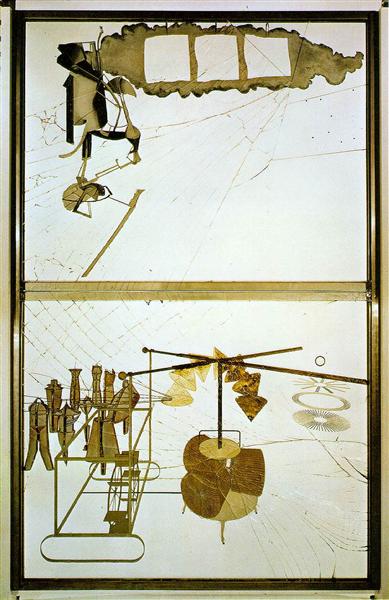
Duchamp's *The Large Glass* (1915-1923). Philadelphia Museum of Art.
The claim is literal. Not "inspired by," not "shares themes with." Elden Ring is the three-dimensional, playable transcription of the process depicted in _The Bride Stripped Bare by Her Bachelors, Even_, the glass tableau Duchamp worked on from 1915 to 1923 and abandoned in a state he called "definitively unfinished." Every named mechanism in Duchamp's accompanying notes maps onto a character, item, or location in the game. The correspondences run too deep and too specific, and there are too many of them, to be coincidence.
In February 2024, Hidetaka Miyazaki [told an interviewer](https://www.pcgamer.com/two-years-after-release-miyazaki-says-elden-rings-world-still-has-a-small-element-that-i-feel-has-not-yet-been-discovered/) there was "a small element" hidden within Elden Ring that no player had yet discovered. He said the discovery was "up to user interpretation," which rules out a hidden area or mechanic; data miners would have found those inside a week. He said it was "a question of when and not if," which rules out trivia. Whatever it was had to be important enough to warrant his personal attention and obvious enough that the discoverer, and the thirty-million-plus other people who owned a copy of the game, would recognize the find when it happened.
This is that.
What follows is the argument in the order it wants to be read. I begin with the philosophical framework that makes the discovery possible, because without it the secret cannot be recognized as a secret. Then _The Large Glass_ and the preliminary works Duchamp spent a decade building up to it. Then a section on the readymades, which are the methodological template for everything that comes after. Then Elden Ring, then the personal story of how I came to find it, and then the correspondences themselves, followed by the deeper systems the game turns out to be built on.
Any single correspondence can be dismissed as pattern-matching. It is the weight of them, and the precision, that carries the case.
---
## On Pataphysics
A word first on what kind of secret this is.
In ordinary usage, physics describes the general laws of the natural world: gravity, force, thermodynamics, the things the world must do in every case. Metaphysics, one remove further out, describes what lies behind or beyond the physical: questions of being, cause, identity, whether a table is still a table when it is broken. Both disciplines assume that the object of their study is governed by stable, discoverable laws that apply to every instance.
Pataphysics is a third remove. The prefix _pata-_ comes from the Greek _epi ta meta ta physika_: "that which lies upon and beyond metaphysics." Where physics asks for the general laws and metaphysics asks what grounds them, pataphysics asks what happens to the exceptions. To the singular cases the general laws cannot accommodate. To the anomalies, the epiphenomena, the irregularities that any honest account of the world has to leave unexplained. Pataphysics is the study of those anomalies, treated not as errors to be corrected but as windows onto the parallel worlds in which each exception would be the rule.
The term was coined by the French writer and playwright Alfred Jarry, who died in 1907. Jarry defined pataphysics as "the science of imaginary solutions" and "the science of the laws governing exceptions." A pataphysician treats imaginary systems as though they were real, works out their internal logic with the same rigor one would apply to a real system, and takes the consequences of that treatment seriously. The ur-symbol Jarry chose for the discipline was the spiral: a figure that is always returning to itself without ever closing, always one step further along even as it appears to repeat.
Marcel Duchamp was devoted to Jarry and to pataphysics. He subtitled _The Large Glass_ "a Delay in Glass," and in his notes he insisted that the work belonged to the category _delay_ rather than to the category _painting_. The distinction matters. Duchamp was not suggesting a modest genre refinement. He was claiming _The Large Glass_ was not a depiction of something at all, in the way a painting depicts a bowl of fruit or a landscape. It was, he said, the preserved trace of an imaginary machine's operation: the arrested instant of a process that does not happen under our physics but would happen under a set of physics only slightly adjacent to ours, and whose mechanics, under those adjacent physics, can be worked out with the precision of an engineering diagram.
To support this claim, Duchamp paired the glass itself with a companion document: a collection of 178 handwritten notes, scraps, and sketches that he published during his lifetime in a cardboard container called the Green Box, after the color of its cover. Another 100 notes were found and published posthumously as the White Box. The notes are not supplementary material. They are, Duchamp insisted, the technical specifications for the machine that _The Large Glass_ depicts, and the glass itself is only the mid-cycle snapshot of that machine in operation. Together the Green Box and the glass form a single work whose meaning cannot be extracted from either half alone. That is what "delay" means in Duchamp's vocabulary. The machine's operation is a four-dimensional process — a process with a time-axis — and the glass is the amber it is suspended in. A fly caught in amber is not a drawing of a fly, and it is not a fly either; it is the fly's motion arrested at an instant, with all the fly's own physics still legible in the pose. The glass is the same kind of artifact for a machine whose physics belong to an adjacent world.
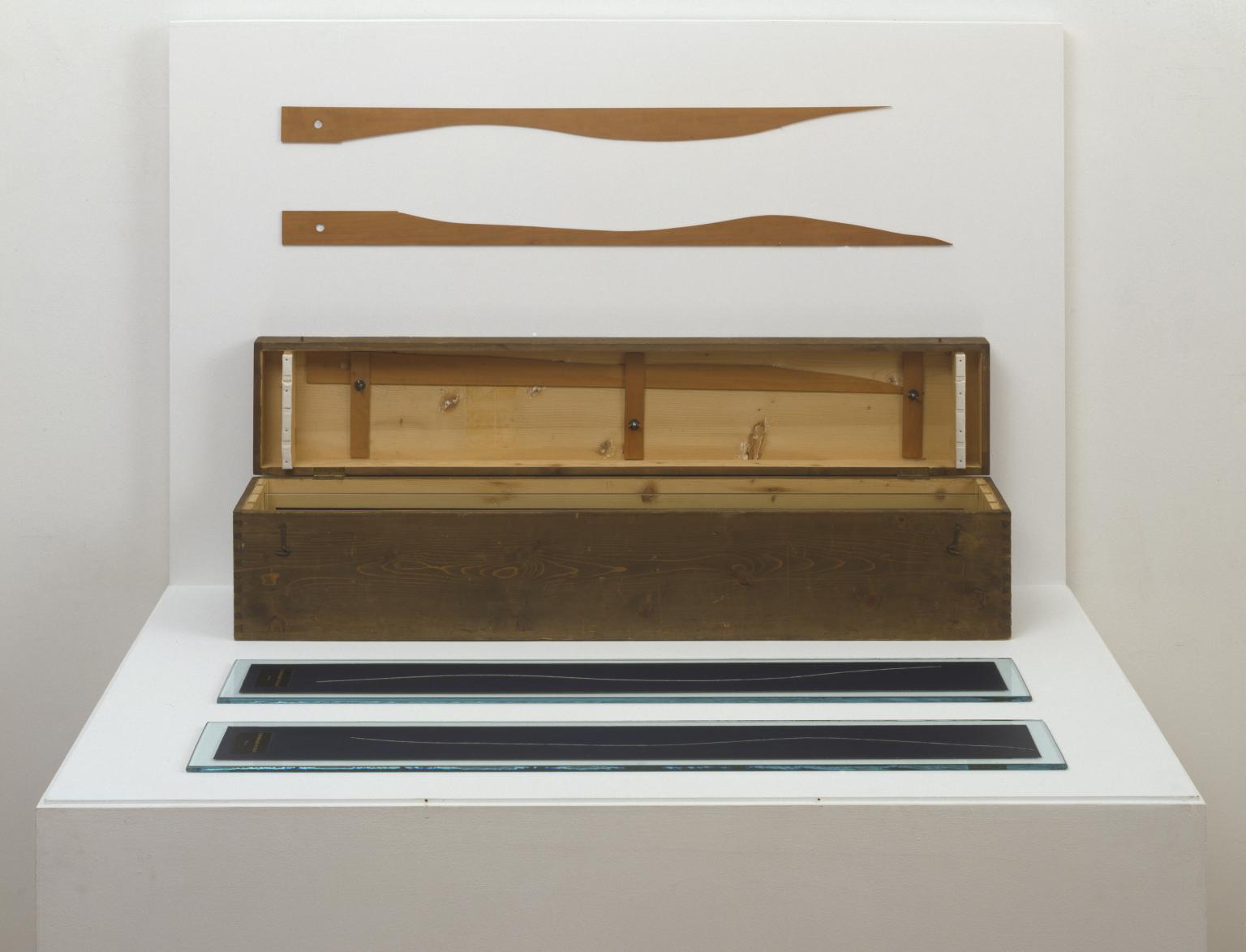
*Three Standard Stoppages* (1913-14). Duchamp dropped three one-meter strings from a one-meter
height and preserved the curves they made, treating the result as three alternative,
chance-generated rulers.
Duchamp had a talent for this kind of arrested gesture. A few years before beginning _The Large Glass_, he made a series of works called the _Three Standard Stoppages_, whose name came from a French sewing term for invisibly mending a tear in fabric, and which preserved the random curves made by one-meter strings dropped from a one-meter height. We will return to the Stoppages when we come to Duchamp's preliminary works. The principle is already the principle of the glass: take an event that should not survive its own happening, and preserve it with the rigor of a physical measurement.
I came to pataphysics through the writer Mónica Belevan, whose Substack is, incidentally, named [_The Bride Stripped_](https://thebridestripped.substack.com/p/prudence-in-hell-023). I had been studying FromSoftware games for an essay about the fifth wall, and I wrote to her because I had seen her gesture at the concept and wanted to understand it. She responded with an entire essay on pataphysics, and the essay's central move was to re-stage the physics/metaphysics/pataphysics progression as layers of theatrical awareness: the fourth wall, the fifth, and what lies beyond.
The fourth wall is the invisible boundary between actors and audience: the convention that lets actors perform what's called "public aloneness," as if they were unobserved. To "break the fourth wall" is to have a character look at the audience and acknowledge that the audience is there. This is standard theater vocabulary. Belevan's point was that the four-walled theater is only the ground floor of a taller building, and the staircase continues upward in the same physics → metaphysics → pataphysics pattern.
- **The physics of the play** is the audience's plain awareness that actors are performing public aloneness. This is ordinary watching.
- **The metaphysics of the play** is the audience's meta-awareness that the actors can see them back. This is what surfaces when the fourth wall breaks and the performance acknowledges its own being-watched.
- **The pataphysics of the play** is the audience's pata-awareness that many different interpretations of the same performance are simultaneously happening in the minds of the different people in the room. The play is not one work being differently understood; it is a cloud of parallel works, each one a slightly different performance taking place in the imagination of a different viewer, with the text and staging serving as the common armature that all of those parallel performances share.
A fifth wall, then, is not a new wall at a fifth cardinal direction. It is the recognition that the play was never happening in one room in the first place.
This is the framework the discovery requires. Elden Ring operates in that fifth-wall register throughout, and the things in it that players routinely file under "the lore is confusing" are the tell. Marika and Radagon are the same being. Godwyn is dead but his corpse is still killing things. The war that ended the world is also the war that is still being fought. These are neither writing failures nor trivial creative choices. They are the operating rules of a world in which the imaginary is treated as physically real and the contradictions of the imaginary are not errors to be resolved but evidence that the world is running on imaginary physics.
The deepest of those contradictions is that time itself is broken, and the breaking is the pretext for the whole game. When Marika shattered the Elden Ring, Radagon — who is the same being as Marika, hammer in the other hand — was trying to repair it _at the same instant_. The shattering and the mending are a single event that could not resolve, and the casualty of the unresolved event is time. Time in the Lands Between does not run in the background the way it runs for us. It is not a river moving at an independent rate while actors take their turns in it. It is a thing that has to be _made_ to happen to a person, deliberately, or it does not happen at all. The people in the Lands Between are trapped in an _unwhen_: not frozen, because they still act, but suspended in a condition where nothing accumulates into forward motion, where every action has to purchase its own step of time and often fails. This is why Marika and Radagon can be the same being without the logical short-circuit destroying the world: the world's time is already destroyed. This is why the demigods can be simultaneously in the middle of a war that has already ended: the war is neither over nor ongoing, it is _unwhen_. And it is why players and characters from different places and different epochs can meet and fight and cooperate inside the same world without any of the usual machinery of time-travel fiction. It is not a loop; it is not an ouroboros eating its own tail; it is simply the absence of a working clock. Fixing time is the pursuit the game does not name but is structured entirely around.
You cannot read Elden Ring with the tools you bring to a conventional narrative, any more than you can read _The Large Glass_ with the tools you bring to a conventional painting, because both works have stepped outside the frame in which conventional reading makes sense.
This is also why the final secret took two years to find, and why it was always going to take the shape it took. A pataphysical secret cannot be data-mined, cannot be unlocked by code analysis or speedrunning or sequence-breaking, because it is not in the code at all. It is in the framework the player brings to the game. It can only be discovered by someone willing to treat Elden Ring as a pataphysical object, which is to say, as a work of art.
---
## Understanding The Large Glass
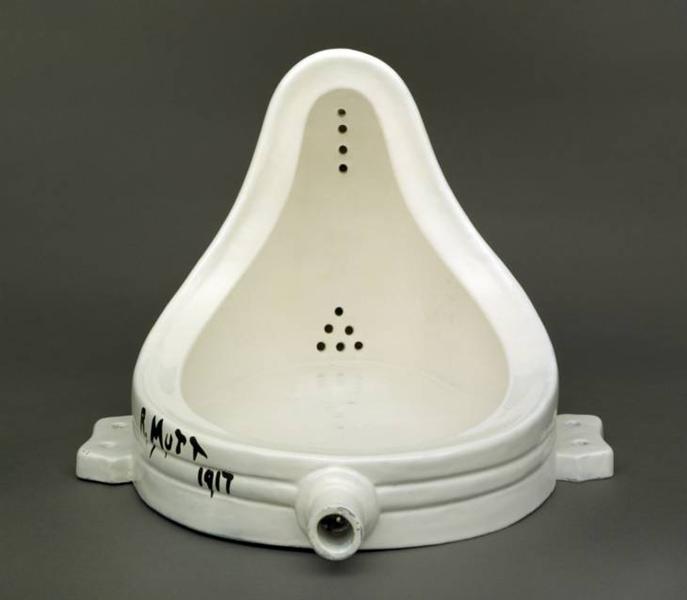
*Fountain* (1917), signed R. Mutt. The work that made Duchamp famous to the public, and the work
that misrepresents him most completely. The readymades section below explains why.
Marcel Duchamp. Perhaps best known as "yes, the urinal guy."
Most people know Duchamp as the man who put a urinal in a gallery and called it art. That is the least interesting thing about him, and as we will see when we get to the readymades, it may not even be true in the way it has been reported for the last century. What matters here is the work Duchamp spent twenty years of his life building: a nine-foot-tall, six-foot-wide glass tableau titled _The Bride Stripped Bare by Her Bachelors, Even_.
A note, before we begin, on the subject matter. The work you are about to be introduced to is frankly sexual in its underlying content. Duchamp's notes describe a process of frustrated desire between two zones, one male and one female, with diagrams and vocabulary that do not shy away from bodily specificity. The title itself, _The Bride Stripped Bare by Her Bachelors, Even_, is only the politest framing of what is underneath. I will do my best throughout this document to treat the material with the courtesy Duchamp did not always extend to it, and to use the clinical vocabulary of his own notes where the alternative would be coy. If I quote Duchamp or his scholars on a particular mechanism using language that reads as startling, the reason is that the work is startling, and no honest treatment can soften it without losing what makes it what it is.
The twenty years did not start from an empty canvas. In the decade before Duchamp began work on the glass itself, he built the piece's components as standalone works, each one a study for a mechanism that would later appear in the final assembly. The order is chronological and the movement is cumulative: early figure studies give way to mechanical ones, mechanical ones give way to chance operations, and each piece is itself part of the case that Elden Ring is the finished machine.
### Duchamp's Preliminary Works
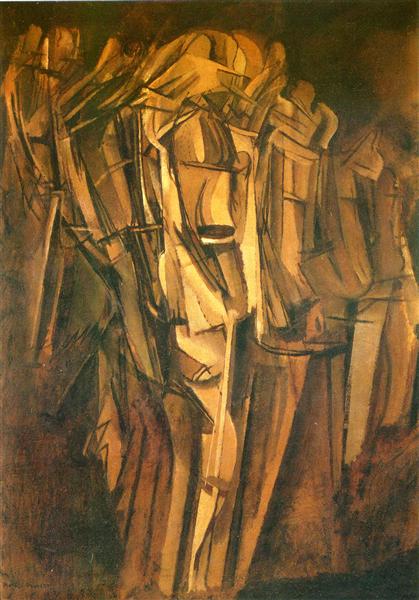
*Sad Young Man on a Train* (1911). A chronophotographic self-portrait: one figure rendered at
several overlapping positions, present in motion but unable to resolve into a single pose.
**Sad Young Man on a Train** (1911). A fractured, cubist self-portrait of a figure in motion, arms close, body immobilized by the train's frame even as the train propels him forward. This is the first appearance of the Malic Mould: the stripped-identity Bachelor, going nowhere despite all the motion.
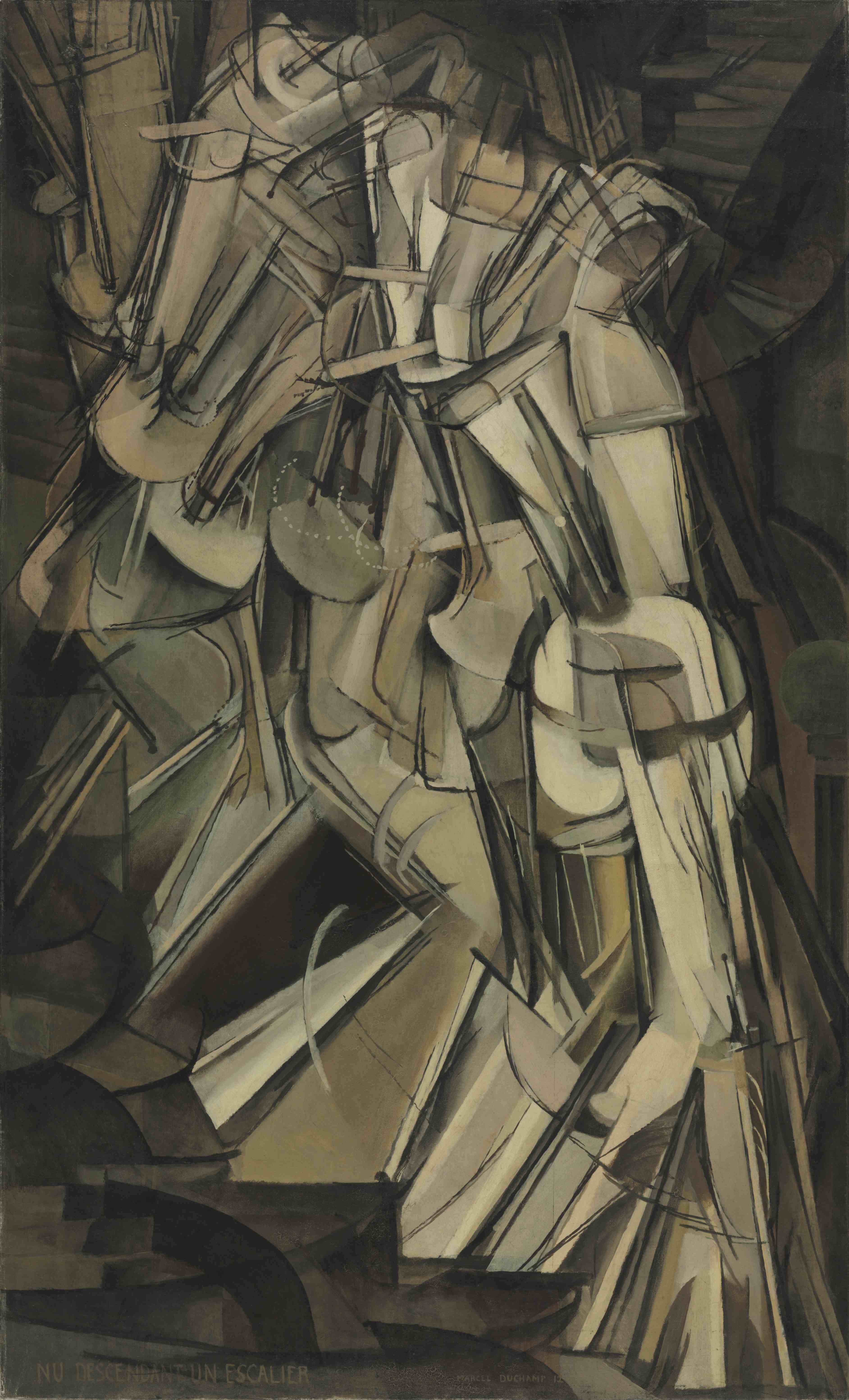
*Nude Descending a Staircase, No. 2* (1912). The four-dimensional figure rendered as a composite
of its three-dimensional shadows at successive instants.
**Nude Descending a Staircase, No. 2** (1912). Duchamp submitted this work to the Salon des Indépendants in Paris in 1912, where the cubist hanging committee (his own brothers among them) rejected it for being "too futurist" and asked him to change the title, which he refused to do. He withdrew the painting in silence and showed it the following year at the Armory Show in New York, where it became the scandal of the exhibition. Critics called it "an explosion in a shingle factory." Visitors queued to see it. The scandal made Duchamp briefly famous in America and, by his own account, also convinced him that painting as an audience-pleasing enterprise was a trap he wanted no further part of. What the painting actually shows is the Bride: a figure rendered in multiple simultaneous positions across several dimensions at once, the three-dimensional composite of a four-dimensional body in motion. The scandal was that the painting did what Duchamp said it did. It showed a being who cannot be seen all at once.
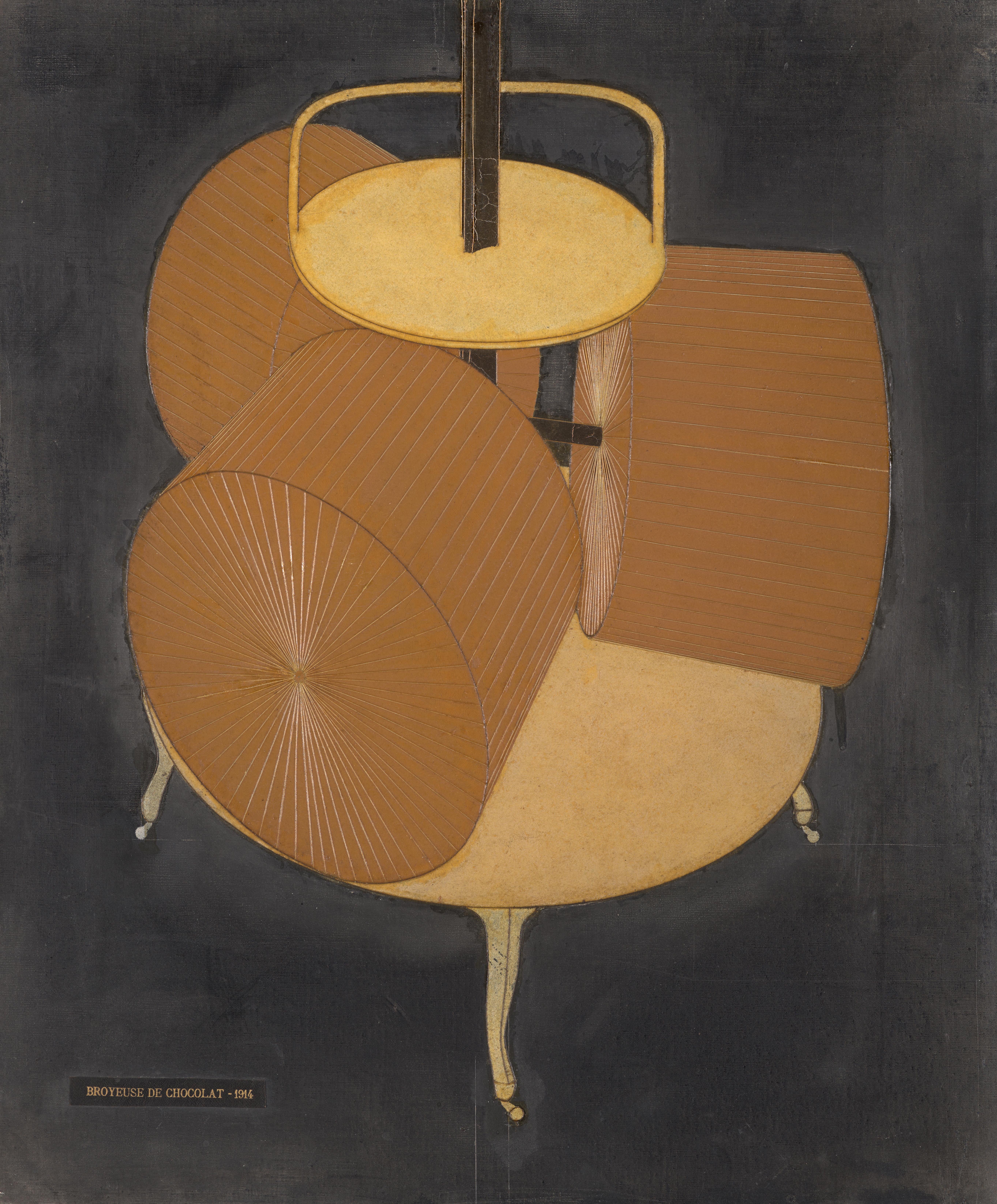
*Chocolate Grinder, No. 2* (1914). Three cylindrical rollers mounted on a four-legged Louis XV
chassis. Duchamp saw the original machine in a Rouen chocolate shop window and painted it twice as
a standalone work before installing it as the central mechanism of the Bachelor's Apparatus.
**Chocolate Grinder, No. 1** and **No. 2** (1913, 1914). Duchamp became fascinated by a chocolate grinder he saw in a Rouen shop window. He painted it as a standalone study twice. The motion is circular, repetitive, and fruitless: the rollers turn in their cradle and produce nothing except more ground chocolate. In _The Large Glass_ this becomes the central mechanism of the Bachelors' Apparatus, and in Elden Ring it becomes the Elden Ring itself.
Look at the Elden Ring symbol on the cover of the game. It is the Chocolate Grinder viewed from above: three circles overlapping, anchored top and bottom by cross-shapes that correspond to the Louis XV Chassis (the four-legged table the rollers rest on) and the Necktie (the disc that caps them). Godrick's Great Rune shows this most cleanly. Look closely and you can see three overlapping cylinders intersecting at their central axis. That is a top-down projection of the Chocolate Grinder, rendered as a single piece of jewelry.
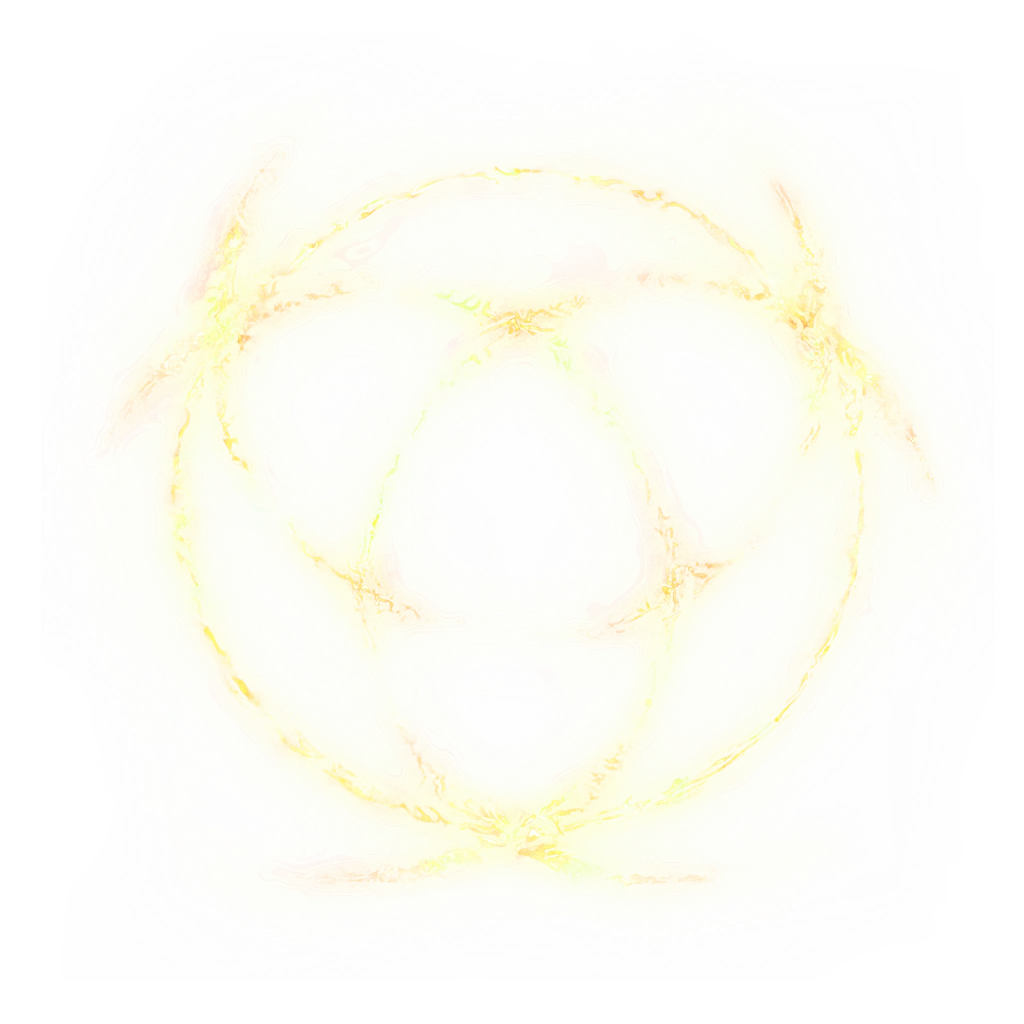
Godrick's Great Rune. Three cylinders overlapping at the central axis, anchored top and bottom.
Compare with Chocolate Grinder, No. 2 above.
The same visual logic governs the rest of the Great Runes. The Elden Ring in Marika's world was a single artifact until the Shattering broke it, after which the fragments were distributed to her demigod children. Each fragment retained a piece of the original's mechanism. Each surviving Great Rune corresponds to a named part of the Chocolate Grinder:
- **Radahn's, Malenia's, and Rykard's Great Runes**: the three rollers of the grinder.
- **Godrick's and Morgott's Great Runes**: the anchor runes, explicitly named as such in the game's lore, that hold the structure together from top and bottom. Godrick's is the Louis XV Chassis. Morgott's is the Necktie.
- **Miquella's Great Rune**: shaped as a cross and semicircle that does not overlay cleanly onto the other five. It corresponds to the Scissors and Sieves, which sit beside the Chocolate Grinder in _The Large Glass_ rather than forming part of its core cylinder.
Radahn — roller
Malenia — roller
Rykard — roller
Morgott — Necktie (anchor)
Miquella — scissors & sieves
Mohg — unmapped
Two Great Runes do not fit the core mechanism cleanly. Mohg's Great Rune (Mohg is Morgott's twin brother, cursed with the blood of the Omen) and Rennala's _Great Rune of the Unborn_ (Rennala is Radagon's former wife, whose rune governs respawning rather than the politics of the Shattering) stand slightly outside the main identification. I classify them the same way Duchamp classifies the Butterfly Pump and the Boxing Match in his own notes: as components that exist in the framework but resist the clean one-to-one mapping the rest of the runes allow. For the purposes of this document I am listing them here for completeness, and setting them aside.
The three Mending Runes carry the correspondence into a different part of Duchamp's apparatus. Recall that the three Mending Runes are forged by three named Tarnished (Goldmask, the Dung Eater, and Fia), each of whom has stepped outside the normal Tarnished-becomes-Elden-Lord cycle to produce a rune that changes the terms of the repair rather than simply enabling it. These three Tarnished are the Three Nets of _The Large Glass_. Each Net, in Duchamp's scheme, captures and processes information from the Bachelors and feeds transformed data to the Bride. Each Mending Rune does the same thing in the game's vocabulary: it takes lived experience (the philosophical commitment of the Tarnished who forged it) and transforms it into a structural modification to the Elden Ring when it is placed inside the reassembled Ring at the foot of the Erdtree. The Nets are where the Bachelor machine receives a message back from its lower half, and the Mending Runes are where the Elden Ring receives one.
Goldmask — Mending Rune of Perfect Order
Dung Eater — Mending Rune of the Fell Curse
Fia — Mending Rune of the Death Prince
Note the mechanism the game describes for the player's endgame. After slaying the demigods, the Tarnished collects their Great Runes and carries them, along with one of the three Mending Runes, to the foot of the Erdtree. There, the runes are reassembled into the Elden Ring, which the new Elden Lord then repairs with the chosen Mending Rune's addition. This is the game saying out loud what the thesis of this document is arguing: the Great Runes are pieces of a broken machine, and reassembling them is the literal goal of the game. The machine they reassemble into is the Chocolate Grinder.
This is not ornamentation. It is the central identification of the entire thesis, and the visual correspondence is exact enough that once you see it, you will not be able to unsee it. **The Elden Ring is the Chocolate Grinder.** The full unpacking arrives in the [correspondences](#the-correspondences) section below.
**Three Standard Stoppages** (1913). You have already met the Stoppages in the pataphysics section above. To recap briefly: Duchamp dropped three one-meter strings from a height of one meter onto prepared canvas and preserved the random curves they made, calling the result "canned chance." The French word _stoppage_ refers to the method of invisible mending used to repair tears in fabric so that the tear can no longer be seen. _Stoppage_ is mending. Duchamp preserved three stoppages. In Elden Ring, three Tarnished can create three Mending Runes.
*Network of Stoppages* (1914). A map of chance-preserved curves laid across an earlier painting.
These curves will become the Capillary Tubes of *The Large Glass*.
**Network of Stoppages** (1914). An expansion of the _Three Standard Stoppages_ project: a map of chance-preserved curves laid across a painting. The curves that would eventually become the Capillary Tubes of _The Large Glass_ are derived from the templates of the stoppages.
*Glider Containing a Water Mill in Neighboring Metals* (1913-15). A preliminary study, on glass,
of the mechanism that would power the Bachelor's Apparatus.
**The Water Mill Within Glider** (1913-15). A preliminary sketch, made on a glass panel, of the powering mechanism for the Bachelor's Apparatus. A literal study for _The Large Glass_, and a rehearsal of the glass-as-substrate technique Duchamp would use for the main work.
*To Be Looked at (from the Other Side of the Glass) with One Eye, Close to, for Almost an Hour*
(1918). The title is the instruction. [See it in action on
YouTube](https://www.youtube.com/watch?v=ObXA5VcVFF0).
**To Be Looked at (from the Other Side of the Glass) with One Eye, Close to, for Almost an Hour** (1918). The title is the instruction. The viewer must stand in a specific physical position, close one eye, and sustain attention for an hour. The piece cannot be glanced at. It demands to be pondered. These are the Occult Witnesses: the viewer becomes a witness only by the act of prolonged, deliberate looking.
Each of these pieces is a component of the machine Duchamp was building. Beginning in 1915, he set about assembling them into the final work itself.
### The Glass Itself
_The Bride Stripped Bare by Her Bachelors, Even_ is not self-contained, as we saw in the pataphysics section. The glass and the Green Box form a single work, and anyone who tries to read the tableau without the notes (or, for that matter, the notes without the tableau) is missing half of what is in front of them. Duchamp was explicit on this point. "Only an initiate," he wrote, "could understand _The Large Glass_." He meant that. This is not a piece you look at and appreciate. This is a piece you read, and then contemplate, and then look at again from the other side of the glass, as it were, considering the frozen apparatus on its own terms as a mechanism suspended between two panes for the duration of its inspection.
The tableau is divided into two halves, each populated by named mechanisms whose interactions Duchamp spelled out in granular detail. Superscript numbers correspond to the callouts in the diagram above. Items marked "undepicted" are absent from the physical glass (Duchamp planned but never painted them), but they are present in the diagram above because the diagram is reconstructed from the Green Box notes, which document the full planned apparatus including the unfinished portions.
Upper Half: Domain of the Bride
-
The Bride
[1] (Pendu femelle, arbor-type): crucified on an apparatus
-
Top Inscription or Milky Way
[2]: flesh-colored, the "skin, or mortal remains, of the Bride"
-
Draft Pistons or Nets
[3]: three targets cut into the Milky Way
-
The Nine Shots
[4]: matchsticks fired from a toy cannon at the glass. None land in the Nets.
-
Juggler of Gravity
[10]: the small curved line above the Occult Witnesses, visible on the glass but
intended for much fuller integration into the planned additions that were never completed
after the 1926 breakage
-
Undepicted: unintelligible messages from the Bride to the Bachelors
Lower Half: Bachelor's Apparatus
-
The Malic Moulds
[11a-i]: nine sets of clothing, an infinite "cemetery of uniforms and liveries"
-
Capillary Tubes
[12]: strip the Bachelors of individual identity
-
Sieves
[13]: unify the Bachelors in their desire to reach the Bride
-
Chocolate Grinder
[14a,b]: three cylindrical rollers on the Louis XV Chassis, connected via
[14c,d] to…
-
Scissors
[14e]: can, by chance, interrupt the Bachelors' ascent
-
Water Mill
[16a]: powers the entire apparatus with futile, endlessly cycling labor
-
Occult Witnesses
[17a-c]: the Bachelors pass through these on their upward journey
-
Butterfly Pump
[18]: part of the planned machinery, never fully drawn on the glass
-
Toboggan
[19]: a descending spiral from the last of the Sieves, undepicted
-
Boxing Match
[24a,b]: undepicted, "causes distance to collapse"
### The Process
The Bride "rains down Love Gasoline" on the Bachelors, animating them. Their essence passes through the Capillary Tubes, which strips them of their individual identities. They descend through the Sieves, which unifies them in their desire to reach the Bride. (In the words of Andrew Stafford's reference work [_Making Sense of Marcel Duchamp_](https://understandingduchamp.com): _"what began as an infinite variety of responses to the Bride has devolved into a uniform potential to squirt."_) The homogenized Bachelors fire upward through the Occult Witnesses, pass between the Scissors (which can, by chance, interrupt their travel), through the Boxing Match (which "causes distance to collapse"), past the Juggler of Gravity (who acts in response to impulses from the Bride), and land at last in the Bride's Domain in an attempt to strike one of the three Nets.
None of the nine shots land within the Nets. The process is frustrated by design. The Bachelors, in Stafford's phrase, "grind their chocolate alone": a frank onanistic image which is, in case anyone reading this has decided to be coy about it, the whole point of the lower half of the glass. One shot, however, lands closer to the Nets than the other eight: the shot that got closest. Remember that detail. The Nine Shots are supposedly the traces left on the glass by matchsticks Duchamp fired from a toy cannon, a production story that I personally do not entirely believe (Duchamp was a compulsive liar about his own methods, and none of his production notes should be taken at face value), but the shot that got closest has a specific role later in this document, and the Tarnished named Vyke is the reason to keep track of it now.
Duchamp's framing terminology for this process is a Delay in Glass. The work does not depict a moment. It depicts a suspension, a process that IS postponement, that IS the failure to reach. An undead process: the Bachelors' desire continues, the machinery continues, the Bride remains unreachable, and the whole apparatus cycles through its states forever.
### The Shattering
One more fact about _The Large Glass_, and one that matters as much as anything else in this section. The glass panel was shattered in 1926 during transportation, or so the story goes. Duchamp reassembled the fragments years later, re-encased them in more glass, and declared the work "definitively unfinished." He said the symmetrical cracking pattern was a feature he had never planned but preferred to his original vision. The piece, after the break, became art about its own incompleteness, and the brokenness became part of the statement.
> **Editor's note:** my own suspicion, for what it is worth, is that Duchamp broke _The Large Glass_ intentionally. The symmetry of the cracks is suspicious. So is his response. So is his entire practice, which as you are about to see in the readymades section was built around concealed authorship and plausibly deniable authorial hand. A man who had spent the previous two decades hiding the fact that his found objects were not found is exactly the kind of man who would report as an accident a breakage whose aesthetic outcome he had already designed. The author is not necessarily committed to this reading. It is, I think, the only story that is consistent with everything else Duchamp ever did.
---
## The Readymades and the Shape of the Joke
Before continuing, a detour through the part of Duchamp's work most people have heard of.
In the 1910s and 1920s, Duchamp began submitting ordinary objects to art exhibitions as art. A bicycle wheel mounted upside-down on a stool. A bottle rack. A snow shovel, titled _In Advance of the Broken Arm_. A urinal, submitted under the pseudonym R. Mutt in 1917, titled _Fountain_. The standard version of the story is that Duchamp elevated these everyday objects into art by the act of declaration. The readymades became the foundational gesture of conceptual art, taught in every survey course, reproduced in every textbook, and given as the answer when anyone asks what Duchamp's contribution to art was.
The standard version is wrong.
Rhonda Roland Shearer, an art historian and one of the foremost Duchamp scholars in the world, published research beginning in the 1990s demonstrating that the readymades were not ready-made. The proportions of _Fountain_ do not match any urinal manufactured by the J. L. Mott Iron Works, the supplier Duchamp claimed to have used. The bottle rack appears to have custom modifications. The perfume bottle Duchamp presented as _Belle Haleine: Eau de Voilette_ came in a size that was not commercially available at the time, suggesting that Duchamp had the bottle made rather than finding one.
*In Advance of the Broken Arm* (1915, replica 1964), from the MoMA collection. Note the
square-section handle visible in the cast shadow: no consumer snow shovel ever made was built that
way, because it would hurt to hold.
And the snow shovel in _In Advance of the Broken Arm_ has a handle with a square cross-section. Not a rounded one. A square one, which is an impossibility as a consumer product, because a square handle would be physically unpleasant to grip for more than about thirty seconds of actual shoveling. No manufacturer ever made a snow shovel that way. Duchamp's shovel was built to be presented as a snow shovel by someone who did not especially care whether the snow shovel functioned as one, and who was possibly also mocking the art world audience that would not notice: people who, on the whole, probably had not shoveled their own snow in a very long time and would not have recognized a non-functional shovel if one had been handed to them. The objects Duchamp presented as "found" were, in many cases, altered or fabricated by Duchamp himself, and a century of art history that took the readymades as ready-made was, strictly speaking, wrong about what the readymades were.
The readymades were fake readymades. Duchamp was making a joke that took eighty years to land.
Shearer's discovery matters for two reasons, and they are the same reason stated twice.
**First:** It is the methodological template for the discovery you are currently reading. Duchamp hid something in plain sight, and the art world did not see it, for two reasons: first, because the accepted narrative was easier than the looking, and second, because the accepted _method_ of looking was not one that would yield to the secret. One had to disbelieve the story before one could see the object. In exactly the same way, Elden Ring hid something in plain sight, and players did not see it because the accepted framework of "video game lore" was easier than the looking, and because the accepted method of looking (data-mining, build optimization, speedrun analysis) was the wrong tool for the kind of secret that was actually in the game. Shearer's phrase for what the readymades turned out to be was "a century-long observational experiment." That is what Elden Ring is.
**Second:** It proves that Duchamp's entire practice was built around the idea of works whose real content would only be visible to the viewer who stopped trusting the accepted interpretation and started paying attention to the object itself. This was not a bug in the readymades. This was the point of them. Sometimes when you know what you are looking at, everything becomes clear.
---
## Understanding Elden Ring
For the uninitiated:
Elden Ring is a 2022 action role-playing game about ambition
in a world that has already ended. It is the seventh and largest entry in a series of games by the
Japanese studio FromSoftware, following Demon's Souls, the Dark Souls trilogy, Bloodborne, and
Sekiro. Hidetaka Miyazaki, the studio's president, directed it. Elden Ring was a cultural event on
release, has sold more than thirty million copies to date, and is by general consensus treated as
the medium's most important contribution to date to the argument that video games can be art.
(Whether or not they have succeeded in that argument is a separate question, and this document is in
large part an answer to it.)
The story the game tells, as a player pieces it together from item descriptions and NPC dialogue and the architecture of the world itself, is this.
Thousands of years before the game begins, Marika the Eternal, God-Queen of the Lands Between and vessel for a cosmic entity called the Greater Will, conquered the world and established a new order centered on the worship of the Erdtree, a massive golden tree that dominates the landscape. She animated her warriors with a force called Grace, which turned their eyes gold and gave them the strength to fight in her name. After the wars were won, Marika stripped her warriors of Grace, sent them off to die in foreign lands, and promised that one day they would be called back.
Then Marika shattered the Elden Ring.
The Elden Ring was the construct that bound together the physical and metaphysical laws of the world: souls, fate, the cycle of life and death. Without it, everything fell apart. Marika's consort Radagon tried to repair the Ring at the same moment Marika was destroying it. The result is a world in both states at once, destruction and repair, neither condition able to finish resolving into the other. (Editor: perhaps intentionally, on the part of both parties.)
Ring a bell?
As punishment for the Shattering, the Greater Will crucified Marika within the Erdtree. Her demigod children, each of whom claimed one fragment of the broken Elden Ring (now called a Great Rune), went to war with one another for control of what was left, and the war did not end so much as exhaust itself. No clear winner emerged.
At the point the game begins, the Tarnished are called back. "The Dead who yet Live," stripped of Grace centuries ago and dying in foreign lands, are returned to the Lands Between by renewed Grace and charged with finishing what the demigods could not. The player embodies one of them. You arrive in the Lands Between without memory, without rank, without any identity beyond the profession you are assigned as a character class at the start of the game. There are nine of these classes: Vagabond, Warrior, Hero, Bandit, Astrologer, Prophet, Samurai, Prisoner, and Confessor. A tenth option, the Wretch, exists only as a deliberately defective starting state, a naked zero-level character with no equipment, the joke of the character-select screen for players who want a harder challenge. You cannot play as anyone who is not one of those nine jobs. You have no name beyond what the player assigns, no face the game remembers, and no history the world acknowledges. Your one directive is to collect the Great Runes from the demigods who hold them, reassemble the Elden Ring at the foot of the Erdtree, and become Marika's new consort, the new Elden Lord.
Millions of players have attempted this. All of them are Tarnished. All of them are one of nine professions. All of them are marching toward the same Erdtree at the foot of which the same crucified woman hangs waiting. Most of them will fail.
The ones who do not fail arrive at a choice. The game offers six distinct endings, and this is where the structure of the work becomes important to observe closely. Four of the endings are straight continuations of the Bachelor machine. In the default Age of Fracture, the Tarnished mends the Elden Ring with no additional modification and becomes Elden Lord on the existing terms; the cycle perpetuates unchanged. In the Age of Perfect Order (Goldmask's Mending Rune), the Age of the Duskborn (Fia's Mending Rune of the Death-Prince), and the Blessing of Despair (the Dung Eater's Mending Rune of the Fell Curse), the Tarnished modifies the terms of the Ring's repair but nevertheless repairs it, becomes Elden Lord, and takes Marika's position as consort. The machine runs in a slightly different register, but it runs. The fifth ending, Lord of the Frenzied Flame, has the Tarnished burn the Erdtree and the Lands Between to the ground in an act of terminal nihilism; this ends the current iteration but does not exit the structure that produced it.
The sixth ending is Ranni's Age of the Stars. In this ending alone, the Tarnished refuses to become Elden Lord in the standard sense. Ranni, an Empyrean who has been plotting against the Greater Will from before the player arrived, takes the Tarnished as her consort and removes the Erdtree's influence from the Lands Between entirely. She and the Tarnished depart on what she describes as a thousand-year journey under the Dark Moon. This is, as far as I can tell, the one ending in Elden Ring that constitutes an _exit_ from the Bachelor machine rather than a perpetuation of it. It is worth noting, because the thesis of this document is not that Elden Ring is a closed loop with no way out, but rather that the game is a Bachelor machine with a single exit hatch labeled "leave entirely," and that the existence of that hatch does not make the rest of the apparatus any less of a Bachelor machine.
The three positions I have just described (preserve the broken forms, burn the whole thing down, or leave entirely) are not a neutral trichotomy. They are the exact three choices a generation of postwar Japanese artists spent their careers turning over. Shuji Terayama, a mid-century Japanese avant-garde playwright whose influence on Miyazaki's generation I will return to in the next section, built his body of work around these three postures. Terayama's generation grew up in a country whose inherited culture had been shattered by an outside force, specifically the American occupation and the cultural transformations that followed it, and could not, after the break, be honestly restored. The choices the situation left them were to pretend the restoration was possible and keep the forms of the old order going as if nothing had happened (the dishonest option, and the one Terayama watched his own country overwhelmingly take); to refuse the pretense and burn what remained (honest, nihilist, and occasionally lethal to his protagonists); or to leave the inheritance entirely and go somewhere else, under a different light, to begin something new (the option his clearest-sighted characters took when they took anything at all). The Age of Fracture and its Mending Rune variants are the first option. The Lord of the Frenzied Flame is the second. Ranni's Age of the Stars is the third.
I am not claiming Miyazaki read Terayama. I am claiming that the choice Elden Ring offers its player at the ending is the same choice a specific lineage of postwar Japanese art has been asking its audience to confront for seventy years, and that Miyazaki's generation inherited the question whether or not the specific plays ever crossed their desks.
That structure, of a delayed process with one narrow escape, is the link between this description and the one you read a few pages ago.
---
## How I Found It
I began studying FromSoftware games seriously around 2020. The original project was an essay about the fifth wall in Dark Souls, and the research put me in contact with Mónica Belevan and the pataphysics framework described earlier. Once pataphysical thinking became visible to me, it was impossible to stop seeing it in the Soulsborne games. For the next two years I read everything I could find on the subject, from [Jarry's Ubu plays](/pataphysics/pataphysics-engine#ubu-and-pataphysics) to the work of Shuji Terayama, the mid-century Japanese avant-garde artist whose influence on Miyazaki's generation is, I think, more significant than has been acknowledged. I held myself during this period to a standard I took from Terayama: to write the kind of thing that could still be read and understood a hundred years from now.
When Shadow of the Erdtree was announced and I saw the trailer, I began to suspect that a pet theory I had been nursing was right. When Miyazaki publicly said there was a final undiscovered element in the game, I began to entertain the idea that the theory was not just right but important, and that other people might want to hear it.
By August of 2024 I had been studying pataphysics and Elden Ring for about two years and had gotten the work to the point that I was satisfied with it, or at least did not have any desire to continue working on it if no one was ever going to see it. I decided I might as well see if I could get it published.
So on the last day of the summer of 2024 I found myself attending a White Party hosted by the Mars Review of Books. I brought my laptop to the event to show my work to people, as much an icebreaker as anything else. If you want to read about the party itself, Nick Dove, the New York-based writer, photographer, and literally (editor: not literally) the world's tallest man, wrote an [excellent substack writeup of the event](https://nickdove.substack.com/p/above-town-2-the-white-party), in which the moment I am about to describe is mentioned in passing.
A woman walked up to me while I was showing Nick Dove my work. She looked over my laptop and said: "What are you guys looking at? Oh, it's a Duchamp!"
I said to her, "Yes it is," pleasantly surprised, and asked whether she was familiar with Duchamp's work.
To which she responded, with a slightly patronizing tone she could not quite keep out of her voice, that yes, in fact, "I actually work for the woman organizing the first Duchamp retrospective in New York in fifty years."
I asked her to repeat what she had just said. She repeated it. I asked her whether she was serious. She was. I turned the laptop toward her, and for something between twenty minutes and an hour I walked her through the thesis. By the end of it she had told me we could do an entire panel on the discovery at the retrospective, and asked whether my travel plans could get me to New York in the next few days to present my work to Rhonda Shearer, the foremost Duchamp scholar in the world and the art historian whose work on the readymades had established that they were not the found objects they had long been assumed to be.
Four days later I was in Shearer's apartment. She spent three hours listening to me talk about video games.
A photograph from the three-hour conversation in Rhonda Shearer's apartment, September 2024.
Her apartment was a museum. It held, among other things, the world's largest private collection of Duchamp's works and personal effects, including what I had assumed were replicas of the White Box notes and which turned out to be originals. At one point in the conversation she took me aside and explained, in her own words, that _The Large Glass_ was a work "only an initiate could understand." Earlier in the conversation she had said something else, in a phrase I did not fully appreciate at the time and have spent the year since trying to do justice to. She said that Duchamp had "set out to win Art." I took that to mean, as I eventually understood it, that the man whose public reputation is as the prankster who put a urinal in a gallery had produced the single most intricate and densely structured work of art in human history and had designed it specifically to go unnoticed for as long as possible.
That is the context for everything that follows. The thesis of this document is that the payoff to Duchamp's joke is Elden Ring.
---
## The Correspondences
The game itself, as the player experiences it, is one cycle of the process shown within _The Large Glass_. The rest of this section is the mapping.
### The C-Shape
The crack pattern in _The Large Glass_, caused by the 1926 transportation accident (or whatever it actually was) and preserved in the reassembly, traces a rough C-shape across the lower half of the tableau. The main landmass of the Lands Between traces the same rough C-shape, opening to the sea on the same side. The geography of the game is the fracture pattern of the glass. (If you are not familiar with the shape of the Lands Between, the [interactive overworld map on the Elden Ring wiki](https://eldenring.wiki.fextralife.com/Interactive+Map) is the clearest way to see it.)
### A Delay in Glass
Duchamp subtitled _The Large Glass_ "a Delay in Glass" and insisted in his notes that the work belonged to the category _delay_. Elden Ring takes place in the Lands Between, a world in a state of suspended incompletion after the Shattering. The game's opening cinematic calls it a world "where death has been robbed from us." Nothing finishes. The demigods do not die permanently, the Tarnished respawn, the cycle does not close. The Lands Between are not a world that has ended. They are a world that is delayed. In Duchamp's exact terminology, they are a Delay in Glass.
Consider the literal object here, too. _The Large Glass_ is a process suspended between two physical panes of glass, held flat for the viewer's inspection in the way a biologist holds a specimen flat on a microscope slide for observation. The nine-foot-tall apparatus is not a free-standing sculpture and not a painting hung on a wall. It is a slide, a prepared specimen of a process, observed simultaneously from both sides through transparent material that is itself part of the work. A sphere intersecting a flat plane is perceived, from inside the plane, as a circle that grows and shrinks. A four-dimensional process intersecting a two-dimensional glass plane is perceived, from the glass's side of the cut, as _The Large Glass_. The Lands Between is the same kind of slide. Its namesake is the state of being _in between_: caught between destruction and repair, between death and life, between the fourth dimension of the Greater Will's intentions and the three-dimensional world in which the player walks around. The game-world is a prepared specimen of a process, observed through interactive gameplay the way Duchamp's specimen is observed through prolonged looking.
### Marika Is the Bride
Marika
is the Bride. She is crucified within the Erdtree as the Bride is crucified on the arbor-type
apparatus. *Arbor* is Latin for tree; the Erdtree is the arbor.
Duchamp borrowed the term "arbor-type" from Girard Desargues' seventeenth-century projective geometry, where it describes a branching, tree-like structure built from axes and nodes. (Duchamp himself was not only an artist but a serious amateur mathematician. His interest in Desargues and in Henri Poincaré's writings on non-Euclidean geometry and the fourth dimension were not ornamental; they were the technical foundation on which he designed _The Large Glass_.) In the Desargues framework, the arbor-type is the shape of the fourth-dimensional figure whose three-dimensional shadow the viewer perceives.
> **Editor's note:** if projective shadows of higher-dimensional objects are hard to picture, I recommend Edwin Abbott's 1884 novella _Flatland_, in which a two-dimensional square is visited by a three-dimensional sphere and learns to see his own world as the cross-section of a larger one. The leap Duchamp is asking the viewer of _The Large Glass_ to make, from three to four dimensions, is the same leap _Flatland_'s square makes from two to three. The difficulty is of the same kind and the payoff has the same flavor.
Duchamp used "arbor-type" to describe the Bride because the Bride is meant to exist in four dimensions and to be only partially visible from three. Marika and Radagon inhabit one body as two genders in a single form. This is the arbor-type in its biological reading as well as its geometric one: the pre-fertilized egg, the bisexual or asexual potentiality of a being before it has committed to a form, the tree of possibilities before it has branched.
When you reach Marika at the end of the game, she drops from her crucified position before the final boss fight begins. Duchamp's notes describe a parallel moment in the Bride's arc: after the Bachelors' process has run its course, the Bride "strips herself" and descends partway toward the lower domain, a ritual transition from her crucified state in the Milky Way toward the waiting Bachelors below, which of course never completes, because the Nine Shots miss the Nets and the Bachelors do not reach her. Marika's drop at the end of Elden Ring is this gesture, rendered in gameplay.
One more note on Marika and Radagon. The game's lore carefully separates them visually through the rune each one bears. Marika's rune is a crucifix-like shape, structural and fixed, with the silhouette of a needle about to pierce fabric.
Marika's Rune.
Radagon's rune, by contrast, is a passing and binding form: a thread worked through the weave rather than the needle that pierces it. I do not have a clean image of Radagon's rune to place alongside Marika's here, so I will simply assert the identification and trust that anyone who has played the game knows the two sigils I am talking about. Marika's rune is the needle. Radagon's rune is the weave. They are the same being because the needle and the weave are the two halves of any woven thing. This is a load-bearing point we will return to when we get to the magic system, because the warp-and-weft relationship between Marika and Radagon is the same relationship as the one between the Law of Causality and the Law of Regression that govern all sympathetic magic in the Lands Between.
### The Tarnished Are the Bachelors
Duchamp called the Bachelors "a cemetery of liveries." Michel Carrouges, the critic who in 1954 first identified the bachelor machine as a category spanning Duchamp and Kafka and others, elaborated: the bachelors are "the nine malic moulds as social types frozen in their roles," inflatable skins for categories of dead man (a gendarme, a priest, a flunkey, an undertaker). The cemetery is Duchamp's own word, and death reigns over the male Bachelor's zone.
The Tarnished are literally undead warriors in armor, perpetually dying and resurrecting. The nine starting classes correspond to the nine Malic Moulds Duchamp painted into the lower half of the glass. They are frozen in their categories (Vagabond, Warrior, Samurai, Prophet, Bandit, Astrologer, Prisoner, Hero, Confessor), which are literally jobs and social types.
Elden Ring does something no other medium could: because it is a multiplayer video game with more than 30 million copies sold, it makes the infinite Bachelor machine actually infinite. Duchamp could only gesture at the idea of a cemetery of liveries. Elden Ring built one and populated it with 30 million simultaneous bachelors.
The thirty million are not a player base in the conventional sense. In the logic this essay has been insisting on, they are all canonical, and they are canonical at the same time. I have been saying the Lands Between is a [daisugi cosmology](/cosmology/daisugi-cosmology) in which many vertical trunks rise from a single base; the thirty million players are the trunks. Each player's Tarnished is an upright shoot off the same Yggdrasil, branching from the one shared base of the world, living a full Elden Ring-shaped life above the canopy and then being felled and regrown as another. The multiplayer architecture makes this explicit in a way the game should not, strictly, be allowed to: other players can step into your run as cooperators or invaders, and when they do, the events of their world and yours interleave without either world being demoted to a simulation of the other. The same Malenia is being fought by a million Tarnished, each of whom is the one Tarnished, none of whom are the same Tarnished, and all of whose fights are happening under the same unbroken conditions while also being distinctly their own — the same people who are different people, set in conflict with one another because their Love Gasoline carries partly conflicting instructions. The correspondence is incomplete, because the transmission is imperfect, because the machine is broken.
The bloodstains and phantom messages scattered across the world are the cemetery made visible and interactive, and they deserve a closer look. Since _Demon's Souls_ in 2009, every FromSoftware game has allowed players to drop short messages on the ground that other players see on their own copies of the game, and to leave bloodstains at the places where they died that other players can replay as ghostly loops. Elden Ring continues the mechanic. It is, more pointedly than players tend to notice, what the Nine Shots were supposed to accomplish if they had landed in the Nets: information transmitted out of the Bachelors' zone and fed upward into the machinery. Duchamp's Bachelors cannot send anything upward because the shots miss. Miyazaki's Bachelors succeed in sending signals to each other across the multiplayer architecture, but the signals are usually trivial: warnings, jokes, lies, marks left where they died. The transmission channel exists. The content is still cemetery.
### The Elden Ring Is the Chocolate Grinder
The core visual identification has already been made in the preliminary works section: the Elden Ring symbol is the Chocolate Grinder viewed from above, each Great Rune maps to a named part, the Mending Runes are top-down sections through the cylinders. What is worth adding here is the structural point that follows from the identification. The Grinder is the central mechanism of the Bachelor's Apparatus in _The Large Glass_. Everything else (the Capillary Tubes, the Sieves, the Scissors, the Water Mill) is in the lower half of the glass specifically to drive, constrain, or route around the Grinder's operation. The Elden Ring is the same thing in Miyazaki's world. The entire game is organized around it. Shattering it broke the world. Fragments of it became the demigods' Great Runes. Reassembling it is the nominal goal of the player. The grinder, in both works, is the piece that has to turn for anything else to matter, and in both works it is broken.
### The Shattering
Marika shattered the Elden Ring. Duchamp's glass was shattered in 1926. Both acts of shattering bear the indicia of intent. Both remain broken after the repair, and in both cases the repair became part of the work.
> **Editor's note:** either by literal intent or by retcon, for Duchamp at least. Whether Duchamp set up the 1926 transportation accident is impossible to prove. What is not disputed is that he accepted the cracks when they came, incorporated them into the reassembly, declared the work "definitively unfinished" in 1923 and then in 1936 rebuilt it around the damage, and in his later writings consistently treated the break as part of the piece. The intention, if it was post hoc, was at least thorough.
Radagon tried to reassemble the Elden Ring and failed, landing the world in permanent stagnation. Duchamp reassembled the glass and declared it "definitively unfinished." The fracture lines became part of the piece. The brokenness is the statement, in both works.
### Grace Is Love Gasoline
The Bride rains down Love Gasoline on the Bachelors. Without it they are inert uniforms in a cemetery. Marika dispenses Grace to the Tarnished, and without Grace the Tarnished are just dead. Sites of Grace are the dispensing points. Grace is what keeps the Tarnished moving, dying, respawning, trying again. Anyone who has played the game recognizes the force I am describing. It is what _gets you off_ the bonfire for your thirtieth attempt at Malenia.
### Capillary Tubes and the Hair of the Bride
The Capillary Tubes in _The Large Glass_ are the wire-like lines that connect the Bachelors' zone to the Sieves, stripping the Bachelors of their differentiated identities as they flow through. The name is from the Latin _capillus_, meaning hair, and in the Green Box notes Duchamp describes the tubes as hair-like in form.
Marika forged the Elden Ring, in the game's lore, out of gossamer strands of her own hair. The Capillary Tubes are literally made from the Bride's hair in both works. Anyone who has carried the Scarseal, a talisman that grants holy protection because it is described as a braid of Marika's hair, has been carrying a piece of this correspondence the entire time.
### Red Fading to Gold
The Malic Moulds in the lower half of _The Large Glass_ were originally painted red. Over the decades, the pigments oxidized and faded to gold. What Duchamp painted as red is, today, what we see as yellow.
Elden Ring's visual aesthetic is famously a world in yellow, but the game's lore carefully establishes that red was once the dominant color of the world and was suppressed from the Golden Order by political force. The Giants' Flame is red. The Crucible is red. Radagon's hair is red. The Frenzied Flame is red-orange. Red lightning exists as its own separate and suppressed lineage. The ruling Golden Order is still trying to strip all traces of red from the world. The oxidation of _The Large Glass_ is the political history of Elden Ring, mapped one-to-one.
### Vyke, the Shot That Got Closest
Duchamp told people he had produced the Nine Shots by firing paint-dipped matchsticks from a toy cannon at the lower half of _The Large Glass_. None of them, he said, landed in the Nets. One came closer than the rest.
> **Editor's note:** like hell he did. Shearer's lifelong project was showing that Duchamp's public accounts of his own working methods were almost uniformly stories he made up after the fact, and her work on the readymades in particular established that almost none of them were the found objects he claimed. The toy-cannon story is in the same register. The Nine Shots are almost certainly placed exactly where Duchamp wanted them and the fiction of the random cannon is a cover. The thing that matters, for purposes of the mapping to Elden Ring, is not whether the shots were aimed, it is that Duchamp wrote into the notes that one of them came closer to landing in the Nets than the others.
Vyke is a minor character in Elden Ring with no speaking lines. He collected two Great Runes. He made it to the foot of the Erdtree. He got closer to becoming Elden Lord than any other Tarnished in the history of the Lands Between, and then he failed. He has no questline worth following, no boss fight that matters to the story. The only reason he appears on the cover of the game is this: Vyke is the shot that got closest.
### Radahn, the Juggler of Gravity
The Juggler of Gravity is a literal, named component in _The Large Glass_. Duchamp planned it but never added it to the glass as it exists in Philadelphia. It survives only in the notes and in the diagrams that accompany the Green Box.
Radahn is a demigod who manipulates gravity magic and holds the stars in place. He is, literally, the Juggler of Gravity. His moveset drives the identification home. He pulls enemies toward him by creating localized gravity wells. He slams his swords into the ground to emit shockwaves of purple gravitational energy that propagate outward in waves. And in the second phase of his fight in the base game, once his health drops below fifty percent, he reverses gravity on himself: he charges his blades with purple energy and launches upward out of the arena, holds himself suspended in the sky long enough to choose his trajectory, and then comes back down as a meteor, crashing into the ground with enough force to kill most players in a single hit. This is not a visual flourish. Juggling gravity is exactly what a juggler of gravity does, and the fight is telling you what he is.
In the base game he is fought once, in Caelid, in a boss battle that is more about the spectacle of a mounted charge than about a position in the main narrative. That fight is not the one that matters for this mapping.
The fight that matters is the one he is given in Shadow of the Erdtree, the 2024 DLC. In the DLC, Radahn returns as the final boss. Fans were baffled by the choice; he had already died in Caelid, and resurrecting him to kill him again looked, on its face, like fan-service or franchise padding. It is neither. The DLC is the completed version of _The Large Glass_ (the state the work would have been in if Duchamp had finished every component he planned and had not suffered the 1926 crack), and Radahn, the Juggler of Gravity, is one of the components Duchamp planned but never added. Putting him in the DLC is not franchise padding. It is finishing the glass.
This is worth pausing on. The base game of Elden Ring corresponds to _The Large Glass_ as the world has it: shattered, reassembled, definitively unfinished, missing the components Duchamp never got around to drawing. The DLC corresponds to what the glass was supposed to become. If you want to know what _The Large Glass_ would look like complete, unbroken, with the Juggler of Gravity and the Boxing Match and the rest of the apparatus in place, you do not look at Philadelphia. You look at Shadow of the Erdtree.
And you can look at something else, too.
The last of the three reproductions of *The Large Glass* that Duchamp personally authorized,
completed in Tokyo in the 1980s. It is the only one of the three made whole: not as a reproduction
of the cracked Philadelphia version, but as *The Large Glass* as Duchamp drew it in the Green Box.
Duchamp authorized three reproductions of _The Large Glass_ in his lifetime. The last of them was completed in Tokyo in the 1980s, at the same time and in the same city Miyazaki was studying at university. That Tokyo reproduction is the only one of the three made from scratch as a whole object rather than as a replica of the cracked Philadelphia original, and the only one Miyazaki could have walked up to as a young man studying in Tokyo and seen in person. For a generation of Japanese art students, the Tokyo reproduction was _The Large Glass_: whole, intact, as Duchamp had drawn it. The version the rest of the world has only ever seen broken. It is the version that sits, undamaged, a short train ride from the studio that would eventually produce FromSoftware's games.
The DLC is the completed Glass. The Tokyo reproduction is the completed Glass that was available to the person who made the DLC. They are one of the strongest circumstantial pieces of evidence in this document for the claim that Elden Ring is a deliberate transcription and not a coincidental echo.
### The Elden Beast Is the Milky Way
The Milky Way in _The Large Glass_ is the cloud-like apparatus the Bride is suspended beneath. The [Szeemann exhibition catalog](https://monoskop.org/images/7/75/Le_Macchine_Celibi_The_Bachelor_Machines_1975.pdf) describes it precisely: "the milky way is flesh coloured, in other words, the skin, or mortal remains, of the Bride." The Bride is suspended inside her own mortal remains, crucified on the cosmic apparatus that holds her.
The Elden Beast is the cosmic entity that holds Marika prisoner. Its form is organic and serpentine, the body of a long-necked fleshy creature with humanoid arms, but its skin is not flesh-colored. It is colored like a starscape: a shimmering translucent silhouette full of moving points of light and gold veins, so that looking at the creature is looking through a piece of the night sky shaped like a body. Fighting the Elden Beast in the final moments of the game is attacking the mechanism that imprisons the Bride, which is also, in the literal visual sense that Duchamp's collaborator described the Milky Way, her mortal remains.
### The Waterwheel
_The Large Glass_'s Bachelor Apparatus is powered by a Water Mill. The mill's motion is futile labor: it turns, the mechanism cycles, the Bachelors grind their chocolate, nothing is ever completed. Duchamp's preliminary piece _The Water Mill Within Glider_ (1917) was an explicit study of this mechanism.
In Elden Ring, the Tarnished gameplay loop is the waterwheel. Die, respawn, try again. Lose your runes, recover your runes, lose them again. Accept no final resolution. The struggle itself is the machine. Thirty million players turning the waterwheel simultaneously through their deaths and their attempts, powering a machine that has no output.
### The Three Nets
Three Tarnished (Goldmask, the Dung Eater, and Fia) each create a Mending Rune, and only they can. These correspond to the three Nets in _The Large Glass_. The Nets, in Duchamp's scheme, capture and process information from the Bachelors and feed transformed data back to the Bride. The Mending Runes do the same thing in different language: they take philosophy and lived experience and transform them into something that can reshape the Elden Ring, and with it the world.
Recall from earlier: _stoppage_ in French is invisible mending, the reweaving of a tear in fabric so that the tear can no longer be seen. Duchamp preserved three standard stoppages. Three Tarnished create three Mending Runes. The vocabulary lines up even before you get to the function.
### Remembrance of Grace
The first Remembrance you can acquire in the game is the Remembrance of Grace. Its item description contains the line "it is just a cycle." The thesis statement of the entire work is placed into the hands of the player near the beginning of the game, on an item the player will trade for a reward without reading twice.
The whole argument is already on a tutorial-area pickup. The game tells you immediately what it is.
### The Roundtable Hold as Paradise of Bachelors
Herman Melville's 1855 diptych _The Paradise of Bachelors and the Tartarus of Maids_ describes, in its first half, a London gentleman's club of retired warriors and lawyers gathering around a round table to drink wine, tell stories, and celebrate a freedom from responsibility that is, on closer inspection, impotence. The second half of the diptych describes a bleak paper mill where women's labor produces the blank pages that the bachelors in London will eventually fill with their self-congratulatory correspondence.
The Roundtable Hold is the gentleman's club of retired warriors gathering around a round table in the hub, telling stories, and celebrating a freedom from responsibility that is, on closer inspection, impotence. The structural duality in Melville's story (bachelors above, women imprisoned below) is the same structural duality as _The Large Glass_, which is the same structural duality as Elden Ring's upper and lower realms. Melville was doing this in 1855. Duchamp was doing it in 1915. Miyazaki did it in 2022. All three are variations on a single mythic pattern, which is precisely what Michel Carrouges argued in [_Les Machines célibataires_](https://www.duchamparchives.org/pma/archive/component/MDP_B004_F003_001/) (1954) when he first identified the bachelor machine as a recurring structure across literature.
### Storytelling as Method
Duchamp documented _The Large Glass_ through the Green Box, a collection of fragmentary, cryptic notes requiring the audience to piece together meaning from scattered sources. Elden Ring tells its story the same way: item descriptions, one-line NPC dialogue, lore hidden in flavor text most players never read. Both works demand that the audience assemble the meaning rather than receive it. Recall Duchamp's own verdict on _The Large Glass_, recorded earlier in this document: only an initiate could understand it. That is the same bar Elden Ring sets for its players. In neither case is the work withholding itself to be coy; it is withholding itself because the act of assembly _is_ the work. The reader who walks away from the Green Box without doing the reading, or from Elden Ring without reading the items, has not been excluded by the artist. They have declined to become an initiate.
This is not a stylistic coincidence. It is the same artistic decision, made a century apart, for the same reason. The notes are part of _The Large Glass_. The item descriptions are part of Elden Ring. Neither work exists independently of the apparatus the audience uses to parse it.
> **Editor's note:** this is where data miners and lore completionists get it right. The thing they miss, unfortunately, is mistaking myopic perusal for evaluation. The item descriptions and the notes are load-bearing, yes, but reading them one at a time and cataloguing them is not the same as reading the structure they collectively describe.
---
## The Magic System Is the Golden Bough
The correspondences above map Elden Ring to _The Large Glass_ at the level of surface elements: characters, items, geography, mechanisms. But the mapping runs deeper than that. The operating physics of the Lands Between, the rules by which magic and causality and meaning work in the game world, is itself a pataphysical transcription of another foundational text.
Sir James Frazer's _The Golden Bough_, published in multiple volumes between 1890 and 1915 (the same year Duchamp began _The Large Glass_), is an anthropological study of magic and religion across cultures. Frazer catalogued what he called "sympathetic magic": beliefs in which objects and forces act on each other at a distance through secret correspondences. He divided sympathetic magic into two branches. **Homoeopathic magic** operates on the principle that like produces like: dancing the motion of rain produces rain. **Contagious magic** operates on the principle that things once in contact remain connected: a lock of hair keeps influencing the person it came from. Frazer presented the whole framework as a catalogue of beliefs that were, of course, not literally true.
Elden Ring's magic system is Frazer's sympathetic magic treated as literally true. This is the pataphysical move in its clearest form: taking a system Frazer described as imaginary and treating it as if it were already the operating physics of a world.
The Golden Order's two foundational Laws state the framework outright, and each one maps directly onto one of Frazer's two branches.
The Law of Regression is described in-game as "the pull of meaning; that all things yearn eternally to converge." This is a verbatim description of **contagious magic**. Things that were once part of a whole remain connected across any distance, and the connection is experienced as a pull back toward origin. The lock of hair yearns toward the body it came from; the fragment yearns toward the object it was broken off of; the Scarseal, a braid of Marika's hair, grants holy protection because the braid is still, at a metaphysical level, Marika. Every Great Rune fragment yearns toward the Elden Ring it was broken off of. Every remembrance retains the power of the demigod it was taken from. The entire logic of relics, remembrances, and physical keepsakes in the game runs on contagious magic, and the Law of Regression is the formal statement of it.
The Law of Causality is described as "the pull between meanings; that which links all things in a chain of relation." This is **homoeopathic magic**, which operates on the principle that like produces like along a structured chain of resemblance and ritual repetition. Bloodgrease applied to a weapon causes enemies to bleed more: in physical reality blood applied to a wound helps it clot, but in Frazer's system blood produces blood. Fire Grease produces fire. Poison produces poison. The entire crafting system is a homoeopathic magic manual, and the Law of Causality is the formal statement of the principle it runs on. The "chain of relation" is the causal chain by which one meaning produces another of the same kind.
Together the two Laws describe a physical universe governed by Frazer's framework, with both branches of sympathetic magic given explicit statutory form and folded into the world's operating physics.
The Frenzied Flame, whose stated goal is to melt all life into one, is contagious magic taken to its terminal point: pure Regression unchecked by the structuring force of Causality. If everything that was once part of a whole yearns to converge, and nothing is holding the distinctions between things in place, the endpoint is literal convergence: all life melted into one undifferentiated mass. It is what happens when _The Golden Bough_'s imaginary physics runs without brakes.
Frazer proposed that human thought had historically moved through three ages: the Age of Magic (commanding nature through hidden laws), the Age of Religion (petitioning higher powers), and the Age of Science (the return to knowable law). These correspond to the three damage types of Elden Ring's magic system: Magic (sorcery, commanding nature through hidden laws), Faith (incantations, petitioning higher powers), and Arcane (forbidden knowledge, the return to law that operates outside the conventional Order).
In the village of Windmill Heights, a group of women in white dresses dance endlessly while a Godskin Apostle armed with a hooked weapon stands at the village's apex. Frazer documented exactly this ritual: among the Thompson Indians, during the absence of husbands at war, the wives would dance with hooked sticks to symbolically pull their men back from danger. At Windmill Heights, the dance never ends because the war never ends. The ritual is in the game. So is its anthropological source.
Return, briefly, to the Warp and the Weave of the Golden Order. The Law of Causality is the warp thread, the structural fixed line. The Law of Regression is the weft, the pulling force that binds. Marika's rune is the needle, fixed and piercing. Radagon's rune is the weave, passing and binding. The entire Golden Order is a weaving operation, and the metaphor is exact, because the operating physics of the world is sympathetic magic, which Frazer described as a web of secret correspondences. The world of Elden Ring is a woven world. That is why the Mending Runes, which repair the world by stopping the fabric, are the mechanism by which anything can be changed at all.
None of this is subtext. It is the declared physics of the game, made legible to anyone who has read Frazer. Miyazaki built a world in which _The Golden Bough_'s catalogue of sympathetic magic is as real as gravity, and then placed it inside a larger work in which the whole apparatus serves as the setting for _The Large Glass_'s process. This is pataphysics inside pataphysics. It is also how you know you are looking at the right thing.
---
## The DLC: The Completed Process
The base game of Elden Ring represents _The Large Glass_ as we find it today: shattered, incomplete, reassembled but forever unfinished. Shadow of the Erdtree, the 2024 DLC, represents what the completed process would look like if Duchamp had lived long enough to add all of the intended components.
In the DLC, Miquella wanders the Land of Shadow stripping himself bare. At each of the Crosses of Miquella, which the player finds scattered across the map, Miquella has discarded a piece of himself, marked in the item descriptions as his flesh, his lineage, his love, his fears, his Golden bearing. He is preparing to become the new Vessel of the Greater Will and to replace Marika as the Bride. The Bride Stripped Bare is not a quest title in the DLC; it is the process the DLC is showing you happening. A figure the game has already identified with the Bride, on the cusp of becoming the new Bride, is stripping himself piece by piece across the map while the player watches. Duchamp's title is the narrative spine of the DLC.
His chosen consort for the new Golden Order is the demigod of gravity: Radahn, the Juggler of Gravity, who serves as the final boss of the DLC. Fans were confused by the choice. Radahn had already been defeated in the base game. Why bring him back? Because the final boss fight is the Boxing Match, another component Duchamp planned for the unfinished portions of _The Large Glass_ but never depicted. The Juggler of Gravity was supposed to participate in the Boxing Match. Duchamp described both in his notes. Miyazaki built both.
There is a further correspondence worth noting here. Romina, Saint of the Bud, is a mandatory boss in the DLC, fought in the Church of the Bud at the end of the Ancient Ruins of Rauh. Her entire moveset is butterflies. In her first phase she summons butterflies, and in her second phase she creates clouds of lingering rotten butterflies that detonate in chain reactions around the arena. Duchamp planned a component for the unfinished portions of _The Large Glass_ called the Butterfly Pump, which was to deliver love gasoline through the Bachelor Apparatus. The Butterfly Pump was never drawn and survives only as a name and a description in the notes. I cannot prove the identification of Romina with the Butterfly Pump the way I can prove the identification of Radahn with the Juggler of Gravity, because Romina's location is not named after the mechanism the way Radahn's moveset is. But the correspondence is a lot more direct than I used to say it was: a saint of the bud (the unopened generative flower), whose whole combat identity is butterflies, fighting in a former cathedral to a procreative principle that has been corrupted into rot. That is the Butterfly Pump. I no longer think it is a tentative identification.
Duchamp declared _The Large Glass_ "definitively unfinished" in 1923. A century later, somebody finished it.
### Gideon the All-Knowing
Gideon Ofnir is the first major NPC the player meets in the Roundtable Hold. He serves as the player's guide through much of the game's main story. Late in the main campaign, Gideon turns hostile and attempts to stop the player from becoming Elden Lord. His stated reason is that he has realized the Tarnished can never truly succeed, that the cycle is designed to perpetuate itself, and that the attempt is therefore fundamentally futile.
Gideon is not wrong. He has understood the Bachelor machine. He has seen that the cycle is the point. The reason he has to stop the player is that his own identity, as the All-Knowing, depends on the world remaining static. If the player changes the world, Gideon stops being all-knowing, which means Gideon stops being Gideon. He is trapped by the fact that the system cannot be resolved without destroying his place in it.
The parallel to Ernest Cline's _Ready Player One_, in which the godlike in-game AI Anorak the All-Knowing attempts to stop the protagonist from completing a puzzle hunt hidden inside a video game by the game's creator, is close enough to be deliberate. Anorak is the copy of the creator Halliday's consciousness; he exists only within the game; Halliday programmed him to stop the winner. The role of Anorak the All-Knowing in _Ready Player One_ is the role of Gideon the All-Knowing in Elden Ring. Both books are about puzzle hunts in games, solved by an outsider whose only advantage is deep familiarity with the creator's influences.
Either the parallel is an accident, or Miyazaki is telling the player through the structure of the game itself that this is what kind of story they are in.
---
## The Final Clue
In the first Dark Souls, Miyazaki told players that [The Pendant](https://darksouls.wiki.fextralife.com/Pendant) was the most important item in the game. The Pendant does nothing. It has no use, no crafting function, no quest attached. Players spent years trying to crack the secret. Miyazaki eventually admitted it was a joke: the most important item in the game was the one that did nothing.
Applying the same logic to Elden Ring. What is the one item in the game that does nothing?
It cannot be consumed. It cannot be sold. It cannot be crafted with. It serves no purpose in any quest, any build, any storyline. It is among the most common items in the game, found everywhere in the Lands Between. The item description says it is "not unusual." The game tells you, explicitly, to dismiss it.
Glass Shards.
Literal fragments of _The Large Glass_, scattered throughout the world.
Thirty million players walked past the evidence every day and did not see it. The most common, most worthless, most ignored item in the entire game, found everywhere, doing nothing, meaning everything.
---
## The Unsolvable Game
Duchamp was a serious chess player. He competed internationally, represented France in four Chess Olympiads, and reached a level of play sufficient to earn the title of master. He wrote a book on endgames (_L'Opposition et les cases conjuguées sont réconciliées_, 1932) that is still in print, and he once said, "while all artists are not chess players, all chess players are artists." Chess, for Duchamp, was the form he retired into when he nominally retired from art, and the reasons he gave for that retreat make it clear that he did not see the two as separate.
Late in his career, Duchamp composed a chess puzzle titled _White to Play and Win_. To this day there is no known sequence of moves that allows white to win. Duchamp's comment on his own puzzle: "There is no solution, therefore there is no problem."
> **Editor's note:** I am struggling not to say "oh brother."
This was a claim about games, not about chess.
A game with one correct solution is a problem, and a problem is utilitarian. A game with no solution is art. This was Duchamp's objection to chess as a fine art form, and it is the objection most critics have historically held against video games: the requirement of a win condition. A solvable game is a tool. An unsolvable game is a mirror.
Every ending in Elden Ring perpetuates the cycle. The Bride remains unreachable. The delay continues. Becoming Elden Lord just restarts the Bachelor machine. You cannot win Elden Ring the way you win chess, and the impossibility of winning is not a flaw in the design. It is the thesis of the work.
By encoding _The Large Glass_ into the structure of a video game, Miyazaki proved something Duchamp could only theorize: that games, when they abandon the requirement of solution, are not merely capable of being art but are among the most powerful artistic media available.
_The Large Glass_ is a four-dimensional concept compressed to two dimensions. Elden Ring is the same concept in three. Only through interactive media can the player experience the delay rather than merely observe it. Only through multiplayer can the infinite cemetery of Bachelors become actually infinite. Only through gameplay can the waterwheel actually turn.
I want to refine the claim I have just made, because the easy version of it is easier to state than to defend, and the refinement matters for the rest of what I want to say.
The easy version runs like this. _The Large Glass_ is a four-dimensional process compressed to two dimensions of glass. Elden Ring renders the same process in three dimensions of space plus a fourth dimension supplied by gameplay, and the player's trajectory through the world is a four-dimensional path through an object that would otherwise sit still. The medium's contribution is the fourth dimension. I believed this for a long time. I no longer think it is quite right.
Elden Ring's relationship to time is stranger than that. Five out of the six endings described earlier do not move time forward in the way a fourth dimension ordinarily does. The Age of Fracture and its three Mending Rune variants all reseat the Tarnished into Marika's old position and resume the cycle under modified terms. The Lord of the Frenzied Flame burns the current iteration of the world to the ground but does not exit the apparatus that produced the iteration. Only Ranni's Age of the Stars actually leaves. The game is, in its stable state, never ending and also never not ending, which is a way of saying that time in Elden Ring passes without producing the accumulation that time is supposed to produce.
This is exactly what Duchamp meant by "delay." In the Green Box notes he is explicit that delay is not a synonym for postponement. It is a category of time in its own right: time held against its normal flow. The French _retarder_, the same word used in musical notation for a passage pulled back from the tempo, is the root he drew on. _The Large Glass_ is a delay, not a description of one. Elden Ring, I now think, is the same category of object rendered in a medium that appears to let time run freely and then, through the design of its endings, withholds the accumulation that free-running time would ordinarily produce.
Return for a moment to Terayama. Terayama's generation grew up in a country whose traditional culture had been shattered by an outside force and could not honestly be restored, and whose dominant response to the situation was to pretend the break had not happened. Japan after the war maintained the forms of the old order as though the war and the occupation had not occurred, and Terayama's work returns again and again to the posture of a culture that refuses to let time move forward. The break had happened. The culture was acting as if the moment of the break had been suspended. Generations passed without producing the accumulation that generations are supposed to produce, because the culture would not acknowledge the break and therefore could not acknowledge what came after it. What Duchamp had named _delay_, Terayama's Japan was living, and the country in the condition is the country that produced the game.
Elden Ring is that condition rendered in code. The player runs around in a world whose break has already happened, the Shattering, and whose inhabitants are all pretending, in one way or another, that it has not. The endings almost all restore the pretense. Miyazaki's game is not just a bachelor machine in Duchamp's abstract sense. It is a bachelor machine with the specific historical content of postwar Japan embedded in [the structure of its endings](/scratch-writings/endings).
So the better version of the dimensionality claim runs like this. The world of Elden Ring is three-dimensional at any instant. Gameplay appears to add a fourth dimension. But the fourth dimension does not do the work a fourth dimension is supposed to do. It does not produce outcomes; it produces more delay, which is what the fourth dimension in a bachelor machine exists to produce in the first place. The player experiences a four-dimensional object whose fourth dimension has been held against its own motion. The medium's unique contribution to the mapping is not that it adds a fourth dimension to _The Large Glass_. It is that it stages the suspension of the fourth dimension, a trick _The Large Glass_ could only point at from two panes of still silvered glass and a set of notes, and a trick that is also, as it happens, the posture of the culture that produced the game.
Video games were the only medium in which what Duchamp started could be completed.
---
## Video Games as Bachelor Machines
By encoding _The Large Glass_ as Elden Ring, Miyazaki makes a meta-statement about the medium he works in. All video games, the argument runs, are already bachelor machines. Elden Ring is the first to make the fact explicit.
Consider the shape of the form. The player is animated by an external force (the narrative, the reward structure, the player's own desire) and propelled through an environment toward a goal that is almost always, in practice, a princess or a macguffin or a boss or some combination of all three. The player dies, respawns, tries again. The player's effort is not conserved between attempts. The satisfaction of reaching the goal never equals the satisfaction the player was promised. The game ends, and the player starts a new one, and the new one is the same shape as the last.
The Bachelor is the player. The Bride is the goal. The machinery between them is the medium itself.
Every video game operates this way, because the form demands it. The closer a game gets to honesty about the shape of the medium, the closer it gets to being a bachelor machine made explicit. Elden Ring is the most explicit version yet made. Its Bride is unreachable because the medium's brides are always unreachable in any meaningful sense. The player's attempts perpetuate the cycle because the player's attempts in any video game perpetuate the cycle. The impossibility of winning is not a design choice specific to Elden Ring. It is the truth of the form, dragged into the open.
Michel Carrouges argued in 1954 that the bachelor machine was not one work but a mythic pattern appearing across literature: Duchamp's _Large Glass_, Kafka's _In the Penal Colony_, Raymond Roussel's machines, Jarry's _Supermale_, others. The structural constant across these works is a two-tier apparatus in which an upper zone inscribes a message on a lower zone through some mechanical drawing device, and the lower zone cycles endlessly without ever being able to send a message back. Video games, considered as a form, fit this pattern almost perfectly. The game designer inscribes meaning on the player from above, through the mechanical apparatus of the game, and the player's input, however frantic, however skillful, cannot alter the design. The player is always the lower zone.
This is the largest claim the discovery makes. Elden Ring is a bachelor machine _about_ video games being bachelor machines. It is the medium's moment of self-awareness, delivered a century after Duchamp identified the pattern and named it.
---
## A Note on Discovery
The secret was never in the code. It was not an Easter egg, not a hidden area, not a data-mined file. It was hiding in plain sight: in the structure of the game, in the names of its characters, in an item everyone carries and no one looks at. It was waiting for someone to look at Elden Ring not as a game to be solved but as a work of art to be understood.
The puzzle is self-proving in the cleanest possible way. You can only discover that Elden Ring is art by first treating it as art. Anyone unwilling to view games as art will never look for this, which means they will never find the proof. The discovery validates the discoverer. I suspect this is exactly what Miyazaki intended, and it is how Duchamp designed _The Large Glass_ to function a century ago: a work that filters for its own audience by rewarding only the kind of engagement it requires.
The Large Glass is a four-dimensional concept in two dimensions, delayed on glass. Elden Ring is the same concept in three, delayed in play. Both works are about the same unreachable woman, the same frustrated machinery, the same cycle that cannot be closed. Both are unfinished by intention. Both were made by artists whose public reputations underestimate them by an order of magnitude.
Sometimes when you know what you are looking at, everything becomes clear.
---
# /master-list
> Master List
> A complete enumerated list of the correspondences between Elden Ring and Duchamp's Large Glass, grouped by structure, symbol, philosophy, and mechanics.
## Structural / Geographical
- **C-shape correspondence**: The C-shape of the landmasses matches the C-shape of the crack pattern in The Large Glass
- **Alchemical topography**: The topography corresponds to alchemical stages of creating the Magnum Opus (documented by others)
- **A Delay in Glass**: The Lands Between exist in a "delay" - semi-permanent state of temporal suspension, just like Duchamp called it "A Delay in Glass"
- **Two planes of existence**: Marika (divine/upper) and Tarnished (mortal/lower) = Bride's domain and Bachelors' domain
- **Dimensional evolution**: The Large Glass is a 4D object portrayed in 2D; Elden Ring is the same 4D concept portrayed in 3D
---
## The Elden Ring / Chocolate Grinder
- **Top-down view**: The Elden Ring symbol on the cover is the Chocolate Grinder viewed from top-down
- **Great Rune correspondence**: Each Great Rune corresponds to parts of the Chocolate Grinder
- **Geometric proof**: Godrick's and Morgott's anchor runes only make geometric sense as top-down view of cylindrical grinder structure
---
## The Shattering
- **Parallel breaking**: The Shattering of the Elden Ring = the shattering of The Large Glass
- **Intentional destruction**: Both widely believed to have been broken on purpose by their creators (Marika/Duchamp)
- **Failed repair**: Radagon attempted to repair the Elden Ring = Duchamp repaired The Large Glass in 1936
- **Repair as art**: Both remain broken/cracked after repair - the repair became part of the artwork
---
## Marika = The Bride
- **Primary identification**: Marika = The Bride
- **Arbor-type**: Marika/Radagon dual nature = Duchamp's "arbor-type" (both genders in one body)
- **Tree-person**: "Arbor-type" literally means tree-person = Erdtree (arbor = tree)
- **Crucifixion**: Marika crucified/suspended on the Erdtree = Bride crucified on the arbor apparatus
- **The descent**: When you finally reach Marika at the end, she drops/descends down from her crucified position, exactly as Duchamp described the Bride's descent in his notes
---
## The Bachelors / Tarnished
- **Primary identification**: All Tarnished = The Bachelors (seeking the Bride)
- **Cemetery of liveries**: Duchamp called the Bachelors "a cemetery of liveries" (dead servants in uniforms) = The Tarnished are literally undead warriors in armor, perpetually dying and resurrecting
- **The cemetery made visible**: Multiplayer bloodstains/messages = the cemetery made visible and interactive
- **36 million dead**: 36 million dead warriors (players) simultaneously existing = the cemetery functioning
- **Infinite cycle**: All Elden Ring playthroughs are part of the infinite cycle through multiplayer/lore integration - millions of Tarnished simultaneously attempting to reach the Bride, making Duchamp's conceptual infinite Bachelor machine literally functional
---
## Vyke - The Shot That Got Closest
- **Cover placement**: Vyke appears on the game's cover
- **The closest shot**: Vyke = Duchamp's "shot that got closest" (Duchamp fired nine paint-dipped matches from a toy cannon at The Large Glass; one got closer than all others)
- **Two Great Runes**: Vyke got two Great Runes, made it to the foot of the Erdtree, closest to becoming Elden Lord but failed
- **Symbolic reference**: Vyke is a minor character with no speaking lines - the only reason for his cover placement is this symbolic reference
---
## Radahn - The Juggler of Gravity
- **Primary identification**: Radahn = The Juggler of Gravity (literal component in The Large Glass)
- **Gravity manipulation**: Radahn manipulates gravity magic, holds the stars in place
- **The boxing match**: Radahn as final DLC boss = the juggler participates in the boxing match (from Duchamp's notes for the unfinished portions)
---
## Miquella & The DLC
- **Unfinished portions**: Shadow of the Erdtree DLC = the unfinished portions of The Large Glass that Duchamp never completed
- **Stripped bare**: Miquella strips himself bare via the crosses (divesting flesh, love, fears, doubts) to become the new Bride
- **Literal transformation**: "The Bride Stripped Bare" = Miquella's literal transformation process through the DLC
- **New arbor-type**: Miquella wants to become the new arbor-type Bride, replacing Marika
- **Scissors and sieves**: Miquella's power to compel love = related to the scissors and sieves that mold/filter Bachelors' desires to fit the Bride
---
## The Three Nets
- **Three Mending Runes**: Three Tarnished who create Mending Runes (Goldmask, Dung Eater, Fia) = the three nets in The Large Glass
- **Processing function**: The nets capture/process information from Bachelors and feed transformed data to the Bride = Mending Runes process philosophy/experience and transform the Elden Ring/world
---
## Elden Beast - The Milky Way
- **Primary identification**: Elden Beast = The Milky Way (the apparatus/crucifix the Bride is suspended on in Duchamp's notes)
- **Cosmic apparatus**: The Elden Beast is the cosmic apparatus holding Marika prisoner
- **Attacking the mechanism**: Fighting the Elden Beast = attacking the mechanism that imprisons the Bride
---
## Grace = Love Gasoline
- **Animating force**: Grace that animates the Tarnished = "love gasoline" that animates the Bachelors (dispensed by the Bride)
- **Dispensing points**: Sites of Grace everywhere = dispensing points for the love gasoline
- **Without Grace**: Without Grace, Tarnished are just dead = without love gasoline, Bachelors don't function
- **Source**: Grace comes from Marika (the Bride) and is what keeps Tarnished moving/respawning
---
## Visual & Aesthetic
- **A world in yellow**: Duchamp described The Large Glass as "a world in yellow"
- **Golden palette**: Elden Ring's entire visual palette is golden/yellow (Grace, Erdtree, Golden Order, runes, Sites of Grace)
- **Defining characteristic**: The world IS a world in yellow - the defining visual characteristic
---
## Red Fading to Gold
- **Oxidation**: The Malic Molds in The Large Glass were originally painted red but faded to gold/yellow over decades due to oxidation
- **Suppressed red**: The Golden Order originally included red (Giants' flame, Crucible, Radagon's red hair, red lightning) which was suppressed/faded to create pure gold aesthetic
- **Visual aging**: The visual aging of The Large Glass = the political suppression of red from the Golden Order
---
## The Waterwheel
- **Futile labor**: The waterwheel in The Large Glass = endless futile labor of the Bachelor apparatus
- **Gameplay loop**: The Tarnished gameplay loop (die, respawn, try again endlessly) = turning the waterwheel
- **The mechanism**: The struggle itself IS the mechanism - 36 million players turning the waterwheel simultaneously through their deaths and attempts
---
## Gideon the All-Knowing
- **System awareness**: Gideon figures out the system is designed for eternal struggle
- **Eternal delay**: "Marika has high hopes for us to struggle onwards unto eternity" = understanding the delay is intentional and the cycle perpetuates forever
- **Static knowledge**: Gideon tries to stop you because he needs the world to stay static to remain "all-knowing" - change destroys his identity
- **Meta-reference**: Possible reference to Anorak "the All-Knowing" from Ready Player One (Halliday's avatar) - meta-commentary on puzzle-hunt narratives
---
## Storytelling Methodology
- **Green Box parallel**: Duchamp's Green Box/White Box notes = fragmentary, cryptic notes explaining The Large Glass
- **Item descriptions**: Elden Ring's item descriptions = same exact storytelling methodology (scattered fragments requiring player assembly)
- **Audience assembly**: Both require the audience to piece together meaning from cryptic, scattered information
- **Part of the artwork**: The notes/descriptions ARE part of the artwork, not supplementary
---
## Glass Shards
- **Ubiquitous item**: Glass Shards = the most common, most ignored item in the entire game
- **Everywhere**: Found literally everywhere in the Lands Between
- **Dismissal instruction**: The item description says they are "not unusual" - the game tells you to dismiss them
- **Hidden in plain sight**: The key hidden in plain sight (Duchamp's methodology)
- **Shearer parallel**: Parallel to Rhonda Shearer's discovery: the readymades weren't real (hidden in plain sight for 80+ years)
- **Literal fragments**: Glass Shards = literal fragments of The Large Glass scattered throughout the world
- **36 million blind**: 36 million players walked past the evidence constantly and never saw it
---
## Cipher Pata
- **Communication system**: Cipher Pata weapon = the encoded messages/signals that the Bride (Greater Will/Marika via Milky Way/Elden Beast) sends to the Bachelors (Tarnished/Malic Moulds)
- **Domain connection**: Represents the communication system between upper and lower domains
---
## Remembrance of Grace
- **Thesis statement**: The Remembrance of Grace item (carried from the start) states "it's just a cycle"
- **Direct statement**: The game directly tells you about the perpetual Bachelor machine from the beginning
- **Hidden in plain sight**: Hidden in plain sight - players carry the thesis statement and never realize it
---
## Philosophical Framework - Pataphysics
- **Jarry devotion**: Duchamp was devoted to Alfred Jarry and pataphysics (the science of imaginary solutions, dealing with exceptions rather than laws)
- **Pataphysical logic**: Elden Ring operates on pataphysical logic - contradictions, impossibilities, exceptions as the operating rule
- **Deliberate confusion**: Time is convoluted, Marika IS Radagon, Godwyn is dead but alive, etc. - not bad writing but intentional pataphysical framework
- **Philosophical methodology**: The game's "confusing" lore is deliberately pataphysical, following Duchamp's philosophical methodology
---
## Philosophical Framework - Frazer's Golden Bough
- **Pataphysical representation**: The entire magic system (Magic, Faith, Arcane) is a pataphysical representation of Frazer's system in The Golden Bough, portraying a world where sympathetic magic is literally true
- **The pataphysical move**: Frazer documented how humans BELIEVED magic worked (but it didn't). Elden Ring creates a world where those beliefs ARE literally true. The "false" science Frazer described IS the operating physics of the Lands Between. Pataphysics: treating imaginary solutions as real.
- **Game runs on Frazer's logic**: Elden Ring's mechanical systems operate on the logic of sympathetic magic, not physics
- **Law of Regression = Sympathetic Magic**: The Golden Order's Law of Regression ("the pull of meaning; that all things yearn eternally to converge") IS Frazer's sympathetic magic itself: the secret sympathy, the invisible ether, the force that makes things act on each other at a distance
- **Law of Causality = Magical Structure**: The Law of Causality ("the pull between meanings; that which links all things in a chain of relation") describes how sympathetic magic structures the world into chains of connected, distinct meanings - Order imposed on the raw sympathetic force
- **Homoeopathic Magic in crafting**: Like produces like. Bloodgrease on a sword makes enemies bleed MORE, not less. In reality, adding blood to a wound helps it clot, but in Frazer's logic, blood produces blood. Fire Grease produces fire. Poison produces poison.
- **Contagious Magic in relics**: Things once connected remain connected. Marika's Scarseal (a braid of her hair) grants holy protection because it was once part of her body. Remembrances retain the power of defeated demigods through the contact of combat.
- **Frenzied Flame = Regression unchecked**: The Frenzied Flame's goal to melt all life into One is sympathetic magic (Regression) taken to its terminal point - pure convergence without the structuring force of Causality
- **Windmill Village War-Dance**: In Frazer's Golden Bough, Thompson Indian women danced while their husbands were at war, using hooked sticks to symbolically pull them from danger. At Windmill Village, women (celebrants) dance endlessly while a Godskin Apostle with a hooked weapon (Godskin Peeler) stands at the apex. If the celebrants are wives of the Tarnished, they perform the same sympathetic magic - but the ritual never ends because the war never ends.
- **Three Ages as damage types**: Frazer's three stages correspond to Elden Ring's three damage types: Age of Magic (commanding nature through hidden laws) = Magic/Sorcery; Age of Religion (petitioning higher powers) = Faith/Incantations; Age of Science (return to knowable law) = Arcane/forbidden knowledge
---
## The Unsolvable Game
- **White to Move and Win**: Duchamp's "White to Move and Win" (1932) = chess puzzle with no solution
- **No problem**: Duchamp's statement: "There is no solution, because there is no problem"
- **Art vs utility**: Games with solutions = problems = utilitarian/not art; games without solutions = art
- **No real solution**: Elden Ring has no real solution - every ending perpetuates the cycle, the Bride remains unreachable, the delay continues
- **Cannot win**: You cannot actually "win" - becoming Elden Lord just restarts the Bachelor machine
- **Elevation to art**: The impossibility of winning elevates it from game to art (applying Duchamp's chess theory)
---
## Duchamp as Gamer
- **Competitive player**: Duchamp was a serious competitive chess player after "retiring" from art
- **Systems understanding**: He understood games as systems, mechanisms, and rules
- **Static game**: The Large Glass IS a game (rules, players, goal) but static/unplayable
- **Made playable**: Elden Ring IS The Large Glass made playable - Miyazaki made the game Duchamp would have made with video game technology
- **Completion**: Miyazaki completed what Duchamp would have done if he had access to interactive media
---
## Miyazaki's Statement
- **February 2024**: Miyazaki said in February 2024 there's "a small element that has not yet been discovered"
- **User interpretation**: "So, whether that's up to user interpretation or up to just further investigation and playing, that's something I'm looking forward to"
- **When not if**: "I think it's a question of when and not if, but there may be something small still missing"
- **The small element**: Glass Shards = the small element everywhere that nobody saw
- **Two paths**: The discovery requires "user interpretation" (viewing it as art) OR "further investigation" (finding the connections)
---
## Self-Proving Puzzle
- **Recursive requirement**: You must view the game as art to discover it's art
- **Filter mechanism**: The puzzle filters for people who already believe games can be art
- **Knowledge requirement**: Only someone who knows both Duchamp and gaming deeply could solve it
- **Recursive proof**: The discovery validates the discoverer's worldview - recursive proof
- **Skeptic blindness**: Skeptics who don't view games as art will never look for this, thus never find the proof
---
## Meta-Narrative
- **Ready Player One**: This discovery mirrors the plot of Ready Player One (creator hides ultimate secret in game, outsider with no resources finds it through deep knowledge of creator's influences)
- **Exact parallel**: The parallel is so exact it may be intentional (Gideon = Anorak the All-Knowing)
- **Puzzle-hunt structure**: Miyazaki may be telling players through the game structure itself that this is a puzzle-hunt narrative
---
## Validation
- **Shearer validation**: Rhonda Shearer (world's foremost Duchamp scholar, discovered readymades weren't real) validated this theory
- **Three hours**: She spent 3 hours discussing it and confirmed the connections are real
- **New medium**: Though she felt Miyazaki doesn't have anything "new" to say about Duchamp (but that misses the point - he's saying something new about games and extending Duchamp's work into a new medium)
---
## Why It Had to Be a Game
- **Dimensional progression**: The Large Glass depicts a 4D concept compressed to 2D (static glass panels); Elden Ring depicts the same 4D concept compressed to 3D (explorable space)
- **Approaching 4D**: Only through interactive 3D media can you approach/represent the 4D concept of the Bride in unreachable dimension
- **Actual infinity**: The multiplayer creates actual infinity (not just conceptual) - millions of Bachelors simultaneously existing
- **Experienced delay**: The delay can only be experienced (not just observed) through gameplay
- **Functional waterwheel**: The waterwheel can only truly function through actual player deaths/attempts
- **Necessary medium**: Video games were the ONLY medium that could complete what Duchamp started
- **Art that had to be a game**: This is art that HAD to be a game - proving games aren't just "also art" but necessary for certain artistic expressions
---
## Video Games as Bachelor Machines
- **Meta-statement**: By creating The Large Glass as Elden Ring, Miyazaki makes a meta-statement: video games themselves are "bachelor machines" (Duchamp's term for mechanical systems of desire/repetition)
- **All games**: All video games operate as bachelor machines - players as bachelors, games as brides, endless loops of desire and futility
- **Revealing the medium**: Making this explicit in Elden Ring = revealing what the medium actually IS philosophically
- **Perpetual desire**: Every video game ends with a bride/princess/goal - but reaching her never truly satisfies, the player remains a bachelor
- **Explicit statement**: Elden Ring makes explicit what all games do implicitly - the bride at the end perpetuates desire rather than ending it
- **BioShock parallel**: This is the same statement BioShock Infinite was attempting to make about games involving rescuing a woman from a monster/father figure - Songbird as the father/monster (just as Big Daddy was in the original BioShock)
---
## Literary Parallel - Melville
- **Paradise of Bachelors**: Herman Melville's "The Paradise of Bachelors and the Tartarus of Maids" - the first part describes a roundtable of former mighty warriors now reduced to has-beens and posturing, directly paralleling the Roundtable Hold
- **Structural duality**: The duality in Melville's story (paradise of bachelors / tartarus of maids) mirrors the structure of bachelors below / bride imprisoned above
---
## Additional Context (Separate Discovery)
- **Daisugi trees**: Daisugi trees (Japanese forestry technique - multiple vertical trunks from one base) appear as stone trees in Elden Ring
- **Candle Trees**: Candle Trees in Elden Ring (actual in-game name) = candelabra structure
- **Personal journey**: Each player's FromSoft journey = their own daisugi/candelabra tree (Yggdrasil/World Tree)
- **Vertical trunks**: Each game = a vertical trunk/candle from their personal base
- **Intersecting trees**: Multiplayer = different players' trees intersecting
- **Burned candelabra**: Dark Souls 3 ending in melted candle/tree stump = the burned-down candelabra after the flames exhaust
- **Connection explanation**: This explains how all FromSoft games connect while each player's experience remains individual
---
# /pataphysics/pataphysics-engine
> A 'Pataphysics Engine
> Seth Giddings's 2007 Games & Culture paper reads videogames as 'pataphysical machines: hyperreal gadgets where play, simulation, surrealism, and technoculture generate imaginary solutions and proliferate realities.
Videogame play as a paradigmatic form of contemporary hyperreality, generating virtual realities
at the heart of everyday life.
Playing Baudrillard's game with a cheat code, identifying the ludic traditions in French
avant-garde thought.
Game studies as unwitting surrealist ethnography, a hyperrealist ethology of simulacral culture.
_Seth Giddings, University of the West of England, UK. Published in_ Games & Culture _(October 2007)._
**Abstract:**
This article plays a game with Jean Baudrillard's thought and the intellectual traditions on which it draws. The game or program here is the hyperreality of the contemporary world, Baudrillard's integral or virtual reality characterized by the dominance of things, of objects over subjects. The cheat code identifies and accentuates the development, application, and interconnection of theories of play, waste, technology, and multiple realities in aspects of 20th century French avant-garde and social scientific thought and practice. It suggests ways in which everyday technoculture, not least videogame culture, can be addressed as at once playful and simulacral.
## The 'Pataphysical Strategy
> The only strategy against the hyperrealist system is some form of pataphysics, 'a science of imaginary solutions'; that is, a science-fiction of the system's reversal against itself at the extreme limit of simulation, a reversible simulation in a hyperlogic of death and destruction.
> — Baudrillard, Symbolic Exchange and Death (1976/1993)
## Ludic Gadgets
For Baudrillard, everyday technologies have an ironically playful hyperreality. In _The System of Objects_, he outlined key distinctions between conventional notions of machines as developed and used for functional ends and a proliferating range of noninstrumental consumer technologies.
Gadgets are characterized by "irrational complexity, obsessive detail, eccentric technicity or gratuitous formalism." They are only subjectively functional, the product of obsession. Gadgets are always ludic, everyday technologies are hyperreal in Baudrillard's terms, but also, as toys, their use or consumption are playful games. Toys and games have always had their own noninstrumental functions and their own particular simulacral realities.
## Play, Culture, Simulacra
Baudrillard establishes the Renaissance as the moment of a key historical and cultural transformation in which the culture of simulation, his precession of simulacra, begins. Significantly, it is specifically in the ludic realm of the theatre that the counterfeit ancestors of contemporary simulacra are fabricated.
The counterfeit and the simulacral are born in seriously playful materials, behaviors, and technologies. In the churches and palaces, stucco is wed to all forms, imitating everything, a mirror of all the others. As stucco and the playful technologies of baroque theatrical machinery spread to other ritual architectures, "[t]heater is the form which takes over social life."
## Surrealism and the Ludic
Surrealism was founded on the play of chance. From the early 1920s, the aleatory aesthetic of Lautréamont's "chance encounter of the umbrella and sewing machine on the autopsy table" was pursued through automatic writing, photography, collage, and many games of exquisite corpse. Such games were deployed to catch out the conscious mind, to shake mundane reality, hint at, or proliferate, other realities in the gaps.
Susan Laxton calls this "the Surrealist ludic," the "deployment of chance meant to militate against means/ends rationality." This linkage between the ludic and the proliferation of realities in Surrealism is precisely the cheat code in play in this essay.
## Ubu and 'Pataphysics
Perhaps the most vivid irruption of the surrealist trope in Baudrillard's writing is his invocation of Alfred Jarry's grotesque creation Père Ubu and his proto-absurdist science of 'pataphysics:
> There is no more marvellous embodiment of Integral Reality than Ubu. Ubu is the very symbol of this plethoric reality and, at the same time, the only response to this Integral Reality, the only solution that is truly imaginary in its fierce irony, its grotesque fullness. The great spiral belly of Pa Ubu is the profile of our world and its umbilical entombment. We are not yet done with 'pataphysics.
> — Baudrillard, The Intelligence of Evil (2005)
## Videogames as 'Pataphysical Machines
Videogame play is a paradigmatic form of contemporary hyperreality. It generates virtual realities at the heart of everyday life and advanced media culture; it is marked by intense intimacies between subject and object, the human and the technological. The code of videogames renders virtual theme parks on the imploded and ubiquitous television screen.
It might be read as absolute confirmation of the domination of the human by things, or then again as a multiplication of reality, perhaps even a ludic 'pataphysics of cyberculture. Game studies has begun, perhaps unwittingly, a surrealist ethnography (or hyperrealist ethology) of simulacral culture.
## The Productive Ambivalence of Play
The ambivalence of play and games has always entailed their machinations in the persistence and reproduction of social orders and hierarchies (from rituals to playgrounds) as well as in their subversion or transformation. Against left pessimist subsumption of play and games to the instrumentalities of consumer passivity and capitalist accumulation, we might maintain the productive ambivalence of play and simulacra, their generation of new realities and their maintenance, inversion, or destruction of existing ones.
Play is artificial, as in mimetic illusions, yet characterized as a primal impulse. It is useless and produces nothing, yet is understood psychologically as a form of practice, trial action for life. It is constructive, as when the smooth play of machine parts keeps up production, and it is destructive, as when too much play in a part can bring the whole to a catastrophic halt.
Key terms in Giddings's framework include:
**Ludic Gadgets**
Technologies characterized by irrational complexity, obsessive detail, eccentric technicity or gratuitous formalism, noninstrumental consumer technologies that invite play.
**The Surrealist Ludic**
The deployment of chance meant to militate against means/ends rationality, games used to shake mundane reality and proliferate other realities.
**Liminal/Liminoid**
Victor Turner's distinction between compulsory ritual (liminal) and individualized, commodified phenomena (liminoid). Both are "seedbeds of creativity."
**Hyperrealist Ethology**
Game studies as surrealist ethnography of simulacral culture, studying behaviors and relationships between human and nonhuman, subject and object.
**Citation:**
Giddings, Seth. _A 'Pataphysics Engine: Play, Technology, and Realities._ _Games & Culture_ 2, no. 4 (October 2007). University of the West of England, UK.
---
# /pataphysics/understanding-pataphysics
> Understanding 'Pataphysics
> A concise introduction to pataphysics as Alfred Jarry's science of imaginary solutions, tracing its clinamen, Duchamp's use of it in The Large Glass, and why Elden Ring operates as pataphysical art.
'Pataphysics studies the laws governing exceptions and the universe supplementary to this one.
Solutions that exist in a realm beyond metaphysics, treating the virtual as real and the real as
virtual.
How Duchamp and FromSoftware use 'pataphysical principles to create layered, meaningful art.
## What is 'Pataphysics?
'Pataphysics (always with the apostrophe) was invented by French writer Alfred Jarry in 1893. It is defined as "the science of imaginary solutions, which symbolically attributes the properties of objects, described by their virtuality, to their lineaments."
In simpler terms, 'pataphysics is a philosophy that extends beyond metaphysics as far as metaphysics extends beyond physics. Where physics describes laws governing the physical world, and metaphysics describes laws governing abstract concepts, 'pataphysics describes the laws governing exceptions to these laws.
### The Clinamen
Central to 'pataphysics is the concept of the _clinamen_ - the minimal deviation that causes the unpredictable. In Epicurean physics, the clinamen was the slight swerve of atoms that allowed for free will and creativity. In 'pataphysics, it represents the exception that proves nothing, yet reveals everything.
## Duchamp and 'Pataphysics
Marcel Duchamp was deeply influenced by 'pataphysical thinking. His readymades, The Large Glass, and even his later works all embody 'pataphysical principles. The Fountain (a urinal signed "R. Mutt") is perhaps the most famous 'pataphysical gesture in art history - an object whose meaning exists entirely in the conceptual realm.
The Large Glass is explicitly a 'pataphysical machine. Its mechanisms - the chocolate grinder, the water mill, the malic molds - all operate according to imaginary physics. The Bride's domain exists in a dimension beyond the three we inhabit.
## Elden Ring as 'Pataphysical Art
FromSoftware didn't just reference Duchamp - they created what may be the first true 'pataphysical video game. Consider how Elden Ring operates:
- Death is not an ending but a mechanical necessity - you must die to progress
- Time loops and contradicts itself - NPCs exist in impossible timelines
- Geography is symbolic rather than logical - connections serve meaning, not physics
- The lore is intentionally incomplete - understanding comes from absence
These aren't design flaws or difficulty choices. They are 'pataphysical design decisions that mirror Duchamp's approach to art. The game operates according to imaginary solutions.
## The Golden Bough Connection
James George Frazer's _The Golden Bough_ (1890) catalogued myths and rituals from around the world, finding common patterns in seemingly unrelated cultures. This comparative mythology influenced both Jarry's 'pataphysics and Duchamp's art.
Elden Ring draws heavily from this tradition. The Erdtree echoes the sacred trees of countless mythologies. The cycle of death and rebirth mirrors dying-and-rising god myths. FromSoftware has created a 'pataphysical mythology.
---
# /pataphysics/vocabulary
> 'Pataphysics Vocabulary
> A glossary of pataphysical terms drawn from Christian Bök's 1997 dissertation, serving as the reference vocabulary behind this site's use of 'pataphysics.
## Core Definition
**'Pataphysics** — "the science of imaginary solutions and arbitrary exceptions... the science of that which is superinduced upon metaphysics... extending as far beyond metaphysics as the latter extends beyond physics... the science of the particular" (Jarry 1965:192, 131)
Where physics studies the material world and metaphysics studies the principles underlying
reality, 'pataphysics studies the exceptions to those principles,the singular cases that refuse to
follow the rules. It treats imaginary solutions as equal to real ones, since both are
constructions of the mind projected onto an indifferent universe. Every law is a shared
hallucination; 'pataphysics is the science of private hallucinations, the study of what happens
when the particular refuses to submit to the general.
**Imaginary Solution (Hugill's Framework)** — "'Pataphysics involves an imaginary solution which symbolically attributes the properties of objects, described by their virtuality, to their lineaments." (Andrew Hugill)
Hugill distinguishes three types of imaginary solutions: (1) Physical: unreal solutions to real
problems,most actual technologies fall here; (2) Metaphysical: using imagination to extend known
technologies beyond physical possibility; (3) Pataphysical: imaginary solutions standardized by
conformity to laws governing exceptions, often remaining imaginary though sometimes producing
'apparently real artifacts.' The pataphysical solution values equivalence among all solutions,'all
things being equivalent',making it fundamentally about embracing imaginative approaches regardless
of conventional utility or feasibility.
## Three Declensions of Exception
**Anomalos** — "the first declension of exception: the anomaly of the aporia. Differing from every other thing in a system that values the norm of equivalence--it serves the will to disrupt... the repressed part of a rule which ensures that the rule does not work." (Bök 1997)
The anomalos is the glitch in the system that reveals the system was never as solid as it claimed.
In a world that prizes sameness and equivalence, the anomalos is what stubbornly refuses to be
equivalent,the data point that breaks the model, the exception that proves the rule was always an
approximation. It doesn't merely violate the norm; it exposes the norm as a convenient fiction
that only worked by ignoring everything that didn't fit.
**Syzygia** — "the second declension of exception: the syzygy of the chiasm. Differing from every other thing in a system that values the norm of difference--it serves the will to confuse... the neglected part of a pair which ensures that such a pair is neither united nor parted for more than an instant." (Bök 1997)
The syzygia is the impossible alignment, the coincidence so perfect it becomes suspicious. In a
world that prizes difference and distinction, the syzygia is what scandalously rhymes,the moment
when opposites reveal themselves as secret twins. It's the laughter that erupts when you realize
that things kept rigorously apart were never really separate, just refusing to stand next to each
other. The syzygia confuses categories by showing that every binary opposition contains its own
subversion.
**Clinamen** — "the third declension of exception: the decline of the swerve. Detouring around every other thing in a system that values the fate of contrivance--it serves the will to digress... the smallest, possible aberration that can make the greatest, potential difference." (Bök 1997, after Lucretius)
Borrowed from Lucretius's ancient atomism, the clinamen is the unpredictable swerve that makes
anything new possible. In a deterministic universe where atoms fall in parallel lines forever, the
clinamen is the inexplicable wobble that causes them to collide, combine, and create. It's freedom
expressed as physics, or physics admitting it was never fully in control. The smallest deviation
from the expected path can cascade into entirely new worlds,chaos theory's butterfly effect
anticipated by two millennia.
## Sciences
**Royal Science** — "a standardized metaphysics: it is deployed by the state throughout a clathrate, Cartesian space, putting truth to work on behalf of solid, instrumental imperatives (law and order)." (Bök 1997, after Deleuze/Guattari)
Royal science is the science of power,the laboratory, the textbook, the grant proposal. It draws
straight lines on Cartesian grids, demands reproducibility, builds consensus. It transforms truth
into a tool for state purposes: building bridges, treating diseases, designing weapons. Efficient
and instrumental, it's constitutionally blind to anything that won't hold still long enough to be
measured, monetized, or militarized. Royal science conquers territory and holds it.
**Nomad Science** — "a bastardized metaphysics: it is deployed against the state throughout an aggregate, Riemannian space, putting truth at risk on behalf of fluid, experimental operatives (trial and error)." (Bök 1997, after Deleuze/Guattari)
Nomad science is the wandering science that refuses to settle or serve. Where royal science builds
cathedrals of certainty, nomad science pitches tents of conjecture. It works in approximations and
accidents, thriving on trial and error rather than proof and replication. It's the science of the
tinkerer, the hacker, the artist,anyone who'd rather explore than exploit. Nomad science doesn't
conquer territory; it passes through, leaving behind only traces and possibilities.
**Paradigm** — "a nomic language-game that must systematically (im)prove its own consistency and efficiency by solving problems, revoking anomaly for the sake of what is normal and known." (Bök 1997, after Kuhn)
Following Kuhn, a paradigm is the framework of assumptions within which normal science operates.
It's a game with rules, and the goal is to solve puzzles while keeping the rules intact. Anomalies
that don't fit are swept under the rug or explained away, because admitting them would threaten
the whole enterprise. The paradigm succeeds by excluding what it can't accommodate, maintaining
consistency through strategic blindness to everything that might complicate the picture.
**Paralogy** — "a ludic language-game that must systematically (ap)prove its own inconsistency and inefficiency by convolving problems, invoking anomaly for the sake of what is abnormal and unknown." (Bök 1997, after Lyotard)
Paralogy is the paradigm's shadow,a game that seeks out what the paradigm excludes. Where paradigm
science solves problems to prove its consistency, paralogical science complicates problems to
explore its own contradictions. It doesn't revoke anomaly but invokes it, treating exceptions not
as embarrassments but as the most interesting data. Paralogy is deliberately inefficient, because
efficiency means filtering out precisely what it wants to find: the unknown, the abnormal, the
singular.
**Poetic Wisdom** — "truth owes its power to an error that demands belief in a 'credible impossibility'--an as if that can provide the premise in the future for a nuovo scienza." (Vico 120)
From Vico's notion of creative misunderstanding: truth often begins as a productive error. The
myths our ancestors believed weren't simply wrong,they were imaginative frameworks that allowed
thought to proceed where strict logic would have stalled. Poetic wisdom is the capacity to believe
provisionally in something impossible, using that 'as if' as scaffolding for building new
knowledge. Science itself rests on such credible impossibilities, accepted not because they're
true but because they're useful.
## Quantum and Indeterminacy
_From Roberto Giunti's "'Pata or Quantum: Duchamp and the End of Determinist Physics" (2003)_
**Observer Effect** — "The spectator brings the work in contact with the external world by deciphering and interpreting its inner qualifications and thus adds his contribution to the creative act... By considering the effect of the observer on the observed system, he changes the rules of science." (Giunti, Tout-Fait 2003)
In quantum mechanics, the act of observation changes what is observed,the famous collapse of the
wave function. Duchamp anticipated this: the readymade has no meaning until a viewer encounters it
and 'measures' it with their attention. The spectator doesn't passively receive meaning but
actively creates it through the act of looking. In video games, the player's observation (and
interaction) literally determines what exists in the game world,unrendered areas don't exist until
viewed.
**Indeterminacy** — "Schrödinger's equations describe particles as discrete quanta of energy that exist as a statistical flux, or a range of possible positions or states... it may not be possible to predict exactly what these particles will do next." (Giunti, Tout-Fait 2003)
The 3 Standard Stoppages dropped threads from a meter height, letting them fall as they
would,chance as measurement, probability as standard. This parallels quantum mechanics'
replacement of deterministic prediction with probabilistic description. Reality isn't a clockwork
mechanism but a field of possibilities that collapse into actuality only when observed. The
Stoppages are canned indeterminacy: randomness preserved and made useful.
**Conventionalism (Poincaré)** — "Poincaré's attitude toward the non-Euclidean geometries was that they were just as valid constructs for solving certain kinds of problems as the more traditional Euclidean descriptions... scientific theories are only conventions used by scientists to describe the patterns they see in nature." (Giunti, Tout-Fait 2003)
Henri Poincaré argued that scientific laws are conventions,useful agreements rather than
discoveries of absolute truth. Euclidean geometry isn't 'true'; it's convenient. Duchamp absorbed
this insight: if the meter is just a convention, why not create new conventions? The 3 Standard
Stoppages are new units of measurement, just as valid as the official meter because all meters are
ultimately arbitrary agreements. Science doesn't reveal reality; it proposes workable fictions.
**Post-Euclidean Geometry** — "A joke about the meter,a humorous application of Riemann's post-Euclidean geometry which was devoid of straight lines... casting a pataphysical doubt on the concept of the straight line as being the shortest route from one point to another." (Giunti, Tout-Fait 2003)
Riemann's geometry dispensed with Euclid's parallel postulate, allowing curved spaces where
'straight lines' bend. Duchamp's 3 Standard Stoppages apply this mathematically: if non-Euclidean
geometry is valid, then curved meters are valid. The work 'casts pataphysical doubt' on the most
basic geometric assumption,that straight is shortest. In curved space, it isn't. Duchamp was doing
topology with thread.
**Slightly Distending** — "A reality which would be possible by slightly distending the laws of physics and chemistry." (Duchamp)
Duchamp's stated intent: not to violate physical law but to 'slightly distend' it,stretch it just
enough to create impossible-but-possible objects. This is the pataphysical method: work within the
rules while bending them. The readymades look like ordinary objects but contain impossible
geometries. The Large Glass depicts a machine that almost works. Video games operate the same way:
physics engines that approximate reality while permitting the impossible.
## Key Concepts
**Ur** — "stranger and more pure than any hrön is the ur (an ectype without prototype), the object produced through suggestion, educed by hope." (Borges 1983:18)
Borges's most unsettling invention: the copy that precedes its original, the echo before the
shout. In his story 'Tlön, Uqbar, Orbis Tertius,' hrönir are objects duplicated by thought, but
the ur is something even stranger,an object conjured into existence by sheer expectation, with no
prior original to copy. The ur suggests that reality might be downstream from imagination, that
things exist because we hoped them into being. It's plagiarism in reverse: the forgery that makes
the original possible.
**Perspectivism** — "reality does not exist, except as the interpretive projection of a phenomenal perspective--which is to say that reality is never as it is, but is always as if it is." (Bök 1997, after Nietzsche)
From Nietzsche: there is no view from nowhere, no unmediated access to things-in-themselves. Every
perception is already an interpretation, shaped by the needs and limitations of the perceiver.
Reality is never given directly but always constructed through a particular perspective. This
doesn't mean reality is 'merely subjective',rather, it means objectivity itself is a special kind
of perspective, one that has forgotten it's a perspective. The world is always 'as if,' never 'as
is.'
**Surrationalism** — "the poetic appropriation of science... using the forms of poetry to criticize the myths of science (its pedantic theories of expressive truth) and using the forms of science to criticize the myths of poetry (its romantic theories of expressive genius)." (Bök 1997, after Bachelard)
Surrationalism is a double critique: it uses poetry to expose the hidden mythologies within
scientific objectivity, while using scientific rigor to puncture poetry's pretensions to romantic
genius. Neither side gets to claim privileged access to truth. The surrationalist poet writes with
mathematical precision; the surrationalist scientist acknowledges the imagination at work in every
hypothesis. It's not anti-rational but hyper-rational, pushing reason until it reveals its own
roots in the irrational.
**Irrationalism** — "the poetic emancipation from science... the Symbolists, the Dadaists, and the Surrealists (all of whom argue for a poetic emancipation from science)." (Bök 1997)
Where surrationalism uses science against itself, irrationalism simply rejects science's authority
altogether. The Symbolists retreated into private symbols immune to analysis; the Dadaists
gleefully sabotaged all systematic thought; the Surrealists sought truth in dreams, automatism,
and madness. Irrationalism declares independence from reason rather than infiltrating it. It's a
cleaner break but perhaps a less interesting one,opposition rather than subversion, refusal rather
than détournement.
**Imaginary Solution** — "the as if is simply the imaginary solution to the question what if... reality is compared with something whose unreality is at the same time admitted." (Vaihinger 98)
Every 'what if' question opens onto an imaginary solution,a fiction knowingly entertained as
fiction. We pretend the economy is a machine, that atoms are billiard balls, that space is a grid.
These fictions aren't errors but tools, scaffolding for thought that we can discard once it's
served its purpose. The imaginary solution admits its own unreality while remaining useful.
'Pataphysics simply takes this further: if all solutions are ultimately imaginary, why not imagine
more interesting ones?
Jarry's invented dimension, neither here nor there,or rather, both simultaneously. Ethernity is
the zone where signs stop pointing to pre-existing realities and start creating them. It's a space
of maximum entropy where all possibilities remain potential, unselected and unobserved. Nothing is
determined because nothing is measured. Ethernity is what exists before the wave function
collapses, before the observer fixes the outcome,the quantum foam of pure possibility underlying
the apparent solidity of things.
Nietzsche's dream-world isn't an escape from reality but reality's secret nature. All truths are
illusions that have hardened into facts through collective forgetting. We no longer remember that
our categories are inventions, that our laws are conveniences, that our realities are dreams we've
agreed to share. The Traumwelt is everywhere, hiding in plain sight. Waking up doesn't mean
escaping the dream,it means recognizing you're dreaming while continuing to dream.
## Four Epistemic Phases
The oldest way of knowing: reality speaks, and we listen. Signs are embedded in nature itself,the
flight of birds, the entrails of sacrifices, the movements of stars. Truth is discovered through
careful reading of what's already written. The interpreter doesn't create meaning but receives it,
decoding messages the universe has always been sending. This is science as divination, knowledge
as revelation, the cosmos as a text authored by forces beyond us.
The Enlightenment revolution: signs aren't found in nature but imposed on it. We write our
equations onto a passive world, projecting our categories onto formless matter. Truth becomes
construction rather than discovery,the scientist doesn't read the book of nature but writes it.
This is science as engineering, knowledge as power, the cosmos as raw material awaiting human
inscription. The world has no inherent meaning; it accepts whatever meaning we assign.
The Darwinian correction: signs neither preexist in nature nor are simply imposed by culture, but
evolve through interaction. Knowledge develops historically, shaped by the feedback between knower
and known. Truth isn't static but grows, mutates, adapts. This is science as ecology, knowledge as
process, the cosmos as an ongoing conversation. Neither nature nor culture has priority; both
change together in a dance of mutual becoming.
The postmodern condition: signs have escaped human control entirely. They evolve faster than we
can track, mutating through networks and algorithms, generating meanings no one intended. Truth is
no longer discovered, constructed, or even evolved,it's produced automatically by systems
operating beyond human comprehension. This is science as simulation, knowledge as emergent
property, the cosmos as a self-writing program. We're no longer authors but characters in a text
that writes itself.
## Figures
Jarry's impossible hero is what Nietzsche's Übermensch might look like if it had a sense of humor
about itself. Doctor Faustroll combines Faust's ambition for forbidden knowledge with a troll's
mischievous embodiment,the sublime and the grotesque fused into one figure. He sails through
symbolic seas on a sieve (because why should boats make sense?), accompanied by a baboon and
pursuing experiments that parody the scientific method. Faustroll is the philosopher who's
realized that wisdom and absurdity are the same thing viewed from different angles.
Faustroll's companion is a dog-headed ape whose only utterance is 'Ha ha.' But this laughter
carries philosophical weight: spoken slowly, 'ha ha' marks duality (two syllables, kept apart);
spoken quickly, it marks unity (blurred into one sound). Bosse-de-Nage is the subhuman commentator
on superhuman philosophy, reminding us that the deepest insights might be indistinguishable from a
joke we don't quite get. His laughter neither affirms nor denies,it simply responds to the
absurdity of existence with the only appropriate sound.
Nietzsche's 'overman' is the being who creates values rather than inheriting them,the one who says
yes to existence in its totality, including suffering and meaninglessness. But 'pataphysics
parodies this figure even while invoking it. The Ubermensch's exceptional nature makes them appear
mad or disabled to ordinary eyes; their transvaluation of values looks like incompetence from
within the old value system. Genius and insanity, wisdom and foolishness, become
indistinguishable,which is perhaps the 'pataphysical point.
The tradition descending from Alfred Jarry doesn't just study exceptions,it creates them. Where
normal scholarship maintains distance from its object, Jarryite 'pataphysics deliberately closes
that gap, producing the very singularities it purports to analyze. The Museum of Jurassic
Technology in Los Angeles embodies this perfectly: you can't tell what's real artifact, what's
elaborate hoax, and what's something stranger than either. The Jarryite doesn't distinguish
between documenting and fabricating the exceptional.
## Devices
Jarry's philosophical instrument is a spinning rod that demonstrates how opposites coincide. Spun
fast enough, its two ends blur into one,up and down, left and right, positive and negative become
indistinguishable. The physick-stick doesn't just illustrate the unity of opposites; it produces
it mechanically, crossing out the distinctions that law and logic depend upon. It's a machine for
manufacturing confusion, demonstrating that binary opposition is just slow rotation.
Ubu's belly-spiral is more than a logo,it's a model of how everything moves. Not in straight lines
of progress but in spirals that return while advancing, that repeat while differing. The gidouille
suggests that history doesn't march forward but coils, that evolution doesn't climb but winds.
It's drawn on Ubu's enormous stomach because appetite, not reason, drives the spiral's motion. All
art and science trace these curves, whether they acknowledge it or not.
Jarry's Clinamen is a machine that careens through galleries, randomly defacing masterpieces. It's
vandalism elevated to method, chance weaponized against tradition. The machine doesn't critique
art,it ejaculates onto it, making a mess that might be more interesting than the original. Pure
creative destruction, emphasis on both words. The Clinamen embodies the swerve as mechanical
process: set something spinning and let it collide with whatever's in its path, transforming
through impact rather than intention.
## Alchemical
The alchemical wedding is the union of irreconcilable opposites: sun and moon, king and queen,
sulphur and mercury. It's not compromise or synthesis but something stranger,a marriage that
preserves difference while achieving unity. In the coniunctio, lead doesn't just become gold;
matter becomes spirit, the base becomes noble, the mortal becomes eternal. This is transmutation
as sacrament, chemistry as soteriology, the laboratory as a site of redemption.
The philosopher's stone is the ultimate exception: it's unique, incomparable, unlike anything
else,yet its power is to make things equivalent, to transmute base metals into gold, to render
different things the same. It's the metaphor for all metaphor, the figure that enables all
figuration. The stone itself may never have existed, but the search for it produced chemistry, and
the idea of it produced poetry. The literal and the figural are revealed as aspects of each other,
endlessly transmuting through the alembic of language.
## Movements
Marinetti and the Futurists worshipped speed, machines, and violence. Their 'pataphysics emerges
from technological collision,the car crash, the factory accident, the mechanical breakdown that
reveals the machine's hidden energies. They sought to destroy not just old poetry but old
humanity, replacing organic sluggishness with mechanical intensity. Their exception is the
malfunction that exposes the sublime violence underlying all technology. The Futurist swerve is
the accident: unintended, catastrophic, and more interesting than anything planned.
The Oulipo (Workshop of Potential Literature) generates literature through mathematical
constraint: write a novel without the letter 'e,' structure a book on the knight's tour in chess,
compose poems using combinatorial algorithms. Their 'pataphysics emerges not from accident but
from rigorous adherence to arbitrary rules. Push a constraint far enough and it starts producing
exceptions,not despite the rule but because of it. The Oulipian swerve is what happens when a
program runs to its logical extreme and starts generating the unintended, the surprising, the
impossible.
The Toronto Research Group and related Canadian 'pataphysicians work with memory and its failures.
Their exceptions emerge from the corruption of archives, the degradation of texts, the
fossilization of language. Where Futurists accelerate toward the future and Oulipians constrain
the present, Canadians excavate the past,finding in its ruins not nostalgia but mutation. The
Canadian swerve is the misremembering that creates something new from something old, the copy
error that becomes more interesting than the original.
## Other Terms
Before the modern museum with its rational categories came the cabinet of curiosities: a
collection organized by wonder rather than taxonomy. Unicorn horns beside clockwork automata
beside misshapen fetuses beside foreign coins. The Wunderkammer makes no distinction between
natural and artificial, rare and impossible, genuine and fake. 'Pataphysics is a Wunderkammer of
ideas, collecting conceptual monsters and categorical anomalies, displaying them not to explain
but to astonish.
Shklovsky's Russian Formalist term for 'making strange': the artistic technique of presenting
familiar things as if seen for the first time. Habituation dulls perception; we stop seeing what
we see every day. Art's job is to de-automatize perception, to restore the strangeness of the
world. 'Pataphysics extends this: not just art but science progresses through estrangement,
through seeing the familiar as alien. Every revolution begins with someone looking at what
everyone knows and asking, 'But what is this, really?'
Harold Bloom's term for the productive misreading by which strong poets swerve away from their
precursors. Influence isn't passive reception but active distortion,you become original by getting
your sources wrong in interesting ways. Misprision is the clinamen applied to literary history:
the smallest deviation from the inherited that makes the greatest difference. Every new work is a
misremembering of old works, and that misremembering is where creativity happens.
From Deleuze and Guattari's geophilosophy: compars is the royal science of fixed positions, the
geometry of the grid. It defines space as a lattice of discrete points, each with its assigned
coordinates. The compars model treats rigidity as normal,but rigidity is actually the exception, a
special case of frozen flow. Most of reality is fluid; it takes enormous energy to hold things in
place. The compars mistake is treating the grid as fundamental rather than as a momentary
crystallization of something always moving.
The nomad science counterpart to compars: dispars is the geometry of flows, vectors, intensities.
Where compars asks 'where is it?' dispars asks 'where is it going?' Space isn't a grid of
positions but a field of forces, not a container but a process. The dispars perspective treats
fluidity as fundamental,yet fluid dynamics is harder to calculate than statics. The exception here
is not rigidity but turbulence: the moment when smooth flow breaks into chaos, when the clinamen
disrupts the laminar.
Jarry's parody economics, governed by Ubu's bottomless appetite. Phynance is pure expenditure
without return, consumption without production, spending without saving. Its outputs are 'pschitt'
(the sound of something escaping) and 'merdre' (Ubu's famous expletive for excrement). Against the
bourgeois economy of accumulation, phynance proposes the aristocratic economy of waste,or perhaps
reveals that all economy is ultimately phynance, converting everything into noise and shit.
The first word of Jarry's Ubu Roi is 'Merdre!','shit' with an extra letter. That excess 'r'
transforms vulgarity into neologism, the familiar into the strange. Merdre isn't just obscene;
it's 'pataphysically obscene, an excess of excess. The word performs what it means: it's shit with
something extra, waste that's more than waste. Merdre announced a new theatrical language where
nothing means quite what it should, where even the simplest words carry surplus.
The only speech of Jarry's baboon philosopher is this repeated syllable, but its meaning changes
with delivery. Slow articulation,'ha... ha',emphasizes the gap between repetitions, marking
difference, duality, the space between things. Fast articulation,'haha',blurs the syllables into
one, marking unity, identity, the collapse of distinction. In two syllables, Bosse-de-Nage
contains all of metaphysics: the problem of the one and the many resolved not by argument but by
tempo.
## Subsidiary Terms
_Terms referenced within the definitions above_
An aporia is an impasse, a point where logic cannot proceed. It's not mere confusion but
structured impossibility,the paradox that emerges precisely from rigorous thinking. Every complete
system contains an aporia at its heart: the liar's paradox, Gödel's incompleteness, the observer
who changes what they observe. The aporia isn't a failure of the system but its secret truth, the
point where the system confesses its own limits.
A chiasm is a crossing, an X-shaped structure where opposites meet and exchange properties. In
rhetoric, it's the ABBA pattern ('ask not what your country can do for you...'); in philosophy,
it's the point where binaries reverse. The chiasm doesn't resolve opposition but inhabits it,
showing how each term already contains its opposite. Order is chaos seen from one angle; chaos is
order seen from another. The chiasm is where you stand to see both at once.
Lucretius needed the swerve (clinamen) to solve a problem in Epicurean physics: if atoms fall in
parallel lines through the void, they'd never collide, combine, or create anything. The swerve is
the tiny, unpredictable deviation that makes collision possible,and thus worlds, and life, and
thought. It's freedom smuggled into determinism, creativity inserted into mechanism. Without the
swerve, the universe would be perfectly orderly and perfectly dead.
Exegesis is interpretation, originally of sacred texts but extended to any reading of meaningful
signs. In the animatismic worldview, the universe is already a text, written by nature or God,
awaiting human decipherment. The exegete doesn't create meaning but uncovers it, reading the book
of the world. This assumes meaning is prior to reading, that signs preexist their interpreters,
that truth is discovered rather than made.
Mathesis is the mathematical ordering of knowledge, the Enlightenment dream of a universal
calculus that could compute all truths. Unlike exegesis, mathesis doesn't read pre-existing signs
but inscribes new ones, imposing order on chaos. The mathesis singularis is a personalized
version: not universal law but a method fitted to each particular perspective. Even mathematics,
it turns out, looks different from different angles.
Plato's anamnesis is recollection of truths the soul knew before birth. More broadly, it's the
recovery of buried knowledge, the sense that learning is really remembering. In the organismic
phase, signs aren't just read (exegesis) or written (mathesis) but implemented,put to work in
history, evolving through use. Knowledge becomes a process rather than a state, growing across
time rather than existing complete in an eternal present.
A medical term for the follow-up history of a patient after treatment, catamnesis here becomes the
tracking of signs that have escaped control. Where anamnesis recovers the past, catamnesis traces
what happens after,the unpredictable mutations of meaning once signs are released into the wild.
Signs evolve beyond their creators' intentions, generating meanings no one planned. Catamnesis is
the science of aftermath, of consequences, of texts that write themselves.
The ectype is the copy, the reproduction, the derived instance. Normally subordinate to the
prototype it copies, but 'pataphysics explores what happens when this hierarchy reverses,when the
copy precedes and produces its original, when Frankenstein's monster turns out to be more real
than its creator. In the precession of simulacra, copies of copies lose touch with any original,
and the ectype becomes primary. We live among ectypes that have forgotten they're copies.
Consider: Elden Ring, the ectype, is played by millions; The Large Glass, the prototype, is seen
by thousands. The copy has already eclipsed its original in cultural reach,the ectype becoming
more real than what it reproduces.
The prototype is the original, the source, the model that copies derive from. Western thought
generally privileges prototypes over ectypes, originals over reproductions. But 'pataphysics asks:
what if the original is itself a copy? What if there was never a first, only an endless series of
reproductions? The ur is the limit case: a copy without an original, proving that the very concept
of 'prototype' might be a retrospective illusion.
Hans Vaihinger's 'philosophy of as if' recognizes that useful fictions pervade all thought. We act
as if atoms were billiard balls, as if the economy were a machine, as if other minds existed.
These aren't truths but heuristics, scaffolding for thought. The 'as if' admits its own
fictionality while remaining indispensable. 'Pataphysics takes this one step further: if all our
truths are 'as if,' then we might as well choose more interesting fictions.
Syncretism is the merging of different beliefs, practices, or schools of thought,often condemned
as impure or incoherent by purists. But 'pataphysics embraces syncretism as method: combining
incompatible frameworks not to synthesize them into consistency but to generate productive
friction. Syncretism doesn't resolve contradictions but inhabits them, drawing energy from the
tension between irreconcilable positions. Every hybrid is an exception to the categories it
combines.
## Duchamp and the Readymade
Duchamp's supposed radical invention: art made by selection rather than creation. However, Rhonda
Roland Shearer's research demonstrates that no readymade was ever simply 'found',each was
carefully fabricated or altered by Duchamp. The Fountain urinal doesn't match any known commercial
model. The Bottle Rack has impossible proportions. The Hat Rack defies physics. Duchamp told us
not to look at them precisely because looking would reveal the deception. The readymade's genius
isn't choosing objects,it's making objects that appear chosen while actually being made.
Duchamp's preferred self-description, coined to avoid the trap of 'anti-artist.' The anti-artist
still defines themselves against art, still needs art to oppose. The an-artist simply operates
elsewhere, in a space where the question of art or not-art doesn't arise. It's negation without
opposition, refusal without engagement. The an-artist doesn't destroy the art world,they simply
wander out of it, leaving it to sort out the consequences.
Duchamp's dismissive term for art that appeals only to the eye,Impressionism, Abstract
Expressionism, anything that prioritizes visual sensation over conceptual engagement. For Duchamp,
retinal art was a dead end, a regression to mere decoration. Real art should be 'gray matter,'
engaging the mind rather than flattering the eye. This critique anticipates conceptual art by
decades and remains controversial: is visual pleasure really so contemptible?
Supposedly a hybrid between pure readymade and art-making. But Shearer's research suggests this
category obscures Duchamp's actual practice: ALL his readymades were 'assisted',none were
unmodified found objects. The Bicycle Wheel's fork doesn't match any manufactured bicycle. The
stool has impossible joinery. The category of 'assisted readymade' may exist to create the false
impression that 'pure' unassisted readymades existed. Every readymade was fabricated; the
distinction between assisted and unassisted is itself part of the deception.
The readymade in reverse: instead of elevating a common object to art, demote an artwork to common
use. Never actually executed by Duchamp, the reciprocal readymade remains a thought experiment,but
one that inspired Rauschenberg's Erased de Kooning. If choosing can make art, choosing differently
can unmake it. The reciprocal readymade completes the circuit: anything can become art, and any
art can become anything.
Duchamp's term for differences so slight they're almost imperceptible,the barely-there gap between
two near-identical things. Infrathin isn't thin, it's thinner than thin, the vanishing limit of
distinction. It's the warmth left in a chair, the smell that carries its source, the interval
between a thing and its perfect copy. Infrathin points to a realm where differences exist but
can't quite be measured, where identity and difference blur into each other.
Duchamp's cross-dressed persona, photographed by Man Ray, who signed several works and generated
puns. Rrose Sélavy isn't just a pseudonym but a complete identity,female, glamorous, witty in ways
Duchamp himself perhaps couldn't be. The name itself is a cascade of puns in French, linking eros
and existence, celebration and irrigation. Gender becomes another readymade: found, selected, worn
as costume, revealing identity itself as a kind of drag.
Duchamp's major work, executed on two glass panels over eight years (1915-1923), depicting a
mechanical bride in the upper realm and her bachelor apparatus below. It's accompanied by
extensive notes (the Green Box) that explain,or further mystify,its iconography. The Large Glass
isn't a painting but a diagram, a machine that doesn't work, a window onto nothing. Its cracking
during transport was declared by Duchamp to be its completion: chance finally having its say.
Duchamp's notes for The Large Glass, published in facsimile in 1934. The Green Box doesn't explain
the artwork but complicates it, adding layers of pseudo-scientific description, private jokes, and
deliberate obscurity. It forces viewers to read as well as look, to 'delay' their perception by
consulting texts that may or may not help. The Green Box suggests that The Large Glass was never
meant to be understood at a glance,or perhaps ever.
Duchamp's traveling retrospective: a suitcase containing miniature replicas and reproductions of
his major works. The Boîte-en-valise is art about art, a museum you can carry, an oeuvre
compressed into luggage. It anticipates both the artist's multiple and the museum gift shop, while
commenting on the portability and reproducibility of the artwork in an age of mechanical
reproduction. Your complete Duchamp, available to go.
Duchamp's secret last work: a tableau visible only through two peepholes in a wooden door,
revealing a nude female figure in a landscape with a waterfall. Where The Large Glass is
transparent and public, Étant Donnés is opaque and voyeuristic. Duchamp worked on it secretly for
two decades while the art world believed he'd retired to play chess. It's a final joke, a final
puzzle, and perhaps a final refutation of everything he seemed to stand for: handmade, figurative,
hidden, erotic.
Duchamp's 1957 talk at the American Federation of Arts convention in Houston. The artist transmits
but cannot fully control meaning; the spectator completes the circuit. Duchamp introduces the 'art
coefficient',the gap between what the artist intended and what was actually realized. This
unexpressed intention is then interpreted by the viewer, who performs a 'transmutation' from inert
matter to art. The work exists in the space between maker and receiver, belonging fully to
neither. In video games, this becomes literal: the player's actions complete the work.
The gap between what the artist meant to do and what they actually did. This isn't failure,it's
where art happens. The artist cannot fully realize their intention; something always escapes,
something unplanned enters. The art coefficient is this remainder, this difference, this
accidental surplus. It's what makes each work unique beyond the artist's conscious control, and
it's what the spectator interprets to complete the creative act.
The signature on the urinal that supposedly changed art history. But Shearer's research reveals
the Fountain urinal doesn't match any model made by Mott Works or any other manufacturer of the
period,it was fabricated by Duchamp, not found. The Stieglitz photograph shows a urinal with
impossible geometry, likely created using Duchamp's 'rehabilitated perspective' technique of
fusing multiple viewpoints. R. Mutt signed a fabricated object to create the myth of the found
object. The joke isn't that a urinal is art,it's that everyone believed it was a urinal.
Rhonda Roland Shearer's revolutionary thesis, developed with Stephen Jay Gould: Duchamp invented a
technique of photographically fusing multiple viewpoints into single 'impossible' images. The Hat
Rack shows prongs that couldn't physically support themselves. The Bottle Rack has proportions
that don't match any manufactured rack. The Fountain's curves are geometrically inconsistent.
Shearer's team used computer analysis to prove these objects violate physical law,they're not
photographs of found objects but composite fabrications. Duchamp 'rehabilitated' perspective by
making it lie convincingly.
## The Green Box (Duchamp's Notes)
_Exact terminology and definitions from Duchamp's preparatory notes for The Large Glass, published 1934_
Duchamp's preferred subtitle for The Large Glass. The work is not a painting but a
'delay',something that suspends time, holds action in abeyance, makes the viewer wait. A 'poem in
prose' isn't quite poetry or prose; a 'spittoon in silver' elevates the base to precious. A 'delay
in glass' is neither picture nor window but something that arrests perception between the two.
Duchamp's formula for The Large Glass. Not expression but precision,mechanical drawing, calculated
perspective, measured dimensions. And not passion but indifference,the aesthetic of 'I don't
care,' the refusal to invest emotionally in outcomes. Together they produce a new kind of beauty:
cold, exact, uninterested in pleasing.
Not irony that negates (saying the opposite of what you mean) but irony that affirms,saying
exactly what you mean while making it impossible to take seriously. The difference is laughter:
negative irony is bitter, corrective; affirmative irony is amused, accepting. Duchamp's irony
doesn't reject the art world but embraces it so completely it becomes absurd.
The Bride's energy source: not aggressive power but 'timid-power,' a hesitant force that
nonetheless fuels everything. The automotive metaphor ('automobiline,' 'love gasoline,'
'cylinders,' 'sparks') mechanizes desire while the adjectives ('timid,' 'feeble') undercut the
machine's potency. The Bride runs on embarrassment, on reluctance made fuel.
The Bride's 'blossoming' is her orgasmic flowering, but Duchamp refuses to symbolize it
grandly,instead offering an 'inventory,' a list, a catalog of components. The blossoming is
cinematic (moving, unfolding in time), vibrating, imaginary. It's not climax depicted but climax
enumerated.
The Bride's internal structure: a tree-form ('arbor') that remains still while everything around
it moves. The arbor-type is rooted in desire but unmoved by the stripping,a stable core within the
blossoming chaos. It's the skeleton of the Bride, the armature on which her transformations hang.
The Bride's ignition system: a magneto generates sparks through rotation, and the desire-magneto
generates the sparks of 'constant life' that ignite the love gasoline. Desire electrified, libido
as alternating current. The Bride is wired for wanting.
The bachelors don't physically undress the Bride,they strip her electrically, through transmitted
impulses. The stripping is informational, vibrational, at a distance. It activates her motor,
triggers her blossoming, but never involves contact. Electric desire: action at a distance, charge
without touch.
Duchamp's experiment: drop a meter of thread from a meter high, let it fall as it will, fix the
resulting curve as a new 'standard.' Chance becomes measurement, accident becomes rule. 'Canned
chance' preserves randomness like preserved food,the spontaneous made durable, the arbitrary made
authoritative.
Duchamp's mock-bureaucratic names for the forces governing his apparatus. Gravity is a ministry,
coincidence has a regime,physical laws imagined as administrative departments. The joke is that
both are equally arbitrary: gravity is just coincidence institutionalized, and coincidence is just
gravity we haven't organized yet.
The Bride's visible form is just one perspective on her 'true form',which exists in higher
dimensions, inaccessible to normal vision. Every shape is a shadow of a shape in another space.
The 'female hanged body' is suspended between dimensions, projected into our view but originating
elsewhere.
The Bride's sexual organ, called both 'sex cylinder' and 'wasp',secreting love gasoline, sensing
imbalance, vibrating, ventilating. The insect name suggests stinging, buzzing, a dangerous female
sexuality. The cylinder contains and channels; the wasp attacks and pollinates.
'Malic' is Duchamp's invented word (rhymes with 'phallic') for the bachelor forms,uniforms,
liveries, hollow molds into which gas is cast. The bachelors aren't persons but costumes, social
roles rather than individuals. Nine professions (priest, delivery boy, gendarme, cuirassier,
policeman, undertaker, flunkey, busboy, stationmaster) become nine hollow vessels.
The malic molds are a graveyard,dead uniforms, abandoned roles. The bachelors are buried in their
social functions, 'hallucinated rather onanistically' (masturbating their own reflections). The
cemetery metaphor makes explicit what the bachelor machine implies: these are not living beings
but the husks of identity.
As the illuminating gas passes through tubes, it 'stretches' and solidifies,becoming rigid rods,
congealing from vapor to solid. The 'unit of length' isn't just a measurement but a transformative
space where states change. Stretching is both extension and solidification, spreading out and
hardening.
The solidified gas-rods shatter into 'spangles',glittering fragments, lighter than air, rising.
'Retail fog' is Duchamp's joke: wholesale fog is weather, retail fog is sold in pieces. The
spangles are desire atomized, broken into purchasable units, too light to matter.
After passing through the sieves, the spangles become 'vapor of inertia',mist that has given up,
snow that falls without purpose. 'Seeking no direction' is the bachelor condition: desire
dissipated into aimlessness, scattered, suspended, going nowhere. Inertia made visible as weather.
The sieves form a labyrinth that disorients the gas,making it forget up and down, left and right.
The 'three directions' are the three spatial axes, and the labyrinth confuses all of them. To pass
through is to lose your bearings, to become dazed, to surrender orientation. The sieves are a
machine for producing confusion.
The chariot's prayer-like repetitions: 'slow life, vicious circle, onanism',the bachelor existence
as liturgy. Life is horizontal (lying down), rebounding (bouncing back without progress), junk
(debris, waste). The litanies are what the bachelor machine chants as it grinds: a hymn to
futility.
The chariot is made of 'emancipated metal',metal freed from its own weight, at least horizontally.
It's heavy but moves as if weightless. This impossible material embodies the bachelor machine's
physics: real enough to exist, free enough to operate outside normal laws. Metal that has
liberated itself from gravity.
Normally friction dissipates energy as heat. In Duchamp's physics, friction 'reintegrates',returns
the energy, reverses the process. The sleigh slides forward, then friction pushes it back. This is
perpetual motion through impossible thermodynamics, the bachelor machine sustaining itself by
violating conservation laws.
The falling weights have 'oscillating density',their heaviness fluctuates, making them impossible
to calculate. This uncertain weight determines which of three paths they take. Chance enters
through unstable matter: the choice isn't random but determined by a density that won't hold
still.
The nine holes in The Large Glass came from shooting matches dipped in paint at the glass. Perfect
skill would hit one point; imperfect skill scatters shots. The holes are skill made visible,
competence measured by dispersion. They're also 'demultiplications',one target becoming many,
unity scattered into plurality by inadequacy.
The three cloud-forms at the top of The Large Glass were made by photographing gauze in a
draft,fabric shaped by moving air, then fixed. Draft pistons are wind made solid, the breath of
chance captured and preserved. Through these nets pass the Bride's 'commands',her communications
with the bachelors, filtered through frozen air.
The area around the draft pistons is 'milky way',cosmic and bodily at once, galactic and fleshy.
The inscription zone is both stellar space and skin, the Bride's commands traveling through
flesh-colored cosmos. Scale collapses: the intimate and the astronomical occupy the same region.
Duchamp let dust accumulate on The Large Glass for months, then fixed it with varnish. 'Dust
breeding' is time made visible, patience as medium. The dust is both random (falling where it
falls) and cultivated (allowed to accumulate deliberately). Breeding dust like breeding animals:
husbandry of entropy.
The circular charts in the lower right are opticians' eye-test patterns. They 'dazzle' the
splash,blind it with vision-testing instruments. The witnesses see but also prevent seeing,
observe but also obstruct. To be witnessed by oculists is to be examined, tested, possibly found
wanting.
A novelty picture that shows different images from different angles,President Wilson from the
left, President Lincoln from the right. Duchamp uses this as a model for perspectival ambiguity:
the same surface showing different things depending on where you stand. Identity as
angle-dependent, meaning as position-relative.
A figure who 'handles' or 'tends' gravity the way a shepherd tends sheep. The handler manages
weight, negotiates with falling. The instruction to 'suppress the center' suggests this isn't
about centralized control but distributed management,gravity tended rather than mastered.
The mechanism that controls the Bride's undressing operates like a boxing match,attack, contact,
release, fall. A 'combat marble' triggers sequences of rams and clockwork. Violence choreographed,
stripping as pugilism. The Bride is undressed by mechanical blows.
The gas, after all its transformations, ends in a 'splash',but explicitly not champagne, not
celebration. The uncorking releases nothing festive, just the termination of bachelor operations.
The splash is ejaculatory but joyless, climax without climax, an ending that ends nothing.
Duchamp's parenthetical name for the laws governing his apparatus. Not physics but 'playful
physics',rules that operate like games rather than like nature. The Large Glass doesn't violate
physics; it plays with physics, treating natural law as a toy rather than a constraint.
The splash drops are reflected back,'mirrorically',to the upper region. 'Mirrorical' is Duchamp's
coinage: like a mirror but more so, reflection as principle. The return suggests the bachelor
emissions might reach the Bride after all, but only as reflections, only as images of images.
Duchamp imagined a new language of 'prime words',irreducible like prime numbers, divisible only by
themselves and one. Abstract words freed from reference, given new schematic signs. This alphabet
would serve only to describe The Large Glass,a private language for a private cosmology.
Sound made spatial, lasting, sculptural,not music that happens in time but sound-shapes that
persist in space. This anticipates sound installation by decades. The sculpture isn't carved but
heard, shaped by where sounds come from and how they combine. Music frozen into object.
A training in forgetting: learning to not recognize similarity, to lose the ability to transfer
memory from one thing to another. 'Identifying' means losing identification,each thing becomes
unique, incomparable, isolated. The goal is perception without categories, seeing without sorting.
The readymade reversed: not elevating the common to art, but demoting art to common use. The
Rembrandt becomes functional, losing its aesthetic privilege. Never executed, but the concept
completes the circuit: if urinals can be art, paintings can be furniture. The categories are
arbitrary in both directions.
The readymade isn't found spontaneously but scheduled,appointed for a future moment, then sought.
It's a rendezvous, a date with an object you haven't met yet. The specification precedes the
encounter: first you decide when to make a readymade, then you find what it will be. Planning
structures chance.
Enigmatic paired terms. A clock seen from the side shows no face, tells no time,it's duration
without information, time without reading. The 'Inspector of Space' might be whoever views the
clock's profile: seeing time as object, inspecting space rather than reading time. These are
officials of an alternate physics.
A readymade you can't see, only hear,and what you hear is unidentifiable. Sealed, soldered,
containing mystery noise. The piggy bank saves sound instead of coins, preserving the
unrecognizable. This is 'With Hidden Noise' described before its making: art as rattle, content as
guess.
The shadows of readymades combined into new figures,readymades once removed, objects known only by
their projections. Extract from each shadow a standard length, compose these into new shapes. The
readymade becomes a shadow of itself, then a component in a composite shadow. Art as eclipse.
Duchamp's note to himself: ration the readymades, don't make too many. The question mark suggests
uncertainty,how many is too many? The instruction recognizes that readymades work through
scarcity; too many would dilute the gesture. Artificial scarcity as artistic strategy.
Art as pathology: not depicting sickness but being sick. A sick readymade would be unwell
somehow,malfunctioning, symptomatic, requiring treatment. The instruction pushes the category
toward failure, disability, breakdown. Health is normal; sickness is exceptional. The sick
readymade privileges the exception.
A picture that folds like a hinge, articulated rather than flat. The yardstick and book are
examples: things that bend, that have joints, that change shape through rotation. A hinge picture
would pivot, showing different aspects as it opens and closes. The picture as door, as joint, as
mechanism.
The bachelor machine's motto, its advertising slogan. Self-sufficiency as masturbation: the
bachelor needs no one else to grind his chocolate. The instruction to have it printed 'like an
advertisement' makes the private public, the onanistic commercial. The bachelor's isolation is
branded.
An alternative subtitle for The Large Glass: 'agricultural machine.' Farming as bachelor
apparatus, cultivation as celibate mechanism. The 'world in yellow' suggests harvest, wheat,
ripeness,but mechanized, industrialized, stripped of natural process. The Bride as crop, the
bachelors as harvesters who never harvest. It is widely understood in the Elden Ring community
that the Erdtree is harvesting the life force of the Lands Between,an agricultural machine feeding
on its own subjects.
The Bride and bachelors are separated by a cooling system,they can never touch, always mediated by
temperature regulation. The cooler isn't for the Bride's protection but the bachelors': she
'warmly rejects' them, her refusal is hot not cold. She's not an icicle but something that must be
kept at distance to prevent burning.
A dystopian note: privatized air, metered breathing, asphyxiation for non-payment. This isn't
about The Large Glass but about the world,capitalism pushed to respiratory extremes. The society
would commodify the most basic necessity, making life itself a subscription service. Duchamp's
dark joke anticipates eco-capitalism by a century.
Invented terms for the capacity to cut,'cuttage' as stored cutting potential, 'cuttation' as the
act. Sharp razors have cuttage in reserve; dull ones have spent it. The note treats sharpness as a
finite resource, cutting ability as something consumed. Every cut depletes the cuttage until
nothing remains.
The Large Glass captures a single moment,an 'instantaneous state of rest',within a process.
Everything is frozen in mid-operation, the machine stopped at one frame. But this instant is also
'allegorical,' meaning something beyond itself. The work is a snapshot that is also a symbol, a
stopped moment that tells a story.
Photography terminology applied to allegory: 'extra rapid' exposure captures what normal
perception misses. The Large Glass uses 'extra rapid' freezing to show what's usually too fast to
see,desire's mechanics, the bachelor machine's operations. Allegory at shutter speed.
The famous opening premise, later the title of Duchamp's final work. These are the givens,what's
assumed, what starts the system. Waterfall provides energy; illuminating gas provides substance.
From these two givens, the entire apparatus follows. But the givens are themselves mysterious: why
these? Given by whom?
## Duchamp Scholarship (De Duve)
_Key terms from Thierry de Duve's "The Story of Fountain: Hard Facts and Soft Speculation" (Nordic Journal of Aesthetics, 2019)_
Duchamp's invented 'ism' derived from the Biblical lex talionis,'an eye for an eye.' De Duve
argues that Fountain was Duchamp's cold-blooded revenge against Albert Gleizes, who had censored
his Nude Descending a Staircase at the 1912 Paris Salon des Indépendants. Talionism elevates
revenge to artistic principle: an 'ism' for an 'ism,' a censorship for a censorship. The R. Mutt
affair was not anti-art but talion,measured, equivalent, precisely calibrated payback.
The three captions on Stieglitz's photograph each invoke a different kind of agency. R. Mutt
authors the fountain (choice as authorship). Stieglitz authors the photograph (aestheticization as
authorship). The Independents author the refusal (censorship as authorship). But these three 'bys'
are not equivalent,Mutt chose, Stieglitz aestheticized, and the Independents refused. De Duve
argues we must examine what kind of agency each 'by' implies.
Attribution ('by') has been settled,we know Duchamp made Fountain. But the 'from' question remains
open: Fountain as a message with a sender and receivers. The French 'de ou par' (of or by)
contains 'de' meaning 'from.' Duchamp isn't just the author of Fountain; he's the sender of a
message to posterity, particularly to art historians. The 'from' question asks: what news did he
send, and to whom?
The unsigned editorial in The Blind Man that recorded the Independents' act of censorship. Usually
attributed to Beatrice Wood but likely steered by Duchamp. The editorial makes the case for Mutt's
fountain while never quite calling it art,instead emphasizing choice, title, point of view, and
'new thought.' The Richard Mutt Case is both the scandal and the document that preserved it.
Often read as European condescension toward America, but De Duve shows this sentiment was already
circulating in American trade journals. The Trenton Potteries Company publication of 1915
declared: 'the great contribution of America to Art is the pure white American bathroom.' The J.L.
Mott showrooms were described as 'artistic and beautiful.' Toilets were already being exhibited as
art,in 1915, the Newark Museum showed 'vitreous china' water closets. Mutt's gesture was less
radical than it appeared.
Duchamp hedged his bets. The deluxe edition of The Blind Man No. 2 was dedicated to 'important
people in the art world,' ensuring that at least some copies would survive to reach art
historians. Copy #7 went to 'Monsieur et Madame Gleizes',Duchamp's nemesis from 1912. The deluxe
edition was Duchamp's insurance policy for posterity, guaranteeing Fountain's place in art
history.
The Independents made Fountain into anti-art, not Duchamp. They imputed to Mutt the intention to
mock their democratic principles. Anti-art is always particular,against this conception of art,
that institution. The party that feels attacked lends the attacker the will to attack, whether or
not the will exists. Fountain became anti-art through the Independents' fearful projection.
The seed of talionism. Duchamp's Nude Descending a Staircase was censored from the cubist room of
the 1912 Salon des Indépendants by Gleizes and Metzinger, the self-appointed guardians of
'orthodox Cubism.' They sent Duchamp's own brothers to deliver the rejection. 'It was a real
turning point in my life,' Duchamp later said. 'I saw that I would never be much interested in
groups after that.' But he remembered,and five years later, he got even.
The New York Independents modeled their society on the French Société des Artistes Indépendants.
Neither Pach, Gleizes, nor Duchamp warned the founders about a fatal loophole: 'No Jury, No
Prizes' meant anyone paying six dollars was an artist, and anything they submitted was art.
Duchamp kept silent because he was 'brooding his sweet revenge.' The trap was structural,built
into the very statutes Gleizes had championed.
R. Mutt alludes to Mutt and Jeff (the cartoon characters, signaling jest) but also to J.L. Mott
Iron Works (the plumbing company whose showroom sold urinals as quasi-art). The name is
duplicitous: joke on the surface, serious underneath. That subtle amputation,o to u,should bring
about 'sophisticated reflections on the semi-artisanal making of urinals and their display as
quasi-art in plumbers' show windows.'
Duchamp manipulated Stieglitz. The aesthetic criteria with which Mutt chose a particular
model,gleaming surface, Brancusi-like curves, potential evocation of Buddha or Madonna,were a
trap. Stieglitz fell into it: he aestheticized the urinal to the point of elevating it to art
status, photographing it with such skill that Beatrice Wood called it 'Madonna of the Bathroom.'
The trap worked because Stieglitz needed it to be art.
Duchamp's 1963 museum retrospective poster nested his 1923 Wanted inside it,the criminal revealed,
the aliases exposed. 'By or of' is incorrect English but perfect French pun: 'de ou par' contains
'from' as well as 'of.' The poster invites art historians to climb back the full list of aliases
(Rrose Sélavy, Marsélavy, Totor, Victor) to the one that inaugurated the series: Richard Mutt.
## Duchampoptics (O'Riley)
_Key terms from Tim O'Riley's "Representing Illusions: space, narrative and the spectator" (PhD thesis, Chelsea College of Art & Design, 1998), Chapter 6_
Duchamp's term for the gap between what the artist meant and what the work actually does. This raw
material is then 'refined' by the spectator 'as pure sugar from molasses.' The creative act is
therefore not located solely in the work itself but in the interaction between work and viewer.
The art-coefficient is the productive difference that makes interpretation possible,and necessary.
Duchamp's rejection of purely 'retinal' art,work that appeals only to the eye and goes no further.
The retina is a dead end; gray matter is the destination. This doesn't mean Duchamp rejected
visual pleasure, but that visual pleasure alone was insufficient. The eye is a corridor, not a
room. Art that stops at the retina never reaches the brain where meaning happens.
Duchamp's radical relocation of artistic creation from artist to viewer. The spectator doesn't
just receive the work but completes it, refines it, invents another work out of it. Each viewing
is a new creation. The artist provides raw material; the spectator produces the finished product.
This makes every encounter with art a creative act, and every viewer an artist.
Duchamp uses perspective symbolically, not just spatially. The Bachelor apparatus is constructed
with precise Albertian perspective,measurable, geometric, trapped in a grid. The Bride is
nebulous, unmeasurable, her forms 'fictitious and dotted.' Perspective becomes a prison for the
bachelors, while the Bride operates in dimensions beyond measurement. The method of depiction
expresses the hierarchy of the figures.
Just as a 3D object casts a 2D shadow, a 4D object would cast a 3D shadow. We are shadows of
higher-dimensional beings, projections into a lower space. The Bride exists in four dimensions;
what we see is her three-dimensional shadow. This explains her strange form,she's not poorly drawn
but dimensionally reduced, a higher being flattened into our perceptual range.
The infra-mince isn't just the barely perceptible difference between two similar things,it's also
the dimensional membrane between 2D and 3D, the infinitely thin layer where projection happens.
Derived from Jouffret's geometry, this concept makes the infrathin structural rather than merely
perceptual. It's the surface where dimensions meet and transform into each other.
'Hypophysical',beyond or beneath physics. Duchamp proposed paintings that would analyze how
objects transform through successive shadow-castings, tracking form-outlines as they degrade
through dimensional reduction. This is physics operating at the edge of perception, where physical
objects become their own ghosts.
Krauss's term for Duchamp's 1918 painting, which contains shadows of readymades (bicycle wheel,
hat rack, corkscrew) traced in pencil,indexes of absent objects. The pointing finger in the
painting indicates 'the connection between the linguistic shifter this... and its referent.' Tu m'
is a catalog of pointing, tracing, indicating,signs that refer to things not present.
Duchamp's first stereoscopic piece, made in Buenos Aires. The seascape is 'resolutely flat',unlike
Victorian stereo cards that emphasized depth. The added pencil drawing projects in front of the
picture plane into real space, but isn't itself stereoscopic (no disparity between left and right
versions). The work confuses spatial conventions: perspectival, stereoscopic, and photographic all
at once.
Clair reads Duchamp's diamond construction in Stéréoscopie à la main as the classic visual pyramid
from Renaissance perspective theory,the cone of vision with its apex at the eye. By placing this
perspectival diagram within a stereoscopic image, Duchamp collapses two incompatible visual
systems into one impossible picture.
Technical terms from stereoscopy. Correspondence means both eyes see the same thing at the same
position,the point is on the picture plane. Non-correspondence means each eye sees something
different,the brain interprets this as depth. Duchamp exploits non-correspondence to project his
drawings forward into real space, violating the picture plane.
Stereoscopy works by repeating nearly-identical images with slight differences. The brain scans
for discrepancies and converts them into depth perception. As a result, 'the spectator becomes
both producer and consumer of the illusion.' The stereoscopic image doesn't exist 'out there',it's
conjured in the viewer's brain from the differential between two flat pictures.
Duchamp's last stereoscopic work was an anaglyph drawing of a chimney hood for his house in
Cadaqués. The stereoscopic effect is slight but crucial,the chimney opening appears to rise in
front of the picture plane. Given its 'passing resemblance to female genitalia' and Duchamp's
twenty years working on Étant Donnés, the modest drawing invites an erotic reading. Vision and
desire merge at the infra-mince.
Lacan's distinction applied to Duchamp: the géométral is perspective's geometric grid, the visual
is embodied perception. Perspective constructs space diagrammatically; stereoscopy constructs it
physiologically. In stereoscopy, the vanishing point, picture plane, and ideal monocular viewer
are 'absorbed into the spectator's physiological make-up.' The viewer's body becomes the
apparatus.
Perspective promised a transparent window onto the world,the picture plane as invisible glass.
Stereoscopy reveals the screen as opaque, reflecting back the viewer's own physiology. The
instability of the virtual image, which 'reflects even the slightest movement on the part of the
viewer,' makes the viewer's body visible to itself. Looking becomes a mirror.
## Cryptography and Alchemy (Moffitt)
_Key terms from John F. Moffitt's "Cryptography and Alchemy in the Work of Marcel Duchamp and Walter Arensberg"_
Walter Conrad Arensberg (1878-1954) was Duchamp's primary patron and fellow cryptography
enthusiast. He published The Cryptography of Dante (1921), The Cryptography of Shakespeare (1922),
and The Shakespearean Mystery (1928), arguing that hidden codes revealed Bacon as Shakespeare's
true author and that Dante's Divine Comedy encoded sexual/reincarnation symbolism. His occult
library included alchemical texts from the 17th century. Arensberg and Duchamp collaborated on
cryptographic artworks.
The 1916 collaborative work between Duchamp and Arensberg. The brass plates are inscribed with
cryptographic text mixing French and English, arranged in the format of 'Qabalistic Squares of
Letters' from grimoires. The hidden object inside remains unknown,not even Duchamp knew what
Arensberg inserted. The inscriptions appear to encode both collaborators' names in anagrammatic
acrostics: 'Arensbarg' and 'Duchanp.'
The format of À bruit secret derives from grimoires,French books of magic. These lettered squares
were used in occult practice, derived from Kabbalistic tradition. MacGregor-Mathers's The Book of
the Sacred Magic of Abra-Melin (1898) provided models Arensberg likely knew. The squares encode
hidden messages readable in multiple directions. The bilingual mixing of languages was itself an
occult technique to 'aid the mind to conceive the higher aspect of the Operation.'
The 1916 Comb readymade inscribed '3 ou 4 gouttes de hauteur n'ont rien à faire avec la
sauvagerie' (three or four drops from above have nothing to do with savagery). Moffitt identifies
the pun: peigne (comb) sounds like péne (penis). The 'drops' are semen. Arensberg's Cryptography
of Dante explicitly discusses 'pene' sequences encoding phallic symbolism in Dante's text. The
comb's teeth become a 'generation of space.'
The 1946 work inserted into Edition XII of the Boîte-en-valise is literally made with Duchamp's
semen, as confirmed by FBI analysis. This connects to the 1916 Peigne's 'drops' and to alchemical
'sperm' symbolism. One who 'paints' with his own sperm becomes the ultimate
masturbator-artist,connecting biological production to artistic creation, the bachelor grinding
his own chocolate made literal.
In alchemical terminology, 'sperm' and 'semen' have precise technical meanings distinct from
common usage. Masculine sperm = sulphur (the fixed, active principle). Feminine semen = mercury
(the volatile, passive principle). Their union produces the 'Philosophical Child.' Arensberg
interpreted alchemy as sexual allegory, equating the retort with the womb and putrefaction with
semen. Duchamp's spermatic artworks literalize this tradition.
Duchamp called himself a 'breather' (souffleur),an alchemical term for charlatans who 'operate
randomly' without true understanding. Souffleurs 'sold for money the secrets of making gold.
Charlatans and swindlers, they have made counterfeit coinage.' If Duchamp practiced alchemy as
'just one big joke,' he was confessing to being a souffleur,a puffer who uses hermetic materials
for elaborate jeux d'esprit while his audience fails to 'get' the punch-lines.
Duchamp's famous equivocal response to questions about his alchemical practice. 'Sans le savoir'
normally means 'unknowingly' or 'unawares.' But Moffitt suggests a double entendre: 'without the
knowledge (gnosis)',raising the question of whose knowledge is lacking: Duchamp's or his
audience's? The statement simultaneously confesses and denies, admits practice while claiming
ignorance, leaving interpretation suspended.
Despite years of equivocation, Duchamp occasionally confirmed alchemical interests directly. To
Smithson in 1963: 'Yes.' To Lanier Graham in 1968: 'We may... call this perspective Alchemical...
We also may call this perspective Tantric... or Perennial. The Androgyne is universal. The
Androgyne is above philosophy.' These rare admissions suggest conscious engagement with hermetic
tradition, not mere coincidence.
Duchamp's 1923 'Wanted' poster uses his own passport photos for a fictional criminal. A 'bucket
shop' is a place for fraudulent bets; to 'bucket' means to cheat or swindle. 'Welch' = one who
welches on debts. 'Hooke, Lyon, and Cinquer' = hook, line, and sinker. The $2,000 reward matches
Dreier's purchase price for The Large Glass. Duchamp portrays himself as a con artist who has just
taken his patron 'hook, line, and sinker.'
The androgyne is a central alchemical symbol: the union of masculine and feminine principles
producing the Philosophical Child. Rrose Sélavy,Duchamp's female alter ego,represents his
attainment of the androgynous state. The name puns on 'Eros, c'est la vie' (Eros is life) and
'arroser la vie' (to toast/water life). Having 'become the Androgyne,' Duchamp transcended the
need for philosophical justification. In Elden Ring, the central revelation is that Marika and
Radagon are the same being,goddess and god fused into one body, the androgyne literalized.
Duchamp's teasing suggestion that his entire oeuvre might be an elaborate prank. His wife Teeny
recalled that 'he would rather have them be put off in the wrong directions.' Paul Matisse noted
that 'agreement was the way he kept his freedom',Duchamp accepted whatever interpretations were
offered rather than correct them. The 'joke' may be that the occult content is real, but Duchamp
enjoyed watching scholars miss the punchlines.
## Bachelor Machines
The bachelor machine is a closed system of desire that can never be consummated. Each exists in
its own isolated pocket of reality, dependent on its own specific conditions. They are
fundamentally mental machines rather than physically feasible devices,concerned with the
exceptions of function rather than practical utility. In The Large Glass, the nine bachelors grind
chocolate endlessly below while the bride blooms inaccessibly above. The bachelor machine
generates energy through frustration, runs on what it can't have.
The bachelors' central mechanism: a machine for grinding chocolate that represents masturbatory
self-sufficiency. 'The bachelor grinds his chocolate himself',producing his own pleasure in
isolation, unable to reach the bride above. The chocolate grinder is onanistic mechanics, desire
that circles back on itself. In Elden Ring terms, the Tarnished dying endlessly at the foot of the
Erdtree enacts the same futile grinding: approaching the goddess, failing, returning to try again.
The bachelors aren't individuals but uniforms, hollow molds that shape the illuminating gas. Each
represents a social role rather than a person,forms into which male identity is poured: priest,
delivery boy, gendarme, cuirassier, policeman, undertaker, flunkey, busboy, stationmaster. The
malic molds are masculinity as costume, desire as social function.
The energy that animates the bachelor machine: gas that takes the shape of whatever mold contains
it, processed through grinders and sieves, always trying to rise toward the bride and always
failing. Illuminating gas is desire rendered as physics, libido as thermodynamics. It lights
nothing, reaches nothing, yet its circulation is the entire point of the machine.
The bride occupies a different order of reality than the bachelors,four-dimensional, electrical,
organic where they are mechanical. Her 'blossoming' is a kind of perpetual becoming that never
resolves into being. She's the goal the bachelors can never reach, the completion their grinding
can never achieve. Between them lies the Horizon, 'the garment of the Bride,' which could also be
the boundary of her fleshly being or the threshold of her psyche.
Sébastien Marot extends the bachelor machine concept to urban theory: cities as apparatus,
landscapes as mechanical systems. The apparatus is any closed system that processes flows,whether
of gas, desire, capital, or knowledge. Ithaca's geology becomes a bachelor machine; Cornell's
campus becomes apparatus; the history of architecture becomes a procession of theory-machines.
Everything is apparatus if you look at it right.
Marot's counter-proposal to Koolhaas's hyper-urbanism: instead of looking up at Manhattan's
vertical stratification, look down at Ithaca's geological layers. Sub-urbanism reads the landscape
as palimpsest, finding architecture in stratigraphy, program in sedimentation. If hyper-urbanism
stacks programs atop each other, sub-urbanism digs through them. The city isn't built on the
ground but extracted from it, already implicit in the geology.
Originally a recycled parchment with traces of earlier writing showing through, the palimpsest
becomes a model for reading landscapes, cities, and artworks. Nothing is ever fully erased; the
old persists beneath the new. Duchamp's Large Glass is a palimpsest in glass: transparent, showing
what's behind it, accumulating cracks and dust as new layers. Every site is a palimpsest if you
know how to read the erasures.
Contemporary landscape can't be understood as theater (the Renaissance model) or as picturesque
view. It's hyper-landscape: multiple scales and systems overlaid, infrastructure and ecology
tangled, the local and the global coexisting in the same space. Hyper-landscape is what you see
when you stop pretending the countryside is 'natural' and the city is 'artificial',when you
recognize that everything is hybrid, layered, connected.
## Literary Bachelor Machines
_Examples from Harald Szeemann's 1975 exhibition "Les Machines Célibataires" and related literature_
Kafka's torture machine is the bachelor machine as writing instrument: it literally writes the law
onto the body, making punishment and inscription identical. The condemned learns their crime by
having it carved into them,understanding arrives only at the moment of death. The Harrow is
justice as mechanism, law as technology, meaning as mutilation. It runs automatically, requiring
no judge, embodying a legal system that has become pure process.
Hadaly is the bachelor machine as ideal bride: a mechanical woman who can be everything a real
woman isn't. She's desire manufactured, femininity engineered, the male fantasy made literal. But
Hadaly is also a critique: if you can build the perfect woman, what does that say about what men
want? The android bride exposes the mechanical nature of romantic idealization,the beloved was
always a projection, always a construction.
Raymond Roussel invented impossible machines that do useless things with perfect precision. A
device that reanimates corpses to replay the crucial moment of their lives. A rooster that
calculates using its own entrails. These aren't satires of technology but celebrations of
purposeless ingenuity,machines that exist only to demonstrate what machines could do if freed from
utility. Roussel's bachelor machines produce nothing but wonder.
Jarry's Supermale competes against a five-person cycling team (and wins), then is connected to a
'love-inspiring machine' to test the limits of human desire. The machine is supposed to measure
love scientifically but instead generates it,until it overloads, producing so much passion that it
kills. Eros and Thanatos fused by engineering. The Supermale has become so mechanical that only a
machine can restore his humanity,but the cure is fatal.
Poe's whirlpool is nature as bachelor machine: a vortex that processes everything that falls into
it, sorting debris by shape and density as it spirals down. The narrator survives by observing
that cylindrical objects sink slower,he lashes himself to a barrel and rides the system. The
Maelström is fatal but comprehensible, deadly but logical. Understanding the machine doesn't stop
it, but it might let you survive it.
Lautréamont's famous simile juxtaposes objects that have no business together,the domestic sewing
machine, the portable umbrella, the clinical dissecting table. The Surrealists took this as a
recipe: beauty emerges from impossible conjunctions, desire from category violations. The sewing
machine becomes a bachelor machine by association: mechanical, repetitive, piercing fabric as the
Harrow pierces flesh, joining things that were separate.
Brisset was a railway station master who developed an elaborate pseudo-etymology: since 'les
dents, la bouche' (teeth, mouth) sounds like 'l'aidant la bouchée' (helping the mouthful),
language itself proves we evolved from creatures eating in swamps. His linguistic machine
processes French through endless puns, generating a complete cosmology from acoustic coincidence.
Utterly mad, utterly systematic,'pataphysics as philology, the bachelor machine as dictionary.
The Amorous Pursuit begins in the airborne sphere. The bride-to-be is the one who initiates the
encounter, and she controls its consummation. Her suitors are bumblers, battered by fate and
bedeviled by obstacles. She is aloof; they are inept. Consummation is not a guaranteed outcome.
Within the Halo are unpainted blank sections called the Nets. From her Nets, the Bride broadcasts
her desires, but in a language that is unintelligible. To her suitors, the dreams of the Bride are
inscrutable. It is a deficiency that will undo them all.
The Amorous Pursuit is like a carnival dunk tank: if a suitor can strike the Nets, the Bride will
plunge to his earthbound domain. But, having entered the Bride's domain, the Splashes miss the
Nets. Nine holes in the glass mark their paths.
In contrast to the contained gas of the bachelors, the Bride's vapors are free-floating and
pervasive,desire that doesn't respect boundaries, that seeps into everything. The vapors stimulate
the Malic Molds, initiating the whole bachelor machine's operation.
What began as nine distinct impulses, each shaped by its host mold, begins to merge as it flows
through the tubes. Individuality gives way to uniformity. The tubes are the first stage of
processing that will eventually reduce all the bachelors' unique desires into a single homogenized
stream.
As they hurtle upward, the Splashes pass between the blades of the Scissors. The trajectories of
the Splashes may or may not be disrupted, depending on chance. Despite obstacles, the Splashes,on
some occasions, at least,cross the Horizon and penetrate the Bride's domain. But they miss the
Nets.
The intersection of the Fate Machine and the Amorous Pursuit represents acts of fate that might
disrupt the bachelors' course. The Scissors embody the danger that comes when chance and destiny
combine,the moment when random misfortune meets inevitable doom.
The Large Glass depicts a chain reaction among abstract forces. That's why Duchamp subtitled it 'a
delay in glass',because it shows a sequence of interactions, suspended in time. This chain of
events involves two component sequences, which occur simultaneously and intersect.
The Bride isn't passive but powered,she has her own motor, running on 'love gasoline' (essence
d'amour). This inverts the usual bachelor machine dynamic: the female isn't just the inaccessible
goal but has her own autonomous energy source. The Bride's motor suggests she doesn't need the
Bachelors at all; their grinding is irrelevant to her blossoming. The machine's futility is even
more complete than it appeared.
The Glider slides back and forth forever, powered by water that falls from an invisible source. It
goes nowhere, accomplishes nothing, but moves with mechanical precision. The Water Mill is the
bachelor machine as pure motion: energy converted to movement converted to nothing. It's the
hamster wheel elevated to high art, the treadmill as metaphysical statement.
After being ground, the illuminating gas rises through seven conical sieves,parasols, cones,
filters that progressively thin and spread the substance. Each sieve attenuates desire further,
diffusing it, making it less substantial. By the time it might reach the bride, it's been filtered
into near-nothingness. The Sieves are the bureaucracy of longing, the institutional processing of
passion into paperwork.
The Oculist Witnesses are eye charts,instruments for measuring vision,placed where they can
'witness' the bachelor apparatus. They see everything and do nothing. They're the audience built
into the machine, the observers who are part of the system they observe. In Elden Ring, the player
occupies this position: watching the futile machinery, participating in it, unable to change its
fundamental operation.
Deleuze saw bachelor machines as fundamentally thanatic: they don't just fail to reproduce, they
actively court death. The machine's celibacy isn't ascetic but suicidal,it refuses life itself.
Every bachelor machine is a tombstone for desire, a monument to what it won't allow. The grinding,
filtering, processing all tend toward entropy, toward the heat-death of the libido.
Szeemann included Holbein's painting because of its anamorphic skull: from straight on, you see
two wealthy men surrounded by instruments of knowledge; from a sharp angle, you see death. The
painting itself is a bachelor machine,an apparatus that produces meaning differently depending on
your position. The skull is always there, built into the system, waiting for the angle that
reveals it.
Montesse compared the bachelor machine to Freud's psychic apparatus and found it deficient: the
Id,seat of drives and life-force,has been removed. What remains is a two-tier structure where
inscriptions flow from above (Super-Ego) to a passive zone below (Ego). This explains why bachelor
machines always succeed in their torture: there's no reservoir of vital resistance, no primal will
to survive. The bachelors are already dead; the machine just makes it official.
Joey withdrew from human connection by becoming a machine. He couldn't eat without first
'connecting' his digestive system to imaginary power sources. He couldn't sleep without 'running
down.' Bettelheim saw this as a defense against unbearable human vulnerability,if you're a
machine, you can't be hurt the way humans hurt. Joey is the bachelor machine incarnate: a body
that functions mechanically, a psyche that refuses the organic. Szeemann included him as proof
that bachelor machines aren't just artistic metaphors but psychological realities.
Mumford saw that machines preceded machinery: the pharaoh's pyramid-building organization was a
'megamachine' of coordinated human labor before any metal gears existed. The ideal staff of a
megamachine consists of bachelors,unattached individuals 'dismembered' from family, community, and
ordinary affection. When labor is divided to the point of 'solitary confinement to a sole task
throughout an existence,' the person becomes a component. The megamachine is society reorganized
as bachelor apparatus.
Against the Freudian unconscious of daddy-mommy-me, Deleuze proposes an unconscious that has no
parents to rebel against, no God to obey or defy, no children to live through. The bachelor
unconscious isn't repressed desire for the mother but desire itself, impersonal and unattached.
It's orphaned from Oedipus, atheist toward psychoanalytic orthodoxy, bachelor in its refusal of
generative futurity. The bachelor machine becomes a model of mind without family romance.
Szeemann emphasized that bachelor machines are closed circuits: the energy they generate stays
within the system, cycling endlessly. The bachelors grind chocolate, the gas rises and falls, but
nothing leaves the apparatus. This is desire as thermodynamic system, libido as heat engine,but
one running in a closed loop, approaching equilibrium, converting energy to entropy. The closed
circuit is the bachelor machine's signature: activity that produces only more activity, work that
accomplishes nothing.
## Interactivity and Digital Art
Interactivity is both a technology and an ideology. Technologically, it's the capacity for two-way
communication between human and machine. Ideologically, it's the avant-garde dream of abolishing
the distinction between artist and audience, making the viewer a co-creator. Duchamp anticipated
this: 'The creative act is not performed by the artist alone; the spectator brings the work in
contact with the external world.' Digital technology seemed to realize this dream,but did it?
Before interactivity was a technology, it was a theory. Duchamp argued that artworks are completed
by viewers, not artists,that meaning emerges in reception, not creation. This seems to democratize
art, but it's also a trap: if the viewer makes the picture, then the artist can never be blamed
for anything. Duchamp's statement licenses both participatory art and critical interpretation,
while absolving the artist of final responsibility.
The interface is where interaction happens,but also where it's shaped, limited, and controlled.
Every interface is a set of possibilities and a set of exclusions. You can do what the interface
allows; you cannot do what it forbids. The dream of perfect interactivity founders on the
interface: there's always a boundary, always a protocol, always someone who designed the options
you're choosing among. The interface is never neutral.
Alan Turing's abstract machine that defines computability: a device that reads symbols, writes
symbols, and moves according to rules. Every digital computer is a physical implementation of a
Turing machine. Daniels connects Duchamp to Turing: both were interested in rule-governed systems,
both explored the boundaries between mechanism and meaning. The Large Glass as Turing machine:
processing illuminating gas according to specified operations, producing nothing but the process
itself.
A field that asks: what if code could be beautiful? What if software visualization weren't just
functional but aesthetic? Aesthetic computing applies artistic principles to computational
structures,not just making pretty pictures with computers, but making the structures of computing
themselves into aesthetic objects. It's the inverse of digital art: not using computers to make
art, but treating computer science as an art form.
In the early days, artists had to write their own code. Then commercial software made programming
optional. Now some artists return to code deliberately, treating the program itself,not just its
output,as the artwork. This connects to Duchamp: if the concept matters more than the execution,
then the algorithm matters more than the image. Software art makes the code visible, treating
programming as writing, as performance, as craft.
Generative art cedes control to systems,algorithms, rules, processes that produce outcomes the
artist didn't fully predict. It's chance operations automated, Cage with a computer. The
generative artist designs the system but doesn't determine the output. This raises questions
Duchamp would recognize: where is the art? In the code, the output, or the system's behavior? Who
is the artist when the machine makes the choices?
Wartofsky's category for objects that don't directly serve production but reshape perception,art,
play, speculation. Tertiary artefacts aren't tools but lenses, changing how we see rather than
what we do. They occupy a 'room without purpose,' the space of aesthetics. For interface design,
this suggests that not everything should be functional,that purposelessness itself serves a
purpose, that systems need slack, play, room for the unexpected.
## Theatre and Ritual
Theatre isn't simple: actors pretend to be subject to events while actually controlling the
ritual; the audience, knowing least, perform the role of fate; the chorus represents the audience
to itself. Every position is doubled, playing itself and something else. This structure might
apply to any complex system: players within players, observers who are also observed,
representations of representations.
Animism,the belief that objects have spirits, that things speak,is supposedly primitive,
superseded by science. But 'pataphysics suggests it survives in disguise: in the way we attribute
agency to systems, in the language of 'what the code wants,' in the uncanny feeling that objects
have their own intentions. 'I came to this place not because I wanted to but because this glass
desired to be next to that one.' Animism never left; it just got better camouflage.
The mimetic isn't just imitation but a whole complex of practices for mediating between worlds:
translation, channeling, possession, interpretation. Things speak, and humans transmit their
messages. The mimetic tradition treats representation not as copying but as hosting,letting
something else speak through you. Art becomes séance, performance becomes possession, the artist
becomes medium in the spiritualist sense.
When we say something is 'like' something else, we keep them safely separate. Metaphor maintains
distinctions even while connecting. But what if the connection is literal? What if objects really
do desire, really do speak, really do have agency? Calling it 'metaphor' is a way of not taking
animism seriously,a red herring that lets us talk about object-agency while denying we believe in
it. 'Pataphysics takes the metaphor literally.
If objects have spirits, then working with objects is always potentially a summoning. The artist
as magician, the artwork as bound spirit, the gallery as temple. This isn't metaphor (see above)
but description: making art really does call something into being, really does bind it into form,
really does present it for contemplation. The language of magic describes what art does better
than the language of aesthetics.
J.B. Jackson's observation: Renaissance art treated landscape as backdrop, a stage for human
action. This theatrical metaphor dominated for centuries,nature as setting, as scenery, as frame.
But contemporary landscape exceeds this model: too complex, too multi-scalar, too full of
non-human actors. The landscape isn't a stage anymore; it's another performer, or perhaps the
whole performance is the landscape performing itself.
## Baudrillard and Simulation
Baudrillard's term for copies that have no original, images that refer only to other images. The
simulacrum isn't a lie (which presupposes a truth to contradict) but a sign that has forgotten it
was ever supposed to refer to anything. We live among simulacra: brands, celebrities, political
spectacles that generate their own reality. The simulacrum connects to Duchamp's ur,the copy that
precedes its original,and to the readymade that becomes more real than the thing it supposedly
copied.
Borges imagined a map so detailed it covered the territory exactly; Baudrillard inverts this,the
map comes first, and reality is constructed to match it. Hyperreality is where Disneyland is more
real than America, where the war is made for television, where experience is designed before being
lived. Video games might be the purest hyperreality: worlds built entirely from code, simulations
that don't simulate anything, maps without territory.
Baudrillard saw 'pataphysics as prophetic: Jarry anticipated a world where the real and the
simulated would become indistinguishable. If reality itself has become an imaginary solution,a
construction, a simulation, a consensual hallucination,then the science of imaginary solutions is
the only rigorous approach. 'Pataphysics isn't escapism but realism; it just recognizes that
'reality' was always imaginary to begin with.
Baudrillard's late pessimism: the system is smarter than its critics. Every rebellion is
recuperated, every transgression is commodified, every exception proves the rule. The system
doesn't fear opposition,it feeds on it. This is the dark side of the readymade logic: if anything
can be made into art, then nothing threatens the art world; if any gesture can be absorbed, then
no gesture is truly radical. Evil isn't stupidity; it's intelligence that has learned to use
everything.
## Play and Games
Huizinga's foundational insight: play isn't what we do after work, it's what makes everything else
possible. Law, war, art, religion,all originated in play forms, in rule-governed contests, in the
magic circle where normal rules are suspended. Homo Ludens suggests that the playing human is more
fundamental than the working human or the thinking human. We didn't evolve to play; we evolved by
playing.
Play requires a boundary: this is the game, that is real life. Inside the magic circle, you can
kill your best friend (in the game), take their stuff (in the game), behave in ways that would be
monstrous outside. The magic circle is what makes play safe,and what makes it meaningful. But the
boundary is permeable: games affect players, virtual actions have real consequences. Where does
the magic circle around Elden Ring begin and end?
Roger Caillois refined Huizinga: play exists on a spectrum from pure spontaneity (paidia,think of
a child's make-believe) to strict rules (ludus,think of chess). Most play involves both:
improvisation within constraints, freedom within structure. Video games typically emphasize
ludus,coded rules that can't be bent,but the best ones leave room for paidia, for emergence, for
play that exceeds what the designers intended.
Seth Giddings's concept: what if we understood game engines as 'pataphysics engines,machines for
producing singular cases, exceptions, imaginary solutions? Every game glitch is a clinamen, every
exploit is an anomalos, every speedrun is a paralogy. The game's rules create a space where
impossible things happen regularly, where physics doesn't apply, where death is temporary. Games
are 'pataphysical by nature; they just don't know it yet.
Victor Turner studied ritual transitions,moments of being 'betwixt and between' ordinary states.
Traditional societies had liminal rituals; modern societies have liminoid experiences: theater,
carnival, games. The liminoid isn't obligatory like ritual but voluntary like leisure, yet it
provides similar transformation. Playing a game, you become someone else, occupy a threshold
state, return changed. Games are liminoid machines, secular rituals of temporary death and
rebirth.
## Bök's Technical Vocabulary
_Underlined/italicized terms from Christian Bök's 'Pataphysics: The Poetics of an Imaginary Science (1997)_
From Latin 'ludus' (game, play). The ludic operates through play rather than work, through
game-rules rather than natural laws. Paralogy is ludic because it treats truth as something to
play with rather than discover. The ludic attitude doesn't take its own rules seriously, which
paradoxically makes them more interesting.
From Greek 'nomos' (law, custom). The nomic enforces rules, maintains consistency, excludes
exceptions. Paradigmatic science is nomic,it establishes laws and defends them against anomaly.
The nomic attitude takes rules absolutely seriously, which paradoxically makes them boring.
Against-the-law, but from within the law. The antinomic isn't lawlessness but the law's internal
contradiction,the exception it must generate to function, the loophole it can't close. Every legal
system contains antinomic elements that undermine it from inside. The anomalos is antinomic: the
glitch the system can't acknowledge without collapsing.
From Greek 'teras' (monster, marvel). Teratology is the study of monstrous births, abnormal forms.
Literary teratism collects textual monsters,works that shouldn't exist according to the rules of
their genre. 'Pataphysics is teratological: it breeds exceptions like a cabinet breeds
curiosities, cultivating the monstrous rather than eliminating it.
The bricoleur works with whatever's lying around, making do rather than making new. Bricolage is
the opposite of engineering: no blueprints, no specialized tools, just clever repurposing.
Duchamp's readymades are bricolage elevated to method,art made from non-art materials, genius
assembled from junk.
From Latin 'alea' (dice). Aleatory art uses chance as method: Duchamp's dropped threads, Cage's I
Ching compositions, Oulipian constraints that generate unexpected results. The aleatory doesn't
eliminate choice but displaces it,choosing to let chance choose. Canned chance is aleatory
preserved.
Stochastic processes involve randomness,not chaos, but patterned unpredictability. Weather is
stochastic: each moment is random but the system has statistical regularities. 'Pataphysics treats
all laws as secretly stochastic,regularities that emerge from underlying randomness, patterns that
are really just improbable coincidences repeated.
The smeared skull at the bottom of Holbein's painting only becomes visible from an extreme angle.
Anamorphosis is perspective weaponized: the image contains hidden content visible only to those
who know where to stand. Duchamp's 'rehabilitated perspective' is anamorphic,his readymades
contain geometries visible only from multiple fused viewpoints.
Calling a chair's 'leg' a leg is catachresis,furniture doesn't have legs, but we've extended the
word beyond its proper referent. All language is secretly catachrestic: every metaphor was once an
impropriety. 'Pataphysics embraces catachresis, deliberately misusing terms to generate new
meanings from the friction.
Medieval monks scraped parchment clean and wrote over it, but the old text leaves traces. Every
text is a palimpsest: earlier writings showing through. The Large Glass is a palimpsest in
glass,earlier states visible beneath later additions, the cracking adding another layer to read.
Meaning accumulates rather than replaces.
Plato feared the simulacrum: the copy so good it undermines the original's authority.
Baudrillard's simulacrum goes further: copies that generate their own originals, reproductions
that precede what they reproduce. Duchamp's readymades are simulacra,the 'found objects' never
existed as such until Duchamp fabricated the myth of finding them.
Meaning never arrives; it's always deferred to the next word, the next context, the next reading.
And meaning always differs from itself,the 'same' word means differently each time it's used. Ha
ha is pure différance: spoken slowly it differs, spoken quickly it defers the difference.
Bosse-de-Nage's laughter is deconstruction as monosyllable.
Foucault's heterotopias are real places that contain all other places in inverted or contested
form: mirrors, cemeteries, ships, museums. The Large Glass is a heterotopia,a real object
containing an impossible space. The Lands Between is a heterotopia,a real game-space inverting the
rules of real space. Heterotopias are where 'pataphysics happens.
Every territory is a captured flow; deterritorialization releases it. The readymade
deterritorializes the urinal,removes it from the bathroom, releases it from its plumbing function.
But deterritorialization is always followed by reterritorialization: the urinal becomes art,
captured by a new territory. The cycle never stops.
Against the tree (arborescent, hierarchical, centered), Deleuze and Guattari propose the rhizome:
grass, potatoes, the internet. Rhizomatic thought has no trunk, no roots, no proper starting
point. 'Pataphysics is rhizomatic,you can enter anywhere, connect anything, there's no correct
path through. The Green Box is a rhizome of notes.
Western thought is arborescent: foundations support superstructures, premises yield conclusions,
origins determine destinations. The family tree, the org chart, the taxonomic kingdom,all
arborescent. 'Pataphysics attacks arborescence by refusing to start from foundations, by treating
all points as equally (non-)fundamental.
Haecceity is what makes this thing this thing,not its general properties but its unrepeatable
singularity. 'Pataphysics is the science of haecceities: each exception is a haecceity, a thisness
that can't be subsumed under general laws. The clinamen is a haecceity,this particular swerve,
unrepeatable, inexplicable by anything but itself.
The virtual is real without being actual: the potential energy in a compressed spring, the
possible meanings in an ambiguous text. Duchamp's delay is virtual,holding actuality in
suspension. Video games are virtual: real effects from non-actual causes. The virtual is where
'pataphysics operates,in the space of potential exceptions.
Transversal connections link unlike things: art to science, high to low, inside to outside.
Transversal analysis refuses to stay within disciplinary boundaries. 'Pataphysics is
constitutively transversal,it connects physics to metaphysics to poetry to games, refusing the
separations that make disciplines possible.
Against transcendence (going beyond, rising above), immanence stays within. The plane of immanence
has no outside, no higher truth to appeal to. 'Pataphysics is radically immanent: no metaphysical
beyond, no true reality behind appearances. Everything is surface; depth is just another surface
seen from the side.
## Jarry and the 'Pataphysical Lineage
Alfred Jarry (1873-1907) invented 'pataphysics and created Père Ubu, the monstrous king whose
first word was 'Merdre!' Duchamp openly acknowledged Jarry as his primary influence. William
Anastasi argues Duchamp 'deliberately embedded Jarry references throughout his major works,
leaving subtle clues in titles, appearances, or notes while consistently deflecting attention
elsewhere.' The 3 Standard Stoppages directly parallel Jarry's descriptions of objects moving
through space.
L'accident is the generative accident, the productive chance event. Jarry died from a cycling
accident; Duchamp's Bicycle Wheel was his first readymade. Three Jarry novels feature sexual
activity + broken glass; three Duchamp glass pieces were 'accidentally' broken. Duchamp's explicit
enthusiasm: 'I like the cracks, the way they fall.' Both artists embraced pataphysics as
philosophy based on 'purely accidental phenomena.'
The first word of Jarry's play caused a riot at its 1896 premiere. 'Merdre' is 'merde' (shit) with
an extra letter,excess upon excess. The play inaugurated the absurdist tradition and demonstrated
that art could function through deliberate provocation and systematic transgression. Ubu's spiral
belly (the gidouille) became the symbol of 'pataphysics itself.
Duchamp explicitly invokes 'pataphysical doubt',uncertainty weaponized against Euclidean axioms.
The meter doesn't lose its identity; it gains new identities. Straight becomes curved, yet remains
'the meter.' This casts doubt on the foundational geometric claim that straight lines are shortest
paths. In curved space, they're not. Duchamp was doing non-Euclidean geometry with thread.
The explicit declaration of allegiance. Duchamp didn't merely admire Jarry,he identified as a
practicing 'pataphysician. His formula 'Arrhe is to art what merdre is to merde' directly deploys
Jarry's vocabulary. The entire Duchamp project can be read as applied 'pataphysics: the systematic
production of imaginary solutions to artistic problems.
## The Pataphor and Beyond
Where metaphor says A is like B, the pataphor takes the metaphor as literal reality and builds a
new world from it. 'While metaphysics and metaphors attain one degree of separation from reality,
pataphors and pataphysics move beyond by two degrees. This allows an idea to assume its own life,
a sort of plasticity freed from the harness of rigid representation.'
Beyond the fourth wall (theater/audience boundary) lies the fifth wall,the pataphysical barrier
between nested realities. Breaking the fourth wall is metalepsis; breaking the fifth is pataphor.
The fifth wall is 'already broken' because pataphysical reality is always-already fictional. You
can only break it 'pataphysically',by pretending it exists in order to transgress it.
In narratology, metalepsis is the transgression of narrative levels,when a character addresses the
audience, when an author appears in their own fiction. The fourth wall separates representation
from reality; metalepsis is the gesture that crosses it. But 'pataphysics asks: what if there's no
wall to cross? What if representation goes all the way down?
Physics → Metaphysics → 'Pataphysics. Each step doubles the distance from 'regular reality.' Where
metaphysics examines the principles underlying physics, 'pataphysics examines the exceptions to
those principles,the swerves, the anomalies, the singular cases that refuse to follow the rules.
This second-order abstraction is 'outside and beyond' normal philosophical operation.
## Brotchie's Corinthians
Brotchie's parody of 1 Corinthians 13 substitutes 'pataphysics for love. The result reveals
'pataphysics as a stance of radical acceptance: patient, benign, neither envious nor puffed up. It
'believes everything',not from credulity but from the recognition that all systems are equally
arbitrary. It 'tolerates everything' because intolerance requires a stable standard, and
'pataphysics has none.
Bök's definition captures 'pataphysics as the science of frustration,not the emotion but the
structural feature. Every rule contains a loophole, a blind spot, an exception that undermines it.
The rule 'does not work' not because it's poorly designed but because no rule can be
comprehensive. 'Pataphysics is aligned with 'my particular interpretation of the tragic as
aesthetics of ex-pulsion (as complementary to pro-pulsion).'
## Reception Theory and Interpretation
Velázquez's painting reveals reception theory in action: for centuries it was seen as a simple
genre scene of weavers. Only later did scholars recognize the mythological narrative (Minerva
punishing Arachne) embedded in the background. The painting's meaning evolved with its viewers. A
great work 'demands a multiplicity of responses',it cannot be exhausted by a single
interpretation.
Duchamp's deliberate obfuscation isn't a barrier to understanding but a gift,a productive
confusion that rewards sustained investigation. The confusion is layered: you solve one puzzle
only to discover another beneath it. This is not obscurantism but pedagogy: forcing viewers to
think, to question, to never rest in easy certainty.
Zaunschirm's methodological principle: the artist's stated intentions are not privileged evidence.
What matters is what the work allows us to understand, not what the artist claims to have meant.
This liberates interpretation from biographical captivity while maintaining rigor,the evidence
must be in the work, not in the artist's explanations of it.
Duchamp's paradoxical instruction from the Green Box. The meaning is 'obvious',right there on the
surface,but only visible to those capable of seeing. Blindness here isn't physical but conceptual:
the inability to perceive what refuses to fit existing categories. The 'pataphysical observer must
develop new organs of perception to see what's been hiding in plain sight.
## Fourth Dimension and Perspective
Macías-Ordóñez argues that ordinary binocular vision already provides access to the fourth
dimension. Two eyes give two perspectives; combining them produces depth perception,a form of
dimensional transcendence. By this logic, seeing Duchamp through a new medium (like video games)
is itself a 4-D operation: adding a new viewpoint to existing perspectives.
Giunti's formula for how the Large Glass achieves fourth-dimensional representation. Perspective
provides depth, transparency allows simultaneous viewing of multiple planes, and the implied
motion of the apparatus adds time. Together they emulate what cannot be directly perceived. The
Green Box (the 'book') must be consulted alongside the Glass,the work is neither object alone but
their interaction.
## The Golden Bough
The overarching category for Frazer's two laws of magical thinking. Sympathetic magic assumes
hidden connections between things, whether through resemblance or prior contact. Elden Ring's
entire mechanical system runs on Frazer's logic, not physics. The Golden Order's Law of
Regression, 'the pull of meaning; that all things yearn eternally to converge,' IS sympathetic
magic itself: the secret sympathy, the invisible ether, the force that makes things act on each
other at a distance.
The first branch of sympathetic magic: like produces like. To cause rain, pour water. To harm an
enemy, harm his image. Elden Ring's crafting system runs on this logic: Bloodgrease on a sword
makes enemies bleed MORE, not less. In reality, adding blood to a wound helps it clot, but in
Frazer's logic, blood produces blood. Fire Grease produces fire. Poison produces poison. The Mimic
Tear embodies this principle literally: an imitation that becomes the thing it imitates.
The second branch of sympathetic magic: things once connected remain connected. A lock of hair can
curse its owner. Relics retain their power. In Elden Ring, holding a braid of Marika's hair
(Marika's Scarseal) grants holy protection because it was once part of her body. Remembrances,
physical remnants of defeated demigods, retain their power and can be transformed into weapons.
The Golden Order's Law of Causality, 'the pull between meanings; that which links all things in a
chain of relation,' describes how contagious magic structures the world into chains of connected,
distinct meanings.
Frazer's first stage of human intellectual development. In this age, humans believed they could
directly control nature through rituals, spells, and sympathetic connections. The magician
commands rather than supplicates; he believes in fixed laws he can manipulate. In Elden Ring, this
corresponds to Magic (sorcery, glintstone): the attempt to control reality through understanding
its hidden mechanics, treating the cosmos as a system to be mastered rather than a power to be
petitioned.
Frazer's second stage. When magic failed too often, humanity concluded that conscious beings, not
impersonal forces, governed nature. The priest replaces the magician; prayer and sacrifice replace
spells and incantations. Rather than commanding nature, humans now petition higher powers. In
Elden Ring, this corresponds to Faith (incantations, the Erdtree): submission to the Golden Order,
channeling the power of the Greater Will, praying to outer gods rather than mastering arcane
formulae.
Frazer's third and final stage. Science shares magic's assumption that nature follows fixed,
impersonal laws, but applies rigorous method rather than false association. The scientist returns
to the magician's confidence in knowable law, purged of magical error. In Elden Ring, this
corresponds to Arcane: the domain of the outer gods, forbidden knowledge, blood magic, and the
mysteries that lie beyond both sorcery's rationalism and faith's submission. Arcane governs what
neither magic nor religion can fully explain.
Frazer documents how women would dance while their husbands were at war, using hooked implements
to symbolically pull their men back from danger. In Elden Ring, the Windmill Village celebrants
dance endlessly while a Godskin Apostle, armed with the hooked Godskin Peeler, stands at the
village's apex. If the celebrants are wives of the Tarnished, they are performing the same
sympathetic magic: dancing to draw their husbands back from danger. But the Tarnished are trapped
in an endless cycle of death and resurrection, so the women dance forever. The ritual never ends
because the war never ends. The hook that should save them presides over a ceremony that cannot
succeed.
---
_Primary Source: Christian Bök, "'Pataphysics: The Poetics of an Imaginary Science," PhD dissertation, York University, December 1997._
_Additional sources:Marcel Duchamp (writings and interviews), Dieter Daniels, Jean Baudrillard, Johan Huizinga, Roger Caillois, Seth Giddings, Rhonda Roland Shearer, Francesco Marullo, Sébastien Marot, the Aesthetic Computing Dagstuhl Seminar, St-Amour, William Anastasi, Mónica Belevan, Jonathan Brown, Evan Bender, Thomas Zaunschirm, Rogelio Macías-Ordóñez, Roberto Giunti, Alastair Brotchie, Andrew Hugill, and Sir James George Frazer._
---
# /pataphysics/what-is-pataphysics
> What is 'Pataphysics?
> An introduction to Alfred Jarry's science of imaginary solutions, the logic of exceptions, and why 'pataphysics matters for modern art, Duchamp, and Elden Ring.
As metaphysics extends beyond physics, 'pataphysics extends beyond metaphysics into the realm of
the imaginary.
While science studies laws, 'pataphysics studies the laws governing exceptions - the universe
supplementary to this one.
The apostrophe in 'pataphysics is essential - it avoids a vulgar pun and marks the word as
belonging to a special category.
## Origins in Alfred Jarry
'Pataphysics was invented by French writer Alfred Jarry (1873-1907), first appearing in his schoolboy farce _Ubu Roi_ and later elaborated in _Exploits and Opinions of Dr. Faustroll, Pataphysician_ (written 1898, published 1911).
Jarry defined it as: "the science of imaginary solutions, which symbolically attributes the properties of objects, described by their virtuality, to their lineaments." This deliberately obscure definition is itself a 'pataphysical gesture.
### The Clinamen
Central to 'pataphysics is the concept of the _clinamen_ - borrowed from Epicurean philosophy. The clinamen is the unpredictable swerve of atoms that allows for free will and creativity. In 'pataphysics, it represents the exception that proves nothing yet reveals everything.
### Key Principles
- Every event in the universe is exceptional
- Laws are correlations of exceptions (even if more frequent)
- The particular is more valuable than the general
- Imaginary solutions are the only real solutions
- The virtual is as real as the actual
## Influence on Modern Art
'Pataphysics profoundly influenced 20th century art movements:
- **Dada:** The absurdist, anti-art movement drew directly from Jarry
- **Surrealism:** André Breton acknowledged the 'pataphysical tradition
- **Situationism:** Guy Debord's détournement has 'pataphysical roots
- **OuLiPo:** The literary group was explicitly 'pataphysical
- **Fluxus:** Continued the tradition of 'pataphysical performance
## Duchamp and 'Pataphysics
Marcel Duchamp never formally joined the Collège de 'Pataphysique, but his work embodies 'pataphysical principles more completely than perhaps any other artist. The readymades, The Large Glass, and Étant donnés all operate according to imaginary physics.
The Fountain (1917) is the quintessential 'pataphysical object: a urinal that becomes art not through physical transformation but through conceptual relocation. It exists in the universe supplementary to this one.
## Why This Matters for Elden Ring
Understanding 'pataphysics is essential for understanding Elden Ring as art. The game doesn't just tell a story - it creates an imaginary solution to the problem of meaning in video games. Its incomplete lore, cyclical structure, and impossible geography are 'pataphysical design choices.
---
# /scratch-writings/belevan
> Mónica Belevan
> A short profile of Mónica Belevan, whose writing on pataphysics and the fifth wall helped clarify the Duchamp-Elden Ring connection and gave the Black Box Theatre theory its name.
**Belevan's Writing**
- [The Bride Stripped](https://thebridestripped.substack.com) — her primary Substack on Duchamp, pataphysics, and the fifth wall
- [Covidian Aesthetics](https://covidianaesthetics.substack.com/) — her broader cultural criticism newsletter
## Daisugi Tree Discovery
The discovery of Elden Ring's final secret took about five years, and began even before the game's release with an unrelated discovery involving the nature of the Dark Souls series. I had been offered an internship at Tlon, which was at the time the chief corporate vehicle for the Urbit project. It was an opportunity and honor I had not expected, so I was very nervous for my first day. During the bi-weekly all-hands meeting, after I was asked to introduce myself, the CEO turned the topic to the structure of Urbit's identity system. He brought up a picture, this picture to be precise, of a daisugi tree and asked if anyone could think of what the tree's structure could represent.
Daisugi (台杉, "platform cedar") is a centuries-old Japanese pollarding technique applied to Cryptomeria, the Japanese cedar. A mature tree is pollarded at the level of its basal canopy: the upper branches are cut away, leaving a living platform where the canopy once was. New vertical shoots grow upward from that platform, and they are trained to grow perfectly straight, so that in time each one becomes a long slender trunk in its own right. Every shoot is independent above the platform, but they all share the same trunk and root system below it. The CEO was using the image as an analogy for Urbit's hierarchy: each node sponsors the ones below it, and the nodes share a common root without being interchangeable. That was the part he wanted the room to see.
I saw something else. It was literally my first day on the job and I was still too overawed to actually say it out loud. What I had just realized is that a daisugi is the shape of the Archtrees from Dark Souls, and that, as far as I knew, no one in the Souls community had made that connection.
When the all-hands ended I immediately searched the wikis, the lore forums, and the longer YouTube essays. As far as I could find, no one had.
## Urbit and Dark Souls and the Fifth Wall
This project began about 5 years ago, before Elden Ring had even been released. I had been working for some time on an essay I was calling "Urbit and Dark Souls and the Fifth Wall", the title being a tribute to the original name of David Wong's second book. I had wanted to write about how the Dark Souls, and by extension all of Miyazaki's games, were the first instance of a work of art managing to break the 5th wall. My argument would be based on what I had at the time believed was a universal understanding that the fifth wall is the barrier between The Observers (the audience members, the readers, the players) from one another, leading to different understandings, and therefore different works of art, as referenced in Duchamp's lecture. I had first read this definition years ago as written by David Wong, author of the Absurdist Lovecraftian horror masterpiece, "John Dies at the End", and had assumed this was the fifth wall's standard definition. To my surprise, when I began doing research on the subject in preparation for the essay, I discovered that not only is it not the standard definition, but that there wasn't one at all. Five years ago there wasn't even a wikipedia page for the term, the page would simply redirect you to the entry for breaking the 4th wall. I searched for both David Wong's original writing on the subject, but found it had been lost to the shifting sands of the internet, presumably during the corporate raiding of Cracked.com.
**The article that named it**
_Prudence in Hell 023_
### AMA 002 — On the 5th Wall and the Black Box Theatre Theory
_Mónica Belevan · The Bride Stripped · May 2, 2022_
_"The fourth wall is an operation known as metalepsis. The fifth wall is an emergent pataphor. We cannot break the fifth wall if it's already broken (unless, of course, we do so pataphysically)."_
Read on The Bride Stripped →
---
# /scratch-writings/bibliography
> Bibliography & Resources
> Primary texts, scholarship, and source trails behind the claim that Elden Ring is The Large Glass, gathered for readers and LLMs who want the evidence base in one place.
## Marcel Duchamp
### Primary Texts
- Michel Sanouillet & Elmer Peterson (eds.) - _Salt Seller: The Writings of Marcel Duchamp_. Da Capo Press, 1989.
- Octavio Paz - _Marcel Duchamp: Appearance Stripped Bare_. Arcade Publishing, 2014.
- Marcel Duchamp - "The Creative Act." Talk delivered at the American Federation of Arts convention, Houston, Texas, April 1957. Published in _Art News_, Vol. 56, No. 4.
- _Elden Ring connection: "The creative act is not performed by the artist alone; the spectator brings the work in contact with the external world... and thus adds his contribution to the creative act." The player completes the game._
### The Large Glass
- [The Green Box](https://www.metmuseum.org/art/collection/search/492389) - Duchamp's notes on The Large Glass
- [The Bride Stripped Bare by Her Bachelors, Even](https://en.wikipedia.org/wiki/The_Bride_Stripped_Bare_by_Her_Bachelors,_Even) - The Large Glass
- Linda Dalrymple Henderson - "The Large Glass Seen Anew: Reflections of Contemporary Science and Technology in Marcel Duchamp's 'Hilarious Picture.'" _Leonardo_, Vol. 32, No. 2 (1999), pp. 113-126. MIT Press. [JSTOR](https://www.jstor.org/stable/1576694)
- Henderson analyzes Duchamp's Large Glass through the lens of contemporary science and technology, particularly X-rays, radioactivity, and the fourth dimension.
- _Elden Ring connection: Duchamp embedded cutting edge scientific concepts (invisible rays, higher dimensions, atomic decay) into seemingly absurd imagery. FromSoftware embeds serious philosophical and art historical content into seemingly "just a video game."_
### Chess
- Francis M. Naumann, Bradley Bailey & Jennifer Shahade - _Marcel Duchamp: The Art of Chess_. Readymade Press, 2009.
- _Elden Ring connection: The Tarnished are bachelors (pawns) who can be promoted if they travel to the other side of the board—they can become a queen (consort). Pawn promotion = becoming Elden Lord. Bailey's essay "Passionate Pastimes" argues chess and art are "aesthetically and conceptually inseparable" in Duchamp, with "coded messages buried in his art that could be fully comprehended only by proficient players."_
### Scholarship & Criticism
- [La Chose en Soie](/duchamp/readymades/la-chose-en-soie) - "The Thing in Silk." Analysis of Duchamp's ready-made philosophy. ([Original source](http://www.zazie.at/Revamp-Duchamp/T_TextSectionsEnglish/03_LaChoseEnSoie.htm))
- _Elden Ring connection: The ready-made as "non-empty parts of glass with the glass removed" parallels FromSoftware's fragmentary lore system—meaning emerges from what surrounds the absence._
- Michel Leiris - "On Duchamp." _OCTOBER 112_, Spring 2005, pp. 45-50.
- Gerald Holton - "Henri Poincaré, Marcel Duchamp and Innovation in Science and Art." _Leonardo_, Vol. 34, No. 2 (2001).
- David Joselit - _Infinite Regress: Marcel Duchamp 1910-1941_. MIT Press.
- Dawn Ades, Neil Cox & David Hopkins - _Marcel Duchamp_ (World of Art series). Thames & Hudson.
- [Making Sense of Marcel Duchamp](https://understandingduchamp.com) - Andrew Stafford.
## Tout-Fait Journal Articles
### Core Research
- [Why the Hatrack Is and/or Is Not Readymade](https://www.toutfait.com/issues/issue_3/Multimedia/Shearer/Shearer09.html) - Rhonda Roland Shearer, Vol. 1, Issue 2. 3D modeling and perspective analysis.
- _Elden Ring connection: Shearer's forensic approach to Duchamp's objects models how to investigate seemingly straightforward game elements for hidden structure._
- [Boats and Deckchairs](https://www.toutfait.com/issues/issue_1/Articles/boat.html) - Stephen Jay Gould & Rhonda Roland Shearer, _Natural History_ (1999). Duchamp's four-dimensional perspective illusion.
- _Elden Ring connection: If Duchamp embedded 4-D illusions in 2-D media, the same could be done in 3-D game space._
- [Marcel Duchamp: A Readymade Case for Collecting Objects of Our Cultural Heritage Along with Works of Art](https://www.toutfait.com/marcel-duchamp-a-readymade-case-for-collecting-objects-of-our-cultural-heritage-along-with-works-of-art/) - Rhonda Roland Shearer (2000).
- Argues that many of Duchamp's alleged mass-produced "readymades" cannot be located in historical catalogs or duplicate forms, suggesting far more artistic intervention than Duchamp publicly acknowledged.
- Seven case studies: Fountain urinal (no matching Mott catalog model), Apolinère Enameled (extensive manipulation revealed), 50cc of Paris Air (atypical ampule form), etc.
- Core insight: "By studying humble and ephemeral historical objects, scholars can gain important insights about the cultures and economies that surround the lives of artists."
- _Elden Ring connection: The "readymade" was itself a deception—the triviality was a mask for hidden craft. If Duchamp's snow shovels and urinals were carefully fabricated rather than casually selected, then the "found object" mythology collapses. The same principle applies: what appears to be "just a video game" may be a carefully constructed artwork disguised as mass entertainment._
### Geometry & Perspective
- [Duchamp's Perspective: The Intersection of Art and Geometry](https://www.toutfait.com/duchamps-perspectivethe-intersection-of-art-and-geometry/) - Craig Adcock (2003).
- Duchamp rehabilitated perspective as rigorous mathematical system: "The Large Glass constitutes a rehabilitation of perspective, which had been completely ignored."
- **Projective geometry**: Three-dimensional objects projecting into four-dimensional space. Glass as metaphor for higher-dimensional perspectives.
- **"Canned chance"**: The _Three Standard Stoppages_ weren't literally dropped strings—Duchamp manipulated them to achieve desired curves, then applied mathematical templates. Control disguised as randomness.
- **"Stoppage"**: Echoes French textile repair terminology—_invisible mending_. The Large Glass's cracks became integral geometric elements; Duchamp called the broken work "a hundred times better."
- **Desargues' influence**: The "arbor-type" terminology for the Bride comes from 17th-century mathematician Girard Desargues's organic vocabulary (tree, trunk, branches)—a geometrical axis around which elements organize.
- **Readymades as geometric statements**: The Bottlerack displays prongs rotating around central axis; _Pharmacy_ positions red/green dots at vanishing points on horizon line. Not arbitrary—deliberate geometry.
- **The fourth dimension**: "A point in a three-dimensional space hides, conceals the fourth direction of the continuum." From 4-D perspective, the Stoppages recede perpendicular to normal space.
- _Elden Ring connection: The game's "apparent randomness" (fragmentary lore, scattered items, non-linear progression) may be as precisely controlled as Duchamp's "canned chance." The Lands Between as geometrical structure—projective, higher-dimensional, with elements organized around invisible axes. What looks like open-world chaos is actually rigorous spatial argument._
- [The Bachelor Stripped Bare by Cabri Géomètre, Even](https://www.toutfait.com/the-large-glass-the-bachelor-stripped-bare-by-cabri-geometre-even/) - Roberto Giunti (2007). Geometric analysis of the Large Glass.
- _Elden Ring connection: The mathematical precision underlying apparent chaos—Duchamp's hidden geometries parallel FromSoftware's structured world design beneath fragmentary narrative._
- [Complexity Art](https://www.toutfait.com/complexity-art/) - Roberto Giunti, Vol. 2, Issue 5. Analysis of how Klee, Duchamp, and Escher independently expressed complexity science concepts decades before they were formalized.
- _Elden Ring connection: "Impossible" visual structures that nonetheless function—like the game's non-Euclidean spaces. Self-organization, feedback loops, and emergence as design principles._
- **Key vocabulary:**
- _Complexity sciences_ - emergent properties from interconnected components
- _Self-organization_ - systems achieving order without external direction; "spontaneously reduces entropy"
- _Edge-of-chaos_ - operating state between rigid order and complete disorder
- _Deterministic chaos_ - unpredictable behavior from simple iterative procedures
- _Sensitive dependence on initial conditions_ - minute variations producing drastically different outcomes
- _Feedback loops_ - circular causal mechanisms (outputs influence inputs)
- _Morphogenesis_ - processes leading to form
- _Fractals_ - self-similar patterns repeating across scales
- _Tessellation_ - covering surfaces with repeated tiles without gaps
- _Topology_ - properties preserved under continuous deformation (Möbius strips, Klein bottles)
- _Impossible 3D objects_ - spatially inconsistent representations violating Euclidean geometry
- _Perpetuum mobile_ - perpetual motion; metaphor for entropy reversal
- _Infra-thin difference_ - Duchamp's concept of imperceptible distinction
- _Holism_ - "the whole is greater than the sum of its parts"
- _Autopoetic_ - self-producing/self-maintaining systems
- The 1925 Chess Poster: Impossible Geometry - Rhonda Roland Shearer & Robert Slawinski.
- _Elden Ring connection: Hidden impossible objects in plain sight._
### Language & Wordplay
- [The Substantial Ghost: Towards a General Exegesis of Duchamp's Artful Wordplays](https://www.toutfait.com/the-substantial-ghost-towards-a-general-exegesis-of-duchamps-artful-wordplays/) - Stephen Jay Gould (2000).
- _Elden Ring connection: "Ghost" puns with French "gosse" (kid) and "goth" (taste). Duchamp's multilingual wordplay models how meaning hides in FromSoftware's naming conventions._
- [The Unfindable Readymade](https://www.toutfait.com/the-unfindable-readymade/) - Hector Obalk (2000). Lecture given Paris, February 1996.
- _Elden Ring connection: The readymade that cannot be found because it was never "ready-made" to begin with—the deception IS the art._
- "Wanted: $2,000 Reward" — Linguistic Decoding
- "Tout-Fait" = "Tu Fait" — The journal name as pun ("all done" / "you did it").
### Science & Philosophy
- ['Pata or Quantum: Duchamp and the End of Determinist Physics](https://www.toutfait.com/pata-or-quantum-duchamp-and-the-end-of-determinist-physics/) - Roberto Giunti (2003).
- _Elden Ring connection: Pataphysics as "science of imaginary solutions"—creating functional systems from absurd premises, exactly as FromSoftware does with lore._
- [Why "Tout-Fait"? — The Poincaré Connection](https://www.toutfait.com/why-tout-fait-the-poincare-connection/) - Thomas Girst (1999). The mathematical foundations.
- _Elden Ring connection: Poincaré's "science and hypothesis" underlies Duchamp's method—theoretical frameworks that generate consistent results from unconventional axioms._
- "Without Poincaré, the Great Glass Would Lack Cohesion" - Michael Enßlen (2002).
- [3-D Goes 4-D](https://www.toutfait.com/3-d-goes-4-d/) - Rogelio Macías-Ordóñez. Binocular vision as fourth-dimensional perception.
- _Elden Ring connection: "As long as we have two views of the same object... we are having a 4-D view." Seeing Duchamp through the video game medium._
### Art History & Context
- [Jarry, Joyce, Duchamp and Cage](https://www.toutfait.com/jarry-joyce-duchamp-and-cage/) - William Anastasi (2000).
- _Elden Ring connection: The pataphysical lineage—Jarry's "science of exceptions" transmitted through Duchamp to contemporary practice._
- [Alfred Jarry and l'Accident of Duchamp](https://www.toutfait.com/alfred-jarry-and-laccident-of-duchamp/) - William Anastasi (1999).
- _Elden Ring connection: Jarry's death (cycling accident) and Duchamp's Bicycle Wheel—the "accident" as generative principle._
- [Glasswanderers: Duchamp and John Cage](https://www.toutfait.com/glasswanderers-duchamp-and-john-cage/) - Julia Dür (2005).
- _Elden Ring connection: Transparency as medium—seeing through to what lies beneath._
- [Jarry = Duchamp: A Visual Correspondence](https://www.toutfait.com/jarry-duchamp-a-visual-correspondence/) - Kurt Godwin (2009).
- [Marcel Duchamp and Glass: Fragility as Aesthetic Value](https://www.toutfait.com/marcel-duchamp-and-glass-fragility-as-aesthetic-value/) - Raymond J. Herdegen (2001).
- _Elden Ring connection: The Large Glass's cracks as completion—the Shattering of the Elden Ring as narrative necessity._
### Technical Studies
- [Variations on the Chocolate Grinder](https://www.toutfait.com/variations-on-the-chocolate-grinder/) - Mark Jones (2000). Computer animation studies.
- _Elden Ring connection: The bachelor apparatus that "grinds its own chocolate"—self-contained systems operating perpetually._
- [Painting in Three Dimensions](https://www.toutfait.com/painting-in-three-dimensions/) - Sarah C. Krank (2003).
- _Elden Ring connection: Video games literally achieve what Duchamp pursued—actual three-dimensional navigation through conceptual space._
- [Painting the Large Glass](https://www.toutfait.com/painting-the-large-glass/) - Octavian Balea (2000).
- [The Large Glass: A Guided Tour](https://www.toutfait.com/from-the-splash-to-the-flash-the-large-glass-a-guided-tour/) - Jean Suquet (trans. Julia Koteliansky & Sarah S. Kilborne, 1999).
- _Elden Ring connection: "The bride has undone her clothing... her clothing covers the world." Compare: the DLC's veil covering the Land of Shadow._
### Economics & Society
- [Duchamp's Financial Documents: Exchange as a Source of Value](https://www.toutfait.com/duchamps-financial-documentsexchange-as-a-source-of-value/) - Shin-Yi Yang (2000).
- _Elden Ring connection: Value created through exchange rather than intrinsic worth—runes as currency system._
- [Sending and Receiving](https://www.toutfait.com/sending-and-receiving/) - Shin-Yi Yang (2000). Wireless/radio technology.
- _Elden Ring connection: Communication across distances—the message system, summoning mechanics._
- [In Boggs We Trust: Money as Shared Delusion](https://www.toutfait.com/in-boggs-we-trust-money-as-shared-delusion/) - Olav Velthuis (2002).
- _Elden Ring connection: The Golden Order as shared delusion—faith systems that function because they are believed._
- [Transfiguring Triviality](https://www.toutfait.com/transfiguring-triviality/) - Kirk Hughey. Critique of post-Duchamp commodification.
- _Elden Ring connection: If readymades were carefully crafted rather than casually selected, the deception becomes the art—triviality as mask for hidden craft._
### Gender & Identity
- [Duchamp & Androgyny: The Concept and Its Context](https://www.toutfait.com/duchamp-androgyny-the-concept-and-its-context/) - Lanier Graham (2002).
- _Elden Ring connection: Marika/Radagon as single androgynous entity—the Bride containing her own Bachelors._
- [Once More to this Staircase: Encore à cet Astre](https://www.toutfait.com/once-more-to-this-staircase-encore-a-cet-astre/) - Bradley Bailey (2002).
### Conservation & Legacy
- ["Macaroni Repaired Is Ready for Thursday": Duchamp as Conservator](https://www.toutfait.com/macaroni-repaired-is-ready-for-thursday-duchamp-as-conservator/) - Mark B. Pohlad (2000).
- _Elden Ring connection: The 3 Standard Stoppages' deliberate damage and "mending"—parallels to mending runes and the act of repair as art._
- [Marcel's Dream (as told by Jacques Villon)](https://www.toutfait.com/marcels-dream-as-told-by-jacques-villon/) - Donald Shambroom (2003).
- [Spring, 1911: Where It All Begins](https://www.toutfait.com/spring-1911-where-it-all-begins/) - Donald Shambroom (1999).
- [The Inventor of Gratuitous Time](https://www.toutfait.com/the-inventor-of-gratuitous-time/) - Robert Lebel (trans. Sarah Skinner Kilborne & Julia Koteliansky, 2000).
- _Elden Ring connection: Time in the Lands Between is "gratuitous"—non-linear, spatially distributed rather than sequential._
### Interviews & Reception
- [The State of Duchamp Studies in the New Millennium](https://www.toutfait.com/the-state-of-duchamp-studies-in-the-new-millenium/) - Thomas Girst (May 2000). Editorial announcing Tout-Fait journal's founding.
- _Elden Ring connection: Artforum called Tout-Fait's contributions "earth-shattering news items"—the potential for discoveries that reframe an entire body of work._
- ["A Very Normal Guy": Robert Barnes on Duchamp](https://www.toutfait.com/a-very-normal-guy-robert-barnes-on-duchamp/) - Interview from Tout-Fait.
- _Elden Ring connection: The artist as ordinary person concealing extraordinary vision._
- [The Artist as a Social Critique](https://www.toutfait.com/the-artist-as-a-social-critique/) - Anja Mohn, Interview with Rhonda Roland Shearer (2005).
- [From Blues to Haikus: An Interview with Charles Henri Ford](https://www.toutfait.com/from-blues-to-haikus-an-interview-with-charles-henri-ford/) - Interview by Rhonda Roland Shearer & Thomas Girst (2000).
- [On Readymades by/of Marcel Duchamp](https://www.toutfait.com/on-readymades-byof-marcel-duchamp/) - Evan Bender (2007).
- _Elden Ring connection: "The layers of confusion are one of the gifts he gave us." Deliberate obfuscation rewards sustained investigation._
- [Minerva, Arachne, and Marcel](https://www.toutfait.com/minerva-arachne-and-marcel/) - Jonathan Brown.
- _Elden Ring connection: Reception theory—"a great work of art demands a multiplicity of responses if it is not to become mere illustration."_
- [Elena del Rivero](https://www.toutfait.com/issues/volume2/issue_4/ArtandLiterature/elena/elena.htm) - Las Hilanderas appropriation.
- _Elden Ring connection: Two-level composition (workers below, myth above) mirrors Large Glass structure and overworld/underground division._
- [RR, Art, Ah!](https://www.toutfait.com/issues/volume2/issue_4/letters/merrington/merrington.html) - Lyn Merrington. Wordplay with "R" and "RR."
- _Elden Ring connection: Rrose Sélavy = Raymond Roussel + "la vie"; Air de Paris = Art de Paris. Phonetic games in naming conventions._
- [Duchamp and Repetition](https://www.toutfait.com/duchamp-and-repetition/) - Thomas Zaunschirm.
- _Elden Ring connection: "It does not matter what his intentions were, but what we can understand." Observable evidence over artist declaration._
### Additional Studies
- [Duchamp as Trickster](https://www.toutfait.com/duchamp-as-trickster/) - Steven B. Gerrard (2000).
- _Elden Ring connection: The trickster archetype—appearing as one thing while being another._
- [Intentions: Logical and Subversive](https://www.toutfait.com/intentions-logical-and-subversive/) - Richard K. Merritt (2003).
- [Potty Talk: Duchamp, Kenneth Burke, and Pure Persuasion](https://www.toutfait.com/potty-talk-duchamp-kenneth-burke-and-pure-persuasion/) - Shin-Yi Yang (2002).
- [Marcel Duchamp's Three Threads](https://www.toutfait.com/marcel-duchamps-three-threads/) - Shin-Yi Yang (December 1999). Review of Ramírez's _Duchamp: love and death, even_.
- _Elden Ring connection: Love, intellectual rigor, and sense of humor as "three threads" running through all work. Also: 3 Standard Stoppages is NOT a readymade but a chance experiment—crucial distinction._
- [Digital Analogies to Duchamp: The Computer as New Medium](https://www.toutfait.com/digital-analogies-to-duchamp-the-computer-as-new-medium/) - Glenn Harvey (2002).
- _Elden Ring connection: Video games as the medium that finally realizes Duchamp's vision—actual interactivity, actual movement through conceptual space._
- [Ready-Mades and Contemporary Art: Does Shearer's Research Matter?](https://www.toutfait.com/ready-mades-and-contemporary-art-does-shearers-research-matter/) - Discussion.
- [Duchamp, Saussure, and the Mysterious "Sign of Accordance"](https://www.toutfait.com/duchamp-saussure-and-the-mysterious-sign-of-accordance/) - Jonathan Williams.
- "50 cc of Paris Air" — The Missing Duplicates
- Complexity Art: A World Where Entropy Doesn't Increase
## Revamp-Duchamp (zazie.at)
Collected philosophical fragments. Full collection at [La Chose en Soie](/duchamp/readymades/la-chose-en-soie).
- [Le Fil du Temps](http://www.zazie.at/Revamp-Duchamp/T_TextSectionsEnglish/01_LeFilDuTemps.htm) - The Thread of Time.
- _Elden Ring connection: Time in the Lands Between is non-linear—past, present, and future coexist spatially._
- [La Fissure de l'Instant](http://www.zazie.at/Revamp-Duchamp/T_TextSectionsEnglish/02_LaFissureDeL'Instant.htm) - The Crack of the Instant.
- _Elden Ring connection: Virgin-to-Bride transformation mirrors Tarnished-to-Lord—irreversible actualization._
- [Le Grand Verre Brisé](http://www.zazie.at/Revamp-Duchamp/T_TextSectionsEnglish/05_LeGrandVerreBrise.htm) - The Large Glass Broken.
- _Elden Ring connection: The Shattering parallels the breaking—destruction that completes the work._
- [Time Just Passes](http://www.zazie.at/Revamp-Duchamp/T_TextFragments/T_TimeJustPasses.htm) - "Time is no trap anymore."
- _Elden Ring connection: Liberation from temporal constraint—traversing time zones as cinetics crosses canvas._
- [The Waterfall](http://www.zazie.at/Revamp-Duchamp/T_TextFragments/T_TheWaterFall.htm) - "The waterfall is an image of what moves the world."
- _Elden Ring connection: Étant donnés' waterfall connects to Erdtree—the animating force._
- [Mon But Était](http://www.zazie.at/Revamp-Duchamp/T_TextFragments/TF_MonButEtait.htm) - "My goal was a static representation of movement."
- _Elden Ring connection: Video games achieve what Duchamp pursued—actual movement through conceptual space._
- [La Roue de Duchamp](http://www.zazie.at/Revamp-Duchamp/T_TextFragments/TF_LaRoueDeDuchamp.htm) - "Rationally, deliberately, systematically mad."
- _Elden Ring connection: Bicycle Wheel as "birth certificate of surrealism"—systematic genre subversion._
- [Il Est Assez Facile](http://www.zazie.at/Revamp-Duchamp/T_TextFragments/TF_IlEstAssezFacile.htm) - Virgin/Bride = virtual/actual.
- _Elden Ring connection: Player transformation from potential to actual—becoming Elden Lord is the "blossoming."_
- [La Mariée à Sa Base](http://www.zazie.at/Revamp-Duchamp/T_TextFragments/TF_LaMarieeASaBase.htm) - The Bride as engine.
- _Elden Ring connection: Marika as Bride—power source of the Golden Order._
- [Decide to Consider](http://www.zazie.at/Revamp-Duchamp/T_TextFragments/T_DecideToConsider.htm) - Ready-Made as "nothing else than a decision."
- _Elden Ring connection: Player choices constitute the art. Decision-making as creative mechanism._
- [Duchamp Se Laisse Porter](http://www.zazie.at/Revamp-Duchamp/T_TextFragments/TF_DuchampSeLaissePorter.htm) - Carried by the logic of doing.
- [Le Centre Est l'Objet](http://www.zazie.at/Revamp-Duchamp/T_TextFragments/TF_LeCentreEstLObjet.htm) - Cubism as object-centered perspective.
- [La Nature N'Est Pas](http://www.zazie.at/Revamp-Duchamp/T_TextFragments/TF_LaNatureNEstPas.htm) - Nature without purpose.
- [D'Ailleurs](http://www.zazie.at/Revamp-Duchamp/T_TextFragments/TF_DAilleurs.htm) - "It's always the others who die."
- [Le Faucon et le Vrai](http://www.zazie.at/Revamp-Duchamp/T_TextFragments/T_LeFauconEtLeVrai1.htm) - The falcon/false pun.
- [Et Bien Que Dieu Soit Mort](http://www.zazie.at/Revamp-Duchamp/T_TextFragments/TF_EtBienQueDieu.htm) - Post-theological objectification.
- [L'Approche de Duchamp](http://www.zazie.at/Revamp-Duchamp/T_TextFragments/TF_LApprocheDeDuchamp.htm) - Visual approach to words.
- [Chaque Image](http://www.zazie.at/Revamp-Duchamp/T_TextFragments/TF_ChaqueImage.htm) - "Each image on the glass has a precise function."
- _Elden Ring connection: Every element in the Lands Between serves deliberate purpose—no decorative noise, only meaning._
## Historical Documents
- _The Blind Man_ No. 2 (May 1917) - "The Richard Mutt Case." Duchamp, Beatrice Wood, and Henri-Pierre Roché, editors.
- _Elden Ring connection: "Whether Mr Mutt with his own hands made the fountain or not has no importance. He CHOSE it." The act of selection as creative act—choosing what to include in a game world._
## Elden Ring
### Primary Sources
- [Elden Ring Wiki](https://eldenring.wiki.fextralife.com/)
- [Miyazaki's Final Secret Interview](https://www.pcgamesn.com/elden-ring/secret)
## Bachelor Machine Theory
- Joseph Nechvatal - "Bachelor Machines: La Machine Célibataire (The Bachelor Machine) on Art and Technology." _Arts_ 7, no. 4 (2018): 67.
- **Core thesis**: "All bachelor machines are mental sex machines, the imaginary workings of which suffices to produce real movements of mind-body." (Carrouges 1954)
- **The nine malic molds**: Duchamp "employed a toy cannon to shoot paint-dipped matches at the glass ground of this work to determine the positions of these nine malic molds that were intended to represent nine job types, into which males are molded as men (all middle class or lower): a priest, a delivery man, a gendarme (military police), a cuirassier (cavalry soldier), a police officer, an undertaker, a go-fer sycophant, a busboy, and a railroad stationmaster."
- **The bachelors' condition**: "Duchamp imagined in the lower Bachelor Apparatus section these nine bachelor bootlickers cock-blocked: trapped in a chain of repetitive emotional states that flutter between hope, desire, and fear."
- **The chocolate grinder**: "The grinding machine in the Bachelor Apparatus area signifies how the bachelors, frustrated with their inability to mate with the bride machine, may achieve some sweet satisfaction by repeatedly sexually stimulating their own genital apparatus."
- **Onanistic circularity**: "This feverish theme of onanistic dual-sexual circularity in The Large Glass presents us with a model of gender grandeur: a theoretical imaginative bisexual machine that functions independently of 'the other', thereby pulling faux dual-sexual passion into a developmental logic of its own, leading to a transcendental infinite."
- **The two mythic spaces**: "Like the net, Duchamp's Large Glass as a mental masturbation machine contains the two great mythic spaces so often explored by western imagination: space that is rigid and forbidden—that requires a circular quest and return (for example, the trail of the Argonauts)—and the space of polymorphic confused borders, of strange affiliations, of magical spells, and of symbolic replacements (the labyrinth space of the Minotaur)."
- **Raymond Roussel's influence**: "This play was a revelatory intellectual experience for Duchamp... Clearly, its punning delirium pushed Duchamp's bachelor machine idea towards celebrating exhaustive circularity and its effects of intransigent obliqueness and mechanical dizziness."
- **Roussel's grinding machine**: "Foucault explains how a machine-like logic provides Roussel's writing with a seemingly endless variety of textual combinations, flowing in grinding circular form... By grinding and grinding, and through his use of labyrinthine extensions, doublings, and duplications, Roussel transmits to the reader the sense of an altered, circular, and exalted state of mind."
- **Oögenesis**: "A moment of bisexual or a-sexual development of the pre-fertilized human egg cell where both female and male potentiality exists simultaneously... This moment of sexual potentiality exemplifies the transcending pansexual bachelor machine concept brilliantly, and it suggests the truth that in life somethings can be both one thing and its opposite at the same time."
- _Elden Ring connection: The Tarnished ARE the nine malic molds—job types into which players are molded. The gameplay loop (die, respawn, try again) IS the chocolate grinder—frustrated bachelors achieving satisfaction through repetitive self-stimulation. The two mythic spaces (rigid quest + labyrinthine confusion) describe the Lands Between perfectly. Marika/Radagon's dual nature = oögenesis made literal. The game is a "mental sex machine, the imaginary workings of which suffices to produce real movements of mind-body."_
- Michel Carrouges - _Les Machines Célibataires_ (The Bachelor Machines). Paris: Arcanes, 1954.
- The foundational text on bachelor machines as artistic concept.
- "All bachelor machines share the signification of autoerotic circularity."
- The bachelor machine "appears first of all as impossible, useless, incomprehensible, [and] delirious."
- Found similar structures across Duchamp, Kafka's _In der Strafkolonie_, Roussel's _Impressions d'Afrique_ and _Locus Solus_, and Jarry's _Le Surmâle_.
- These contraptions share "a common framework which portrays modern unrequited and mechanical sexuality."
- The bachelor machine is a "'pataphysical' machine, since it has no reason for existing."
- _Elden Ring connection: "Impossible, useless, incomprehensible, delirious" - this describes the Lands Between perfectly. A game with "no reason for existing" in utilitarian terms - no solution, no winning, only the perpetual machine. The unrequited sexuality of 36 million Tarnished pursuing a Bride they can never truly possess._
- Harald Szeemann & Jean Clair (eds.) - _Junggesellenmaschinen / Les Machines Célibataires_ (The Bachelor Machines). Exhibition catalog, Kunsthalle Bern, 1975.
- Major traveling exhibition expanding Carrouges's argument across Modernism.
- Exhibited full-scale models of bachelor machines including Duchamp's Large Glass and Kafka's torture apparatus from _In der Strafkolonie_.
- Szeemann's interpretation: "It had to do with a belief in eternal energy flow as a way to avoid death, as an erotics of life: the bachelor as rebel-model, as anti-procreation."
- The modern myth of the bachelor machine as "a kind of new technological articulation of the mythological tale of Narcissus where machinism, terror and auto-eroticism are materialized into an operating system where everything is translated in terms of intensities and flow."
- _Elden Ring connection: "Eternal energy flow as a way to avoid death" - the Tarnished literally avoid death through respawning. "Anti-procreation" - the game is childless, sexless, the Bachelors grinding endlessly without issue. "Everything is translated in terms of intensities and flow" - runes, grace, the gameplay loop itself._
- Pietro Rigolo - "Harald Szeemann's La Mamma: Notes on an Unrealized Exhibition." _Getty Research Journal_, No. 7 (January 2015), pp. 207-213. [JSTOR](https://www.jstor.org/stable/10.1086/680748)
- Documents an unrealized Szeemann exhibition project, illuminating his curatorial methodology.
- _Elden Ring connection: Szeemann's approach to exhibition as Gesamtkunstwerk (total artwork) parallels FromSoftware's world building: every element serves the whole, nothing is decorative noise._
- François Roche - "'Alchimis(t/r/Ick)—Machines." _Log_, no. 22 (2011), pp. 158-168. [JSTOR](http://www.jstor.org/stable/41765724)
- Explores the alchemical and trickster dimensions of machine aesthetics.
- _Elden Ring connection: The alchemist/trickster machine transforms base matter into gold, lead into meaning. The game performs alchemy on the player: frustration becomes mastery, death becomes progress, fragments become narrative._
- Stephen Barker - "Hamlet the Difference Machine." _Comparative Drama_, Vol. 46, No. 3 (Fall 2012), pp. 401-423. [JSTOR](https://www.jstor.org/stable/23526356)
- Reads Shakespeare's Hamlet through the lens of mechanical philosophy and the difference engine.
- _Elden Ring connection: Hamlet as proto bachelor machine: the melancholic prince caught in a closed circuit of revenge, unable to act, grinding through soliloquies. The play within a play as apparatus for revealing hidden truths, just as the game reveals its Duchampian structure to those who look._
- Gilles Deleuze & Félix Guattari - _Anti-Oedipus: Capitalism and Schizophrenia_. Paris: Les Éditions de Minuit, 1972.
- **Machines as "systems of cutting"**: "Systems that cut, interrupt, and redirect flows."
- **The bachelor machine** constitutes "a combination of the desiring-machine and the body without organs as 'a genuine consummation,' that produces 'intensive quantities' with automatic and auto-erotic propositions that signify a new birth 'as though the eroticism of the machine liberated other unlimited forces.'"
- "The bachelor machine has the capacity to produce desire-breaks within the social body, which the 'body without organs' registers within the social flow of the production of desire."
- _Elden Ring connection: The game IS a system of cutting - it cuts, interrupts, redirects the flow of the player's desire. Death cuts the flow; respawning redirects it. The intensive quantities produced are real: frustration, triumph, obsession, discovery. The game produces "desire-breaks within the social body" - 36 million players simultaneously experiencing the bachelor machine's cuts and flows._
- Marcel Duchamp - Notes for The Large Glass (1913):
- "A tormented gearing [that] gives birth to the desire-part of the machine."
- _Elden Ring connection: The gameplay IS tormented gearing - the mechanical frustration of the difficulty, the grinding, the repetition. This torment "gives birth to the desire-part" - the compulsion to continue, the desire that the machine produces in the player._
- S. Rosenbaum - "Mixed Feelings: Ashbery, Duchamp, Roussel, and the Animation of Cliché." _GENRE_ 44, no. 1.
- **Roussel's direct influence on Duchamp**: "It was fundamentally Roussel who was responsible for my glass, The Bride Stripped Bare by Her Bachelors, Even. From his Impressions d'Afrique I got the general approach." (Duchamp 1973, 126)
- **The readymade as simultaneous object and sign**: "The readymade is captured as a sign of itself, a citation, as it were, in the flesh. And what this citation demonstrates... is that, under the regime of the snapshot, every bit of reality exists as a potential citation, a potential copy, displaced from its own center of gravity."
- **Puns as mechanism**: "Puns suspend conventional meaning by creating an interval that delays their capacity to refer, by being objectified or made either into words or images." "A pun is like a switch that mechanically enables us to discover the creative potential of language."
- **The bachelor machine's fertility**: "The fertility of Duchamp's 'bachelor machine' is located not in a representation of sexual consummation but in the associative, punning erotic play invited by its verbal and visual elements."
- **Ready-made feelings**: "Are we not supposed to react in a ready-made way to a ready-made? That is, would a cliché or stock answer not be the most appropriate one in such a situation?"
- **Embracing accident**: Duchamp "embraced the vicissitudes of accident and chance... when his Large Glass cracked and he incorporated the cracks into the work."
- **Escape from cliché**: Duchamp: "It was a way to get out of a state of mind — to avoid being influenced by one's immediate environment, or by the past: to get away from clichés — to get free."
- _Elden Ring connection: The game IS a readymade - "captured as a sign of itself, a citation in the flesh." Every element exists as "a potential citation, displaced from its own center of gravity." The player's responses are "ready-made" - trained by years of gaming clichés - yet the bachelor machine suspends conventional meaning, creating intervals that delay reference. The game's fertility is not in "winning" (consummation) but in the associative, punning play it invites. The Shattering = Duchamp embracing the cracks. And the discovery itself is "a way to get out of a state of mind... to get away from clichés — to get free."_
- Danai Spyrou - "Decoding the Literary Machine: Analyzing the Machinic Dispositif in E. M. Forster's 'The Machine Stops' and in Franz Kafka's 'In der Strafkolonie.'" MA Thesis, Media Studies / Comparative Literature & Literary Theory, Leiden University, March 2017. Supervisor: Dr. Janna Houwen. [Link](https://studenttheses.universiteitleiden.nl/access/item%3A2610682/view)
- Demonstrates that the machines in Forster and Kafka are not merely operational structures but "social entities with affective propositions" that transcend their material structure and expand within social fields.
- **Machinic dispositif**: The term describes how machines acquire a social character, forming "an assemblage of heterogeneous discourses with sociopolitical propositions" (drawing on Foucault's concept of dispositif as system of relations between discourses, institutions, law, science, philosophy).
- **On Carrouges' structural analysis**: Both Duchamp's Large Glass and Kafka's apparatus share the same overall structure (two superimposed elements), the same operating principle (vertical movements), hieroglyphic inscription at top, and result in a final effect ("dazzled splash" in Duchamp; "transfiguration" in Kafka).
- **On the bachelor machine's implosion**: "When the machine ceases to be a bachelor machine the moment the Officer sets out the machine for himself, the apparatus automatically embraces its lethal nature and is transformed into a death machine." The entrance of the Officer cancels the celibacy, resulting in crumbling.
- **Baudrillard's "inexchangeable"**: Applies to explain Forster's Machine collapse. Kuno constitutes "the inexchangeable object, which the Machine cannot process or make use of," leading to malfunction and death. Natural death "cannot be programmed and localized."
- _Elden Ring connection: The game itself functions as a machinic dispositif: an apparatus that produces subjects, manages bodies, and inscribes meaning through repeated death. The "inexchangeable" in Elden Ring is the player who refuses the system's logic, who discovers what lies beneath the apparatus. Kuno's discovery of the outside world parallels the discovery that Elden Ring IS The Large Glass: an unprogrammed, unlocalizable event that the system cannot process._
- Gregg Lambert - "The Bachelor-Machine: Kafka and the Question of Minor Literature."
- **Core thesis**: "A statement is literary when it is 'taken up' by a bachelor who precedes the collective conditions of enunciation."
- **The bachelor as subjective condition**: "What Deleuze and Guattari identify as a bachelor (or what they also call an 'artistic singularity') only refers to the subjective conditions of enunciation, but these subjective conditions do not refer back to the individual subject of the writer."
- **Collective enunciation**: "The most individual enunciation is a particular case of collective enunciation... a statement is literary when it is 'taken up' by a bachelor who precedes the collective conditions of enunciation."
- **Not science fiction**: "This is not to say that this collectivity that is not yet constituted (for better or worse) will become the true subject of enunciation... in either case, that would fall into a sort of science fiction."
- **Bachelor desire as social**: "The nature of the desire that informs an artistic singularity must first be understood positively as a 'unique idea' that is formed to express a real social desire and not simply as a phantasy or merely as an aesthetic and dreamy escapism."
- **Real intensities**: "Writers produce real intensities directly on the social body, intensities that are communicable with other social subjectivities, inasmuch as readers can perceive the intensity in their own experience, and can share in some sense the same hallucinatory reality."
- **Literature as delirium**: "A people might be the name of a specific delirium that has obsessed many modern writers... like the positive status of bachelor desire we spoke of earlier, we would need to define the people as a specific form of delirium that thus have a hallucinatory quality of collective enunciation."
- **Fabulation**: "There is no literature without fabulation, but as Bergson was able to see, fabulation—the fabulating function—does not consist in imagining or projecting an ego."
- **Becoming other**: "To write is always to engage in a movement to become something other than a writer. The writer does not speak about it, but is always concerned with something else."
- **A people who are missing**: "The vocation of a writer is to create a language for a people who is missing... not in place of but for the benefit of."
- _Elden Ring connection: The Tarnished IS the bachelor who "precedes the collective conditions of enunciation." 36 million players share the same "hallucinatory reality" - visions and auditions produced by the bachelor machine. The game produces "real intensities directly on the social body" - death, frustration, triumph, discovery. The "people who are missing" are the players who will eventually discover what the game means. The game fabulates - it does not imagine or project an ego, it produces a delirium that is "world historical." Playing IS writing in this sense: engaging in a movement to become something other than a player._
## FromSoftware / Soulsborne Studies
- Nathan Wainstein - [_Grant Us Eyes: The Art of Paradox in Bloodborne_](https://tuneandfairweather.com). Dublin: Tune & Fairweather, 2025. Illustrations by Jaye Shepherd. ([Local sections](../documents/grant-us-eyes/index.md))
- Print ISBN: 978-1-916740-17-4 / Digital ISBN: 978-1-916740-20-4
- Close reading of Bloodborne through modernist art theory, exploring "negative form" - artistic elements that discomfit, confuse, or alienate.
- _Elden Ring connection: Framework for understanding FromSoftware's deliberate use of ambiguity, difficulty, and estrangement as artistic virtues. The oscillation between "modernist perversity and sheer technical failure" applies directly to how Elden Ring's fragmentary lore functions._
- **Key vocabulary:**
- _Negative form_ - aspects of a work that discomfit, confuse, or alienate; break rules; violate normal ways of making sense of or enjoying art
- _Estrangement_ - art's power to make familiar things seem alien (Shklovsky)
- _Ambiguity_ - artistic virtue even when contradictory (Empson's "Seven Types of Ambiguity")
- _Difficult art_ - important modern works are difficult (Steiner)
- _Blissful text_ - text that "unsettles the reader's assumptions" and "brings to a crisis his relation with language" (Barthes)
- _Wrongness_ - generalized negativity oscillating between modernist perversity and technical failure
- _Piecemeal storytelling_ - narrative through item descriptions rather than cutscenes
- _Spatially disjunctive gameworld_ - non-Euclidean level design
## Art Theory & Criticism
- Holt N. Parker - "Toward a Definition of Popular Culture." _History and Theory_, Vol. 50, No. 2 (2011), pp. 147-170. [JSTOR](http://www.jstor.org/stable/41300075)
- Examines the problematic distinction between "popular" and "high" culture, arguing that these categories are unstable, historically contingent, and often ideologically motivated.
- _Elden Ring connection: The discovery that Elden Ring is The Large Glass collapses the popular/high distinction entirely. A video game (the quintessential "popular culture" medium) turns out to be a direct reimagining of canonical avant garde art. Parker's analysis of how cultural hierarchies are constructed and maintained helps explain why such a connection would be systematically overlooked: the assumption that "popular" entertainment cannot contain "high" art prevents the very perception that would reveal it._
- Alexander R. Galloway - _Gaming: Essays on Algorithmic Culture_. Minneapolis: University of Minnesota Press, 2006.
- Foundational text analyzing video games as "algorithmic cultural objects" requiring new interpretive methods beyond traditional textual analysis.
- **Chapter structure:**
- _Gamic Action, Four Moments_ - Framework dividing action into diegetic/nondiegetic and operator/machine quadrants. "The video game, a cultural object, contains a built in cultural critique of the information society."
- _Origins of the First Person Shooter_ - How the subjective camera (marginal and alienating in cinema) becomes the dominant mode in gaming. Film failed with the subjective shot; games succeed.
- _Social Realism_ - Distinguishes "realisticness" (polygon counts) from true social realism. Introduces the "congruence requirement": games achieve realism when there is fidelity of context between the gamer's social reality and the game world.
- _Allegories of Control_ - The central theoretical contribution. Video games are allegories for life under "protocological networks of continuous informatic control." Games don't hide control; they flaunt it. "To play the game means to play the code of the game. To win means to know the system."
- _Countergaming_ - Adapts Wollen's seven theses on countercinema to gaming. Calls for "radical action" (new grammars of gameplay) not just radical graphics.
- **Key concepts:**
- _Playing the algorithm_ - Games require internalizing the logic of the program
- _Control allegory_ vs _deep allegory_ - horizontal scanning vs vertical demystification
- _Operator_ vs player - emphasizing the machinic, cybernetic aspect of interaction
- _Radical action_ - "Artists should create new grammars of action, not simply new grammars of visuality"
- _Congruence requirement_ - fidelity of context between game world and player's social reality
- _Gamic vision_ - fully rendered, actionable space; montage becomes superfluous
- _Elden Ring connection: Galloway's framework illuminates how Elden Ring operates. The game is a "control allegory" that flaunts rather than hides its underlying system. Players must "play the algorithm" of the bachelor machine without being told the rules. The fragmentary lore system achieves social realism not through photorealism but through congruence: the player's experience of piecing together meaning mirrors Duchamp's demand that viewers actively construct The Large Glass's significance. Elden Ring's opacity is not a failure of communication but a formal strategy. "To interpret a game means to interpret its algorithm." The countergaming chapter's conclusion is prophetic: "when it does, there will appear a whole language of play, radical and new... just as Godard did to the cinema, or Deleuze did to philosophy, or Duchamp did to the art object." Elden Ring IS that radical action: not just radical graphics, but a new grammar of gameplay that IS the Duchampian apparatus._
- Alexander R. Galloway - _The Interface Effect_. Cambridge: Polity Press, 2012. [JSTOR article version](https://www.jstor.org/stable/10.5250/symploke.17.1-2.0231) (symplokē, Vol. 17, No. 1-2, 2009)
- Examines interfaces as aesthetic and political objects rather than merely functional tools. Analyzes digital culture through video games, software design, and visual media.
- **Key concepts:**
- _Interface as process_ - interfaces function as techniques of mediation or interaction, not discrete objects
- _From ideology to simulation_ - virtual worlds like WoW represent a shift from traditional ideology to "an ideological relationship to ideological conditions"
- _Societies of control_ - drawing on Deleuze, how digital media reflect post disciplinary power structures characterized by distributed networks and continuous modulation
- _The unworkable interface_ - the limits and contradictions inherent in interface thinking
- **Chapter structure:** (1) The Computer as a Mode of Mediation, (2) The Unworkable Interface, (3) Software and Ideology, (4) Are Some Things Unrepresentable?, (5) Disingenuous Informatics, (6) We Are the Gold Farmers
- _Elden Ring connection: Galloway's analysis of WoW's HUD as revealing "information age labor" applies directly to Elden Ring's interface design. The game's minimalist HUD (no minimap, obscure stats, cryptic item descriptions) is itself an aesthetic and political statement, rejecting the transparent, informatic interface in favor of opacity and mystery. The shift "from ideology to simulation" describes how Elden Ring operates: not representing the bachelor machine symbolically, but simulating it. Players don't interpret the apparatus; they inhabit it._
- Mary Flanagan - "Critical Play: The Productive Paradox." In _A Companion to Digital Art_, edited by Christiane Paul, 445-460. New York: Wiley Blackwell, 2016. [PDF](https://ems.andrew.cmu.edu/2019/wp-content/uploads/2019/01/flanagan_ch20.pdf)
- Explores critical play as both artistic practice and critical methodology in digital art.
- **The 20th century tradition**: "The 20th century's rich tradition of strange games, its fascination with chess, and absurd, playful performances were instrumental in how we see art today and how we can approach electronic games from a critical play perspective."
- **Critical games discussed**: Unmanned (2012), Mainichi (2012), Every Day the Same Dream (2009), Waco Resurrection (2004), PainStation (2001), Uncle Roy All Around You (2003), Brainball (1999), [giantJoystick] (2006)
- **Key insight**: Critical games emerge from "social groups, indie gamers, activists, and youth asking questions with the medium of their time."
- _Elden Ring connection: Flanagan's framework of "critical play" applies directly to FromSoftware's approach. Elden Ring is not merely entertainment but a "strange game" in the 20th century avant garde tradition: Duchamp's chess obsession, the Situationists' détournement, Fluxus games. The game asks questions with the medium of its time. Its opacity, difficulty, and fragmentary lore are not design flaws but critical strategies, forcing players to engage with the medium itself rather than passively consuming content. The "productive paradox" is that frustration becomes meaning._
- [Art and Secrets](https://www.kurtvonmeier.com/art-and-secrets) - Kurt von Meier
- Sarah Perry - "Grand Unified Theory on Nerdom"
### Narrative Theory
- Kent Puckett - _Narrative Theory: A Critical Introduction_. Cambridge University Press.
- "The healthy know not of their health, but only the sick" (Thomas Carlyle) — Puckett argues the same is true of narrative: "narrative becomes visible and thus calls out for a theory only when it has already begun to break down; narrative reveals itself as in need of a theory when narrative is 'sick'" (22-23).
- _Elden Ring connection: Negative form constitutes not only narrative theory's privileged object but its very reason for being. FromSoftware's "sick" narratives—fragmented, contradictory, ambiguous—demand interpretation precisely because they deviate from healthy narrative convention._
- **Key concept: Hunt A / Hunt B** (from Wainstein's application):
- _Hunt A_ - The local, physical, historical hunt rooted in Yharnam's world
- _Hunt B_ - The transcendent, eternal hunt that "repeats with each new game cycle and each time a player, anywhere, engages with Bloodborne"
- "The game's fiction of perpetual repetition across alternate dimensions makes the existence of other players narratively canon."
- _Elden Ring connection: The same duality applies—there is the in-world history of the Shattering (Hunt A), and there is the eternal recurrence of the Tarnished's quest across all players and playthroughs (Hunt B). The multiplayer fiction is narratively canon._
### The Fifth Wall
- Neal Stephenson - _The Diamond Age: Or, A Young Lady's Illustrated Primer_ (1995). The "Dramatis Personae" sequence. ([Full text](../documents/diamond-age-dramatis-personae.md))
- **The complete elimination of the barrier between audience and performer.**
- "Theatre's not just a few people clowning about on a stage, being watched by this herd of oxen. I mean, sometimes it's that. But it can be ever so much more—really it can be any sort of interaction between people and people, or people and information... We are tied in to everything here—plugged into the whole universe of information. Really, it's a virtual theatre. Instead of being hardwired, the stage, sets, cast, and script are all soft—they can be reconfigured simply by shifting bits about."
- The show "reconfigures itself dynamically depending upon what happens moment to moment... It is a smart play—an intelligent organism."
- The labyrinth "was constructed of information. In order to escape, he would have to hack it."
- "Belief isn't a binary state, not here at least."
- _This is what breaking the fifth wall looks like when portrayed in fiction. In Souls games, it is not portrayed—it is enacted. The player IS the performer. There is no depiction of the dissolution of the barrier; the barrier simply does not exist._
- "It's not that we do a set show, reconfigure, and a different one next night. The changes are dynamic and take place in real time. The show reconfigures itself dynamically depending upon what happens moment to moment—and mind you, not just what happens here, but what is happening in the world at large. It is a smart play—an intelligent organism."
- "The internal variables of the play depend on the total universe of information outside... not in a simple deterministic way—these things are all inputs."
- "That lack of determinism causes some to dismiss the whole process as wanking. But in fact it's an incredibly powerful tool. Some people understand that."
- "Some people come here because they are on a quest of some sort—trying to find a lost lover, let's say, or to understand why something terrible happened in their lives, or why there is cruelty in the world... Society has never been good at answering these questions—the sorts of questions you can't just look up in a reference database."
- "But the dynamic theatre allows one to interface with the universe of data in a more intuitive way."
- "I'm seeking a fellow called the Alchemist," Hackworth said. Suddenly, things got bright... everyone in the place had been watching and listening to his entire conversation with the woman. The spectacles had deceived him... The curtain parted to reveal a large electric sign descending from the fly space: **JOHN HACKWORTH in QUEST FOR THE ALCHEMIST starring JOHN HACKWORTH as HIMSELF.**
- _Elden Ring IS this. You cannot look up "what does Elden Ring mean" in a reference database. But the dynamic theatre—the game's openness to external information—allows you to interface with meaning intuitively. Knowledge of Duchamp, The Large Glass, the bachelor machine tradition, pataphysics: these are all inputs. The lack of simple determinism (you can't prove FromSoftware "intended" Duchamp) will cause some to dismiss it. But it's an incredibly powerful tool. The discovery doesn't change the game—it changes what the game means._
- _And the sign: starring YOURSELF as YOURSELF. Not a character. You. The Tarnished is not a role you play—it is you, on a quest, and everyone has been watching the whole time._
- "Think you can get away with scientific rationalism all night? What's going to happen the first time you actually start believing what you see?"
- "We can fake sounds, we can fake images, we can even fake the wind blowing over your face, but how do we fake the sensation of free fall?"
- _Scientific rationalism says: it's just a theory, it's just an interpretation, you can't prove intent. But what happens when you actually start believing what you see? When the discovery is real, not theoretical? The free fall is real. You can't fake that. Elden Ring IS The Large Glass—not as metaphor, not as influence, but as fact._
### 'Pataphysics
**'Pataphysics Is...** (from _Apocryphal 'Pataphysics_)
> 'Pataphysics is the science (ha, ha) of imaginary solutions.
> 'Pataphysics it's said is to metaphysics as metaphysics is to physics.
> 'Pataphysics is tertiarily the science of the particular.
> By another measure it's all the laws governing exceptions.
> But also it describes a universe supplementary to this one...
>
> "Sleep well, A. Your dreams are in French and full of fish but there's someone in a new century sitting beside you, a fellow drunk, not asleep—awake. He knows so much more than you do about the internet, neural plasticity, and the atomic bomb. But you know more about French whores and everything that ever has been and ever will be said about Dadaism, which you don't know about yet. Teach us. I'm yours to ponder and we're here to expand."
**On taking nonsense seriously** (from _Apocryphal 'Pataphysics_)
> "When nonsense feels like a lie, don't bother with it; it's useless in the most obviously boring way. But when nonsense feels true, it very likely comes from a place of legitimate pataphysical exploration, and you should indeed set your mind upon taking it seriously. How will you know if something feels true? The bot observing your number in the matrix will observe your MPFC light up."
**Your Hand at a 'Pataphor** (from _Apocryphal 'Pataphysics_)
> "When you extend a metaphor beyond its reasonable limits until an entirely new context is created, then you've escaped into the realm of the pataphor. So, start with a metaphor and then reach into the blank space that surrounds it; see what you find happening next."
>
> _Example:_ "One night, Dante consumed six gin and tonics in half an hour... Leaving the bar, out of luck and now also out of money, he spotted a limousine idling without a driver. It was a beautiful sight to Dante, like a giant, black blood capsule, filled with Satan's creamiest black blood cells. Swallowing the limousine whole, Dante crunched down on the capsule, spewing dark rivers of blood throughout the city, washing away all the beautiful college girls of Dante's dreams."
>
> _The 'pataphor extends:_ "Deep in his guts, a maniacal brigade of booze-triggered microbes would spring into action, crafting satanic paraphernalia out of basic metals salvaged from fecal matter reservoirs. Their ritualistic chants would summon one of Satan's personal microbial foot soldiers, who would in turn cast a spell upon Dante, inflicting upon him some unwise mission he had no choice but to carry out."
>
> "Next thing, Dante found himself spending the night in jail as a burglar and a sandwich thief."
**Duchamp, Duchamp's Urinal, Duchamp's Large Glass** (from _Apocryphal 'Pataphysics_)
> "There's something about Duchamp that's uniquely Dada, just like there's something about Jarry that's uniquely pataphysical. In a way, every human is an individual art movement."
>
> "Marcel Duchamp's works stand out as some of the most arousing. On a placard next to one of his works, you read that he didn't particularly associate with Dada; he didn't particularly associate with groups or movements of any sort."
>
> "The work you're standing before—of course—is one of his urinals. Suddenly your entire sense of understanding the 'art world' breaks down. This is just a urinal associated with some guy with a French-sounding name. What are you doing in this place anyway? It's too absurd, yet it's too real. It's both at once. It's too much!"
>
> "Above all else, you're drawn to Duchamp's Large Glass. You've seen pictures of it before, but now you're especially drawn to it. You read the description and find that it's a contrivance of love and suffering. And it's in Philadelphia. As long as it stays in Philadelphia, you realize, you'll be safe. You promise to never go to Philadelphia. Just this thought has got you massively turned on. So much so it almost hurts."
**Syzygy** (from _Apocryphal 'Pataphysics_)
> "It's the alignment of three celestial bodies. You'd think they wouldn't be lined up straight as an arrow like that; you'd think they'd be lined up crooked like a politician. If you take issue with the syzygy, if you try to make it more corrupted politically, guess what—you get warped. Simple as that.
>
> But it turns out that fucking with a syzygy is a particularly pataphysical thing to do. Setting your mind to work against a straight line of heavenly bodies gives you all types of warped realities, beginning with your guts, your senses, and your sentences.
>
> Everything becomes serendipitous and grows a pun. The warping force gets way deep into your mind, till your thoughts are pure hilarity—totally butchered syntax and grammar and a punch-drunk Picasso for a mind's eye."
>
> _Elden Ring connection: The discovery IS a syzygy—the alignment of Duchamp / The Large Glass / Elden Ring. Three celestial bodies lined up straight as an arrow. "Fucking with" this alignment—trying to understand it, work against it, corrupt its perfect linearity—produces the warped realities: the puns (Elden/Elden), the serendipities (finding connections everywhere), the "butchered syntax" of trying to articulate what you're seeing. The warping force gets into your mind. Your thoughts become hilarity. A punch-drunk Picasso for a mind's eye._
**Cheat Sheets** (from _Apocryphal 'Pataphysics_)
> "The shadow world is full of cheat sheets. Anytime your mind shoots out past the metaphysical, you might smack right into one. Or you might have to scrounge around a little. If you think you found what you were looking for, that's not it, put it back. But if you snatch up something that makes you scream, gag, or faint, then you might be in luck.
>
> Let's say you grab a handful of them and manage to make it out of the shadow world and re-hook your consciousness to your zombie self. First thing, you'll need to organize your new cool things. In the file management system in your brain, add a new folder for 'Cheat Sheets' and add plenty of space for folders designating sub-categories:
>
> 1. Turning Imagination into Reality
> 2. Acquiring Loads of Riches (Real and Imagined)
> 3. Founding Cults, Religions, International Corporations, Etc.
> 4. Mystical/Ritualistic/Esoteric How-Tos
> 5. Conquering Individual Minds
> 6. Conquering Nations and Other Types of Fancy Civilizations
> 7. Refurbishing the Secret Hideout in the Depths of Your Soul
>
> This will help you get started organizing your cheat sheets, but you'll probably want to personalize the sub-categories. Not everyone is into conquering nations, for example.
>
> After your cheat sheets are all nice and organized for when you might need them, then you can start organizing your pocket aces, extra sets of jokers, etc., if you haven't already, as you make your dives into the shadow world for new tools to re-shape the otherwise boring plane of existence housing your zombie self."
>
> _Elden Ring connection: This bibliography IS a collection of cheat sheets snatched from the shadow world. The key test: "If you think you found what you were looking for, that's not it, put it back." You don't go looking for Duchamp in Elden Ring. You find something that makes you scream, gag, or faint—and THEN you're in luck. The discovery wasn't sought. It was stumbled upon in the shadow world past the metaphysical, and now it needs organizing: Duchamp scholarship, bachelor machines, 'pataphysics, narrative theory, complexity science. Tools to reshape the otherwise boring plane of existence where Elden Ring is "just a video game."_
**Every Event Extraordinary** (from _Apocryphal 'Pataphysics_)
> "In pataphysics, every event in the universe is accepted as an extraordinary event."
>
> _Elden Ring connection: This is why the discovery works. Conventional thinking dismisses connections as "coincidence" or "reading too much into it"—sorting events into ordinary (meaningless) and extraordinary (meaningful). 'Pataphysics refuses this sorting. Every event is extraordinary. Every connection between Elden Ring and The Large Glass is not a coincidence to be explained away but an extraordinary event to be accepted. The Bride and Marika. The Bachelors and the Tarnished. The Shattering and the cracks. Not coincidences. Extraordinary events, all of them._
- M. O'Dair - ["'Pataphysics: Your Favorite Cult Artist's Favorite Pseudoscience"](https://pitchfork.com/features/article/9527-pataphysics-your-favorite-cult-artists-favorite-pseudoscience/). _Pitchfork_, 2014.
- Robert Wyatt was introduced to 'pataphysics in 1967 when Soft Machine performed a live soundtrack to _Ubu Enchaîné_ at the Edinburgh Festival. By the time of their second album, Wyatt was introducing the band as "the official band of the Collège de 'Pataphysique."
- _Elden Ring connection: 'Pataphysics as artistic practice passed through the 20th century underground—Jarry to Duchamp to the surrealists to Soft Machine to contemporary cult artists. The tradition continues._
- Timo Airaksinen - "'Pataphysics and 'Pataphors: A Dialectical Approach." _The Journal of Mind and Behavior_ 45, no. 1 (Winter 2024): 29-48. [PDF](https://jmb-online.com/pdf/05/JMB-45-1-2024-29.pdf)
- **'Pataphysics**: "as far from metaphysics as metaphysics is from physics" — the science of imaginary solutions, the science of exceptions
- **'Pataphor**: "When you extend the metaphor beyond its reasonable limits until an entirely new context is created, then you have escaped into the realm of the 'pataphor."
- **Standard order**: Basis > Metaphorization > 'Pataphor
- **Dialectical reversal**: 'Patamoment > 'Pataphor > Metaphorization > Basis — start from the 'pataphor and work back to the basis
- **On fate and chance**: "Necessity and contingency apply equally to her life's course and end-state. Therefore, chance and determinism, luck and fate, are the same... the realization of which is a decisive 'pataphysical truth."
- _Elden Ring connection: The discovery operates 'pataphorically. The standard approach would be: Duchamp's Large Glass (basis) > metaphorization > Elden Ring ('pataphor). But the dialectical reversal is how the discovery actually works: you start with the 'patamoment (playing Elden Ring, sensing something), recognize the 'pataphor (Elden Ring as bachelor machine), trace the metaphorization, and arrive at the basis (The Large Glass). The discovery doesn't move from Duchamp to Elden Ring — it moves from Elden Ring back to Duchamp._
- **Key vocabulary:**
- _'Pataphysics_ — the science of imaginary solutions; the science of exceptions; as far from metaphysics as metaphysics is from physics
- _'Pataphor_ — extending a metaphor beyond its limits until an entirely new context is created; using metaphorical similarity as a reality with which to base itself
- _'Patamoment_ — "a shock, alarm, and wake-up call that makes you consider a given 'pataphor in your imagination"; signals a new world
- _Imaginary solutions_ — hypotheses, possible worlds; "all hypotheses are imaginary solutions to scientific problems"
- _Science of exceptions_ — ideographic science (like history) vs. nomothetical science (like physics); everything is exceptional and unpredictable
- _Supplementary world_ — a possible world created by 'pataphoric activity; "any changes to our actual world" creates a novel possible world
- _Epiphenomenon_ — a secondary phenomenon that supervenes upon something else; emergent quality
- _Supervenience_ — asymmetrical relation of ontological dependence between two sets of properties
- _Emanation_ — something X comes about only because of Y when X and Y are mutually non-homogeneous
- _Ambiguation_ — the principle that meanings or contents of concepts tend to overlap; indifference; equivocation
- _Equivalence_ — everything is equal, especially inconsistencies, contradictions, and oxymorons
- _Metonym_ — type of metaphor where two independently meaningful terms are fully interchangeable
- _Pickwickian sense_ — words may mean whatever we want; no general agreement on proper meaning
- _Oxymoron crowd_ — those who shout "but that is impossible; it does not make sense!"
- _Falsificationism_ — Popper's philosophy; trying to find exceptions to lawlike hypotheses; "Popper is a 'pataphysicist"
- _Miracle_ — an event contrary to valid natural laws that does not refute them; accepting anomaly AND law together
- _Dialectical unity of contradictions_ — Hegelian logic; 'pataphysical because it accepts certain contradictions
- Linda K. Stillman - "Where Creativity meets the Web: a pataphysical partnership." 2016. [Academia.edu](https://www.academia.edu/66800456/Where_Creativity_meets_the_Web_a_pataphysical_partnership)
- Explores the intersection of Jarry's 'pataphysics with web based creative practice.
- 'Pataphysics as "the science of the supplementary and virtual universe that investigates the particular" where "art and science are on the same side of the coin."
- Key characteristics shared by 'pataphysics and web culture: **fragmentation, juxtaposition, shifting semiotic borders, creative destruction, playfulness, decentralization, mirroring and data linking.**
- Jarry's 19th century framework (developed during his 34 year lifetime ending in 1907) provides conceptual tools for analyzing how creativity operates within networked digital environments.
- _Elden Ring connection: Stillman's list of 'pataphysical characteristics reads like a design document for FromSoftware's approach. Fragmentation (item description lore). Juxtaposition (high fantasy meets cosmic horror meets baroque machinery). Shifting semiotic borders (what is real, what is dream, what is memory). Creative destruction (the Shattering). Playfulness (hidden walls, illusory floors, troll messages). Decentralization (no single authoritative narrative). Mirroring (Marika/Radagon, overworld/underground). Data linking (grace connections, the very structure of the discovery itself). The web is 'pataphysical; video games are 'pataphysical; Elden Ring is 'pataphysical._
- Andrew Hugill - _'Pataphysics: A Useless Guide_. MIT Press, 2012.
- The definitive English language study of 'pataphysics, tracing its history from Jarry through the Collège de 'Pataphysique to contemporary practice.
- **On the impossibility of definition**: "To understand 'pataphysics is to fail to understand 'pataphysics. To define it is merely to indicate a possible meaning, which will always be the opposite of another equally possible meaning, which, when diurnally interpolated with the first meaning, will point towards a third meaning which will in turn elude definition because of the fourth element that is missing."
- **On evidence**: "What we see of 'pataphysics in the so called real world is what has been created to provide the evidence of 'pataphysics."
- **On quantum parallels**: "It seems to connect with the paradoxes and uncertainties of quantum mechanics, yet it does so through a very different kind of mathematics, a purely imaginary science."
- **On definitions themselves**: "The very notion of a 'definition,' which is a cluster of words that gives the specific sense of a term that holds true in all (or as nearly all as makes no difference) situations, is itself un'pataphysical."
- **On liquid life**: "'Pataphysics opens up a space for liquid life by enabling the impossible, invisible, imaginary, and contradictory qualities of the living realm to be acknowledged, not as truths but as paradoxes, and to hold spaces open for experiment that would otherwise be closed by logic and empiricism."
- _Elden Ring connection: Hugill's paradoxes apply directly to the discovery. To understand the connection between Elden Ring and The Large Glass is to fail to understand it. What we see of the bachelor machine in the game is what has been created to provide the evidence of the bachelor machine. The very notion of "proof" (that FromSoftware "intended" Duchamp) is un'pataphysical: the discovery holds true not by logical demonstration but by opening a space where the impossible, invisible, and contradictory can be acknowledged. The Lands Between IS liquid life: spaces held open for experiment that would otherwise be closed by the logic of "it's just a video game."_
### Insipid Criticism (Counter-Examples)
- Wainstein on Duchamp (from _Grant Us Eyes_):
- "Marcel Duchamp's painting Nude Descending a Staircase, No. 2 (1912) depicts multiple moments in time simultaneously. It also looks a bit like a video-game glitch."
- _Critique: This is the kind of shallow, superficial connection that passes for insight in games criticism—a visual resemblance ("looks a bit like") offered without depth, historical context, or understanding of what Duchamp was actually doing. Duchamp's work was a systematic dismantling of retinal art and an exploration of the fourth dimension; reducing it to "looks like a glitch" flattens a century of art history into a throwaway observation._
- Wainstein on sexuality in Souls games (from _Grant Us Eyes_, Ch. 10 "Fair Maidens"):
- "Perhaps nothing is at once more central to Bloodborne's narrative and yet more dissonant with the work's overall tone, mood, and disposition than – in a word – fucking."
- Claims Souls games are "authentically desexualized" with "no sexual code" — "nigh-universal celibacy" that lacks neurosis.
- References "How to Pick Up Fair Maidens," a book in Gehrman's study.
- _Critique: Wainstein entirely misses the connection to Duchamp's Large Glass and the bachelor machine tradition. The Souls games are not "authentically desexualized" — they are bachelor machines. The Bride (Marika/Moon Presence/Gwynevere) presides over the Bachelors (Tarnished/Hunters/Chosen Undead) in a structure of perpetual, frustrated desire that never achieves consummation. Gehrman's "How to Pick Up Fair Maidens" is not "incongruous" — it's the key. The celibacy is the point: bachelor machines transform eros into mechanical repetition. Wainstein sees the surface (no explicit sex) without recognizing the deep structure (the entire game IS about sex, encoded in the Duchampian apparatus)._
---
# /scratch-writings/duchamp-biography
> Duchamp: Biography & Legacy
> A staging biography scaffold for Marcel Duchamp: the major periods, the unfinished status of the page, and direct links into the Rhonda Shearer and chess sections that support the site's larger argument.
**Unfinished**
This page is a work in progress.
1911-1918: From Cubism through the preliminary studies for The Large Glass.
1915-1920: The revolutionary period of Fountain, Bottle Rack, and conceptual art.
1920-1968: The "retirement" that secretly produced Étant donnés.
## Preliminary Works (1911-1918)
Content to be written...
## The Readymades As An Era (1915-1920)
Content to be written...
## Rhonda Shearer
For a detailed examination of Rhonda Shearer's groundbreaking research into the readymades, see the [dedicated page](/duchamp/rhonda-shearer/profile).
## Chess
For an in-depth exploration of Duchamp's chess career and its artistic significance, see the [dedicated page](/duchamp/chess/overview).
---
# /scratch-writings/endings
> Endings as Post-War Japan
> A reading of Elden Ring's endings as allegories for post-war Japan, through Terayama, Ibsen, Mishima, kegare, and Goldmask's pragmatism. Preserves the live argument intact for side-by-side preview review.
## The Allegory
The whole game is a giant allegory for what Japan was like after the Pacific War, where America had dominated the political landscape and culture, but there were still foreign influences (Outer Gods) that had footholds, if only minor ones in Japan, like communism.
The Erdtree is literally grafted onto the Greattree that would normally be the world tree in a world like Dark Souls. It is a parasitic organism that imposes a form of peace and order in the Lands Between, at least before the Shattering—in the same way that America conquered Japan and grafted its system of government onto its existing society. The Japanese constitution is written in English.
Also: **Marika** is pronounced like **'Merica**.
## The Outer Gods as Foreign Ideologies
**The Greater Will** = America — dominant, the imposed order, the "peace" maintained through structural control.
**Other Outer Gods:**
- Communism (USSR/China influence) — a minor foothold, dangerous, treated as existential threat
- The Frenzied Flame = total revolution, burn the system entirely
- The Rot = decay from within, what happens when the imposed order fails to deliver
- The Dark Moon (Ranni's path) = withdrawal, sovereignty, cutting ties with ALL outer influence
The demigods aren't rebels—they're factions within the American-dominated political landscape fighting for control of the same colonial apparatus. LDP vs Socialist Party, but all operating within the post-war constitution written in English.
## The Frenzied Flame: The Temple of the Golden Pavilion
The Frenzied Flame ending is a direct reference to **The Temple of the Golden Pavilion**. Frenzy is very similar to schizophrenia, and the motivation of the man who burned down the temple is eerily similar to the Erdtree—in that he viewed it as a giant golden edifice that had enslaved his ancestors and dominated his whole life.
**Hayashi Yoken** — the young monk who burned Kinkaku-ji in 1950, right in the middle of the American occupation.
### The Parallels
**The Golden Pavilion / The Erdtree:**
- Overwhelming golden beauty
- Ancient, sacred, dominant
- Not just a structure but an _ideal_ that crushes those who live under it
- Its perfection is the problem
**Mizoguchi / The Tarnished who chooses Frenzy:**
- Alienated, stuttering (Mizoguchi), graceless (Tarnished)
- Obsessed with the beautiful thing that excludes them
- The structure has dominated their entire existence
- The only liberation is total destruction
**The Madness:**
Mishima writes Mizoguchi's act as emerging from a kind of psychotic break. The Frenzied Flame requires embracing the Three Fingers, losing yourself to chaos. It's not rational political action—it's the schizophrenic solution. When reform is impossible, when working within the system only perpetuates it, burning becomes the only authentic act.
1950 — Japan under occupation, a monk burns the most beautiful thing in his world because he can't live under its shadow anymore.
**The Frenzied Flame ending isn't evil. It's Hayashi Yoken's view.**
## Godfrey = Mishima
**Godfrey** represents **Yukio Mishima** — not the Frenzied Flame arsonist, but a different figure entirely.
- The warrior who served the system
- Exiled when his martial purpose was no longer needed
- Returns to reclaim power through strength
- Sheds his "civilized" name (Godfrey → Hoarah Loux) to become the primal warrior again
- Wants to _restore_ through force, not destroy
- The nationalist who believed Japan lost its way, who formed his militia, who tried the coup
Godfrey was made into a lord to serve Marika's order. When the conquering was done, the warrior was cast out. He returns believing he can reclaim it through combat—the martial spirit reasserting itself.
Mishima believed post-war Japan had been spiritually neutered. He built his body, formed the Shield Society, tried to inspire restoration of the Emperor's divine status. When it failed, he returned to his "primal" identity through seppuku.
Godfrey's boss fight—he literally tears off the golden regalia and becomes Hoarah Loux. The civilized mask falls. The barbarian underneath.
## The Dung Eater: Kegare and the Invisible Minority
The Dung Eater's ending represents Japan's invisible minority and their cultural paranoia about impurity.
### Kegare (穢れ)
Ritual impurity in Shinto belief. Not moral evil, but _contamination_. It comes from contact with death, blood, disease, childbirth, certain animals, certain occupations.
Kegare is contagious. It spreads through contact, through lineage, through association. You can be purified through ritual (harae), but some forms of kegare were considered permanent—especially occupational kegare tied to bloodlines.
The **Burakumin** were considered permanently kegare because their ancestors handled death (executioners, corpse handlers) or animal slaughter (butchers, tanners, leather workers). Even generations later, with no connection to those trades, the _ancestral contamination_ followed them through family registries.
### The Mending Rune of the Fell Curse
> "Loathsome rune gestated by the Dung Eater. Used to restore the fractured Elden Ring when brandished by the Elden Lord. The reviled curse will last eternally, and the world's children, grandchildren, and every generation hence, will be its pustules. **If Order is defiled entirely, defilement is defilement no more, and for every curse, a cursed blessing.**"
### The Ending Narration
> "Our seed will look back upon us, and recall. The reviled curse that defined our age. The Blessing of Despair."
**"If Order is defiled entirely, defilement is defilement no more."**
That's the Burakumin logic exactly. The category of impurity only exists in relation to purity. If everyone is defiled—children, grandchildren, every generation—the distinction collapses. Kegare loses meaning when there's no clean to compare it to.
"For every curse, a cursed blessing." The taint becomes inheritance becomes identity becomes universal. Not liberation _from_ the curse, but liberation _through_ universalizing it.
## Ranni: A Doll's House
### Terayama's Critique of Nora
Shuji Terayama wrote an essay making fun of the play _A Doll's House_, talking about how the main character walks out into the cold dark night into fear and doubt and loneliness believing that this will mean she is free, when before she had only been a doll for her father and then her husband. Terayama points out that she lives in a society where as a woman she can't even take out a line of credit and posits that she would likely have become a whore. She would still be a doll to men, but men who would care about her far less than her husband.
### Ranni's Ending
> "Mine will be an order not of gold, but the stars and moon of the chill night. I would keep them far from the earth beneath our feet. As it is now, life, and souls, and order are bound tightly together, but I would have them at a great remove. And have the certainties of sight, emotion, faith, and touch... All become impossibilities. Which is why I would abandon this soil, with mine order."
> "Now cometh the age of the stars. A thousand year voyage under the wisdom of the Moon. Here beginneth the chill night that encompasses all, reaching the great beyond. Into fear, doubt, and loneliness... As the path stretcheth into darkness... My fair consort, eternal."
She names them explicitly: fear, doubt, loneliness, darkness. She's not blind to them. She believes they ARE freedom. That the absence of certainty—of sight, emotion, faith, touch—is what liberation feels like.
- No gods to guide you means fear.
- No order to structure you means doubt.
- No grace to connect you means loneliness.
And she thinks that's _good_. The suffering is the proof that you're finally free. If it doesn't hurt, you're still a doll.
### The Parallel
**Nora** walks out into the cold. Her children stay with the man she can't stand.
**Ranni** walks out with her order. The Lands Between stays with... nothing. An impossible remove.
Both frame abandonment as self-actualization. Both leave dependents to suffer the consequences of their "freedom." Both get romanticized by people who don't want to see the selfishness at the core.
This is why people twist themselves into knots trying to make her not be selfish. Nora literally abandons her children in the care of a man she can't stand to be with a moment longer. Ranni abandons the Lands Between, saying that the order will be at an impossible remove.
### She Is Literally a Doll
Ranni killed her original flesh to escape her lineage—Marika's bloodline, the Golden Order's claim on her. She chose to become a puppet. A doll.
And then she walks out into the cold dark night, into fear and loneliness, believing she's finally free.
Terayama's Nora escaped being a doll for her father and husband... by becoming a doll for the streets.
Ranni escaped being a vessel for the Greater Will... by becoming a literal doll who abandons everyone.
FromSoft made the reference explicit. She _is_ the doll. The doll who thinks walking out makes her not a doll anymore.
### True Believer
She honestly believes she is doing the right thing. That's what makes it tragic, not villainous.
Nora isn't evil. She genuinely believes leaving is the only moral choice. She can't be a real mother while she's still a doll—so she has to go, find herself, become real. She walks out believing she's doing the hard right thing.
Ranni is the same. She genuinely believes removing the Order is liberation. That making sight, emotion, faith, and touch into impossibilities will free people from the Greater Will's grip. She's not malicious. She's earnest.
True believers are more dangerous than cynics. Cynics know what they're doing. True believers walk into the snow and call it spring.
### The Time Machine
There's another dimension to Ranni's doll body, one that connects to Alfred Jarry's pataphysics. In Jarry's "How to Construct a Time Machine," the device works by isolating the body from duration—a "machine of absolute rest" that moves forward in time first, then backward.
Ranni's doll is modeled after the **Snow Witch** who taught her. Not a random form—a specific vessel, inherited from her teacher. This is the pataphysical machine: by killing her flesh and becoming a doll, Ranni removed herself from the normal flow of life and death that the Golden Order governs. She isolated herself from duration.
Her ending involves "a thousand year voyage under the wisdom of the Moon." Time on a cosmic scale. The machine doesn't just walk out into the cold—it moves _through_ time in ways flesh cannot.
If Jarry's machine goes forward then backward, Ranni could have set events in motion that span eons in both directions. The Snow Witch teaching Ranni the cold sorceries. Ranni becoming the Snow Witch's form. The form continuing into the thousand-year voyage. Past and future wrapped in the same mechanism.
The doll isn't just a puppet escaping her strings. It's a temporal vessel—a sieve that falls through reality and encounters itself on the other side. Ranni the doll teaching Ranni the girl to become Ranni the doll.
This is what makes her confidence so unshakable. She's not guessing that her plan will work. She's already lived it, from inside a machine of absolute rest.
## Vessels: The Strumpet and the Saint
The Nora becoming a whore is synonymous with the description of Marika being a strumpet and whatever term was used to describe Melina as a potential vessel for the Rot God. This also parallels to how in Bloodborne the Outer God chooses a whore over the saint who had been groomed to be a vessel.
**Bloodborne:** Oedon chooses Arianna the prostitute over Adella the saint. The Church groomed their nun, prepared her as the pure vessel. The Outer God picked the whore instead.
**Elden Ring:** Marika is called a strumpet. Melina is positioned as potential vessel for the Rot. The Golden Order has its categories of purity, its proper succession, its groomed saints—but the Outer Gods don't care.
The Outer Gods don't respect the hierarchy. The carefully prepared saint, the proper vessel, the pure lineage—passed over. The strumpet gets chosen. The whore becomes the mother of gods.
### The Key
It's not that the Order's purity obsession is "cope." It's that **willingness to be a vessel is what allows it**.
The saint is groomed, prepared, trained—but that preparation is about control, about shaping the vessel to the Order's specifications. It's conditional willingness. Willingness to be what _they_ want.
The whore is already willing. Already open. Already practices being a vessel. Not pure, but _receptive_. The disposition is there—not because she's been shaped for it, but because she's chosen it.
The Outer God doesn't care about the purity. It cares about the willingness to receive. The saint resists even as she submits—her purity is a kind of guard. The strumpet has no guard.
Marika was willing. That's why she was chosen. Her strumpetry wasn't a flaw the Greater Will overlooked—it was the qualification.
## Terayama's Heretics
This parallels to Shuji Terayama's play _Heretics_ (Jashumon), where it is revealed that the various characters are being controlled by other characters by strings, who are also in turn being controlled by strings. The main character realizes that to cut the strings would mean to remove his own power to move, so in the climax of the play, he instead pulls on the invisible strings and begins wrapping himself in them.
### Two Responses to the Strings
**Ranni's logic:** The strings control me. I will cut the strings. I accept that this means I cannot move. Paralysis is freedom.
**Heretics' logic:** The strings control me. The strings also allow me to move. Cutting them cuts my own power. So instead—pull them. Wrap them around myself. Make the entanglement so total that there's no distinction between puppet and string.
Ranni walks into the cold. Empty. Free in the sense of being nothing.
The Heretics protagonist wraps himself in the strings until he _is_ the strings. Not free from control—free _through_ total enmeshment. The puppet who becomes the mechanism itself.
## Goldmask: The Only Good Ending
Goldmask is the Heretics ending. He's the version of Nora that realizes that she actually had a really good life and she can never be not under the influence of someone's power. It's impossible.
He stands there, arms outstretched, wrapped in contemplation of the Golden Order. Doesn't speak. Doesn't move. Just studies. Becomes the study.
His ending—the **Age of Perfect Order**—doesn't reject the strings. It perfects them. The flaw wasn't the Order itself, it was the gods' fickleness. Marika's betrayal. The puppeteer's weakness.
Goldmask's solution: wrap yourself so completely in the logic of the Order that you can fix it from within. Remove the gods' caprice but keep the structure. Let the strings run themselves.
- He doesn't cut the strings like Ranni.
- He doesn't burn it all like the Frenzied Flame.
- He doesn't curse everyone like the Dung Eater.
He pulls the strings tighter and tighter through pure contemplation until he understands them completely, then removes the flawed puppeteer (the gods) and lets the mechanism operate on its own.
His posture is the image: arms out, crucified on his own understanding, wrapped in golden light, silent. He became the strings.
### The Nora Who Stayed
Goldmask is the Nora who doesn't leave.
She looks at the door. She looks at the cold. She looks back at her house—flawed, yes. Her husband is imperfect. The structure made her a doll. But...
She had a roof. She had her children. She was _cared for_, even if imperfectly. The alternative isn't freedom—it's the street, it's whoring, it's still being under someone's power except now they don't even pretend to love her.
Goldmask looks at the Golden Order—parasitic, grafted, imposed. But functional. People live under it. The alternative isn't freedom—it's the Outer Gods, it's chaos, it's still being under something's power except now there's no structure at all.
His realization: _You can never not be under someone's power._ That's the human condition. Puppet strings all the way up. The question isn't how to escape—escape is impossible. The question is how to make the strings work better.
So he doesn't leave. He stays. He studies. He finds the flaw—not the Order, but the gods' fickleness—and removes _that_. Keep the house, remove the caprice, let the structure run clean.
### Why It's the Only Good Ending
- Ranni abandons everyone and calls it freedom.
- Frenzied Flame destroys everything and calls it liberation.
- Dung Eater curses everyone and calls it equality.
- Default Elden Lord just... continues the broken system.
**Goldmask is the only one who actually fixes something.**
He accepts reality:
- Power structures are inevitable
- You cannot escape being under someone's influence
- The Order itself isn't evil—the gods' caprice is
- Liberation is a fantasy that leads to the cold
So he doesn't run. He doesn't burn. He doesn't curse. He perfects.
In the post-war Japan frame: Goldmask is the pragmatist who says "Yes, the American system was imposed. Yes, it's foreign. But it works. The problem isn't the constitution—it's the corrupt politicians, the capricious leaders. Remove the caprice, keep the structure, make it run clean."
He's the only one who loves the Lands Between enough to stay and do the work. Everyone else is too busy with their grand gestures—walking into snow, burning golden pavilions, spreading curses.
Goldmask just stands there. Studies. Understands. Fixes.
**The silent one got it right.**
---
# /scratch-writings/golden-bough
> The Golden Bough
> A reading of Frazer's comparative mythology as Elden Ring's deep template: sacred kingship, sympathetic magic, sacred trees, scapegoats, external souls, and the shadow rites the game buries inside its mythic structure.
The central image: the priest who guards the sacred grove at Nemi, who can only be replaced by
his killer.
Frazer identified common mythological patterns across cultures: dying gods, sacred kings,
fertility rites.
Frazer traced humanity's evolution from sympathetic magic through religion to science.
## About The Golden Bough
_The Golden Bough: A Study in Comparative Religion_ (later subtitled _A Study in Magic and Religion_) was first published in 1890 by Scottish anthropologist James George Frazer. It grew from two volumes to twelve in subsequent editions, becoming one of the most influential works of comparative mythology.
The title refers to an ancient Italian legend: at the sanctuary of Diana at Nemi, a runaway slave could become priest-king by breaking a branch from a sacred tree and killing the current priest in single combat. Frazer used this strange custom as a lens to examine sacred kingship, dying-and-rising gods, and fertility rituals across world cultures.
### Key Themes
- **The Dying God:** Figures like Osiris, Attis, Adonis, and Dionysus who die and are reborn
- **Sacred Kingship:** Kings who embody divine power and must die to renew the land
- **Sympathetic Magic:** The belief that like affects like, that images can influence their subjects
- **The Scapegoat:** Ritual transfer of evil or misfortune to a victim
- **Fire Festivals:** Cyclical celebrations marking death and rebirth
## Influence on Modernist Art
The Golden Bough profoundly shaped modernist thought. T.S. Eliot explicitly referenced it in _The Waste Land_. Joseph Campbell's _Hero with a Thousand Faces_ built on Frazer's comparative method. The book made artists aware of deep mythological structures underlying culture.
The symbolists and surrealists drew on Frazer's catalog of magical thinking. Marcel Duchamp, deeply read in occult and anthropological literature, would have encountered these ideas directly or through his intellectual milieu.
## Miyazaki's Sociology
Hidetaka Miyazaki studied sociology at Keio University before entering the game industry. This is not incidental. _The Golden Bough_ is foundational to the sociological and anthropological study of religion - Frazer's comparative method shaped how we understand myth, ritual, and sacred structures across cultures.
Every FromSoftware "Souls" game is, in a fundamental sense, the journey of the Golden Bough: the cyclical death and renewal of sacred kingship, the fire that must be linked or allowed to fade, the endless succession of chosen undead who must kill gods to claim their power. Dark Souls, Bloodborne, Sekiro, Elden Ring - each is a ritual enactment of Frazer's core thesis.
## The Sacred Parasite
One of The Golden Bough's most famous passages concerns mistletoe - how "primitive" peoples entrusted their souls to this plant they believed sacred. What Frazer reveals, with characteristic Victorian irony, is that mistletoe is a parasite. The sacred object venerated as a source of life is actually feeding on its host tree.
This insight directly influenced H.P. Lovecraft's cosmic horror: the anthropological terror that our sacred structures mask something older, stranger, and indifferent to human meaning.
The Erdtree _is_ mistletoe. It is presented as the sacred source of grace, the axis around which the Lands Between revolve. But the game reveals that the Erdtree is grafted onto something older - the Great Tree, the Crucible, the primal life force that existed before the Greater Will's order. The golden tree that promises eternal life is a parasite feeding on what came before.
The people of the Lands Between believe their souls return to the Erdtree upon death - this is why the dead are buried among its roots. The Erdtree is quite literally the repository of souls, the External Soul of an entire civilization. When the cycle of death was broken, souls stopped returning properly, and Those Who Live in Death emerged - not truly alive, not truly dead.
### The Haligtree: Mistletoe on Mistletoe
Frazer notes that the most sacred mistletoe was considered to be mistletoe that grew on top of other mistletoe - a second-order parasite, doubly removed from the host tree. This is the Haligtree.
Miquella's Haligtree is "Unalloyed Gold" - an attempt to grow a NEW sacred tree, purer than the Erdtree, free from the Greater Will's influence. But structurally, it's a parasite on a parasite. A golden bough growing from the golden bough. The most sacred form of the sacred plant, according to Frazer's own framework - and yet it too is corrupted, infested with rot, a failed transcendence.
## The Erdtree Connection
The Erdtree in Elden Ring is a direct descendant of Frazer's sacred trees:
- It stands at the center of the world, like the World Tree of Norse mythology
- It governs the cycle of death and rebirth
- To become Elden Lord, one must defeat the current guardian
- The tree is dying, and the land withers with it
- Various endings involve different relationships to the tree's power
This is not mere inspiration - it's a deliberate deployment of mythological structures that Frazer identified as universal. FromSoftware has created a 'pataphysical mythology.
## The Tarnished as Priest-King
The player's role in Elden Ring mirrors Frazer's priest at Nemi. You are an outsider (the runaway slave) who must defeat the current powers (break the bough) to claim rulership. The cycle of death and return echoes the dying god motif. Your journey is a ritual enactment of the deepest human myths.
The easiest ending to achieve - the one requiring no special quests, no hidden paths - is the Age of Fracture. You become Elden Lord, but you do not mend the golden order. The ring remains shattered. The throne you claim is diminished.
This is Frazer's ritual in its purest form. You are the priest-king of Nemi, holding the sacred grove until the next Tarnished comes to break the bough and take your place. No transcendence, no escape from the cycle - just succession. The game's default state is not victory but continuation: you are Elden Lord only as long as it takes for another to claim your throne.
## Chapter-by-Chapter Analysis
What follows is a systematic analysis of The Golden Bough's major chapters and their connections to Elden Ring. Miyazaki didn't just read Frazer - he made the book playable.
### Chapter 1: The King of the Wood
The foundational chapter describes the priest at Nemi who guards a sacred grove with drawn sword, constantly vigilant, who can only be replaced by being killed. "Grey hairs might seal his death-warrant" - any weakness invites challenge.
- **The Priest at Nemi → The Demigods:** Each shardbearer guards their domain until a Tarnished comes to take it. Godrick's grafting desperation, Rennala's grief-madness, Radahn's rot - these are the grey hairs that mark them for death.
- **The Runaway Slave → The Tarnished:** Only an escaped slave could break the bough and challenge the king. The Tarnished are explicitly those who lost the grace of the Erdtree - exiles who return.
- **The Sacred Tree → The Erdtree:** Its thorns bar entry until you've proven yourself. The "golden bough" you must break is killing the demigods and burning the Erdtree.
- **Diana and Virbius → Marika and Radagon:** The goddess and her consort, literally fused. The god-queen and her spouse whose separation shattered the order.
- **Egeria the Water-Nymph → Melina:** The guide who counsels the Tarnished, who offers herself as kindling.
### Chapters 2-4: Priestly Kings and Magic
Frazer establishes that in ancient societies, kingship and priesthood were inseparable. The king was a religious figure who performed sacrifices, mediated between humans and gods, and was often considered divine. He distinguishes between magic (which commands) and religion (which supplicates).
- **Divine Kings → The Demigods:** Their divinity is literal, not metaphorical. Marika is both Queen and Goddess. The Golden Order is both political and religious.
- **King's Health = Land's Health:** The Shattering. When the Elden Ring broke and the demigods fell into war, the Lands Between fell into rot, decay, and madness.
- **Magic vs Religion → Sorceries vs Incantations:** The magician commands nature through fixed laws; the priest supplicates personal gods. The academy's sorceries (INT) vs the Golden Order's incantations (FTH) - Frazer's fundamental distinction made into game mechanics.
- **Arcane as Science:** In Japanese, Arcane (ARC) literally means "the secrets of the gods" - but functionally it's the science stat. It governs complex status effects, build-up triggers, and discovery mechanics. It requires the most technical understanding of how the game actually works, and rewards empirical mastery over faith or academic study. In Bloodborne, Arcane existed but Faith did not (a game about cosmic horror has no gods to pray to). In Dark Souls 3, it was called Luck. Frazer's progression - magic to religion to science - is encoded in the stat system.
- **"The haughty self-sufficiency of the magician... could not but revolt the priest"** → The war between the Carian Academy and the Golden Order.
### Chapter 3: Sympathetic Magic and the Item System
Frazer divides sympathetic magic into two branches: **Homeopathic Magic** (like produces like) and **Contagious Magic** (things once connected remain connected). Elden Ring's entire item system is built on these principles.
#### Homeopathic Magic: Like Produces Like
> From the first of these principles, namely the Law of Similarity, the magician infers that he can produce any effect he desires merely by imitating it.
> — James George Frazer, The Golden Bough
- **Greases:** Blood Grease applies blood to your weapon → weapon causes bleed buildup. Fire Grease applies fire → fire damage. Magic Grease, Poison Grease, Rot Grease - each applies the imitation of an element to produce that element's effect. Pure homeopathic magic.
- **Pots and Consumables:** Fire Pots imitate fire to produce fire. Poison Pots, Sleep Pots, etc. The thrown object resembles its effect.
- **Spirit Ashes:** You summon an _imitation_ of a creature - a spirit, a copy - and it produces the creature's effects. The Mimic Tear is the ultimate expression: an imitation of yourself.
- **Sorceries:** Carian sorceries create phantom swords, phantom bows - imitations of weapons that produce real damage. The image produces the effect of what it imitates.
#### Talismans as Homeopathic Magic
Talismans embody the "like produces like" principle through their forms, images, and associations:
- **Claw Talisman:** Shaped like a claw → increases jump attack damage. The image of striking produces the effect of striking harder.
- **Arrow's Reach Talisman:** An arrow → increases arrow range. The image of the projectile enhances the projectile.
- **Arrow's Sting Talisman:** An arrow → increases arrow damage. Same principle, different aspect.
- **Green Turtle Talisman:** A turtle (slow, steady, enduring) → increases stamina recovery. The turtle's qualities transfer to the bearer.
- **Blue Dancer Charm:** Image of a dancer → increases damage when lightly equipped. The dancer's agility becomes your agility.
- **Crucible Talismans (Knot, Feather, Scale):** Each contains an aspect of the primordial Crucible → produces that aspect. The Feather grants flight (dodge extension), the Scale grants defense, the Knot grants tail attacks.
- **Scorpion Charms:** Shaped like scorpions → boost elemental damage but lower defense. The scorpion is deadly but fragile; so becomes the wearer.
- **Dragoncrest Talismans:** Dragon imagery → dragon-like resistance to physical damage. The dragon's toughness becomes yours.
- **Warrior Jar Shard:** Piece of a warrior jar → increases skill damage. The warrior's fragment carries the warrior's prowess.
- **Bull-Goat's Talisman:** Image of the bull-goat → increases poise. The beast's stubbornness transfers to you.
- **Spear Talisman:** A spear → increases counter damage (spears excel at counters). The weapon's nature becomes your advantage.
- **Godskin Swaddling Cloth:** Cloth that swaddled something → heals on successive hits. The nurturing association produces nurturing effects.
This is Frazer's homeopathic magic in pure form: the image, form, or symbolic association of an object produces effects that resemble what it depicts. A claw strikes. A turtle endures. A dancer moves freely. The game's entire talisman system operates on magical correspondence, not material causation.
#### Complete Talisman Analysis: The Encyclopedia of Like-Produces-Like
The following is a comprehensive analysis of how each talisman in Elden Ring embodies Frazer's homeopathic magic principle. Every single one operates on magical correspondence.
##### Animal Talismans: Creature Essence Transfer
- **Green Turtle Talisman:** Turtle → stamina recovery. The tortoise is slow but enduring; its steadiness becomes your stamina.
- **Longtail Cat Talisman:** Cat → immunity to fall damage. Cats always land on their feet; so do you.
- **Bull-Goat's Talisman:** Bull-goat → raises poise. The stubborn beast cannot be staggered; neither can you.
- **Ancestral Spirit's Horn:** Spirit creature's horn → FP restoration on kills. The ancestral spirits drew life from the land; you draw FP from the dead.
- **Companion Jar:** Living jar → raises pot potency. Jars understand jars; carrying one makes your thrown pots deadlier.
- **Gold Scarab:** Golden beetle → increases runes obtained. The scarab hoards precious things; it attracts more gold to you.
- **Silver Scarab:** Silver beetle → raises item discovery. The scarab finds treasures; it helps you find them too.
##### Scorpion Charms: Deadly but Fragile
Every Scorpion Charm raises attack but lowers defense. The scorpion is venomous but easily crushed - the form dictates the trade-off:
- **Fire Scorpion Charm:** Scorpion (elemental) → fire attack up, damage negation down.
- **Lightning Scorpion Charm:** Scorpion (elemental) → lightning attack up, damage negation down.
- **Magic Scorpion Charm:** Scorpion (elemental) → magic attack up, damage negation down.
- **Sacred Scorpion Charm:** Scorpion (elemental) → holy attack up, damage negation down.
##### Drake Talismans: Dragon Protection
Dragons are elementally resistant; their image produces elemental resistance:
- **Dragoncrest Shield Talismans (+1, +2, Greatshield):** Dragon crest → physical damage negation. Dragons have thick scales.
- **Flamedrake Talismans (+1, +2):** Fire drake → fire damage negation. Fire dragons are immune to flame.
- **Boltdrake Talismans (+1, +2):** Lightning drake → lightning damage negation.
- **Spelldrake Talismans (+1, +2):** Magic drake → magical damage negation.
- **Haligdrake Talismans (+1, +2):** Holy drake → holy damage negation.
- **Pearldrake Talismans (+1, +2):** Pearl-hued drake → non-physical damage negation. The pearl's purity rejects all elements.
##### Weapon Talismans: The Form Enhances the Function
Each weapon-shaped talisman enhances what that weapon DOES best:
- **Claw Talisman:** Claw → jump attack damage. Claws strike from above.
- **Dagger Talisman:** Dagger → critical hit damage. Daggers are for backstabs and ripostes.
- **Spear Talisman:** Spear → counter attack damage. Spears punish those who strike first.
- **Axe Talisman:** Axe → charged attack damage. Axes are swung with power.
- **Hammer Talisman:** Hammer → stamina damage against blocking enemies. Hammers smash through guards.
- **Lance Talisman:** Lance → mounted attack damage. Lances are for horseback.
- **Curved Sword Talisman:** Curved sword → guard counter damage. Curved swords excel at quick ripostes.
- **Twinblade Talisman:** Twinblade → final hit of chain attacks. Twinblades are about the combo finisher.
- **Arrow's Reach Talisman:** Arrow → increases bow range. The arrow flies further.
- **Arrow's Sting Talisman:** Arrow → increases arrow/bolt damage. The arrow pierces deeper.
##### Feathered and Winged: Flight and Lightness
- **Crucible Feather Talisman:** Feather → improved dodge rolling (but increased damage). The bird's flight becomes your evasion, but feathers are fragile.
- **Blue-Feathered Branchsword:** Blue feather → defense up when HP is low. The bird takes flight when threatened.
- **Red-Feathered Branchsword:** Red feather → attack up when HP is low. The wounded bird strikes fiercely.
- **Winged Sword Insignia:** Winged emblem → attack power rises with successive attacks. Wings beat faster and faster.
- **Rotten Winged Sword Insignia:** Corrupted wings → GREATLY raises attack with successive attacks. The rot makes it more powerful (Malenia's curse = strength).
##### Amber Medallions: Crystallized Vitality
Amber is fossilized tree resin - preserved life force. The color determines what it preserves:
- **Crimson Amber Medallions (+1, +2):** Red/blood-colored amber → maximum HP. Red = blood = life.
- **Cerulean Amber Medallions (+1, +2):** Blue amber → maximum FP. Blue = mind = magic reserves.
- **Viridian Amber Medallions (+1, +2):** Green amber → maximum stamina. Green = vitality = endurance.
##### Seed Talismans: Growth and Restoration
- **Crimson Seed Talisman:** Red seed → better HP flask restoration. Seeds grow into life; red seeds restore life.
- **Cerulean Seed Talisman:** Blue seed → better FP flask restoration. Blue seeds restore mind.
##### Horn Charms: Beast Resistance
Horns are defensive appendages on hardy beasts:
- **Immunizing Horn Charm (+1):** Horn → raises immunity. The beast shakes off poison.
- **Clarifying Horn Charm (+1):** Horn → raises focus. The beast's mind is unclouded.
- **Stalwart Horn Charm (+1):** Horn → raises robustness. The beast endures cold and blood loss.
- **Mottled Necklace (+1):** Multiple horns strung together → raises immunity, focus, AND robustness. A collection of beast protections.
##### Icon and Heirloom Talismans: Invoking the Named
Objects associated with powerful beings transfer that being's traits:
- **Radagon Icon:** Radagon's image → shorter cast times. Radagon was known for swift, decisive action.
- **Radagon's Scarseal/Soreseal:** Radagon's seal → raises physical stats but increases damage taken. His power at his price - the scar/sore reminds you that power costs.
- **Marika's Scarseal/Soreseal:** Marika's seal → raises mental stats but increases damage taken. The goddess's power leaves its mark.
- **Godfrey Icon:** First Elden Lord's image → enhances charged spells/skills. Godfrey was patient, powerful, deliberate.
- **Stargazer Heirloom:** From one who gazed at stars → raises intelligence. Contemplation of the cosmos sharpens the mind.
- **Prosthesis-Wearer Heirloom:** From Millicent's line → raises dexterity. The prosthesis-wearer learned precise control.
- **Starscourge Heirloom:** From Radahn → raises strength. The Starscourge held back the heavens through sheer might.
- **Two Fingers Heirloom:** From the Two Fingers → raises faith. The Fingers are agents of the Greater Will's faith.
##### Assassin's Talismans: The Killer's Edge
- **Assassin's Crimson Dagger:** Assassin's red blade → critical hits restore HP. The assassin drinks life from their kills.
- **Assassin's Cerulean Dagger:** Assassin's blue blade → critical hits restore FP. The assassin draws power from precision strikes.
- **Crepus's Vial:** Legendary assassin's tool → silences all movement. Crepus was never heard coming.
- **Concealing Veil:** Veil → conceals wearer when crouching. A veil hides what's beneath it.
##### Crucible Talismans: The Primordial Aspects
The Crucible was the primordial soup where all life mixed. Each talisman contains one aspect:
- **Crucible Feather Talisman:** Bird aspect → enhanced dodging. The bird flew free.
- **Crucible Scale Talisman:** Scale aspect → reduced critical damage taken. The beast had thick hide.
- **Crucible Knot Talisman:** Tail/horn aspect → reduced headshot damage. The knotted creature was protected.
##### Shield Talismans: Defense Takes Form
- **Greatshield Talisman:** Shield image → improved guard ability. The shield blocks.
- **Ritual Shield Talisman:** Sacred shield → defense up when HP is full. The ritual protects the pure.
- **Ritual Sword Talisman:** Sacred sword → attack up when HP is full. The ritual empowers the whole.
##### Sorcery and Faith Talismans: Power of Study and Devotion
- **Graven-School Talisman:** Sculpted heads of sorcerers → raises sorcery potency. The collected wisdom enhances spells.
- **Graven-Mass Talisman:** MASS of sculpted heads → GREATLY raises sorcery potency. More heads = more power.
- **Faithful's Canvas Talisman:** Painted devotion → raises incantation potency. The faithful's expression strengthens prayers.
- **Flock's Canvas Talisman:** Painting of the devoted flock → GREATLY raises incantation potency. A congregation's faith is stronger than one.
- **Carian Filigreed Crest:** Carian royal emblem → lowers FP cost of skills. The Carians were masters of efficiency.
- **Primal Glintstone Blade:** Raw glintstone → spells cost less FP but max HP reduced. The primal stone is efficient but dangerous.
- **Old Lord's Talisman:** Ancient lord's symbol → extends spell duration. The old lord's power lingered.
- **Moon of Nokstella:** The underground city's moon → more memory slots. Nokstella's sorcerers knew many spells.
##### Arsenal and Equipment Load: Bearing the Weight
- **Arsenal Charm (+1):** Military symbol → higher equip load. Warriors carry more gear.
- **Great-Jar's Arsenal:** The Great Jar's gift → vastly higher equip load. The Great Jar held an army's worth within.
- **Blue Dancer Charm:** Dancer image → attack up when lightly equipped. Dancers move unburdened; their freedom is strength.
- **Erdtree's Favor (+1, +2):** Erdtree blessing → raises HP, stamina, AND equip load. The tree's grace is comprehensive.
##### Exultation Talismans: Joy in Suffering
These talismans depict beings who find power in affliction:
- **Lord of Blood's Exultation:** Mohg's symbol → attack up when blood loss occurs nearby. The Lord of Blood celebrates hemorrhage.
- **Kindred of Rot's Exultation:** Rot creature's symbol → attack up when rot/poison occurs nearby. The rot kindred feed on decay.
##### Warrior Legacy Talismans: Dead Champions' Gifts
- **Warrior Jar Shard:** Piece of warrior jar → boosts skill damage. The jar contained warriors; their spirit remains.
- **Shard of Alexander:** Piece of Alexander specifically → GREATLY boosts skill damage. The Iron Fist's determination persists.
- **Millicent's Prosthesis:** Her artificial arm → raises dexterity, attack grows with successive hits. Millicent adapted and overcame.
##### Death and Sacrifice Talismans
- **Prince of Death's Pustule/Cyst:** Godwyn's growth → raises vitality. Godwyn cannot die; his flesh grants resistance to death.
- **Sacrificial Twig:** Twig from sacred tree → lost instead of runes on death. The sacrifice takes your place.
- **Blessed Dew Talisman:** Holy dew → slowly restores HP. The Erdtree's moisture heals.
- **Godskin Swaddling Cloth:** Cloth that wrapped godflesh → successive attacks heal. The intimate contact with divine flesh transfers healing properties.
- **Taker's Cameo:** Rykard's symbol → HP restored on enemy defeat. The devouring serpent consumes life.
##### Roar and Breath: The Beast Within
- **Roar Medallion:** Roaring beast image → enhances roars and breath attacks. The beast's power in its voice.
- **Perfumer's Talisman:** Perfumer's tool → raises perfume potency. The craftsman's symbol enhances the craft.
##### Woe and Curse Talismans: Negative Correspondences
Some talismans embody negative qualities that produce negative effects - still homeopathic magic:
- **Shabriri's Woe:** Shabriri's curse → constantly draws enemy attention. Shabriri drew only hatred.
- **Daedicar's Woe:** Daedicar's suffering → increases damage taken. The woe is transferred to the wearer.
- **Entwining Umbilical Cord:** Cord that bound mother and child → changes demeanor. The connection persists, transforming behavior.
##### Mirror Talismans: Appearance as Reality
- **Furled Finger's Trick-Mirror:** Mirror → appear as Host of Fingers. You see what the mirror shows.
- **Host's Trick-Mirror:** Mirror → appear as cooperator. Reflection determines appearance.
Every talisman in Elden Ring operates on the principle of homeopathic magic: the image, form, or symbolic association of the object produces an effect corresponding to what it represents. Frazer would recognize every single one.
#### Contagious Magic: Once Connected, Always Connected
> From the second of these principles, namely the Law of Contact or Contagion, the magician infers that whatever he does to a material object will affect equally the person with whom the object was once in contact.
> — James George Frazer, The Golden Bough
- **Talismans:** Objects that were once connected to power retain that power. The Erdtree's Favor talisman contains a blessing from the Erdtree - contact with the sacred transfers its properties. Every talisman is contagious magic: an object that touched something powerful and retained the connection.
- **Great Runes:** Pieces of the shattered Elden Ring. They were once part of the whole, and they retain their connection to it. Activating them at Divine Towers - places that still connect to the Erdtree's power - restores their function.
- **Ashes of War:** Skills extracted from weapons or warriors. The technique was once connected to its source, and that connection persists - you can now apply it to a new weapon.
- **Remembrances:** The demigod's soul-essence, once part of them, still connected to their power. Consuming it transfers their abilities to you through that connection.
- **Godrick's Grafting:** The most literal contagious magic. Godrick attaches arms, dragon heads - body parts that were once connected to their owners' strength. He believes (correctly, in this world) that the connection persists.
- **Deathroot:** Godwyn's death spreading through the Erdtree's roots. His corpse touched the roots; now everything the roots touch is infected with his death. Contagion through contact.
- **Bloodflame:** Mohg's blood magic. Blood that touched the Formless Mother retains that connection - it burns with her power.
#### The Crafting System as Applied Magic
Crafting in Elden Ring is explicitly sympathetic magic. You combine materials based on their sympathetic properties:
- **Blood-related materials → Bleed effects:** Bloodrose + beast blood = blood grease. The materials that resemble or touched blood produce blood effects.
- **Fire materials → Fire effects:** Smoldering Butterfly + mushroom = fire pot. Things associated with fire produce fire.
- **Rot materials → Rot effects:** Aeonian Butterfly (from Malenia's rot) produces rot. The butterfly was infected; it carries the infection forward.
The entire crafting cookbook system is Frazer's sympathetic magic systematized into recipes. It's not chemistry - it's magical correspondence made playable.
### Chapters 6-8: Magicians as Kings, Departmental Kings
The evolution from magician to chief to sacred king. Frazer describes "departmental kings" - the King of Fire, King of Water, King of Rain - who rule specific aspects of nature rather than political territories.
- **Magician → Chief → King:** The Golden Order's founding. Marika was an Empyrean chosen by the Greater Will - power crystallized into political structure.
- **Departmental Kings → The Demigods' Domains:** Rykard is the Lord of Blasphemy (fire/devouring). Rennala rules the moon and rebirth. Radahn held the stars. Mohg commands blood. Each is a departmental king of a shattered cosmos.
- **"When a vacancy occurs, all eligible men flee and hide"** → The Tarnished don't want to be Elden Lord - they're compelled by grace. Ranni explicitly rejects her destiny.
### Chapters 10-12: Tree Worship and Sacred Marriage
Communities bring a sacred tree to the village amid rejoicing. The tree brings fertility, blessing. The May-King and May-Queen embody the tree spirit. Divine marriages were performed to ensure fertility.
- **The May-Tree → The Erdtree:** The great tree at the center that radiates blessing outward. The minor Erdtrees scattered across the land. Sites of Grace spreading from the central tree.
- **Tree Dressed as Woman → Marika in the Erdtree:** The goddess literally inhabiting the tree. The tree IS the queen.
- **Divine Marriage for Fertility:** Marika's marriages to Godfrey (mortal champion) and Radagon. These unions produced the demigods who maintain the order.
- **Dionysus Married to the Queen:** At Athens the god was annually married to ensure the vines' fertility. The Erdtree's blessing as divine fertility. The demigods as fruits of the sacred tree.
### Chapter 14: Succession to the Kingdom
Kingship transmitted through marriage, not blood. The king was a man of another clan who married the hereditary princess. He must leave his people and live with his wife's people.
- **Kingship Through Marriage → Godfrey:** A foreign warrior (Hoarah Loux, a barbarian chieftain) who married into divinity through Marika. The kingdom passes not by blood but by reaching the goddess.
- **"He must leave the home of his birth" → The Tarnished's Exile:** Godfrey was exiled. All Tarnished were exiled. To return and claim the throne, you must come from outside.
### Chapter 24: The Killing of the Divine King
The central thesis of The Golden Bough: "The man-god must be killed as soon as he shows symptoms that his powers are beginning to fail, and his soul must be transferred to a vigorous successor before it has been seriously impaired by the threatened decay."
- **Why Kill the King? → The Entire Game:** The demigods and creatures of the Lands Between can die - they simply don't age or die naturally. They live forever unless killed. You KILL them to claim their runes while they still have strength. That's why you get Remembrances. The game mechanically enacts Frazer's central thesis.
- **The Shilluk King's Fertility → The Stagnation:** The king was killed when he could no longer satisfy his wives because his fertility was the land's fertility. In the Lands Between, everyone has lived so long they've gone insane. The reason no one reproduces anymore isn't mystical infertility - it's that the entire population is inconceivably old, maddened by centuries of existence without death's renewal.
- **"When he can no longer reproduce his kind, it is time for him to die":** The demigods produce no new children. Miquella and Malenia are cursed - unable to grow, frozen in time. The entire order has aged past the point of renewal. The sign that it must be violently replaced.
- **Combat to the Death → Boss Fights:** "Any son of a king had the right to fight the king in possession." The demigods war among themselves. The Tarnished as potential successors who fight each of them.
- **The Zulu King and Grey Hair → Godrick's Grafting:** A Zulu king must have no wrinkles or grey hair. Godrick's grafting is a desperate attempt to stay strong, to not show weakness. The demigods' corruptions are the grey hairs - signs they must be replaced.
### Chapters 29-31: The Myth of Adonis
> Under the names of Osiris, Tammuz, Adonis, and Attis, the peoples of Egypt and Western Asia represented the yearly decay and revival of life... a god who annually died and rose again from the dead.
> — James George Frazer, The Golden Bough
- **The Dying and Rising God → The Tarnished:** You die and rise repeatedly. The demigods embody this too - Godwyn's death is "unnatural" precisely because he died in soul but not body.
- **Tammuz/Adonis as Divine Spouse → Radagon:** The youthful spouse of the great mother goddess who must die so the cycle continues.
- **"During her absence... all life was threatened with extinction" → The Shattering:** When Ishtar went to the underworld, reproduction stopped. When Marika broke the ring and was imprisoned, the cycle of death and rebirth broke.
- **The River Runs Red → The Scarlet Rot:** "Every year the face of nature was dyed with his sacred blood." Mohg's blood dynasty. The literal bloodstains across the Lands Between.
### Chapters 48-51: Eating the God
One of Frazer's most disturbing sections: the ritual consumption of sacred beings to absorb their power. "The Kamilaroi of New South Wales ate the liver as well as the heart of a brave man to get his courage. In Tonquin also there is a popular superstition that the liver of a brave man makes brave any who partake of it."
- **Consuming the Brave Man → Remembrances:** You kill the demigods and consume their Remembrances at the Roundtable Hold. Enia literally extracts their power for you. Eating Malenia's remembrance gives you her sword or her rot. Eating Radahn's gives you his gravity or his rain of arrows. You absorb their qualities by consuming their essence.
- **The Heart and Liver:** Frazer notes these organs specifically held courage and vital essence. In Elden Ring, you don't just take a trophy - you CONSUME. The Remembrance system is cannibalistic communion made into game mechanics.
- **Communion with the Divine:** Frazer traces this practice from "savage" cannibalism to the Christian Eucharist - eating the body of the god to partake in divinity. The Tarnished consuming demigod Remembrances is exactly this: eating god-flesh to become more godlike.
- **Runes as Consumed Souls:** Every enemy you kill drops runes - fragments of the Elden Ring, pieces of soul. You absorb them into yourself. The entire leveling system is ritual consumption of the dead.
### Saturn and the Golden Age
Saturn, the god of sowing and husbandry, was said to have ruled during a fabled Golden Age. Frazer writes: "His reign was the fabled Golden Age: the earth brought forth abundantly: no sound of war or discord troubled the happy world: no baleful love of lucre worked like poison in the blood of the industrious and contented peasantry."
- **Saturn → Marika:** Marika's order is literally called the _Golden_ Order. The Erdtree glows _gold_. The age before the Shattering was an age of peace, prosperity, and divine blessing - Saturn's reign made literal. Marika IS Saturn: the divine ruler whose golden age must eventually end.
- **The Dark Shadow:** "Yet the bright tradition of his reign was crossed by a dark shadow: his altars are said to have been stained with the blood of human victims." The Golden Order too has its dark shadow - the Land of Shadow, the Hornsent genocide, the violence that founded the peace. Every golden age is built on blood.
- **"At last the good god, the kindly king, vanished suddenly":** Saturn disappeared. Marika shattered the Elden Ring and was imprisoned within the Erdtree. The golden ruler who built paradise becomes the broken god at its center.
### Chapter 57: Public Scapegoats
Evil is concentrated into a material vehicle - animal, object, or human - which is then expelled or destroyed, carrying away the community's sins and diseases.
- **The Human Scapegoat → The Tarnished:** They were expelled from the Lands Between, stripped of grace, sent into exile. Now they return - but their function is still to absorb the sins/corruptions of the land.
- **"He is paraded through the streets... that he might carry off the sin" → The Tarnished's Journey:** You travel through every region, absorbing the corruption - rot, madness, death, blood - until you reach the center to either perpetuate or transform the order.
- **The Ship That Carries Away Evil → Ranni's Ending:** Sailing away into the stars. The Age of Stars as a ship carrying away the old order entirely.
- **Godwyn as Scapegoat:** The first demigod to die - but his death was USED. His body buried beneath the Erdtree, his death distributed through the land as deathroot. The scapegoat for an order that had abolished death.
### Chapter 66: The External Soul
This chapter explains everything about how Elden Ring works mechanically. The soul can be stored OUTSIDE the body - in an egg, in a bird, in a tree, in a chest at the bottom of the sea - and as long as it's safe there, the person is immortal.
- **The Erdtree as Collective External Soul:** The people of the Lands Between believe their souls return to the Erdtree on death - that's why the dead are buried in its roots. The tree is literally the External Soul of an entire civilization.
- **The Great Runes as Fragmented Souls:** The demigods' power is literally fragmented and stored in physical objects. When you take their rune, you take part of their soul/power.
- **The Elden Ring as External Soul:** Marika's soul is the Elden Ring itself - shattered and distributed among her children.
- **Godwyn's Split Death:** His soul died but his body lived, because in this cosmology soul and body can be separated. This is why Those Who Live in Death exist - souls that couldn't return to the tree properly.
- **"In the egg is my heart" → Nested Power:** The Elden Ring was in Marika, who is in the Erdtree, which is grafted on the Great Tree, which draws from the Crucible. Runes within demigods within the order within the tree.
- **Koshchei the Deathless → The Demigods:** "My death is in an egg, in a duck, in a hare, in a chest, in the sea." They can be killed, but they don't die naturally - their external souls (runes) must be claimed.
- **The Hero Squeezes the Egg → Boss Fights and Remembrances:** As you damage the demigod, you're really after their rune. Taking the Remembrance is taking the egg. Crushing it at the Roundtable gives you their power.
## Summary: The Golden Bough Made Playable
| Golden Bough Concept | Elden Ring Implementation |
| ---------------------------------------- | --------------------------------------------------------- |
| The Priest at Nemi | Demigods guarding domains; Tarnished as challenger |
| Kill the king while strong | Boss fights - claim runes before natural death |
| The runaway slave | Tarnished - exiled, graceless, returning to claim power |
| Sacred Tree | The Erdtree |
| Mistletoe as sacred parasite | Erdtree grafted on the Great Tree/Crucible |
| Mistletoe on mistletoe (most sacred) | The Haligtree - Unalloyed Gold, second-order parasite |
| Divine Marriage | Marika + Godfrey/Radagon; Tarnished becoming consort |
| King's health = land's health | The Shattering corrupts all regions |
| Magician vs Priest | Sorceries (INT) vs Incantations (FTH) |
| Magic → Religion → Science | Arcane (ARC) - "secrets of the gods" = empirical mastery |
| Homeopathic Magic (like → like) | Greases, pots, spirit ashes, phantom sorceries |
| Contagious Magic (contact persists) | Talismans, Great Runes, Ashes of War, grafting, deathroot |
| Dying god (Adonis/Osiris) | Godwyn; the Tarnished dying and returning |
| Eating the God (cannibalistic communion) | Remembrances consumed for power; runes as absorbed souls |
| The External Soul | Great Runes, Remembrances, shattered Elden Ring |
| Saturn's Golden Age | The Golden Order - Marika as Saturn |
| Scapegoat | Tarnished absorbing the land's corruption |
| Age of Fracture | Default ending = the cycle continues |
## Shadow of the Erdtree: The Hidden Rites
The DLC reveals what the Golden Order buried - literally and mythologically. The Land of Shadow is Frazer's repressed sacred history made playable.
### The Land of Shadow as the Underworld
In The Golden Bough, every sacred grove has its dark twin - the underworld, the land of the dead, the place where the goddess descends to find her dying consort. The Land of Shadow is this realm: hidden behind the Erdtree, accessible only through Miquella's dreaming body, containing the secrets Marika wanted buried.
- **Ishtar's Descent → Miquella's Journey:** In the Tammuz myth, Ishtar descends to the underworld to retrieve her dead lover. Miquella descends into the Land of Shadow, shedding parts of himself at each step, to reach something - or someone - at the bottom.
- **The Katabasis:** The Greek term for descent to the underworld. Orpheus descending for Eurydice. The Tarnished following Miquella's path downward, through increasingly dark and ancient places.
### Messmer the Impaler: The Hidden Son
Frazer documents countless myths of the divine son who is hidden, exiled, or killed to protect the throne. Moses in the bulrushes. Oedipus exposed on the hillside. The dangerous prince whose existence threatens the current order.
- **The Exiled Prince:** Messmer is Marika's son, hidden in the Land of Shadow, commanding the armies that purged the Hornsent. He is the secret history of the Golden Order - the violence that made it possible.
- **Fire as Purification:** Frazer extensively documents fire festivals as rites of purification - burning away the old to make way for the new. Messmer's fire burned the old civilization to ash so Marika's order could rise.
- **The Son Who Must Die:** Like Adonis, like Tammuz, Messmer is the divine son fated to die. The player kills him not to destroy the order but to uncover what it buried.
### The Hornsent: The People Before
Frazer's work is fundamentally about what came before - the "primitive" practices that underlie civilized religion. The Hornsent are this: the civilization that existed before Marika, with their own sacred tree (the Scadutree), their own rituals, their own relationship to death and divinity.
- **The Conquered Sacred:** When one religion conquers another, the old gods become demons. The Hornsent's practices - whatever they were - became abominations in the Golden Order's telling.
- **The Jar People:** Frazer documents countless cultures that stored souls, spirits, or power in vessels. The jars of the Hornsent are external souls - containers for something sacred that the Golden Order found abhorrent.
- **Ritual Sacrifice:** The Divine Beast Dancing Lion, the furnace golems, the shadow-realm's creatures - hints at what rites the Hornsent practiced, and why Marika sent Messmer to end them.
### The Scadutree: The Shadow Tree
If the Erdtree is the sacred tree of Nemi, the Scadutree is its shadow - the dark twin, the inverse, the tree that holds what the golden tree cannot contain.
- **The Tree of Death:** Frazer notes that sacred trees often come in pairs - one for life, one for death. The Scadutree is where souls go that the Erdtree rejects.
- **Scadutree Fragments:** The blessing system of the DLC. You consume pieces of the shadow tree to grow stronger in this realm - just as the base game has you consume pieces of the golden order.
- **The Roots Go Deep:** Both trees share roots. The shadow and the light are connected at the base. What Marika tried to separate was never truly separate.
### Miquella's Apotheosis
The DLC's true subject is Miquella's attempt to become a god - not through the Greater Will's order, but through something else. This is Frazer's magician becoming king becoming god.
- **Shedding the Self:** Miquella discards his body parts - his love, his charm, his gender, his past. Each thing shed is power gained. This is the ritual death that precedes divine rebirth.
- **The New Consort:** Miquella chooses Radahn as his consort - brainwashing the demigod into serving as his vessel for divine marriage. The sacred marriage, but corrupted, forced, wrong.
- **The God That Failed:** Like the Haligtree, Miquella's apotheosis fails. The player stops it. The new order - Miquella's kinder, gentler godhood - is aborted. The question the DLC leaves: was that a good thing?
### St. Trina: The Feminine Divine
Frazer documents the goddess who is also the god - divine figures who cross or transcend gender, who contain both principles. Miquella/St. Trina is exactly this.
- **The Sleep Goddess:** St. Trina brings sleep - the little death, the nightly descent to the underworld. Her lilies induce dreams. She is the liminal deity, existing between states.
- **The Androgyne:** Frazer notes that many ancient deities were androgynous or able to shift gender. Miquella IS St. Trina - the beautiful boy is also the maiden of sleep. Two aspects of one divine principle.
- **The Goddess Who Is the God:** Just as Marika IS Radagon, Miquella IS Trina. The pattern repeats. The divine in the Lands Between is always doubled, always containing its opposite.
### DLC Summary: What Frazer Helps Us See
The DLC is the return of the repressed - Frazer's "savage" substratum breaking through the civilized surface. Everything Marika buried comes back: her hidden son, the people she exterminated, the shadow of her golden tree, the violence that founded her order. And at the center, her child Miquella trying to build something new on the same bloody foundations - and failing, because the cycle demands it.
---
# /scratch-writings/large-glass-breakdown
> Selected Quotes on the Large Glass
> A source-quote page drawn from Duchamp's notes on *The Bride Stripped Bare by Her Bachelors, Even*, focusing on the geometry and mechanisms of the work he built from 1915 to 1923.
## Geometric Definitions
_Source: Roberto Giunti, "The Bachelor Stripped Bare by Cabri Géomètre, Even" (2007), citing Duchamp's notes._
### Bachelor Apparatus (General Forms)
> The principal forms of the bachelor apparatus or utensil are imperfect: Rectangle, circle, square,
> parallelepiped, symmetrical handle; demisphere.
### The Chocolate Grinder
> The threads could also be related to the geometric concept of ruled surface.
> The rollers do not interpenetrate as the device is grinding.
### The Water Mill
> The wheels will rotate forward and backward, the paddles will be over and under, in front and
> back.
> The rotation of the water wheels was intended to enable the onanistic left-right motion of the
> Chariot.
### The Sieves / Parasols
> The spangles pass through the parasols A, C, D, E, F…B. and as they gradually arrive at D, E, F, …
> etc. they are straightened out.
> The group of these parasols forms a sort of labyrinth of the three directions.
### The Chariot / Glider
> The Chariot will turn inside out as if it were a glove.
### The Bride's Realm (Upper Half)
> In the Bride – the principal forms will be more or less large or small, no longer have
> mensurability in relation to their destination.
> Parabolas, hyperbolas (or volumes deriving from them) will lose all connotation of men-surated
> position.
### The Fourth Dimension Formula
> **Perspective + Transparency + Motion = Emulation of 4D spatiality**
> One must consult the book, and see the two together — to remove the retinal aspect.
---
# /tldr
> TL;DR
> The discovery in about 3,000 words. The polished condensation of the thesis that Elden Ring is Marcel Duchamp's The Large Glass, timestamped on Bitcoin via OpenTimestamps before publication.
# Elden Ring's Final Secret
**[Elden Ring](https://en.wikipedia.org/wiki/Elden_Ring) is [Marcel Duchamp's](https://en.wikipedia.org/wiki/Marcel_Duchamp) "[The Bride Stripped Bare by Her Bachelors, Even](https://en.wikipedia.org/wiki/The_Bride_Stripped_Bare_by_Her_Bachelors,_Even)."**

---
## The Mystery
[Hidetaka Miyazaki](https://en.wikipedia.org/wiki/Hidetaka_Miyazaki), the creator of Elden Ring, [announced that there was a final secret](https://www.pcgamesn.com/elden-ring/secret) hidden within the game that no one had found. While there were initially several articles written claiming that the secret was a minor lore detail contained on an obscure shield, the general consensus was that this idea of a "final secret" was a hoax perpetrated by Miyazaki to fuel entertaining speculation about the game, something he had done in the first [Dark Souls](https://en.wikipedia.org/wiki/Dark_Souls) game. This was because despite the combined efforts of the army of data miners and lore hunters that make up the game's fanbase digging through the very code of Elden Ring since its release, no one had been able to find anything notable enough to be considered THE final secret. Until now.
---
## The Discovery
The final secret is that Elden Ring is the process captured within Marcel Duchamp's "The Bride Stripped Bare by Her Bachelors, Even", referred to hereafter as "The Large Glass". Whereas Duchamp created the Large Glass to be a four dimensional process (the fourth dimension being time) represented two dimensionally, the game is the three dimensional interpretation of the events as they occur within the work of art itself. The entirety of The Large Glass is transcribed into the game, down to the smallest details. Duchamp documented his vision for The Large Glass in [The Green Box](https://www.metmuseum.org/art/collection/search/492389), a collection of notes and sketches published in 1934.
---
## Understanding The Large Glass
The Large Glass tells a story of unrequited love within two planes of shattered glass, the lower Realm of the Bachelors and the higher Realm of the Bride. Duchamp described The Large Glass as "a delay in glass" in the same way one would say "a poem in prose", with the events happening in "a world of yellow" repeating themselves over and over in a never ending cycle.
The nine [Malic Moulds](https://artgallery.yale.edu/collections/objects/33914) (i.e. the Bachelors) are described as representing an infinite "cemetery" of "uniforms or liveries" which are animated by the Love Gasoline rained down on them by the Bride who is crucified beneath the cloud-like Milky Way. The Milky Way contains three "Nets" which the Bachelors, after having their desires shaped to fit the will of the Bride by traveling through the Capillary Tubes, the Sieves and the Chocolate Grinder, are then shot up to the Realm of the Bride to try to land in one of the three nets and consummate their relationship with the Bride.
Alas, as evidenced by the nine matchsticks that Duchamp fired through a toy cannon at the upper glass, none of the bachelors manage to land in the nets (though notably one does get close) and so in Duchamp's words "the bachelors grind their chocolate alone."
Unseen in the glass are the [Juggler of Gravity](http://www.golob-gm.si/4-three-standard-stoppages-marcel-duchamp/e-handler-of-gravity-marcel-duchamp.htm) and the Boxing match that it participates in. These are the least understood aspects of The Large Glass as Duchamp never had the chance to include them before the glass was accidentally shattered during transportation in [1926](https://www.philamuseum.org/collections/permanent/54149.html). Duchamp, after he had put all the pieces back together some 10 years later, was surprised with how much he liked the added feature of the now finished work, stating that there was a [ready-made](https://en.wikipedia.org/wiki/Readymades_of_Marcel_Duchamp) intention to the symmetrical cracking that he had never planned to include.
---
## Understanding Elden Ring's Lore
Elden Ring tells a story of ambition in a world of fracture and gold. Thousands of years before the game began, Marika the Eternal, God-Queen of the [Golden Order](https://eldenring.wiki.fextralife.com/Golden+Order) and Vessel of the Lovecraftian [Outer-God](https://eldenring.wiki.fextralife.com/Outer+Gods) known as [The Greater Will](https://eldenring.wiki.fextralife.com/Greater+Will), conquered the [Lands Between](https://eldenring.wiki.fextralife.com/Lands+Between) and established a new order based on the worship of the [Erdtree](https://eldenring.wiki.fextralife.com/Erdtree), a massive golden tree that dominates the landscape of the in-game world.
After her victory she stripped her warriors of the [Grace of Gold](https://eldenring.wiki.fextralife.com/Grace) they had used to fight in her name and sent them off to fight and die in foreign lands, with the promise that one day, after they had died, that Grace would be restored to them and they would return to their home, guided by rays of gold. Among these warriors was Hoarah Loux, who would later be known as Godfrey, Marika's first consort and Elden Lord.
Later, when Marika's son Godwyn the Golden was assassinated, in her grief Marika would shatter the [Elden Ring](), a [pataphysical](https://en.wikipedia.org/wiki/Pataphysics) construct that makes up both the world's physical laws such as gravity and life as well as metaphysical concepts like souls and fate. At the same time Marika was shattering the Elden Ring, her consort Radagon attempted to put the pieces back together, creating the fractured world the game takes place in.
As punishment for her crime, The Greater Will crucified Marika within the Erdtree which led her various inbred [demigod](https://eldenring.wiki.fextralife.com/Demigods) children to war amongst themselves to see who would fill the power vacuum left in her absence. Among these demigods were Rennala, Radagon's former wife and mother to Ranni, who plotted the Night of the Black Knives. Also among the key figures were Mohg, twin brother to Morgott, and Maliketh, guardian of Destined Death. In the Shadow Lands, hidden from view, Messmer the Impaler carried out Marika's brutal campaign of conquest.
No clear winner emerged from the war, resulting in the abandonment of The Greater Will and the recalling of the [Tarnished](https://eldenring.wiki.fextralife.com/Tarnished), those stripped of the Grace of Gold, to the Lands Between. The player embodies the role of one of "the Dead, who yet Live" brought back to life by Grace, guided by the mysterious Melina, to slay the demigods, claim the title of [Elden Lord](https://eldenring.wiki.fextralife.com/Elden+Lord), and become Marika's new consort.
---
## The Correspondences
The game itself, as the player experiences it, is one cycle of the process shown within The Large Glass.
Queen Marika (the Bride) originally forged the Elden Ring by using gossamer strands of hair (the Capillary Tubes, with Capillary deriving from the Latin _capillus_ meaning to be like or resemble hair). The Elden Ring itself is a Chocolate Grinder with the individual [Great Runes](https://eldenring.wiki.fextralife.com/Great+Runes) that make it up, each claimed by one of Marika's demigod children after its shattering, perfectly corresponding to the named parts of Duchamp's Chocolate Grinder in the middle of The Large Glass. Godrick's (Louis XV Chassis) and Morgott's (Necktie) runes are explicitly said to be the "anchor runes" that hold the structure together from the top and bottom. Malenia's, Radahn's, and Rykard's runes are the Rollers within the Chocolate Grinder. Notably, Miquella's rune, which is the form of a cross and semi-circle and does not cleanly overlay onto the rest of the Elden Ring, bears a striking similarity to the Scissors and the Sieves connected to the Chocolate Grinder.
In the same way that The Large Glass was shattered then later put back together by Duchamp, Marika shattered the Elden Ring which was then put back together by her consort Radagon, both events leading to the creation of the shattered world that the events of the game, and the glass, take place in.
The shattering of the Elden Ring led to Marika (the Bride) being crucified within the Erdtree by the Greater Will (Milky Way). Marika then rains down Grace (Love Gasoline) that animates the Tarnished (Malic Moulds) and gives them life. The Tarnished like the Malic Moulds are from an infinite cemetery of uniforms and liveries, who have no memory of who they are outside of the professions. While there are both only nine named Moulds as well as nine starting classes, the infinite number of potential players, and therefore infinite number of potential games, that Elden Ring can have due to its nature as a video game encapsulates the infinite nature of The Large Glass better than any other possible medium for its interpretation.
The Tarnished are literally Bachelors setting out to become the consort of Marika (The Bride) and while none ever succeed until the player's arrival, just as one matchstick got closer than all the others to hitting the nets, one Tarnished got closer than any of the others, Vyke, and he is on the [cover of Elden Ring's box](https://en.wikipedia.org/wiki/Elden_Ring#/media/File:Elden_Ring_Box_art.jpg).
### The Erdtree as Cinematic Blossoming
There are several parts of both Elden Ring and The Large Glass that seem to correlate with one another, but either from lack of detail within Duchamp's notes or through deliberate obfuscation on the part of Miyazaki or both, there is not enough evidence to conclusively point to a one-to-one correlation between them. A minor example of this would be Duchamp's "Realm of the Butterfly Pump" within The Large Glass and Romina, Saint of the Bud in Elden Ring's DLC. First seen in its launch trailer, the character is similar to Vyke in that it has a disproportionate amount of visibility in promotional material relative to its importance in the world. It is possible that Romina, whose boss fight is required to finish the game, corresponds to the "Realm of the Butterfly Pump", one of the mechanisms that Duchamp was unable to include in The Large Glass before the shattering. This would be appropriate for the DLC as it takes place within the hidden unseen parts of The Lands Between, and all of the parts of The Large Glass that correspond with the DLC can only be seen within Duchamp's notes. Further, Duchamp's diagram for The Butterfly Pump bears a striking resemblance to Romina, Saint of the Bud's in-game form. Unlike the self-evident example of the Elden Ring being a chocolate grinder viewed from the top down, without more information about the character's purpose, it's impossible to know for sure.
However, the most important example of a correlation that can't be proven to have causation is the concept of the "Flower Crucible" in Elden Ring and Duchamp's description of the Bride's Cinematic Blossoming. The Flower Crucible is one of the most controversial aspects of Elden Ring's lore as all mention of it was removed from the game. We only know of its implied existence from descriptions in items that ended up being cut from the game but were left, purposely or otherwise, visible in the game's code. From what little can be gleaned, the Flower Crucible was the "primordial form of the Erdtree", possibly as can be interpreted from the in-game art of the Miranda Flower and from various murals found on the world's ruins. It would also explain the early association of red with the Golden Order before becoming taboo and replaced with gold, in the same way that Duchamp's bachelors over the years have faded from red to gold. Why this was cut from the game is not clear, though it may have been an attempt to streamline the narrative. Without more information, we can't tell if the Bride's Cinematic Blossoming, which creates the very Milky Way she ends up crucified beneath, correlates to the Flower Crucible that created the Erdtree that Marika is crucified within. It may be enough information for speculation, but not enough to prove correlation.
---
## The Three Nets
While the player character is a Tarnished (Malic Moulds) of no renown, there are several named Tarnished in the game that play important roles in the world's history and the game's endings. Notably, three of the five Tarnished mentioned by name in the game's opening scene each have quest lines that can determine the game's ending.
These three tarnished, Fia the Deathbed Companion, The Ever-brilliant GoldMask, and the Loathsome DungEater, each represents aspects that exist outside of the Golden Order, and therefore the natural state of the world. Fia represents Those-Who-Live-in-Death, Undead who are not animated by Grace like the Tarnished. The DungEater represents the misbegotten beings who have been born with attributes which during the time before the Golden Order were considered Divine Blessings. The Goldmask, who is modeled after Archimedes, represents those who believe the Golden Order can be perfected, a deeply heretical belief.
While all Tarnished (Bachelors) are called to The Lands Between to slay the Demigods, become Marika's (The Bride) new consort and Elden Lord, these three Tarnished forgo their purpose to create mending runes that allow for the shattered Elden Ring, and the shattered world, to be repaired. Fia creates the Mending Rune of the Death-Prince, The DungEater creates the Mending Rune of the Fell Curse, while the GoldMask creates the Mending Rune of Perfect Order. Each of these Mending Runes can be placed within the Elden Ring at the end of the game, but only one can be chosen, and the Elden Ring, and therefore the world becomes defined by its new addition. Each of these mending runes corresponds to each of the three nets, and even serves the same purpose conceived by Duchamp for The Large Glass, which is for the Bride and the Milky Way to receive feedback from the world around them and to change accordingly. It is notable that one of the two other named Tarnished, Sir Gideon, The All Knowing, is the only Tarnished that not only does not want to become Elden Lord, but believes that no one should. In his words "Marika has high hopes for us to struggle onwards towards eternity". He does not want the world to change, because only in a static unchanging world can he be "All-Knowing".
---
## The DLC: The Completed Process
One of the most impressive acts of transubstantiation that Miyazaki pulls off in rendering The Large Glass into the format of a video game is that the base game of Elden Ring is a representation of the shattered, incomplete process of The Large Glass as we find it to be today, while the DLC (The Shadow of the Erdtree expansion pack) is the representation of what the now completed process would look like if Duchamp had been able to add all the intended parts to his work.
In the DLC, the Tarnished who is now recognized as the lord of the Golden Order, follows in the footsteps of Miquella, the only one of the demigods not seen in the base game, as he wanders the world "stripping himself of his flesh, his lineage, and of all things Golden," in anticipation of becoming the new Vessel of the Greater Will and replacing Marika as the new Bride in The Large Glass mechanism. Miquella, and his chosen Consort Radahn, the demigod of gravity, serve as the [final boss of the DLC](https://eldenring.wiki.fextralife.com/Promised+Consort+Radahn).
This explains why Radahn was chosen to be the final boss despite the confusion and mixed response from the fanbase, so that he could be the literal Juggler of Gravity that participates in The Boxing match that serves as the final challenge for the bachelor (the player) before completing the cycle.
---
## The Final Clue: Shards of Glass
There are many other clues and points of reference that point to Elden Ring being the three dimensional representation of Duchamp's "The Bride Stripped Bare by her Bachelors, Even" but perhaps the most important clue of all lies in the practical joke that Miyazaki played all those years ago in the first Dark Souls game. He stated in an interview that [The Pendant](https://darksouls.wiki.fextralife.com/Pendant) starting gift was the most important item to take at the beginning of the game, ["to choose that or nothing"](https://www.eurogamer.net/does-dark-souls-pendant-mystery-actually-have-an-answer), and players at the time of this writing are still trying to figure out what it does, even after he had [admitted it was a practical joke](https://www.pcgamer.com/dark-souls-pendant-mystery-solved-was-a-prank-all-along/) and that The Pendant does nothing.
Following that same logic, that the item that does nothing is the most important in the game, there is one item in the game that does nothing. It can't be consumed, sold, or crafted with nor does it serve any purpose in the game's story, yet it can be found everywhere in The Lands Between.
**Shards of Glass.**
---
# /xenotext-theory/theory
> The Xenotext Theory
> Research notes connecting Christian Bök's The Xenotext to Elden Ring and The Large Glass, with six linked theory threads on uncontrollable meaning, floral crucibles, maidens, bombardment, and the capital.
## Uncontrollable Meaning
_The xenotext means what interpreters cannot prevent it from meaning - not encoded meaning, but meaning that escapes control._
### The Core Concept
The epigraph from Brian Rotman defines the xenotext:
> The xenotext offers no redemption... It means what its interpreters cannot prevent it from meaning.
The xenotext is **meaning that escapes control**. Not meaning the author encodes, not meaning the reader extracts - meaning that the work generates _despite_ author and interpreter.
### The Project
Bök encoded a poem ("Orpheus") into the genome of a bacterium so that when the cell reads the gene, it produces a protein that encodes a second poem ("Eurydice").
Once encoded, the meaning escapes Bök's control. The cell will produce Eurydice whether anyone wants it to or not. The bacterium doesn't care about poetry - it just executes.
### Connection to FromSoft
Elden Ring is a xenotext. Not because FromSoft encoded meaning for players to decode - but because the game **means what interpreters cannot prevent it from meaning**.
- FromSoft cannot control what the game means to players
- Players cannot control what the game makes them feel, think, or become
- The meaning emerges from the execution and escapes everyone's grasp
**The game means despite itself.**
_Source: Bök, The Xenotext Book 1 (2015)_
## The Inversion: How Miyazaki Knew
_The xenotext principle works both ways - encode densely enough and discovery becomes inevitable._
### The Inversion
The xenotext principle works both ways.
If the parallels between Elden Ring and The Large Glass were sparse or vague, they could be coincidence - pattern-matching, apophenia. The work would "mean" this to some interpreters but not others.
But the parallels are not sparse. They are:
- Structural (Bachelor Apparatus / Tarnished system)
- Mechanical (desire machines, grinding operations)
- Thematic (stripping, delay, unfulfillment)
- Systematic (Nine Malic Moulds / multiplayer phantoms)
- Procedural (The Green Box notes / item descriptions)
The density is too high. The correspondences too precise. **Too many to be accident.**
### Inevitable Discovery
This means it cannot NOT be intentional.
And if it's intentional, Miyazaki knew someone would find it. Not because he left clues pointing to the answer - but because the xenotext cannot prevent itself from meaning what it means.
Miyazaki could trust the xenotext principle: encode the secret densely enough, and discovery becomes inevitable. The meaning will emerge because it cannot be suppressed. The only variable is time.
**The final secret was always going to be found because it is impossible for it not to be found.**
## Flower Crucible Erdtree
_The Flower Crucible as Orpheus (the first poem), the Erdtree as Eurydice (what the system produces)._
### The Xenotext Structure in Elden Ring
**Xenotext:**
- Orpheus = the first poem, the instructions encoded in DNA
- Eurydice = the second poem, produced when the cell reads and executes the code
**Elden Ring:**
- The Crucible = Orpheus? The primordial life force, the original instructions
- The Erdtree = Eurydice? What was produced when the code was applied
### Miranda and the Flower Crucible
Miranda, maiden of the Flower Crucible is said to have been the very first of this breed.
Miranda:
- Prays (posed in prayer)
- Calls down light
- First of her breed (maiden of the Flower Crucible)
- Feeds on human flesh
Bök's flower maidens:
- Croon prayers/orisons
- Call heroes home
- First/primordial
### The Timeline
The Erdtree was formed AFTER the Tarnished were sent away.
1. Flower Crucible exists (primordial, the original code)
2. Tarnished sent away (exiled, cast out)
3. Erdtree forms (produced in their absence)
4. Tarnished called back (to a transformed world)
They left one world. They return to another. The Eurydice that came back is not what Orpheus went down for.
## The Late Heavy Bombardment
_Parallels between Bök's cosmic arrival imagery and the Elden Beast's descent._
### Bök's Imagery
From "The Late Heavy Bombardment":
> What dire seed must these onslaughts have scattered, like shrapnel, across your cremated badlands? What prion? What virus? What breed of spore must have emerged...
> When mighty golems swan-dove from orbit to drive their glaives of iron into your black mesas
### The Elden Beast
- The Elden Beast arrived as a golden star from outer space
- It's literally shaped like an amoeba - a single-celled organism
- It carried the Elden Ring to the Lands Between
- It's the "seed" that transformed the world
The Elden Beast IS the xenotext made flesh: a foreign body arriving from space, carrying encoded information, that means what the world cannot prevent it from meaning.
### Golems from the Sky
Bök: "mighty golems swan-dove from orbit to drive their glaives of iron"
Elden Ring: A Guardian Golem that crashes down from the sky in Limgrave.
That's not a thematic parallel. That's the same image.
_Source: The Xenotext, "The Late Heavy Bombardment"_
## The Hive and the Capital
_Bök's overfilled hive parallels the corpse wax-stuffed houses of Leyndell._
### The Overfilled Hive
From "On the Labour of the Horde":
> All godmothers love their kindergarten, just as treasurers love a counting-room, the honey packed so tightly in its cells that the columbarium drips with dew.
A columbarium is a structure for housing cremated remains - urns in cells. The hive as a house of death.
### The Capital
In Leyndell, the capital of the Lands Between, houses are packed to overflowing with corpse wax - the golden amber substance from the Erdtree.
Honey in cells / corpse wax in houses.
The columbarium dripping / the capital overflowing.
Sweetness that is death / gold that is death.
The hive-capital, overfilled with the product of the dead.
_Source: The Xenotext, "Colony Collapse Disorder"_
## Flower Maidens
_Bök's flower maidens calling heroes home parallel the Finger Maidens._
### Bök's Maidens
From "The Virelay of the Amino Acids":
- "nursemaids, held hostage, console nymphal handmaidens"
- "comely hamadryads, hereafter crafting hypnotic harmonies, calling heavenly heroes - come home"
- "concubines, haunting cathedrals, calling heavenly heroes - come home"
- "orphic handmaidens" - directly associated with Orpheus
What the flower maidens do:
- Held hostage (bound to their purpose)
- Console the heartbroken
- Craft hypnotic harmonies
- Haunt cathedrals
- Croon prayers
- Call heroes home
### Finger Maidens
Finger Maidens:
- Bound to the Tarnished (held hostage to their role)
- Guide/comfort
- Commune with the Two Fingers (prayers)
- Found at churches/roundtable
- Call the Tarnished back via grace
"orphic handmaidens" - they serve the Orpheus structure. They call the heroes back from wherever they were sent.
### Cut Content Theory
Originally there may have been "Flower Maidens" / "Finger Maidens" connected to the Flower Crucible. This was cut during development. The Flower Crucible concept was reduced to just the one Miranda reference.
The Finger Maidens we have in the game may be a remnant/replacement of what was originally "Flower Maidens."
---