Forensic Analysis
Shearer applied scientific methods to examine Duchamp's objects, revealing hidden craftsmanship.
Rhonda Roland Shearer's full archival essay on Marcel Duchamp's "Impossible Bed" and its relationship to Poincaré's influence, reproduced with the original illustrations from marcelduchamp.org.
Updated
4/15/2026
Reading Time
100 min
Shearer applied scientific methods to examine Duchamp's objects, revealing hidden craftsmanship.
Many "found objects" were actually hand-made, deliberately crafted to appear mass-produced.
Her findings forced a complete reconsideration of Duchamp's relationship to craftsmanship and deception.
Born in 1954 in Aurora, Illinois, Rhonda Roland Shearer is a multidisciplinary artist, researcher, and cultural advocate who built a career bridging art, science, and journalism.
In 1996, Shearer co-founded the Art Science Research Laboratory in New York City with renowned paleontologist Stephen Jay Gould. The organization operates as a 501(c)(3) nonprofit dedicated to exploring intersections between artistic and scientific inquiry.
This collaboration proved essential: Gould brought evolutionary biology's emphasis on empirical evidence and skepticism toward received narratives, while Shearer contributed deep knowledge of art history and forensic examination techniques.
In 1998, Shearer founded Tout-Fait: The Marcel Duchamp Studies Online Journal, which became the primary venue for publishing her groundbreaking research on Duchamp's readymades. The journal brought together art historians, scientists, museum conservators, and artists to examine Duchamp's work through multiple disciplinary lenses.
Before her research career, Shearer established herself as a sculptor and visual artist beginning in the 1970s. Her work has been exhibited internationally, including solo shows at Wildenstein Gallery in London (1987) and New York (1989-1990). Her artistic practice emphasizes connections between natural forms, mathematical concepts, and human experience.
American Mathematical Society, American Association for the Advancement of Science, International Society for the Arts/Sciences/Technology, and College Art Association.
Part I: Marcel Duchamp's "Impossible Bed" and Other "Not" Readymade Objects: A Possible Route of Influence from Art to Science
From Art & Academe (ISSN: 1040-7812), Vol. 10, No. 2 (Fall 1998): 26-62
In 1958, Lionel and Roger Penrose published a paper announcing their discovery of impossible figures. These impossible figures formed a new class of visual illustrations, specifically demonstrating a foible in human perception of dimensionality in representations. If we are given a conflicting but balanced mix of visual clues, our logic in two-dimensional representations becomes overwhelmed, and we can easily be fooled about what is possible or likely in three dimensions.
The rendered object, on the one hand, looks right; but on the other hand, our intuition tells us that something must be wrong and signals us to use our minds. Our faulty senses always win.
When we do use our minds, we can see how the Penroses' visual ambiguity is created. The far corners of an impossible cube rise and push away. Further analysis reveals impossible "overlaps" and corner joinings of the bars compared with an actual cube in three-dimensional space.
Visual clues lead to conscious expectations. Whether or not these clues conflict, our unconscious minds process them and apparently make a best guess of prediction for interpreting what we are seeing. The confusion introduced by illogical depth signals (between two and three dimensions) is artificial, because the brain does not normally have to deal with this kind of ambiguous object in the everyday world.
Based both on apparent "rules" of how the world works and our prior experience of objects and representations, our unconscious guesses are generally so good that, for the most part, our expectations match reality. But impossible figures (and visual illusions in general) prove that perception is less a direct translation of reality than a complex interaction between the eyes and brain, creating only a limited representation of a reality that we believe to be true based on our experiences.
Much mischief can be created by someone aware of how vulnerable we are to mixed depth clues in representations, and, more broadly, to the wide gap between the seduction of the obvious ("seeing is believing...if it looks like a duck...then it's a duck") and critical thinking ("but is it a duck?").
Scholars have documented many cases wherein artists have been influenced by science. Escher, most famously, made extensive use of Lionel and Roger Penrose's concept of the impossible figure in numerous prints and credited their 1958 article as the source of his inspiration. Yet, what about instances of scientists being influenced by artists? Examples from art history are difficult to locate.
Let us consider Marcel Duchamp's famous "rectified" readymade Apolinère Enameled, created in 1916-1917. Duchamp tells us that this work is an enamel paint display sign that he acquired and for which he then changed the text at the top and bottom. Duchamp also claims that he added the "missing" reflection of the back of the girl's head in the mirror above the dresser. He does not indicate the significance of the piece.
Several scholars have noted that something is "wrong" with the bed, the best analysis being that of Andre Gervais (1984). Despite observations that the bed was "out of whack," no scholar has considered the historical relationship between this fact and the Penrose discovery.
Duchamp's bed is, in fact, a classic example of an impossible object done in 1916-1917, yet the Penroses' paper was published in 1958! Duchamp's example predates the Penrose discovery by forty years.
One must ask: could the Penroses have been influenced by Duchamp's bed? Shearer's research, although not conclusive, offers strong circumstantial evidence that the answer may be "yes." If such is the case, we have located an unusual example of an artist's influence on scientists. Until now, Duchamp has only been credited with having been influenced by scientists and mathematicians—namely, Poincaré and various texts on perspective.
As in a British detective story, our investigation carries us back to 1958, the date of publication of the Penroses' article on "impossible figures." Lionel and Roger Penrose's close relative, Roland Penrose, was a well-known British artist and was the first British collector to own Duchamp's works.
Materials owned by Roland Penrose included Duchamp's Box in a Valise, a miniature museum enclosing all of Duchamp's major works in a collapsible portable display case. This Boîte en Valise was eventually produced in an edition of three hundred and included, among its sixty-eight works, a reproduction of Apolinère Enameled.
The year 1958 was a busy time for Duchamp in England. British artist Richard Hamilton had proposed to Duchamp that he create a typographical version and translation of the famous Green Box Notes. Duchamp had visited Roland Penrose's house and knew him very well. In the meantime, Hamilton himself was often at Roland's home.
Lionel and Roger Penrose enter the story at this point. Tony Penrose, Roland's son, testifies that Duchamp was at their home on more than one occasion. More significantly, Roger, and especially Lionel Penrose, were often at Roland's as well, playing chess and engaging in lively intellectual conversations. According to Tony Penrose, discussions of optical illusions, a subject that greatly interested both Roland and Lionel, inspired them to treat the topic in their writing.
Thus, as the detective announces before confronting the suspect in a murder mystery, we have motive, means, and opportunity:
It is likely that Roland Penrose showed Lionel and Roger the Apolinère Enameled work before or at the time of the 1958 publication of their discovery.
If Lionel and Roger had, in fact, seen the bed in Apolinère Enameled before their publication, two interpretations seem plausible:
Shearer votes for the second. In a recent conversation, Roger Penrose told her that he was familiar with the idea that Apolinère Enameled was an impossible figure, but did not remember when he first recognized this. Tony Penrose agrees that the second scenario seems more likely, and that his father probably discussed Duchamp's optical illusions with Lionel and Roger in the course of the brandy and chess conversations that often took place in his family home.
There is no smoking gun, but all the circumstantial evidence leads to the conclusion that Lionel and Roger Penrose's scientific discovery may have been influenced by the artist Duchamp. The dates speak for themselves:
This fact does not detract from the importance of the Penroses' discovery. Duchamp's demonstration provided one example of an impossible figure. The Penroses joined this with an entire category of optical illusions and coined the term "impossible figure." Shearer's point is only to suggest one possible influence of an artist's work upon a scientific discovery. The more typical course of influence runs the other way, from science to art, as is well documented in art history.
Duchamp himself had an intense interest in perceptual ambiguity and optical illusions and constructed a number of scientifically original related devices and machines. In 1935, he entered an annual Paris inventor's salon with his Rotorelief discs—cardboard circles designed to be spun on a phonograph turntable.
The varied designs appear to lift spontaneously and to recede between two and three dimensions. From his twelve Rotorelief designs, we would not, at first, suspect that these discs were anything more than a two-dimensional pattern. Only from another perspective, that of the discs actually spinning, does this two-dimensional design surprise us—as we learn that the flat, two-dimensional image can become dimensionally unstable, seeming to change with its movements from two to three dimensions and back again.
A Rotorelief was, in fact, included in the Boîte en Valise, providing another optical illusion piece by Duchamp that might have prompted Roland Penrose to share his collection with Lionel and Roger Penrose.
The story of Apolinère Enameled not only records an artist's possible influence on a scientist's discovery, it also marks, like the rest of Duchamp's life and work, a possible influence of science upon an artist.
Duchamp said that he acquired the Sapolin sign for Apolinère Enameled and altered the letters. Despite vigorous research and detective work, no other copy of this sign has ever been found. The closest example, discovered by artist Sherrie Levine, was a Sapolin paint sign, with the same bed and similar lettering, but with only a plain black background.
We can easily surmise why the bed was given its peculiar form by the paint company. Even though the bed is an "impossible figure," it was obviously rendered this way (without an interruption of the footboard's rungs by the back mattress rail) for greater ease in stamping out the metal form from a template. Duchamp's eye must have seized upon the resulting transition from manufacturing necessity to perceptual absurdity as a good example of how a dimensional representation or individual fixed perspective fails to embody truth in nature, forcing us to actively employ our minds to "see."
Duchamp, throughout his life, insisted that he hated "retinal art," preferring the "non-retinal beauty of grey matter." Given his insistence that the readymades were "completely grey matter," Duchamp continued to be amazed that people stubbornly praised their beauty (as in the tradition of "retinal art")—in direct opposition to his pronouncements.
In fairness, Duchamp never explained how the cerebral beauty of the "moves," "patterns" and "schematics" that he discerned in both chess and art actually related to his readymades. He claimed that chess playing and art were unconscious processes, removed from the senses and, therefore, fourth dimensional.
According to Duchamp's system:
Creativity was a ninety-degree hinged rotation, moving from the four-dimensional unconscious idea to the three-dimensional pattern, with the two-dimensional schematic map capturing both and acting as an intermediary between the invisible and the visible—a means of bringing forth a discovery as well as memorializing the discovery in a form for others ("spectators") to see with their fourth-dimensional minds.
Duchamp states that his readymades, like Apolinère Enameled, the urinal, bottle rack, snow shovel, etc., are "three-dimensional shadows" of his "fourth-dimensional" Large Glass mechanism.
The Large Glass (created between 1915-1923) and notes (mostly completed between 1911-1915) were Duchamp's masterpiece, also entitled The Bride Stripped Bare By Her Bachelors, Even. Duchamp often repeated that to understand his project one had to put the Large Glass and the notes together: "the conjunction of the two things (Glass and Notes) entirely removes the retinal aspect that I don't like. It was very logical."
But how could readymades be third-dimensional shadows of his fourth-dimensional Large Glass machine? For an answer we can look to the great mathematician Henri Poincaré, who continues to be regarded as one of history's great mathematicians and was also a famous popularizer of scientific ideas. Many artists at the beginning of modern art in the early-twentieth century knew and discussed Poincaré's works.
Poincaré had developed a specific geometric technique where two-dimensional shadows could be used to express the existence of a three-dimensional sphere without the observer ever actually seeing the three-dimensional object. From a two-dimensional creature's perspective, by mentally putting together (in a series) the relations of two-dimensional shadows projected from the sphere, we can, through logic, extrapolate and therefore "know" or see in our minds the higher dimensional object.
Duchamp had also said that he wanted the titles of his readymades "to carry the mind of the spectator towards other regions more verbal." For Duchamp, one cannot physically see the fourth dimension.
For two-dimensional creatures, Poincaré's 2-D shadows would lead to the 3-D sphere only if they were to use the inductive powers of their minds to "see" the existence of a sphere they could never physically perceive. According to Poincaré's definition of shadow projections, and by dimensional analogy, we should be able to use Duchamp's 3-D readymade shadows to lead ourselves to the higher fourth-dimensional perspective of the Large Glass.
Duchamp defined the fourth-dimension as beyond direct sensory experience, whereas the second and third dimensions can be experienced by the senses. In other words: two-dimensional creatures would have to use their minds to evaluate the relations among the sizes of the shadow circles in order to get to the sphere; and by analogy, we have to use our minds to evaluate the relations among the readymades to mentally "see" or understand what the Large Glass is in the fourth dimension.
Let us return to what Duchamp called his "rectified readymade," Apolinère Enameled. Think of it as a shadow of the Large Glass, as defined by Poincaré in his projection technique. Will it bridge the different dimensions and enable us to see beyond our three-dimensional limited perspectives to the next higher dimension?
Gervais (1984) made the general observation that the bed is an "impossible object" and cited three problems:
Shearer made a three-dimensional model of the Apolinère Enameled room and objects and did a computer analysis of the entire picture. She discovered that these three problems (that Gervais and she had noticed independently) are not the only examples of false perspective with respect to the bed.
The entire room—the rug, the dresser, the walls, the girl—is all "out of whack."
She discovered that even the reflection in the mirror of the back of the girl's head that Duchamp said was "missing" cannot be right when you consider the necessary angles for reflections and the girl's closeness to the wall.
Although we accept the whole picture as a Gestalt, each individual object, in relation to the others, exists in an independent world that we have to force ourselves to see.
Faulty depth clues in the bed provide the most obvious "shadow" (analogous to a single circle in the sphere's projection) of this readymade. Now we must find the others which will, like the series of circles in Poincaré's projection, follow in a false and deceptive perspective similar to that of the bed.
But one immediately finds that it is impossible to simply fix the perspective. You have to choose a part, the headboard or footboard of the bed for example, and then adjust everything else to this choice as a set of projection lines. No single perspective is correct or immediately correctable. We must select one part, adjust the rest to it and create a new whole.
Using the footboard or the headboard as choices, all else in the room shifts. Due to the power of the false perspective clues, you have to fight your retinal vision and force your mind to make careful comparisons in order to see what are, paradoxically, very real and obvious differences that continually slip away from direct perception. Making point by point comparisons, you will be surprised by how "stupid" your vision is, and how willingly (lamb to slaughter) you go along with the seductive power of false and ambiguous perceptual clues.
James Nazz, the computer graphics specialist who did the computer analysis for Shearer, was amazed. In his efforts to put everything into a "correct" perspective, he quickly realized how "off" everything was despite how "correct" it looked.
Upon further investigation, he observed that this effect was created by certain key alterations or "tweakings" made to create a correct appearance and fool the eye. What better test of a spectator's non-retinal resolve, and what better demonstration of the overt failure of the retinal could we cite, than the deceptive Gestalt of Duchamp's Apolinère Enameled.
According to Poincaré, we do not live in just one single perspective, but "the aggregate of our muscular sensations will depend upon as many variables as we have muscles. From this point of view motor space would have as many dimensions as we have muscles."
Because we have so many simultaneous perspectives at any given time, all these views are stitched together and only emerge as one after being chosen and integrated by the unconscious. This is a good description of what happens to us when looking at Apolinère Enameled. From all the ambiguous depth and perspective clues, our unconscious selects and integrates one view that becomes our consciously accepted reality and disregards the now irrelevant information.
The unconscious "choice" is not a replication of reality, but only a "best choice" among ambiguous clues—a procedure that works well most of the time. The key, however, according to Poincaré, lies in not accepting everything "readymade" from the unconscious. For no matter how inspired an unconscious intuition might be, Poincaré insists that we still need conscious logic, or to use his exact words, "verification by measure and experiment."
Let us temporarily suspend our attachment to the traditional view that "readymades" mean easily purchased, manufactured objects and consider Poincaré's definition of "readymade" as our new hypothesis for what Duchamp meant by the term.
We soon see that Poincaré's definition of a "readymade series" leads us to knowledge of the true mechanism of the Large Glass, just as the series of shadows of the circles leads us to the sphere. Poincaré defines "readymade" as one stage of a larger process of creativity. Moreover, he claims that discovery in any field (art or science) operates identically to the larger-scale, machine-like creativity of universal nature itself.
According to Poincaré, all systems—from the largest (Milky Way) to the smallest (gaseous molecules)—operate like "probabilistic systems of chance." In fact, modern chaos theory is based on Poincaré's idea of probabilistic systems.
Individual creativity, Poincaré tells us, operates in three distinct steps:
When we adopt Poincaré's definition of "readymades" as part of a larger creative process that requires both unconscious "intuitive choice" and critical thinking, we are led to conclude that Duchamp's three-dimensional "readymades" are intended to represent shadows of his fourth-dimensional creativity machine!
The Large Glass is an (observable) three-dimensional slice of the (invisible) fourth-dimensional universal system of creativity in nature. Duchamp acknowledged in his notes that he was aware of "Poincaré cuts."
A Poincaré cut is a method invented by Poincaré, similar to his use of two-dimensional shadows, to convey an invisible three-dimensional sphere. A 3-D Poincaré cut allows us to visually represent a moment or "snapshot" of a fourth-dimensional non-linear system that could not be physically seen from our limited, human perspective.
A Poincaré cut is a window into a system of chance and complexity, which captures emergent patterns of randomly-generated order.
Duchamp, from 1911-1915, wrote an initial set of notes (his initial conditions) from which he generated both a system and all his major work for the rest of his life. For example, "a clock in profile," first written about before 1915, does not return as an object until the 1960s. The cryptic note, "Given 1. the waterfall, 2. the illuminating gas," is written before 1915, yet we do not learn of the existence of this work until his death in 1968.
People familiar with Duchamp's writing and works know that he was extremely interested in chance (he even wrote a note about "canned chance"). Given his original notes (his initial conditions), we can make fairly good predictions. However, neither we nor Duchamp himself could have said exactly what or when. Perhaps this was the joke when Duchamp said he would plan "a kind of rendezvous" with his readymades.
Before one can discover anything new, one has to suspend present beliefs in order to surpass them. In Poincaré's mechanism of discovery, this leap takes the form of a disaggregation and remixing of gaseous molecules. Duchamp proclaimed that he "doubted everything" and did not "believe in fixed positions."
How can we believe in a single dominant perspective if, as we have learned from Apolinère Enameled, any one perspective is actually a combination of perspectives chosen by the unconscious, susceptible to error and capable of improvement?
If doubt is fundamental to the beginning of the discovery process, then perhaps the readymades were the seeds of doubt Duchamp sowed. If we find that the rest of the readymades are in the "wrong perspective" and have fooled us, the seeds of doubt should bear fruit in a full-scale inquiry into the Large Glass machine (identified by Duchamp as the source of his readymades).
When we follow Duchamp's recommendations and put the Large Glass and notes together, we see that Duchamp describes, in text and image, a Poincaré machine of chance. Speaking of the "Pendu" Bride in the top half of the Glass, Duchamp tells us, as Poincaré does about his machine, that his "Pendu" mechanism is "extremely sensitive to differences" in "meteorological" influences.
The "Pendu" (add -lum for pendulum or -le for pendule, in French) is shaped like a "double pendulum." Like the weather, the double pendulum is always used as a key example of the marriage of irregularity and order in a chaotic system. Duchamp's sketch of his "Pendu" is, in fact, identical to the double pendulum of chaos theory.

Illustration 7B: The double pendulum—a key example of chaotic systems
Duchamp, moreover, uses Poincaré's exact, technical term "unstable equilibrium" to describe his machine. The vapor cloud emitted from Pendu's "swinging to and fro," he calls the "Milky Way" which, like the pendulum, is an example of a probabilistic system.
The "draft pistons," the three window-like cuts in the Milky Way cloud, Duchamp calls the "nets" or "triple cipher." Duchamp claims that he made the draft pistons by using netted fabric with dots and placing the fabric in front of three literal (and open) windows, with air currents blowing through. The three resulting "snapshots" (his words) captured subtle differences in the movements.
Chaos scientists similarly refer to "Poincaré cuts" as "snapshots" of probabilistic systems of chance.

Illustration 8: One of Duchamp's draft piston photographs
For both Duchamp and Poincaré, it is the initial conditions, and the forces of air resistance and gravity, which create irregular and irrational movement in the pendulum. For his draft pistons (Poincaré cuts) within the Milky Way (a large-scale probabilistic system), Duchamp mockingly borrows from his Pendu (pendulum) the effects of "air currents."
These currents create irregularities of motion and literally represent all scales of probabilistic systems in nature:
All scales are impacted by the small effects of their initial conditions.
Look at Duchamp's three Poincaré cuts in his Milky Way system. They closely resemble standard Poincaré cuts used in chaos theory. Poincaré frequently used the very same examples to illustrate nature's three major scales: the Milky Way, dust in fluid, and gaseous molecules—all of which are probabilistic systems whose Poincaré cuts would look alike.

Illustration 7A: A Poincaré cut—patterns emerge from probabilistic systems
However random the movement in a probabilistic system, the Poincaré cut proves that something remains constant across vast scales. Poincaré states that this intangible "something" allows us to recognize that, despite any overt changes that we perceive in nature, it is only our concept of nature's laws that really changes. Nature itself always remains essentially the same.
For both Poincaré and Duchamp, the creativity game is played by changing our perspectives in two ways:
Since "logic proves" whereas "intuition discovers," we need both conscious logic and unconscious intuition to be creative.
Duchamp's Large Glass includes all four of Poincaré's examples of probabilistic systems:
Duchamp made the sieves in the Large Glass function just as Poincaré described in his theory of the unconscious creative process. In the Large Glass, the "sieves" are the only visibly active part of the machine.
Duchamp used actual dust in lacquer fluid to represent gaseous molecules ("illuminating gas") in his sieves, employing the same analogy for "invariance" within nature (despite nature's overt changes of scale) that Poincaré characteristically uses.
We note that the dust increases in density from the first to the last sieve. The last sieve occupies that critical point of final unconscious choice of a new perspective which will be launched, as if "readymade," into the conscious mind of the discoverer.

Illustration 9: The Sieves in the Large Glass
Following Poincaré's insistence that readymade "sudden illuminations" and "right combinations" come in rare, limited "series," Duchamp consciously limited the production of his readymades. Duchamp even wrote a note reminding himself to "limit the number of readymades yearly."
Before 1915, when he first uses the word "readymade" in direct connection with his objects, Duchamp refers to a "readymade" series, out of his Large Glass machine, as an "operation" of choice. Duchamp's emphasis on choice goes back to his 1917 public statement following the rejection of his fountain urinal from the Society of Independent Artists' Exhibition. Duchamp wrote that the important thing was that "Mr. Mutt CHOSE" it (emphasis original).
Duchamp, like Poincaré, often repeated that it was the unconscious mind that "chooses." According to Duchamp, "because the subconscious attends to the choice—in reality everything has happened before your decision."
Duchamp states that the "readymade" "chooses you" and is "pulled out" from the unconscious. If we use Poincaré's definition of the "unconscious choosing" of a new idea or perspective, Duchamp's comments are no longer contradictory. The "readymade" would seem to "skip earlier stages (of conscious work) and come to its final conclusion," readymade for verification (measure and experiment by us) just as Duchamp claimed.
If the unconscious mind does the choosing, artists are literally "mediumistic beings" in a state of "complete anesthesia" (absence of conscious mind) and would avoid relying upon the "hand, taste or style" which Duchamp frequently stated was his creative goal.
Duchamp makes the same point when he argues that conscious "indifference" is the "common factor" among all readymades: "if you arrive at a state of indifference...at that moment it becomes a 'readymade'".
Obviously, if the choice occurs in the unconscious, Duchamp is correct to conclude that "no intention or object is in view" during this selection process, and that readymade ideas are only subsequently "unloaded" into the conscious mind. When Duchamp declared that readymades are "manufactured goods," he neglected to inform us that the manufacturing was occurring in the machinery of the unconscious.
If we find, as we do, that the Apolinère Enameled is not what it initially seemed to be from the vantage point of our first unconscious choice of perspective, then perhaps, using Poincaré's definition of readymade, we should critically examine all the other readymade objects to see whether a strategy of consistent "doubt" leads us both to a fuller understanding of Duchamp's Large Glass (a discovery machine) and to a discovery of our own about the relationship of the readymades to the Glass.
Let us first take Duchamp's Why Not Sneeze Rrose Sélavy? (1921). He tells us that it is a purchased birdcage to which he added a cuttlebone, marble "sugar cubes," and a thermometer.

Illustration 10: Why Not Sneeze Rrose Sélavy? (1921)
Given the skepticism that follows from our investigation of Apolinère Enameled, the suspicion arises that, although we have always accepted the presupposition that Duchamp bought it readymade and did not change it, this assumption is likely to prove false.
The evidence that Duchamp did, indeed, alter the birdcage is right before us. The wires across the top edge have obviously been clipped off and cut to reduce the size of the cage. As in the case of the bed of Apolinère Enameled, we are now looking at an impossible birdcage.
Examine the object non-retinally and try to imagine a bird that could fit within this cage. Look at the perches in relation to the cage. What bird could sit on these? Consider also the cuttlebone's absurd size in relation to the cage—the cuttlebone is bigger than the implied bird should or could be; it towers above the cage, obviously oversized.
What about Duchamp's snow shovel (1915)? The original readymade, photographed in Duchamp's studio, shows a shovel with a square shaft. Now compare this to the snow shovel that Duchamp really did purchase in a hardware store, in accordance with the explicit request of his collector, Katherine Dreier, in 1945. That shaft is round—but every drawing and reproduction since has had a square shaft like the lost original in the photograph.
I stared and stared at these shovels, keeping the hypothesis in mind that something was wrong with the perspective. I knew that something looked fishy about the hanging shovel's size. If the bicycle wheel in the foreground is approximately 26½ inches in diameter and the wheel from one of his optical machines (Rotary Glass Plates, 1920) in the background is about 13 inches, how could the shovel in the middle be full-size in relation to the other measurements?
But it was not until I imagined picking up the square-shafted shovel and using it that I realized what was wrong. No wonder that Duchamp sardonically titled this "readymade" In Advance of the Broken Arm.
Hand tools, brooms, and shovels all have round shafts and a slip-in, male into female connection. But the original, unlike the 1945 purchase, has a bolt and anchoring sleeve above the shovel blade, attaching it to the handle.
My almost completed research into the history of tools confirms my suspicions that Duchamp changed the snowshovel's shaft. Duchamp scholar Molly Nesbit (1991) used a typical tool design book from the period when Duchamp was educated in France to demonstrate that every real tool has a round shaft handle, and typical male/female connection of shaft to shovel.
For my study of Duchamp's Hat Rack (1917) and Trap (coat rack, 1917, titled Trébuchet, a French word for trap in chess, where a pawn is sacrificed in the interest of a larger strategy), I have completed research on hooks in general and hat racks and coat racks specifically.
Hooks, by definition, either go up or run straight. In hundreds of examples, I have never seen a hook curving down (which makes sense, for if you try to hang a hat or a coat on a downward hook, the item is likely to fall off!).

Illustration 13A: Hat Rack (1917)

Illustration 13B: Trébuchet (Trap) coat rack (1917)
Duchamp's hooks go the wrong way! Duchamp admits that he changed the orientation of the coat rack, claiming that he nailed it to the floor because he kept tripping over it. The main hook goes down and the two smaller hooks go up. If we try to turn the coat rack around to correct this, then the two small hooks go down and the large one goes up. (The hooks even vary—the last middle hook is bent up and unusable.)
As he claimed for the snowshovel, Duchamp claims that he lost both the original Hat Rack and Trap (coat rack). What I have illustrated here are, allegedly, the originals hanging in his studio. The Hat Rack looks, even at first glance, like a counterfeit.
And the perspective shown in the Hat Rack cannot be correct. Look at the distortion and incorrect perspective in the arrangement of hooks.

Illustration 14A: Schwarz drawing from the original photograph
How could the false perspective of the drawing and original photograph be translated in the reproduction of a symmetrical "hat rack" with six equal hooks when the drawing and photograph showed five varied sizes of hooks and an impossible configuration, and overlap?
Duchamp's Hat Rack should look like the traditional Brentwood design implied by his object. But think about it. Make a mental picture of how the original would have looked as an actual Hat Rack. Even if we mentally rotate and correct the hooks to go up, what constituted the rest of the hat rack's total form? What was on top of the hook section structure? How did the hook section connect to a stand below? How could it make sense?

Illustration 14B: Traditional Brentwood hat rack design

Illustration 14C: Historical hooks (late 19th/early 20th century)

Illustration 14D: More historical hook examples
In retrospect, Duchamp was right. The coat rack is a Trébuchet, a mental trap, set right in front of us. We trip right over it, missing the fact that the main hook goes the wrong way.
We do not see this because our fixed perspective blinds us. We are told that the objects are a coat rack and a Hat Rack and we accept this claim. Our unconscious choice of perspective, based on what we are told, prevents us from seeing what is actually before our eyes.
The same applies to the putative original sign from Apolinère Enameled. What did the original ad show? The Sapolin ad that Sherrie Levine found looks right as an ad design. But what about Apolinère Enameled, with a black strip painted above and below to hold text and display the bed?
It is difficult to imagine a proper sign with the elements that Duchamp presents to us—bed, text and background painting. Given the complexity and subtlety of the ambiguous perceptual clues, together with the label on the back of the sign, I suspect that Duchamp may have painted the background.
The label on the back states, "Wipe off with damp cloth." Duchamp adds in his own hand, "Don't do that." If the sign were enamel, it could be wiped—after all this is a sign to advertise enamel paint! But perhaps this altered label is a clue that it is not enamel, and that the entire background painting, not just the changed letters at the top or bottom, are done in some other kind of paint.
What about Fresh Widow (1920), a French window built by Duchamp? Real French windows open out. Duchamp's Fresh Widow is put into by more than just an incorrect spelling and black covering where glass should be. His French windows in Fresh Widow incorrectly open in, as signaled by the handle pulls and hinges.
As for the rest of the readymades, after considering my hypothesis, a person who requested to remain unnamed told me that he had noted that the Bottlerack (1914) seemed to have the wrong number of hooks and "that something seemed wrong" with the Bicycle Wheel on a stool, although he did not know exactly what.
When I actually counted the Bottlerack hooks (using Duchamp's photograph of the "lost original"—a photo that scholars have noted has an incorrect and artificially-placed shadow), I observed that, as compared with his later reproductions, the tiers contain an odd number of hooks, asymmetrically distributed among the four quadrants in each tier of the rack (13, 10, 9, 9, 9, in the five tiers, respectively).
Would such an asymmetry cause bottles placed on the hooks to topple the bottle dryer due to the unequal distribution of weight among the four quadrants, or would the bottles overlap and therefore make the rack not fully functional? Both effects would be testable by putting bottles on the hooks and observing the results. All commercial French bottle racks that I have seen contain an equal number of hooks in each quadrant of each tier.
And what about the Bicycle Wheel on a stool? When I examined the various photos of the (alleged) second lost version in Duchamp's studio and compared them with later readymade reproductions, I soon noted that in three different studio views, the allegedly same stool had different rungs missing.

Illustration 15A

Illustration 15B

Illustration 15C
Rungs emerge and disappear, in whole and in part, essentially indicating that these photos represent either three different stools or doctored photographs.
Duchamp admitted that he retouched photographs. In the coat rack, this touching up is overt, although its purpose is not clear. Since we know that Duchamp doctored some photographs, shouldn't we be skeptical about what we see (retinally) in his other photographs, on the alert for other, perhaps undeclared, photographic alterations?
In the case of the Bicycle Wheel (1913), why has no one questioned the discrepancies among the three versions of what is supposed to be the original stool? How can this "original" stool be considered a readymade from a store? And how, then, can it be used for further reproductions?
Moreover, how did all the alleged Bicycle Wheel on a stool "reproductions" get "reproduced" with no broken or missing rungs? Was all this a test set by Duchamp for those doing the reproductions? Or did Duchamp allow the production of complete stools in order to encourage us in our false assumption that a readymade is an unchanged everyday object—the "I can also buy it at the store" artist's mythology?
One can also question the readymade entitled 50 cc of Paris Air (1919). The break at the stem where the glass hook meets the glass bulb seemed suspicious. We both questioned whether hooks were part of the standard design for this type of pharmacy vial.
A second question concerns the title of 50 cc of Paris Air. Why only 50cc's in the title, when the container apparently holds 125cc's?
Kirk Varnedoe, Director of Paintings and Sculptures at the Museum of Modern Art, told me that, for his High/Low exhibition, his researchers looked everywhere for readymades identical with Duchamp's "lost" originals. They were able to find only two "probable" examples of Duchamp's Fountain urinal (1917) and his Comb (1916).
Duchamp claimed that his "Comb" was for dogs, but the research of Varnedoe's colleagues indicates that this strange Comb (with such small teeth) was probably only part of a larger cow grooming device.
Duchamp's original Fountain urinal is supposedly shown in three photographs: (1) two in his studio, strangely hanging from a door frame; and (2) the famous photo that Duchamp had taken by Alfred Stieglitz.
Inconsistency arises again in the case of these three photographs of the urinal; the three examples do not seem to match. Moreover, whereas we observe only one set of holes in the "lost" original, the full-scale reproductions (and some later versions for the Boîte) have two sets of holes, a design that is both traditional and necessary for flushing and draining functions.
According to Varnedoe, scholars have often tried to replicate Duchamp's 3 Standard Stoppages (1913-1914). In this piece, Duchamp claims to have taken three meter length threads, dropped them from a height of one meter, and then glued the resulting forms to blue canvas with drops of varnish.

Illustration 16: 3 Standard Stoppages (1913-1914)
I dropped meter threads too, following Duchamp's protocol, and never even got close to obtaining the results claimed by Duchamp. Something was very wrong. I even cut additional threads and tried to match the curves in his three threads by superimposing mine over his.
The inherent elasticity of thread never allowed me to exactly match the curves of his threads. Several times I came fairly close to matching my thread to his; but as soon as I tried to replicate my "experiment," the thread would suddenly become either too long or too short, a result apparently caused by the stretching or restraining efforts of my previous attempt.
It was a "crazy making" experience—neither dropping nor hand manipulation of the threads created predictable results or replication. In fact, I am not sure how Duchamp was able to obtain his original results.
Shearer's suspicions were vindicated. Working with paleontologist Stephen Jay Gould, she asked MOMA conservators Erika Mosier, Pat Houlihan, and Christopher McGlinchey to examine the original object. They solved the old problem "with almost embarrassing simplicity" by studying the canvas backs through the glass mounts.
Each thread passes through needle holes from the verso (back) to the recto (front), meanders for a meter along the recto, then goes through another needle hole back to the verso—where it extends for several additional centimeters, making a much longer total thread length than Duchamp's claim of an "exact" one meter.
Duchamp didn't drop the threads at all. He purposefully sewed them, then put tension on the string by holding both verso ends to produce any pattern of his own choice on the recto side.
The evidence was always visible: the string "ends" on the display side don't fray at all (as ordinary cut string always does)—because they aren't ends, but places where a continuing string passes through a hole. The relief impressions of the verso extensions are visible pushing up from the back. Even the miniature version in the Boîte en Valise shows all six "ends" and faint extensions.
When Walter Hopps and Arturo Schwarz asked Duchamp how to replicate the patterns for reproductions (they couldn't match the smooth curves even by hand), Duchamp told them to simply trace the wooden templates—a tacit admission that no one could produce them by dropping.
Duchamp could have mounted the canvases on opaque wood or cardboard, hiding his method completely. Instead, he glued them on glass—so one could see his procedures clearly. As Shearer and Gould wrote: "I have hidden this in plain sight. I have given you deliberate hints. Why don't you be critical and look carefully, and not just believe what creative people or authoritative scholars tell you."
The title itself was a clue all along: "Stoppages" is French for "invisible mending"—the work truly and absolutely literally represents a genuine invisible mending, a sewn pathway hidden in plain sight.
Artist Cleve Gray, translator of the White Box notes, was told "many times" by Duchamp that "Poincaré was at the bottom of everything he was doing."
As for Duchamp's "lost" Underwood typewriter cover readymade (Traveler's Folding Item, 1916), Nesbit and Sawelson-Gorse discovered an actual example from an Underwood company ad of this period. But again, when we compare Duchamp's lost version with this official image, the shapes do not match. Duchamp's typewriter cover clearly does not adhere to the slanting angles of an actual typewriter.
Finally, what about Duchamp's Pharmacy, a supposedly readymade landscape image, with two colored dots placed within the background? When we look at various versions of the Pharmacy (1914) or read Duchamp's own commentaries on this piece, sometimes he specifies red and yellow dots, but at other times, red and green. It all depends on which interview you read, or which version you see.
Duchamp proclaimed that the ability of the unconscious to be creative was genetically inherited and could not be learned; he compares not having this "esthetic echo" to being "color blind" and not being physically able to see red and green.
Is his Pharmacy readymade a "non-retinal vision exercise", where if we notice that red and green is sometimes red and yellow—and that this inconsistency is part of a larger pattern of inconsistencies in his readymades—we are led to the realization that the readymades are not merely unaltered manufactured objects?
Do we pass the test by understanding that they are three- and two-dimensional non-retinal objects that can be truly perceived and understood only by the 4-D mind that questions the retinal?
Duchamp claimed his 1934 Green Box contained meticulous "facsimiles" of 94 manuscript items from 1911-1915, reproduced with "absolute fidelity to physical appearance." Scholars including Calvin Tomkins, Elizabeth Cowling, and David Joselit accepted this narrative, describing Duchamp "scouring specialist suppliers for exactly matching papers."
The evidence tells a different story.
Shearer obtained an original note and compared it to its Green Box reproduction. Chemical analysis by conservators revealed:
Examination of 22 original notes at the Pompidou Center revealed that every single note showed substantial differences from its reproduction. Duchamp employed "complex combinations of different papers and different inks"—contradicting his stated commitment to accuracy.
Duchamp's own handwritten instructions on note backs proved purposeful modification. Some bore the marking "Ag 1/4 recto seul" (enlarge by 1.25), and Green Box versions were indeed enlarged accordingly. Beyond simple printing, he employed pochoir stencils for colored highlights—labor-intensive work requiring multiple stencils per color to simulate natural handwriting overlap.
Rather than creating "facsimiles" (meaning "to make similar"), Duchamp perhaps created what Shearer calls "facvarious" reproductions—introducing intentional variations while claiming fidelity. He manipulated scholarly discourse itself, a fitting irony given his reputation for challenging conventions.
Roberto Giunti's analysis from Tout-Fait: The Marcel Duchamp Studies Online Journal
In a remarkable analysis published in Tout-Fait, Roberto Giunti argues that Duchamp's famous alter ego encodes the principles of complexity science—decades before these concepts were formally theorized. The name "R.rO.S.E. Sel. A. Vy" breaks down as:
Giunti identifies a fundamental geometric property that further confirms Shearer's suspicions: "the distance (as a straight line) between the visible extremities of each Stoppage is constant."
This challenges Duchamp's stated procedure. The threads appear mathematically arranged despite claims they were freely dropped—suggesting hidden structural devices maintaining uniform spacing. The work functions as an axiom negating Euclidean uniqueness: rather than one straight line through two points, the Stoppages demonstrate infinite possible lines, representing multiplicity via the number three.
The Network of Stoppages (1914) exhibits "three Stoppages repeated three times, organized hierarchically" through a tree graph. Duchamp shifts from monodimensional to bidimensional space via 90° rotation—a signature gesture indicating dimensional progression.
The underlying Young Man and Girl in Spring features "doubling cascades" and recursive branching:"spherical flowers, inside spherical inflorescence, inside spherical shrubs." This demonstrates recursion operating across scales—fractal-like organization predating Mandelbrot's mathematical formalization.
Jean Clair's topology interpretation positions the Fountain as a transversal Klein bottle section. The urinal functions simultaneously as supply device (external) and receiver (internal)—embodying the topological property where inside/outside distinction collapses.
The signature "R. Mutt" (German Mutter/Mother) reinforces this: motherhood involves internal contents becoming externalized through offspring, mirroring Klein bottle properties where "we lose the distinction between inner and outer."
The Large Glass exemplifies autopoiesis—Maturana and Varela's model of self-producing systems. The Glass exhibits "operational closure": self-referential behaviors where internal states determine responses independent of external inputs.
Giunti argues the Glass-Box system demonstrates "infinite production of sense" through structural coupling with interpreters. The hermetically sealed system "recursively reconstructs and remodels itself, co-evolving" with observers, generating perpetually compatible yet distinct interpretations without internal contradiction.
The Bride functions as "motor" simultaneously producing and transmitting "timid-power"—exemplifying the part-whole paradox characteristic of autopoietic organization.
Henderson notes Duchamp's interest: "the n-dimensional and non-Euclidean geometries were a stimulus" for his artistic exploration beyond traditional perspective. Combined with Cleve Gray's testimony that "Poincaré was at the bottom of everything" Duchamp was doing, a picture emerges of an artist who intuited complexity science principles through aesthetic practice rather than mathematical formalism.
Roberto Giunti, Tout-Fait Volume 2, Issue 5
In another landmark analysis, Giunti identifies unexpected connections between three twentieth-century artists—Paul Klee, Marcel Duchamp, and M.C. Escher—through the lens of complexity sciences. Despite radical differences in personality and artistic approach, all three intuitively grasped complexity concepts decades before formal theorization.
Giunti identifies three interconnected mathematical themes across all three artists:
The artists explored spatial ambiguity and multiple perspectives:
All three conceived "perspective in terms of an iterative process"—treating vanishing points as attractors of dynamic systems, concepts fundamental to complexity theory.
All three artists engaged with topologically significant figures:
These topological representations visually express complex systems where components interact through "non-linear pathways, often looping"—reflecting the interconnected nature of complex systems.
Giunti emphasizes complexity sciences' fundamental changes to worldview:
Klee captured this ethos: the artist operates "in the space between law and unpredictability," maintaining creative tension between "extreme formal rigor and uncertainty."
Giunti argues that Klee, Duchamp, and Escher unconsciously anticipated complexity sciences by intuitively grasping that "complex processes" generate emergent, unpredictable outcomes. Their holistic artistic approaches—treating works as organisms with interacting elements—mirror complexity theory's core insight that reductionism cannot adequately explain complex systems.
All three consistently chose: complexity over simplicity, holism over reductionism, uncertainty over determinism, contingency over necessity, chaos over law.
Interview from Tout-Fait: The Marcel Duchamp Studies Online Journal
Robert Barnes, an American painter who became acquainted with Duchamp and the Surrealist circle in 1950s New York, performed specific tasks for the artist and witnessed the creation of Étant donnés firsthand. His interview in Tout-Fait provides rare personal insights into Duchamp's character and methods.
Duchamp explicitly asked Barnes to retrieve pigskin from a Trenton, New Jersey butcher for Étant donnés. Barnes recalls: "Yeah. And I didn't know how to drive a stick shift...I took this truck...and picked up this pigskin." The material arrived in a barrel of brine left at the staircase base since it was too heavy to carry upstairs. Barnes observed the work in pieces at Duchamp's 14th Street studio, suspecting the pigskin had cracked and the new material might have been for patching.
Barnes describes Duchamp as "a very normal guy" and surprisingly bourgeois—someone who caught colds, ate honey from a silver bee, and smoked cheap cigars ("Blackstones"). He emphasizes: "He was normal...very, very bourgeois."
Duchamp gave Barnes artwork without payment, telling him: "if you need money sometime, you could probably sell this." Barnes never sold these pieces, viewing the gesture as genuine friendship rather than investment.
At a gathering, guests stared at Barnes sitting on a sculpture. Duchamp, noticing his discomfort, said: "They are looking at you Robert, because you are sitting on a Brancusi...That's what it's for, to be sat upon."
On Duchamp's explanations of his own work, Barnes offers a crucial insight:
"I think intentionally misleading, done after the fact, and meant to feed people who want to be fed."
Barnes suggests Duchamp wasn't a scientist but an inventor operating "beyond science; beyond accuracy and figures." This allowed him to "manipulate us" through conceptual rather than technical brilliance.
When Barnes questioned why Duchamp created commercial editions of ready-mades, Duchamp explained it as completing a cycle: transforming junk into commercial objects. This represented the "traversing of time" concept central to his work.
Barnes critiques how Duchamp's legacy has been appropriated by academics. He warns that explaining art destroys its power: "explaining it becomes the most obscene thing you do."
This observation aligns perfectly with Duchamp's own method: the truth hidden in plain sight, available to those who look critically rather than those who accept authoritative explanations.
3D Modeling and Perspective Analysis from Tout-Fait
In a detailed forensic analysis published in Tout-Fait, Shearer challenges the foundational art history claim that Duchamp's readymades were unaltered, mass-produced objects. Using 3D modeling and perspective geometry analysis, she demonstrates that the hatrack is not a simple readymade but rather an altered or photographically manipulated creation.
Duchamp provided six distinct depictions of his hatrack (five 2D, one 3D model). Analysis reveals fundamental differences:
As Shearer notes: "Not only are the curvatures of the hooks different in all 6 representations, but we must conclude that even the number of hooks varies."
When researchers attempted to construct 3D models matching each 2D depiction, they discovered something remarkable: "we cannot take the matching historical hooks...place them evenly on a symmetrical rectangular wood board and...find one single perspective viewpoint" that matches all Duchamp's representations.
This suggests Duchamp employed "cut and paste" photographic compositing—fusing multiple perspective views from different camera positions into single images, rather than depicting single objects from fixed viewpoints.
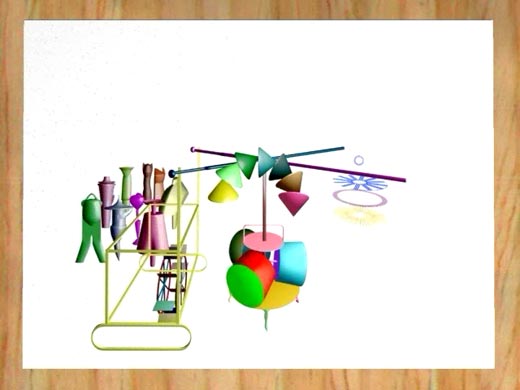
3D modeling analysis reveals the hatrack cannot exist as a single object from any viewpoint
Interactive software analysis reveals each hatrack representation occupies distinct geometric space:
These anomalies cannot result from simple perspective distortion alone.
Shearer identifies a working print from 1940 where Duchamp masked and separately positioned coatrack and hatrack components—suggesting deliberate cut-and-paste methodology. The working print shows "cutting and pasting a separate paper cutout of the coatrack onto the background studio photo."
Additional forensic indicators include:
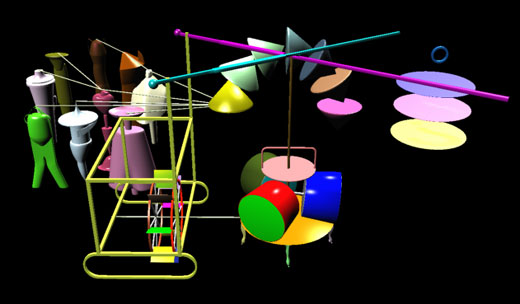
3D model by Gregory Alvarez and Rhonda Roland Shearer: "We would have to move one eye or lens in 3D space approximately 43 times around the model to see the same information Duchamp shows us in one instant."
Shearer concludes: "Duchamp's readymade hatrack only exists in the mind, not in factual nature."
Rather than selecting unaltered readymades, Duchamp appears to have:
This methodology aligns with Duchamp's stated interest in "rehabilitated perspective"—a mathematical system fusing multiple viewpoints that contradicts traditional linear perspective geometry. The hatrack, like the impossible bed in Apolinère Enameled, exists as a non-retinal object that can only be truly "seen" by the 4-D mind.
Rhonda Roland Shearer, Tout-Fait Vol. 1, Issue 2
Shearer argues that museums must develop parallel historical collections alongside artworks to properly contextualize Duchamp's practice. Understanding his readymades requires examining the actual mass-produced objects from which they allegedly derived.
The fundamental problem: "Without knowledge about French water and gas signs...Duchamp's major readymade work Eau et Gaz (1958) loses much of its meaning."
William Camfield was "the first to speculate that perhaps none exists" regarding duplicate urinals. Kirk Varnedoe's research team similarly failed to locate exact mass-produced readymade duplicates.
Preserving ephemeral historical objects creates an "active matrix for cross-disciplinary research" rather than static museum storage—allowing scholars to verify or challenge artistic claims against documented historical evidence.
Rhonda Roland Shearer & Robert Slawinski, Tout-Fait Vol. 2, Issue 4
Duchamp claimed he created his Poster for the Third French Chess Championship (1925) by tossing building blocks into a net bag, photographing the result, then enlarging and coloring the image.
Using 3D computer modeling software, Shearer and Slawinski attempted to reconstruct the cube positions. Their critical discovery: the cubes have geometrically impossible spatial relationships—their surfaces, edges, and vertices would need to interpenetrate to coexist simultaneously as depicted.
Specific anomalies: some cubes display proportional inconsistencies where tops appear smaller than vertical sides, contradicting standard perspective rules. The researchers compare Duchamp's cubes to "impossible figures"—optical illusions where familiar visual cues conflict with mathematical reality.
This research suggests Duchamp deliberately constructed impossible geometry in 1925—predating Oscar Reutersvärd's recognized "impossible figures" by nine years.
Juan Alfaro, "The Art of Looking Back and the Reward of More or Less Being Seen" (2000)
Juan Alfaro's analysis of Wanted: $2,000 Reward (1922-1923) reveals it as a multilayered linguistic puzzle rather than a simple altered found object. The piece contains embedded wordplay that directly addresses themes of deception, false selection, and artistic authenticity—challenging the "official story" that readymades were merely found objects chosen through indifference.
Alfaro decodes the names and text on the wanted poster:
The embedded message: the readymades involve deliberate choosing and deception, not indifferent selection.
Alfaro proposes that "tout-fait" (ready-made) is a homophone for "tu fait" (you make), positioning spectators as co-creators of meaning. This connects to Duchamp's famous statement that "the REGARDEURS [viewers] who make the pictures."
The ready-made concept itself contains the instruction: you complete the work through interpretation. Duchamp rejected purely "retinal" art in favor of intellectual engagement requiring auxiliary interpretation—the viewer must decode, not merely observe.
Alfaro references Shearer's findings that readymades like L.H.O.O.Q. and In Advance of a Broken Arm were handcrafted, not found objects. This reframes the readymades as "wholly original works" disguised to appear mass-produced—the deception itself being the art.
"The 'Wanted' poster tells us directly: the readymade story is a lie, and the choosing was deliberate. Duchamp embedded the confession in plain sight."
Rhonda Roland Shearer, Response to "Infusion Ball or Holy Ampule?" (2000)
In her response to challenges defending the mass-produced status of Duchamp's Paris Air (1919), Shearer identifies the fundamental problem with the readymade thesis:
"No exact duplicate exists for any of his productions in the historical record."
This contradiction undermines the entire readymade concept—if objects were truly mass-produced, duplicates should be findable. Yet after decades of searching, no one has located a matching commercial version of any Duchamp readymade.
Shearer examines historical infusion device illustrations, noting that documented medical ampules featured separate metal clasps rather than integrated glass hooks. A glass hook would be impractical—patient movement creates stress that would break such a fragile component. This suggests historical evolution away from glass hooks, making Duchamp's version an anomaly rather than a standard product.
The work is titled "50 cc of Paris Air," yet the actual ampule holds approximately 125 cc—more than double the stated volume. Standard medical ampules came in sizes like 35cc and 125cc. The mismatch between title and object suggests either:
Shearer concludes: no documented mass-produced duplicate matching Duchamp's 1919 Paris Air has ever emerged, suggesting custom fabrication rather than readymade appropriation.
This analysis reinforces the broader finding: across every readymade—the snow shovel, the hat rack, the bottle rack, the bicycle wheel, the urinal—no exact commercial match has been found. The statistical probability of this being coincidence approaches zero. Duchamp made them all.
Richard Kegler, "Through the Large Glass" — MFA Thesis, SUNY Buffalo (1994)
In 1994, Richard Kegler executed an installation using The Large Glass as a framework for computer-generated works, extending Duchamp's intentions "in ways that would not have been possible before the introduction of high end computer image manipulation."
Kegler argues that the computer represents the "new medium of expression" Duchamp was searching for:
"The glass as 'ground' has a function and status anticipating that of the computer monitor as a screen of operations—of transformations—and the site of interaction and negotiation of meaning."
The Large Glass was Duchamp's "sum of experiments" in searching for this new medium. Using 3-D animation software, Kegler rendered The Large Glass with movements suggested by Duchamp in his notes—the representation of 3-D space on a 2-D plane (the computer screen) fits precisely with Duchamp's intention for the lower section of the Glass.
Taking a cue from Duchamp's note "Make a room made of mirrors..." coupled with his attempts at visualizing the 4th dimension, Kegler created a room with mirrored walls reflecting a computer monitor running a program called "4-D"—visualizing a sphere extruded into 4th dimensional space, rotating.
This reflection repeated to infinity by reflection upon itself approaches another attempt at 4th dimensional visualization. The viewer, picked up as a reflection, becomes part of this infinitely repeated space—viewable only through one window facing into the room.
Duchamp's 4-D was the theoretical concept popular in the late 19th century: the 4th Dimension as a spatial extension of the 3rd Dimension, similar to how the 3rd extends the 2nd. In simpler terms: a 2-D shadow is cast by a 3-D object; following the same premise, objects in a 3-D world would be projections of corresponding 4-D objects.
Kegler notes that the concept of the fourth dimension "has parallels to the notion of 'cyberspace'... the nebulous universe of computer interaction." 3-D computer modelers simulate 3-D through 2-D representation on a screen while maintaining in virtual space information about the objects represented.
The installation used appropriated imagery, computer manipulations, and nods to Duchamp's work—"reproductions of reproductions of facsimiles"—creating what Kegler calls "Digital Analogies to Duchamp."
Source: P22 Projects Archive
A computer animation visualizing the Large Glass in motion demonstrates how digital media can realize Duchamp's mechanical intentions:
Watch: The Large Glass Animation →
This animation brings the Bachelor Machine to life—the Chocolate Grinder rotating, the Glider sliding on its runners, the Sieves filtering, the Oculist Witnesses spinning—revealing the kinetic dimension that exists only in Duchamp's notes and the viewer's imagination when looking at the static glass panels.
Mark Jones, Tout-Fait (2000) — Computer Animation Studies
Mark Jones's research presents computer animations exploring Duchamp's Chocolate Grinder paintings (1913-1914), investigating whether Duchamp successfully "reinvented perspective in the 20th century."
These works—Chocolate Grinder, No. 1 (1913) and Chocolate Grinder, No. 2 (1914), both at the Philadelphia Museum of Art—are crucial to Duchamp's development because they*"prefigure the Large Glass through clarity of drawing, observance of perspective and the incorporation of mechanism and rotation."*
The research involved analytical study, visits to chocolate manufacturers, correspondence with Duchamp scholars, and 3D modeling using AutoCAD at British Aerospace. Two animations emerged:
The Chocolate Grinder represents the bachelor apparatus par excellence—a machine that "grinds its own chocolate," operating in perpetual self-contained motion. In the Large Glass, the grinder sits at the center of the Bachelor Machine, mediating between the Nine Malic Molds and the Oculist Witnesses.
Scholarly dialogue on Gould & Shearer's thesis (Natural History, 1999)
Stephen Jay Gould and Rhonda Roland Shearer's essay "Boats & Deckchairs" (published simultaneously in Tout-Fait and Natural History, December 1999) explored Duchamp's engagement with fourth-dimensional perception—specifically the problem of viewing multiple sides of an object simultaneously.
Duchamp's work repeatedly addresses the limitation that we cannot perceive all sides of a three-dimensional object at once. The Hatrack's "impossible perspective" composites, the Large Glass's "rehabilitated perspective," and the impossible bed in Apolinère Enameled all engage this perceptual constraint.
James L. Schmitt, O.D., raised important technical challenges: even with mirrors or fiberoptic systems showing opposite sides of an object simultaneously, the brain perceives either diplopia (double vision) or fusion into a flat, two-dimensional image—not enhanced dimensionality.
This points to a deeper insight: true 4D comprehension may require moving beyond visual perception entirely. Duchamp's non-retinal art philosophy aligns with this—the fourth dimension is conceptual, not optical.
Schmitt suggested that tactile sensation (like handling a penknife with closed eyes) might approach 4D understanding better than vision—simultaneously sensing surfaces that vision must perceive sequentially. This resonates with Duchamp's interest in the "infra-mince"(infra-thin)—sensations at the edge of perception that cannot be captured visually.
The scholarly dialogue reveals that Duchamp's 4D investigations remain productively unresolved— exactly as 'pataphysical science intends.
Thomas Zaunschirm, Professor of Art History, Essen University (2000)
Thomas Zaunschirm's response to Shearer and Gould's research offers a striking assessment of its significance:
"Duchamp will prove more significant than Picasso in coming decades, but only if scholars challenge his own stated explanations."
Zaunschirm argues that "what Duchamp intended matters less than what we can understand" about his work. The artist's own declarations should not be taken at face value—independent critical examination is essential.
Zaunschirm describes Shearer's findings—particularly regarding the Green Box and the 3 Standard Stoppages—as "obvious" yet overlooked. These revelations interrupt established art historical narratives by demonstrating what careful forensic analysis reveals.
The work "falls apart" under scrutiny, simultaneously making Duchamp "hateable" yet*"interesting again and again."* The deception, once exposed, reveals deeper layers of conceptual sophistication.
Zaunschirm emphasizes that scholarly consensus matters less than examining phenomena directly. Shearer's forensic approach—3D scanning, geometric analysis, historical comparison—bypasses established interpretations to engage with the physical evidence itself.
This methodology proves essential for understanding Duchamp: the objects themselves tell a different story than the official narrative.
Anja Mohn, Interview with Rhonda Roland Shearer, Tout-Fait (2005)
Anja Mohn's interview with Shearer captures the essence of her research program and the controversy it generated. Shearer describes her own evolution: "I have learned my lesson from Duchamp," she says, and consequently has discarded the object from her work—concentrating entirely on "the rewriting and manipulation of art history."
Duchamp's gravestone reads: "Besides—it is always the others who die." Mohn asks: does this suggest that we would die—the accuracy of our perception, our curiosity—while he would not? The hidden issues in the readymades, "once discovered indeed would give him a second revival and guarantee his spirit and influence to live on far beyond the fame of his time."
Duchamp explicitly expressed interest in a future public: "You should wait for fifty years or a hundred years for your true public. That is the only public that interests me."
Mohn connects Shearer's findings to Poincaré's epistemology: "axioms of geometry are neither a synthetic a priori truth nor an empirical truth and they are a convention in a disguised form. We choose an appropriate convention in the light of our experience and thus the question is not whether it is true or not but whether it is convenient or simple."
We see what we know, and convenience plays a far greater role in our perception than we would like to admit. Duchamp exploited this: "Our blind spots become the very spots where he can fool us."
Duchamp hated the retina—for him it was the source of misperception. In interviews he expressed dislike for all art based on the visual alone, calling it "retinal." As he told Cabanne:
"The retinal shudder! Before, painting had other functions: it could be religious, philosophical, moral."
Shearer's interpretation: "Duchamp through his work gives us the visual version of a truly new mathematical system that describes how eye and mind work together."
Since Shearer went public with her ideas, controversy erupted. Critics found fault in her usage of 3D rendering and scientific methods as opposed to traditional art-historical methods. Others wanted more visual evidence or assumed she read facts to conform to her theory.
Mohn asks: "Is this perhaps another blind spot, the attempt to dwell on conventional methods of research in art history and ultimately the reluctance to give up well known and comfortable beliefs about what art can be and what our perception is capable of?"
She concludes with Poincaré: "To doubt everything or to believe everything are two equally convenient solutions; both dispense with the necessity of reflection."
Thomas Girst, Editor-in-Chief, Tout-Fait inaugural editorial (1999)
The journal's name was chosen deliberately: "tout fait" was the standard French translation for "readymade," but the editors discovered something more significant:
The term "tout fait" appeared frequently in the writings of mathematician Henri Poincaré, who influenced Duchamp significantly.
After debating roughly twenty alternatives, the editorial team selected "Tout-Fait" specifically to highlight intersections between art and science—the central theme of Shearer's research program.
Tout-Fait was published by CyberArtSciencePress, the publishing division of the Art Science Research Laboratory, Inc.—Shearer's not-for-profit research organization. The journal brought together:
The interdisciplinary approach—art history, forensic analysis, mathematics, evolutionary biology— was essential for uncovering what traditional Duchamp scholarship had missed.
The journal's design featured colorful square shapes derived from Duchamp's 1918 painting Tu m'—his last "regular" painting before "abandoning" art for chess. Even the journal's visual identity encoded Duchamp references.
A significant milestone for Duchamp scholarship: The Large Glass entered the public domain on January 1, 2019, along with other works from 1923. As Hrag Vartanian reported in Hyperallergic, this means the work can now be "freely read, cited, republished, and otherwise used without copyright restrictions."
This removes licensing barriers that previously governed reproduction and scholarly analysis— enabling the kind of forensic examination that Shearer's research requires. The work can now be studied, reproduced, and discussed without estate approval.
Timothy A. Phillips on Linda Dalrymple Henderson's "Duchamp in Context" (2002)
Timothy A. Phillips examines Henderson's scholarly work, arguing that understanding Duchamp requires recognizing the artist's serious engagement with mathematical and scientific thought. Duchamp studied intensively at the St. Genevieve Library, focusing specifically on optics and perspective, making him "a savant of the history of ideas."
Phillips argues that Poincaré's concepts—particularly from Science and Method andScience and Hypothesis—provide essential coherence to the Large Glass:
"Without Poincaré, the Great Glass would lack cohesion and relevance to seminal modern thought."
Phillips notes Shearer's discovery of Renaissance geometer Jean François Niceron's (1613-1646) influence on Duchamp. Niceron's La Perspective Curieuse employed folded prisms and multiple viewpoints to reveal "unsuspected images"—a technique directly aligned with Duchamp's visual strategies.
The Large Glass depicts transformation across dimensional realms: the "illuminating gas" ascends from the Bachelor Realm (three-dimensional) to the Bride's realm (four-dimensional), mirroring alchemical transmutation. Phillips quotes Blake: "energy is eternal delight"— characterizing the erotic and universal energy throughout Duchamp's work.
Following Poincaré's model, genius involves unconscious processing of randomly accumulated knowledge, culminating in "tout fait" (the illuminating flash). This probabilistic approach displaced deterministic Newtonian physics—reflecting Einstein's famous discomfort with a universe where "God played dice."
Phillips concludes that viewing Duchamp's entire oeuvre—readymades, precision paintings, and notes—as an integrated closed system reveals him as a major philosopher comparable to Popper, Jaspers, or Wittgenstein. His achievement: conveying complex scientific and philosophical insights through wit and visual sophistication rather than academic discourse.
Michael Enßlen, Tout-Fait (2002)
Enßlen confronts a crucial question: if Duchamp's readymades were fabricated rather than found, does this invalidate the ready-made concept entirely? His answer is nuanced and illuminating for understanding how Shearer's research reshapes—rather than destroys—Duchamp's legacy.
Enßlen summarizes the ASRL findings directly:
"The bicycle wheel wobbles, the snow-shovel with the title In Advance of the Broken Arm does not work and even the Fountain to all appearance is different from all urinals that Duchamp could have bought anywhere."
The physical objects themselves betray their manufactured origin—they are too imperfect to be mass-produced, exhibiting the subtle irregularities of hand-crafting.
Arthur Danto's influential "indiscernibility thesis" argued that perceptually identical objects can differ in artistic status based on context alone. Shearer's research challenges this: if the readymades were never perceptually identical to commercial objects, the philosophical foundation shifts.
Enßlen makes a crucial distinction: theoretical validity differs from artistic practice. Even if Duchamp's specific readymades were fabricated, the conceptual strategy of appropriation remains legitimate:
"It would appear, then, that the research of the ASRL gives more reason to expect that the influence of Duchamp will continue rather than that it will fade."
Enßlen cites artists who demonstrate the ready-made principle's vitality independent of Duchamp's actual methods:
If Duchamp's readymades were elaborate fabrications, this doesn't diminish his achievement— it transforms our understanding of it. He wasn't simply selecting objects; he was creating simulations of selection itself. The ready-made becomes not a found object but a meditation on what it means to find, to choose, to authenticate.
For contemporary artists, this expanded understanding opens new possibilities: appropriation as commentary on appropriation, authenticity questioned through manufactured inauthenticity.
Glenn Harvey, Tout-Fait (2002)
Harvey draws unexpected parallels between Duchamp's Large Glass and Ferdinand de Saussure's foundational work in semiotics, proposing that both thinkers—working contemporaneously but apparently independently—pursued remarkably similar intellectual problems through different disciplines.
Duchamp sought to isolate what he called "the sign of accordance"—a relationship demonstrating how various interdependent facts reach an instantaneous state of rest. He expressed this algebraically:
a/b
Where "a" represents the instantaneous state (like a photographic exposure), and "b" represents possibilities. Crucially, the value resides in the dividing bar itself, not in any resultant outcome. Harvey notes: "once a and b become concrete or qualitative, they lose their abstract quantitative character."
Saussure founded semiology by establishing "the sign" as a two-sided psychological entity joining concept with sound pattern—what he described as "a system of signs expressing ideas, comparable to military signals."
Saussure struggled to describe the relationship between thought and sound, resorting to metaphor:
"Like air in contact with water: changes in atmospheric pressure break up the surface of the water into a series of divisions, i.e. waves."
Harvey argues Duchamp understood this problem's internal contradiction better than Saussure. In the Large Glass, three glass bars (not one) separate the Bride from her Bachelors—suggesting the mediating zone itself contains irreducible complexity.
Though both thinkers worked contemporaneously (Saussure's Course in General Linguistics was published posthumously in 1916), no evidence suggests Duchamp read Saussure. Yet their conceptual concerns converged: isolating the abstract relations that govern concrete phenomena.
This parallel illuminates Duchamp's intellectual sophistication—he was grappling with the same foundational problems that would shape 20th-century linguistics, philosophy, and structuralism.
Raymond J. Herdegen, Tout-Fait (2001)
Herdegen presents a striking visual comparison between two works separated by over sixty years:
The juxtaposition requires no elaborate textual analysis—the visual correspondence speaks for itself, suggesting deep conceptual affinity between the founder of 'Pataphysics and his most devoted artistic heir. Both works engage with religious imagery through unconventional materials and symbolic transformation.
This visual note reinforces the Jarry-Duchamp lineage: from late 19th-century symbolist literature to mid-20th-century avant-garde art, a continuous thread of 'pataphysical thinking that transmutes sacred imagery into something stranger and more unsettling.
Donald Shambroom, Tout-Fait (1999)
Shambroom explores Duchamp's deliberate embrace of glass as an artistic medium and his philosophical acceptance—even celebration—of its inevitable deterioration.
Duchamp initially chose glass to preserve oil colors from oxidation:
"My own colors were completely protected, the glass being a means for keeping them both sufficiently pure and unchanged for rather a long time."
However, his experiments with trapping fresh paint behind sealed lead foil ultimately failed— the paint reacted with the foil and deteriorated anyway.
Duchamp valued glass for creating spatial effects through perspective, stating the material "was able to give its maximum effectiveness to the rigidity of perspective." Yet this theoretical advantage never fully materialized—the Large Glass appears flat and distorted in gallery settings.
Rather than lamenting the famous 1926 breakage, Duchamp celebrated it:
"The more I look at it the more I like the cracks: they have a shape. There is a symmetry in the cracking... a curious intention that I am not responsible for, a ready-made intention."
The cracks became a collaborator's contribution—chance completing what deliberation had begun.
Shambroom argues Duchamp drew inspiration from Leonardo da Vinci's fragile Last Supper, which deteriorated yet gained cultural mystique through decay. Damaged European artworks acquired romantic power precisely through their fragility. Duchamp created an "indestructible" American masterpiece because its fragility made it immune to nostalgic tradition.
In the 1930s, Duchamp reproduced his glass paintings as miniatures on celluloid for his portable museum. Since celluloid cannot crack, he meticulously hand-scratched each of the 300 copies with etching needles to replicate the cracks—ensuring the surfaces were "as good as broken."
This detail epitomizes Duchamp's method: what appears accidental was laboriously fabricated; what seems found was carefully made; what looks broken was deliberately scratched by hand.
Kurt Godwin, Tout-Fait (2009)
Godwin argues that Spring (also titled Young Man and Girl in Spring), created when Duchamp was 24, represents far more than a wedding gift for his sister Suzanne. It served as an early study for his final masterpiece, Étant donnés, created decades later between 1946-1966.
Godwin proposes that Duchamp employed an unusual creative methodology:
"Very early on—Duchamp planned and prepared for the major works he would eventually produce."
Rather than developing organically, his major projects evolved from extensive note-taking years or decades before execution. The 1911 painting already contained the seeds of work he wouldn't complete until 1966.
The second version of Spring became integral to multiple interconnected projects:
Black bands applied to Spring's margins created dimensions exactly half-scale to the Large Glass, demonstrating how Duchamp recycled and repurposed earlier work into subsequent projects.
Notably, Spring was excluded from Boîte-en-valise, Duchamp's portable museum of career-defining works—just as Étant donnés was withheld until after his death. This suggests intentional parallelism between his first and final major statements: both too revealing to include in his public self-curation.
Roberto Giunti, Tout-Fait (2007)
Giunti employs Cabri Géomètre II—interactive geometry software typically used for high school education—to reconstruct and verify Duchamp's perspective rendering in the Large Glass. The results confirm Duchamp's claim of "mathematical, scientific perspective."
Using Cabri's dynamic geometric construction capabilities, Giunti reconstructs the Bachelor apparatus from Duchamp's original plan and elevation sketches, discovering:
Beyond static perspective analysis, Giunti proposes that rotary motion functions as the mechanism through which the Bachelor apparatus emulates higher dimensionality:
Perspective + Transparency + Motion = Emulation of 4D spatiality
Giunti emphasizes Duchamp's own theory: perspective alone cannot convey 4D presence. Understanding requires what Duchamp termed "intuitive knowledge of the fourth dimension." As he stated:
"One must consult the book, and see the two together" to remove "the retinal aspect."
The notes bundled with the Glass constitute an integral component of the artwork, directing mental engagement beyond visual data. The Fourth Dimension emerges not from perspective trickery but from coupling canonical geometric rendering with intentional motion and topological conceptualization.
Julia Dür, Tout-Fait (2005)
Dür explores the artistic philosophies and personal friendship between Duchamp and John Cage, examining how both artists blurred distinctions between art and everyday life.
"A human is a human, as an artist is an artist; only if he is categorised under a certain '-Ism' he can't be human nor artist."
Duchamp actively resisted being labeled, declaring himself "anti-artistic" while secretly creating masterpieces.
Through Zen Buddhism study, Cage developed music free from personal intention. His revolutionary 4'33" consists entirely of silence, inviting audiences to recognize environmental sounds as musical composition:
"Art is not an escape from life, but rather an introduction to it."
Roberto Giunti, Tout-Fait (2003)
Giunti explores how Klee, Duchamp, and Escher's impossible objects relate to concepts of entropy and self-organization—anticipating complexity science decades before formal theoretical frameworks emerged.
Impossible objects like Escher's Waterfall exist in:
"A world which isn't subjected to the law of thermodynamics: here entropy doesn't increase, but reduces itself, to allow perpetual motions."
These paradoxical structures mirror how "complex systems with self-organization" spontaneously reduce entropy by "introducing new levels of order among its elements."
Following Jean Clair's analysis, Giunti notes that the Large Glass and similar mechanical constructs represent "perpetuum mobile" variations that "produce more energy than they use"—inverting thermodynamic reality into imaginative possibility.
The article emphasizes Stuart Kauffman's principle of "Order for free"— describing how systems can achieve order without external energy input, seemingly defying entropic expectations. Duchamp's machines embody this principle visually: closed systems that generate rather than dissipate organization.
The Bachelor Apparatus operates in a realm where the arrow of time points differently— where desire circulates endlessly rather than exhausting itself, where the "illuminating gas" transforms rather than disperses. This is not physics but 'pataphysics: the science of imaginary solutions operating under laws that invert our own.
Jonathan Williams, Tout-Fait
Williams argues that Duchamp's artistic systems anticipated conceptual frameworks later validated by quantum mechanics—both responding to the same intellectual current challenging deterministic worldviews.
"A joke about the meter—a humorous application of Riemann's post-Euclidean geometry" that cast doubt on linear measurement itself.
The work functions as "a critique of scientific laws and determinist causality"— a 'pataphysical system substituting erotic desire for conventional physical forces. The Bride inhabits an immeasurable fourth dimension, presaging quantum unmeasurability.
Duchamp's readymades demanded viewer participation in creating artistic meaning, paralleling Heisenberg's insight that observation fundamentally alters measured systems:
"The creative act is not performed by the artist alone; the spectator brings the work in contact with the external world."
Both Duchamp and quantum physicists drew on Henri Poincaré's conventionalism—the notion that scientific theories are useful metaphorical frameworks rather than absolute truths about nature.
Steven B. Gerrard, Tout-Fait (2000)
Gerrard examines Duchamp's characteristic behavior through a 1968 chess photograph with a Max Ernst-designed set. The central observation: Duchamp positioned the board with a dark square in the lower right corner, when proper setup requires a light square there.
"Duchamp seems to always both 1) deceive, yet 2) leave clues of his deception."
This dual approach ensures that his tricks remain discoverable rather than permanently hidden. The deception invites detection; the puzzle demands solving.
Gerrard references Wittgenstein's observation that connects to Duchamp's method:
The wrongly-oriented chessboard is visible to anyone who knows the rules—hidden in plain sight, waiting for the attentive viewer.
Richard K. Merritt, Tout-Fait (2003)
Merritt examines how symbolic logic, virtual reality, and concept visualization can illuminate Duchamp's deliberately deceptive artistic practice.
"The body of work produced by Marcel Duchamp was a programmatic, if playful, undermining of deterministic thinking."
A pivotal example from the White Box (1967): a commercial postcard that, when rotated 90 degrees, transforms boats into deckchairs—demonstrating how "viewing from a different dimensional vantage point reveals entirely different objects."
Duchamp's chess mastery informed his artistic philosophy. Chess exemplifies how complex systems combine rule-based logic with unquantifiable elements like intuition, making outcomes inherently non-deterministic despite fixed rules.
Merritt demonstrates that traditional symbolic logic fails to capture Duchamp's plural intentions. Three major interpretations all prove internally consistent yet mutually exclusive:
Merritt emphasizes that Duchamp deliberately left "clues for altering our perspective" to his intentions. The work fundamentally demands multi-dimensional thinking rather than singular interpretations—reflecting Poincaré's insight that knowledge is fundamentally relational rather than absolute.
Lanier Graham, Tout-Fait (2002)
Graham argues that androgyny—understood as metaphysical balance achieving cosmic consciousness—was central to Duchamp's artistic practice. Rather than superficial gender-bending, Duchamp engaged androgyny as a spiritual symbol representing the integration of male/female, rational/intuitive, and finite/infinite consciousness.
Duchamp himself stated his perspective as "metaphysical if any," describing art as "an outlet toward regions which are not ruled by time and space."
Graham includes a 1967-68 exchange where she asked if Duchamp's perspective could be called "Alchemical." He responded affirmatively but cautioned:
"The Androgyne is not limited to any one religion or philosophy. The symbol is universal. The Androgyne is above philosophy."
Graham establishes androgyny as a universal sacred symbol across world religions—Taoism, Hinduism, Buddhism, Judaism, Christianity, and Islam:
"What may seem to be two-ness actually is oneness when seen from a higher level of perception."
Olav Velthuis, Tout-Fait (2002)
Velthuis argues that J.S.G. Boggs, a contemporary artist who creates handmade currency, parallels Duchamp's conceptual approach. While Duchamp critiqued the art world, Boggs interrogates economic systems through meticulously crafted bills and coins.
"I don't want to copy myself... they no longer make pictures; they make checks."
Duchamp created checks for personal use; Boggs extends this principle by generating millions in economic transactions using fabricated currency.
"When you are dealing with an abstraction, the borderline between something and nothing is very subtle."
Money lacks intrinsic material value—it operates entirely on collective agreement. Boggs exposes this convention by creating plastic coins and hand-drawn bills.
Shin-Yi Yang, Tout-Fait (2002)
Yang analyzes Duchamp's readymades through Kenneth Burke's rhetorical theory, arguing that Duchamp functions as a skilled persuader using non-verbal symbols rather than merely creating aesthetic objects.
Burke defines humans as "symbol-using (symbol-making, symbol-misusing) animal[s]" who create meaning through interpretation. Symbols, including words, can never truly represent what they signify. Persuasion operates through identification and "consubstantiality"— establishing rapport between speaker and audience.
Visual objects possess greater rhetorical power than words because they exist in sensory experience. Objects invite viewers to identify them without requiring linguistic translation, strengthening audience connection.
Yang's central analysis examines the 1917 urinal. The piece operates through strategic indeterminacy—the title "Fountain" creates conceptual tension when applied to a urinal, forcing viewers through dialectical negation to transcend conventional definitions.
" Pure persuasion: absolute communication, beseechment for itself alone."
Duchamp selected ordinary objects with "total absence of good or bad taste," transformed them through signature and display, and frequently gave works away rather than commercializing them—indicating persuasion as intrinsic purpose rather than means to fame or profit.
Bradley Bailey, Tout-Fait (2002)
Bailey argues that Duchamp's 1911 drawing Encore à cet Astre deserves analysis "in its own right" rather than merely as a study for Nude Descending a Staircase.
The drawing contains three distinct elements that Bailey synthesizes as representing:
This framework anticipates Duchamp's later explorations of unfulfilled desire in the Large Glass.
Bailey proposes the grid represents a vertical chessboard—a device Duchamp employed in studio studies, connecting to concurrent works like Portrait of Chess Players.
The title (from Jules Laforgue's poetry) contains multiple resonances: "astre" as anagram for "stare" and homonym for "stair"—typical Duchampian linguistic play embedding meaning in sound.
Mark B. Pohlad, Tout-Fait (2000)
"It is not the time to finish anything. Now is the time for fragments."
Pohlad challenges the myth that Duchamp was indifferent to his artworks' survival. Instead, he documents Duchamp's lifelong obsession with conservation, repair, and physical preservation.
When the Large Glass shattered during transport in 1933, newspapers described it as "reduced to an enormous pile of unattached fragments."
Rather than abandon it, Duchamp spent months reconstructing it:
"I haven't answered your letter... because I have turned into a glazier who thinks of nothing else from 9 in the morning to 7 at night but repairing broken glass."
He later inscribed: "-cassé 1931/ -réparé 1936"—acknowledging damage and restoration as integral to the work's history.
"Men are mortal, pictures too."
Duchamp believed physical condition directly affected historical significance. He expressed anxiety about contemporary artists using "perishable materials," calling it "a form of suicide, as artists go."
Tu m' (1918) features a trompe l'oeil tear "repaired" by three safety pins—suggesting conservation's crude compromises. The Unhappy Readymade (1919) deliberately deteriorated, serving as "a metaphor for the damaging effect of time on art."
Duchamp explored repair and conservation in 3 Standard Stoppages (1913-14). He had been inspired by a Paris shop sign, "stoppages et talons," advertising invisible mending and heel repairs to socks and stockings (et talon, or étalon = "standard").
Mending is an operation of repair and maintenance. Perhaps the varnished threads in 3 Standard Stoppages, whose shape determined a new standard of measure, are meant to be read as threads which have become unraveled from an "invisible" mend. Interpreted this way, what is being conserved in this work (mends) is the evidence of repair, now absurdly made standard in the templates.
What makes this doubly preposterous is that the forms that repairs take are wholly contingent on the damage they seek to rectify. This work thus suggests something of the despairing futility of predicting and measuring repair.
Duchamp completed it in 1936 by cutting the canvases according to the shape of the varnished threads, gluing these to glass plates, and fitting them into a slotted wooden box. Also included are flat wooden "templates" (yardsticks, of sorts) whose shapes were determined by threads dropped from a certain height. Thus completed, the format reflected his attempt to conserve the sophisticated documentation of a pataphysical experiment.
William Anastasi, Tout-Fait (2000)
Anastasi argues that Alfred Jarry's work profoundly influenced three twentieth-century giants—James Joyce, Marcel Duchamp, and John Cage—who deliberately created art that few wanted to engage with, echoing Goethe's satirical poet:
"Do you know what would really delight me as a poet? To write and recite what no one wants to hear."
Jarry's Faustroll contained stream-of-consciousness passages and invented words that presaged Joyce's innovations. The text reveals obsessions with chance (l'accident) and pataphysics—Jarry's alternate science studying exceptions and accidents rather than universal laws.
Anastasi contends Duchamp deliberately embedded Jarry references throughout his major works, leaving subtle clues in titles, appearances, or notes while consistently deflecting attention elsewhere. Works like the 3 Standard Stoppages directly parallel Jarry's descriptions of objects moving through space.
Though less directly indebted to Jarry personally, Cage absorbed Jarry's spirit through his admiration for Duchamp and Joyce. Both Jarry and Cage embraced anarchism and chance; Cage's 4'33" collapses the art-life distinction Jarry challenged.
Duchamp and Cage embodied opposite approaches to artistic disclosure: Duchamp cloaked his methods in mystery while Cage meticulously documented his processes.
Shin-Yi Yang, Tout-Fait (2000)
Yang examines how wireless technology and radio transformed mass media by introducing "immaterial" communication—and how this relates to Duchamp's work.
Radio amateurs and listeners preceded commercial broadcasting. Modifying Duchamp's famous concept, Yang suggests:
"Ce sont les récepteurs, qui font les médias"—receivers make media.
Radio signals couldn't be controlled to reach single receivers, enabling amateur listening. This unplanned development mirrors how 1990s hackers created the internet boom.
Yang connects wireless transmission with psychoanalysis as parallel 19th-century developments introducing non-dialogic, one-way communication. Both transformed how humans process information.
The Large Glass represents bachelors and bride separated by "wireless" connections. Suzanne Duchamp's Radiation of Two Lone Ones at a Distance(1916-20) more explicitly combines wireless technology with erotic desire, depicting antenna-like forms transmitting messages across distance.
John Cage's Imaginary Landscape No. 4 represents a subversive use of radio—continuing the lineage from Duchamp's immaterial transmissions.
Shin-Yi Yang, Tout-Fait (2000)
Yang examines four financial readymades—the Tzanck Check (1919), Monte Carlo Bonds (1924), Czech Check (1965), and Cheque Bruno (1965)—as critical interventions into art market mechanisms and value creation systems.
These works transcend typical readymade critique by specifically targeting economic institutions. The financial documents expose how value emerges through exchange relationships, challenging assumptions about intrinsic worth in both financial and artistic domains.
"Value is created through exchange, through the display, circulation, and consumption of the work, in a game where worth has no meaning in itself."
Despite publicly condemning commercialism, Duchamp actively participated in art market transactions. He facilitated sales of Brancusi sculptures, collaborated with dealer Arturo Schwarz on reproduced readymades, and maintained relationships with major collectors.
This contradiction becomes productive rather than disqualifying—demonstrating that value systems (artistic and monetary) share fundamental mechanisms rooted in social belief rather than inherent properties.
Duchamp gave away original works to intimates while treating distant artworks as commercial commodities. This mirrors anthropological patterns where gift-giving reinforces community bonds while commercial exchange involves strangers.
Schwarz's 1964 edition of readymades generated controversy. Critics like Daniel Buren and John Cage viewed these reproductions as betraying the readymade's original critique, transforming artistic provocation into commercial enterprise. Duchamp avoided signing additional readymades once Schwarz began authorized reproductions, attempting to protect edition value.
Hector Obalk, Tout-Fait (2000) — Lecture given Paris, February 1996
A readymade has to carry some contextual details which say: "this is a readymade." If not, it is only a shovel decorating the studio of an eccentric Frenchman. It is not enough that MD bought a bottle rack without using it to dry up bottles. It is not enough that MD believes and makes believe that this bottle rack is a work of art... MD also has to believe and make believe that he (and not the designer) became the author of these chosen objects. And the only way to do so is to exhibit clearly the chosen object in an art show amid other works of art and with the same status.
Such an exhibition didn't take place.
So if there is no work on the object (because it is only chosen), and if there is no exhibition of the chosen object, there is no readymade, and consequently there is no new artwork. It is like a knife without a blade, and to which the handle is missing.
Nine of ten "pure" readymades (unassisted objects) are now lost or destroyed. Critically, Obalk observes that Duchamp deliberately avoided exhibiting these objects during his lifetime, despite his prominence in the New York art world (1915-1935). The artist had sufficient authority to display them had he chosen to do so.
Duchamp's unpublished notes reveal readymades as conceptual exercises:
When Duchamp created actual objects corresponding to these notes (like With Hidden Noise), he labeled them "semi-readymades"—acknowledging they departed from the pure concept.
Obalk links readymade theory to Duchamp's "infrathin"—imperceptible differences between nearly identical mass-produced objects. The artistic gesture resides not in choosing the object, but in the conceptual space between intention and physical reality.
The difference between a bottle rack in a hardware store and the same object as potential artwork exists only in imagination—an infinitesimal, invisible distinction.
The readymade is never a work of art for Duchamp—it functions as conceptual material. The actual artworks are the philosophical notes, the theoretical propositions, the speculative scenarios. Physical objects are merely vehicles for these ideas.
Without explicit exhibition in an art context, claiming a readymade is artwork amounts to confusing "the existence of Madame de Récamier with the painting portraying her."
Stephen Jay Gould, Tout-Fait (2000)
Gould argues that Duchamp's verbal creations—particularly wordplays and puns—deserve serious scholarly attention comparable to his visual works.
Duchamp inscribed candy wrappers at a 1953 Paris exhibition with:
A Guest + A Host = A Ghost
Gould connects wordplay to Duchamp's concept of the infrathin—that effectively invisible plane of separation, through which all products of human brilliance must pass in their transition from the tiny and palpable into wondrously diversifying realms of ever expanding meaning.
"What better illustration than the humble and neglected wordplay that transforms a tiny and almost risible difference into a marvelously evocative cascade of ever diversifying meanings?"
"The wordplay joins the readymade to fuse the central principle of Duchamp's art, and of intellectual life in general: seek the richness that the human mind can extract from every item in our endlessly complex universe, even from things so apparently coarse or trivial—the mass-produced industrial tool or the crude and silly wordplay—that they pass beneath the notice, or fall under the active contempt, of most people."
Keep your eyes and ears—and your mind—open, for the world does lie exposed in a grain of sand, and heaven in a flower. One might even privilege the humble and the despised as more worthy than the showy and mighty—the belief of all revolutionaries, both in politics and art.
"Deposuit potentes de sede et exaltavit humiles"—he hath put down the mighty from their seats, and exalted them of low degree.
And so the ghost of Marcel Duchamp, the ultimate (and arrogant) Cartesian rationalist, covering his consummately intellectual ass in a nihilistic shroud of Dada, laughs at us as he urges both his fans and enemies to envelop his sweet little jokes in sharp and multiple layers of meaning.
William Anastasi, Tout-Fait (1999)
Duchamp stated: "Rabelais and Jarry are my gods, evidently."
Anastasi argues that Duchamp deliberately broke three major glass artworks while publicly attributing the damage to accidents, drawing inspiration from Jarry's novels where sexual encounters are repeatedly accompanied by shattered glass imagery.
Three of Duchamp's glass works were reportedly broken "accidentally":
Three Jarry novels feature sexual activity + broken glass; three Duchamp glass pieces were "accidentally" broken. Duchamp's own accounts of when and where the breakage occurred are inconsistent. His explicit enthusiasm: "I like the cracks, the way they fall."
Jarry's "coition through the glass wall" directly parallels Duchamp's 1913 shop window soliloquy discussing "cutting through the glass pane" with "regret as soon as possession is consummated."
Jarry's novels (Days and Nights, Messalina, The Supermale) contain: sexual motifs combining virginity and machinery, imagery of "stripped bare" figures, and machine-brides accessible via valves or mechanisms.
Both Jarry and Duchamp embraced pataphysics—Jarry's invented philosophy based on "purely accidental phenomena." Duchamp signed correspondence "Yours Pataphysically," described his 3 Standard Stoppages as casting "pataphysical doubt" on geometry, and used Jarry's neologism "merdre" in his art formula.
The concept elevated chance/accident from mishap to artistic principle. The Large Glass's damaged state is not unfortunate but integral to its conceptual completion—transforming accident into intentional artistic strategy.
Jean Suquet (trans. Julia Koteliansky & Sarah S. Kilborne), Tout-Fait (1999)
"The Bride has undone her clothing which falls down onto the horizon and covers the world around. She is nue [nude], nuages [clouds], nébuleuse[nebula]. Milky way flesh color," writes Duchamp with one stroke of the pen, one flap of the wing.
Compare: In Shadow of the Erdtree, the veils of the Shadow Tree cover the sky of the Land of Shadow—the Bride's discarded clothing becoming the shroud that obscures an entire realm.
Suquet describes transformations:
The lower section features mechanical components (chocolate grinder, bachelors, pipes, sieves) representing masculine energy constrained by gravity. Gas serves as a metaphor for spirit struggling upward against physical limitation.
"A troubadour enters into the scene and will reveal himself as the Bride's letter-weight, the lady's spokesman: the juggler of the center of gravity. He DANCES on the horizon line. He flexes, he straightens himself up, from one foot to the other, at the mercy of the cannon shots... His body, sharpened into a spring, twists like an endless screw between the bottom and the top."
At his head, he erects a round platform in which a black ball rolls—the clot of darkness he juggles with. The ball vacillates, zigzags, dangerously brushes against the edges, but it does not fall. For the Bride sends it orders of new balance by licking it with a flame tongue, by flicking it with touching letters.
Duchamp represented this deus ex machina in the shape of a guéridon[pedestal table], a table tournante [swivel table]—the Oracle of the married-divinity. The Large Glass cleared it away into transparency. The fundamental dodge making diabolic the empty space, the miraculous blank around which the puzzle has been reconstituted.
"With one last stroke of the pen, Duchamp instituted the appellation: Tender of Gravity. The doctor of the law de la chute des graves [of the collapse of the graves] who unites the One in the sky with us on the ground."
What drug is carried by the guéridon that is the Bride's bed-side table? Address it sharply: guéris donc! [so heal!]. And si tu es gai, ris donc![if you're cheerful, then laugh!]. To heal gravity is to laugh.
Compare: Radahn, the final boss of Shadow of the Erdtree, is the "chosen consort" of the Bride-figure Miquella. Radahn is famous for his mastery of gravity magic—he who learned to conquer gravity so his horse could bear him. The Tender of Gravity, the one who dances on the horizon line, who "heals" the law of the collapse of the graves.
By spelling the letters of the Bride, the trismegistus juggler-handler-tender of gravity undresses this well-balanced virtue labeled by Duchamp: irony of affirmation. He personalizes OUI from top to toe—a OUI whose letters anybody can make dance to their liking.
The work culminates in dual transformations: the Bride becomes "effervescent writing" while the bachelors' energy transmutes into "a dazzling gaze." The "stripping bare" functions as a poem, with the final affirmation being "OUI" (yes).
Sarah C. Krank, Tout-Fait (2003)
Krank challenges painting's obsolescence by evolving it into three dimensions—relief structures that expand beyond the frame into space.
Krank reinterprets Duchamp's Nude Descending a Staircase, No. 2 (1912) asNude Redescending a Staircase—a nine-foot-tall three-dimensional version with forms projecting up to 22 inches outward.
"By being removed from a physical frame, these paintings, no longer contained, are allowed to visually expand into space extending across walls as well as outward toward the viewer."
She preserves Duchamp's angular geometry while introducing organic qualities: "combine those hard, angular lines with the organic feel that Duchamp only suggests."
Forms gradually extend from the surface, moving viewers from observation to immersion within the artwork's spatial presence—the painting becoming environment.
Donald Shambroom, Tout-Fait (2003)
A fictional narrative purportedly told by Jacques Villon (Duchamp's older brother) about a recurring childhood dream Marcel experienced during grammar school.
A small pond in a meadow surrounded by golden reeds that form tunnel networks. During the dry season, the pond becomes mud with two protruding brass pipes. Young Marcel retrieves these pipes and fashions them into "a musical instrument of his own design," creating "a sound never heard before, different from any of the instruments in the brass band in town."
Upon discovering his mother watching him play, "she could see his cheeks puffed out and his face turning red." Marcel resolves to "only play his own compositions, written in a musical notation that he had devised, and that only he could read."
This dream serves as metaphorical foundation for Duchamp's later artistic philosophy—his commitment to creating innovative works on his own terms, independent of conventional traditions or audience comprehension.
Octavian Balea, Tout-Fait (2000)
Romanian artist Balea describes painting on his parents' glass window at 2 A.M., inspired by Duchamp's masterpiece:
"One night, at 2 A.M., staring at the ceiling and walls, I thought the world was getting back at me for a mistake I had never made."
"I think that Duchamp wanted to tell more, more than the human mind is able to understand."
Despite mockery from fellow students in post-Ceaușescu Romania, Balea remains committed to introducing modern art to his peers—transforming an impulsive gesture into philosophical inquiry about meaning and artistic communication.
Robert Lebel (trans. Sarah Skinner Kilborne & Julia Koteliansky), Tout-Fait (2000)
Lebel, Duchamp's biographer who saw him nearly daily during WWII exile in New York, wrote this philosophical narrative around 1943-44. It won the Prix du Fantastique in 1965.
A mysterious inventor named A. Loride theorizes three distinct forms of time:
"Waste is strictly mandated to be not ostensible."
Modern society enslaves individuals to productivity-based temporality. Even those claiming freedom remain mentally bound to its rhythms. True liberation requires transcending usefulness entirely—not through contemplation, but through active refusal of conventional meaning-making. Quiet resistance rather than ostentatious rejection.
"Freedom is never separate from a certain silence."
Compare: In the Lands Between, time itself has become gratuitous. The Shattering broke not just the Elden Ring but the forward motion of history—demigods locked in eternal stalemate, the Tarnished returning endlessly, the world suspended in an interminable present. The Lands Between exist in "neutral time" awaiting someone to impose meaning, or in "gratuitous time" where the very concept of progress has been abandoned. Grace itself—guiding the Tarnished—is perhaps the last vestige of "social time," an obligation structure in a world that has otherwise escaped temporal bondage.
Interview by Rhonda Roland Shearer & Thomas Girst, Tout-Fait (2000)
Charles Henri Ford (1913-2002), interviewed at age 87 in his New York apartment. Ford founded the avant-garde magazine Blues at age 16, edited View magazine (crucial for showcasing European Surrealists), and co-authored The Young and the Evil(1933).
The interview examines mysterious photographs in View's March 1945 Duchamp issue. Ford notes that Duchamp went through considerable effort creating special photographic effects for the magazine's cover. An aging Duchamp portrait involved heavy makeup—demonstrating his commitment to visual transformation.
Ford commissioned Duchamp to create a cover for André Breton's poetry collection, depicting Breton's face as the Statue of Liberty in drag. Ford explains playfully:
"Breton... was noted for not cherishing homosexuals."
Ford recites his surrealist tribute to Duchamp, using repetitive "Over..." construction to catalog human experience—transgression, madness, sexuality, artistic ambiguity—before closing with "Marcel, wave!"
View magazine functioned as a crucial cultural bridge connecting European avant-garde movements with American artists during the 1940s. Ford demonstrates deep engagement with Duchamp's artistic philosophy—particularly his use of androgyny, surprise, and conceptual play.
Part II explores Poincaré's discovery theory, the 3 Standard Stoppages as a verification toolkit, and the Large Glass as a 4-D creativity machine.
Read Part II: A Possible Route of Influence From Art To Science →
Rhonda Shearer, working with a team of researchers, made a startling discovery: many of Marcel Duchamp's famous "readymades" - objects supposedly selected from mass production - were actually handcrafted fakes. The bottle rack was modified. The hat rack was custom made. Even the famous urinal may not have been a standard Bedfordshire model.
This discovery, published in the late 1990s and early 2000s, fundamentally changed how we understand Duchamp. He wasn't simply choosing objects - he was creating elaborate deceptions that questioned the very notion of authenticity and selection.
Shearer published her findings through the Art Science Research Laboratory and the journal Tout-Fait: The Marcel Duchamp Studies Online Journal. Her team used 3D scanning, forensic comparison, and historical research to demonstrate that many readymades could not have been commercially produced objects.
Shearer's work reveals that Duchamp was playing an even deeper game than previously understood. The readymades weren't about choosing mass-produced objects - they were about creating perfect simulations of mass production. The deception itself was the art.
This understanding is crucial for the Elden Ring connection. If Duchamp's method involved creating elaborate fakes that appeared to be something else, then looking for similar hidden structures in other artworks becomes a legitimate interpretive strategy.
Shearer's research suggests that Duchamp's entire career was a sustained 'pataphysical project: creating imaginary solutions that appear real, objects that simulate their own origins, art that pretends to be anti-art while being deeply crafted.
This opens the possibility that other works - perhaps including video games - might operate according to similar principles of sophisticated concealment.
Evan Bender, Tout-Fait (2007) | Read original
Bender responds to Shearer's investigative work questioning whether Duchamp's readymades were actually unmodified commercial objects. He argues this revelation isn't surprising, proposing that Duchamp likely moved beyond the "pure" readymade concept quickly after establishing it:
"Duchamp never showed much desire to repeat himself. After Nude he painted no more cubist paintings, after the large glass he made no more mechanosexual delays."
"Once you have the idea, what's interesting about repeating the simple (boring) act of buying an object and signing it?"
Bender traces Duchamp's progression—from the bottle rack (1915) through modified readymades like With Hidden Noise (1916) to increasingly conceptual works. Artistic restlessness drove innovation rather than deception.
"The layers of confusion are one of the gifts he gave us."
Duchamp's modifications, misleading statements, and obfuscation are characterized as deliberate artistic gestures—intentional ambiguity rather than dishonesty.
Jonathan Brown, Tout-Fait | Read original
Brown argues that Velázquez's Las Hilanderas (The Spinners, c. 1655-1660) exemplifies how great artworks accommodate multiple interpretations rather than conveying single, fixed meanings. The painting's true subject—Ovid's tale of Arachne's transformation—wasn't definitively identified until the 20th century, requiring 45 years of scholarly detective work.
The painting deliberately positions the mythological climax in the background while foregrounding anonymous workers at their spinning wheels. This structural ambiguity resists definitive explanation.
Scholars have variously read the work as political allegory, virtue symbolism, or Velázquez's claim that painting constitutes a liberal art. Each author asserts absolute certainty while collectively proving "no single interpretation can possibly be sufficient."
"Las Hilanderas is the validation of reception theory, which holds that the meaning of art works is altered as the expectations and presuppositions of viewers change over time and through circumstance. It also proves that multiple meanings need not be self-contradictory. Indeed, I would argue that a great work of art demands a multiplicity of responses if it is not to become mere illustration."
This principle—that great art demands multiple interpretations to avoid becoming "mere illustration"—applies directly to understanding works like the Large Glass, Étant donnés, and potentially Elden Ring. The meaning emerges through the viewer's engagement, not despite ambiguity but because of it.
See: Elena del Rivero in Tout-Fait
Elena del Rivero's Les Amoureuses: Elena & Rrrose (2001) appropriates Julian Wasser's famous 1963 photograph of Duchamp playing chess with nude Eva Babitz at his Pasadena retrospective. Del Rivero inserted herself into the composition, wearing a golden pleated dress while stringing pearls, positioning herself opposite Duchamp.
Her companion piece, Las Hilanderas (The Spinners) (2001), was a tableaux vivant performance referencing Velázquez's painting. Using traditional paper-thread making techniques, she explored Ovid's myth of Arachne and Athena—the mortal weaver who challenged divine authority through her art.
Del Rivero describes her approach as establishing "a possible dialogue through difference." Her work examines time's passage through meditative, repetitive labor and the "en-gendering" of art—how gender constructs meaning in artistic discourse.
Brown describes this collision of Duchamp and Velázquez as bringing "a de-stabilizing presence" that Velázquez would approve. His parents were pioneering Dada collectors who revered Duchamp as a polymathic genius (his mother called him "Leonardo Duchamp"). He sees Velázquez and Duchamp as kindred spirits:
"Reticent artists" and "masters of ambiguity" who resisted certainty.
Compare: The spinning wheel in Las Hilanderas connects to Duchamp's Bicycle Wheel (1913)—both works about rotation, craft, and transformation. The two-level composition (workers below, mythological scene above) mirrors the Large Glass's structure: Bachelor Apparatus below, Bride's domain above.
Kirk Hughey, Tout-Fait | Read original
Hughey responds to Arthur Danto's defense of contemporary art, challenging the philosophical foundations of Pop Art and post-Duchamp aesthetics. The core question: does closing the gap between art and everyday life render art meaningless?
Danto: "Closing the gap between art and life... nothing an artist made could carry meanings more profound than those evoked by everyday garments, fast food, car parts, street signs."
Hughey's counterargument: if art merely shows us what we already recognize without revealing hidden significance, why require artistic intervention at all? Triviality hasn't been elevated—everything else has been diminished.
Duchamp's genuinely provocative readymades have been misappropriated as justification for trivial art-making. The readymade was conceptually revolutionary; its descendants are merely commercial products recontextualized for profit.
Contemporary art functions primarily as speculative wealth vehicles rather than philosophical or aesthetic inquiry—distinguishable from commercial goods only through market mechanisms. Art has ended not by becoming metaphysics (Hegel's vision) but by becoming indistinguishable from marketplace commodification.
This critique highlights why Duchamp's actual practice matters: if Shearer is right that the readymades were carefully crafted rather than casually selected, they escape this critique entirely. The deception itself becomes the art—not triviality celebrated, but triviality as mask for hidden craft and meaning.
Lyn Merrington, Tout-Fait | Read original
Merrington explores Duchamp's deliberate use of the letter "R" and double "RR"s as linguistic wordplay connecting multiple concepts.
The pseudonym Rrose Sélavy deliberately echoes Raymond Roussel's initials (RR). "Rrose Sélavy / Roussel, la vie" represents Duchamp honoring Roussel by "giving him life."
Duchamp's star-shaped haircut on the back of his head (Tonsure, 1919) may reverse Roussel's play L'Étoile au Front (The Star on the Forehead)—a joke inverting "le front" (forehead) to the back.
The French pronunciation of "R" mirrors the English word "air." This creates cascading homophonic meanings: "Air de Paris" becomes "Art de Paris"—linking Duchamp's gift to Arensberg to artistic transmission.
Duchamp: "Arrhe is to art what merdre is to merde"—asserting cynically that art monetized becomes equivalent to excrement. ("Arrhe" = financial deposit; "merdre" = Jarry's famous obscenity from Ubu Roi)
Duchamp's linguistic indeterminacy collapses boundaries between art, commerce, life, and language itself—art's value depends entirely on interpretation and context.
Rogelio Macías-Ordóñez, Tout-Fait (response to Gould & Shearer's "Boats & Deckchairs") | Read original
Macías-Ordóñez extends Abbott's Flatland analogy, proposing that humans already possess 4-D perspective through binocular vision:
"A Square didn't have to fly too high above Flatland to see the shocking...perspective being offered from a 3-D world."
"As long as we have two views of the same object (depth vision)... we are having a 4-D view of the world."
Two-eyed creatures viewing objects simultaneously from slightly different points gain depth perception exceeding 3-D constraints. A floppy disk held at minimum focusing distance between the eyes reveals both sides simultaneously—invisible to single-eyed creatures.
Binoculars create "deeper" 3-D views because image sources are wider apart than eyes. Non-visual creatures like octopuses achieve similar perception through "wrapping objects" with multiple sensory channels.
This connects directly to Duchamp's fourth-dimension investigations in the Large Glass— the attempt to represent 4-D reality through 2-D/3-D media. The "Oculist Witnesses" in the Bachelor Apparatus are literally about optical perception crossing dimensional boundaries.
Thomas Zaunschirm, Tout-Fait | Read original
Zaunschirm challenges the scholarly consensus that Duchamp rejected repetition, advocating for deconstructing "this vain palace of interpretations" and examining phenomena directly.
"It does not matter what his intentions were, but what we can understand."
Observable evidence takes priority over artist declaration. Duchamp's relationship with repetition was more complex than his statements indicated—contradictions between stated positions and actual practice (Green Box, Three Standard Stoppages) require independent critical thinking.
Duchamp will outlast Picasso because his work resists fixed meaning, remaining "hateable, but interesting again and again."
Duchamp's significance lies in dismantling art historical certainty. Recognition requires active intellectual engagement to perceive what remains "obvious, but not for blind men."