The Living Thesisliving-thesis
Living Thesis
The current, evolving statement of the discovery. Where the claim from the initial thesis has been expanded, cited, and pressure-tested.
Updated
4/11/2026
Reading Time
45 min
On this page (35)
- Elden Ring's Final Secret
- On Pataphysics
- Understanding The Large Glass
- Duchamp's Preliminary Works
- The Glass Itself
- The Process
- The Shattering
- The Readymades and the Shape of the Joke
- Understanding Elden Ring
- How I Found It
- The Correspondences
- The C-Shape
- A Delay in Glass
- Marika Is the Bride
- The Tarnished Are the Bachelors
- The Elden Ring Is the Chocolate Grinder
- The Shattering
- Grace Is Love Gasoline
- Capillary Tubes and the Hair of the Bride
- Red Fading to Gold
- <ItemCard id="a4703925c7572">Vyke</ItemCard>, the Shot That Got Closest
- <ItemCard id="c0433bc4f626b">Radahn</ItemCard>, the Juggler of Gravity
- The <ItemCard id="12d61495995d3">Elden Beast</ItemCard> Is the Milky Way
- The Waterwheel
- The Three Nets
- Remembrance of Grace
- The Roundtable Hold as Paradise of Bachelors
- Storytelling as Method
- The Magic System Is the Golden Bough
- The DLC: The Completed Process
- Gideon the All-Knowing
- The Final Clue
- The Unsolvable Game
- Video Games as Bachelor Machines
- A Note on Discovery
Elden Ring's Final Secret#
is Marcel Duchamp's .
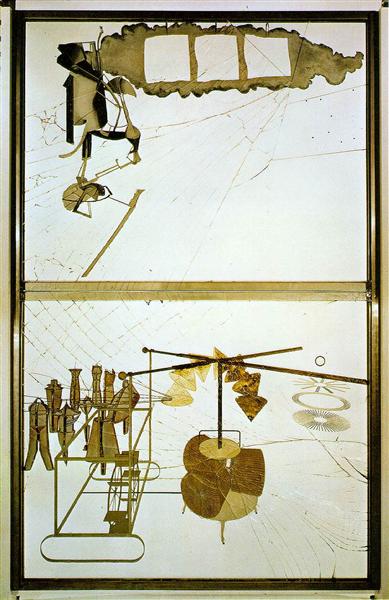
Duchamp's The Large Glass (1915-1923). Philadelphia Museum of Art.
In February 2024, Hidetaka Miyazaki told an interviewer there was "a small element" hidden within Elden Ring that no player had yet discovered. He said the discovery was "up to user interpretation," which rules out a hidden area or mechanic; data miners would have found those inside a week. He said it was "a question of when and not if," which rules out trivia. Whatever it was had to be important enough to warrant his personal attention and obvious enough that the discoverer, and the thirty-million-plus other people who owned a copy of the game, would recognize the find when it happened.
This is that.
What follows is the argument in the order it wants to be read. I begin with the philosophical framework that makes the discovery possible, because without it the secret cannot be recognized as a secret. Then The Large Glass and the preliminary works Duchamp spent a decade building up to it. Then a section on the readymades, which are the methodological template for everything that comes after. Then Elden Ring, then the personal story of how I came to find it, and then the correspondences themselves, followed by the deeper systems the game turns out to be built on.
Any single correspondence can be dismissed as pattern-matching. It is the weight of them, and the precision, that carries the case.
On Pataphysics#
A word first on what kind of secret this is.
In ordinary usage, physics describes the general laws of the natural world: gravity, force, thermodynamics, the things the world must do in every case. Metaphysics, one remove further out, describes what lies behind or beyond the physical: questions of being, cause, identity, whether a table is still a table when it is broken. Both disciplines assume that the object of their study is governed by stable, discoverable laws that apply to every instance.
Pataphysics is a third remove. The prefix pata- comes from the Greek epi ta meta ta physika: "that which lies upon and beyond metaphysics." Where physics asks for the general laws and metaphysics asks what grounds them, pataphysics asks what happens to the exceptions. To the singular cases the general laws cannot accommodate. To the anomalies, the epiphenomena, the irregularities that any honest account of the world has to leave unexplained. Pataphysics is the study of those anomalies, treated not as errors to be corrected but as windows onto the parallel worlds in which each exception would be the rule.
The term was coined by the French writer and playwright Alfred Jarry, who died in 1907. Jarry defined pataphysics as "the science of imaginary solutions" and "the science of the laws governing exceptions." A pataphysician treats imaginary systems as though they were real, works out their internal logic with the same rigor one would apply to a real system, and takes the consequences of that treatment seriously. The ur-symbol Jarry chose for the discipline was the spiral: a figure that is always returning to itself without ever closing, always one step further along even as it appears to repeat.
Marcel Duchamp was devoted to Jarry and to pataphysics. He subtitled The Large Glass "a Delay in Glass," and in his notes he insisted that the work belonged to the category delay rather than to the category painting. The distinction matters. Duchamp was not suggesting a modest genre refinement. He was claiming The Large Glass was not a depiction of something at all, in the way a painting depicts a bowl of fruit or a landscape. It was, he said, the preserved trace of an imaginary machine's operation: the arrested instant of a process that does not happen under our physics but would happen under a set of physics only slightly adjacent to ours, and whose mechanics, under those adjacent physics, can be worked out with the precision of an engineering diagram.
To support this claim, Duchamp paired the glass itself with a companion document: a collection of 178 handwritten notes, scraps, and sketches that he published during his lifetime in a cardboard container called the Green Box, after the color of its cover. Another 100 notes were found and published posthumously as the White Box. The notes are not supplementary material. They are, Duchamp insisted, the technical specifications for the machine that The Large Glass depicts, and the glass itself is only the mid-cycle snapshot of that machine in operation. Together the Green Box and the glass form a single work whose meaning cannot be extracted from either half alone. That is what "delay" means in Duchamp's vocabulary. The machine's operation is a four-dimensional process — a process with a time-axis — and the glass is the amber it is suspended in. A fly caught in amber is not a drawing of a fly, and it is not a fly either; it is the fly's motion arrested at an instant, with all the fly's own physics still legible in the pose. The glass is the same kind of artifact for a machine whose physics belong to an adjacent world.

Three Standard Stoppages (1913-14). Duchamp dropped three one-meter strings from a one-meter height and preserved the curves they made, treating the result as three alternative, chance-generated rulers.
Duchamp had a talent for this kind of arrested gesture. A few years before beginning The Large Glass, he made a series of works called the Three Standard Stoppages, whose name came from a French sewing term for invisibly mending a tear in fabric, and which preserved the random curves made by one-meter strings dropped from a one-meter height. We will return to the Stoppages when we come to Duchamp's preliminary works. The principle is already the principle of the glass: take an event that should not survive its own happening, and preserve it with the rigor of a physical measurement.
I came to pataphysics through the writer Mónica Belevan, whose Substack is, incidentally, named The Bride Stripped. I had been studying FromSoftware games for an essay about the fifth wall, and I wrote to her because I had seen her gesture at the concept and wanted to understand it. She responded with an entire essay on pataphysics, and the essay's central move was to re-stage the physics/metaphysics/pataphysics progression as layers of theatrical awareness: the fourth wall, the fifth, and what lies beyond.
The fourth wall is the invisible boundary between actors and audience: the convention that lets actors perform what's called "public aloneness," as if they were unobserved. To "break the fourth wall" is to have a character look at the audience and acknowledge that the audience is there. This is standard theater vocabulary. Belevan's point was that the four-walled theater is only the ground floor of a taller building, and the staircase continues upward in the same physics → metaphysics → pataphysics pattern.
- The physics of the play is the audience's plain awareness that actors are performing public aloneness. This is ordinary watching.
- The metaphysics of the play is the audience's meta-awareness that the actors can see them back. This is what surfaces when the fourth wall breaks and the performance acknowledges its own being-watched.
- The pataphysics of the play is the audience's pata-awareness that many different interpretations of the same performance are simultaneously happening in the minds of the different people in the room. The play is not one work being differently understood; it is a cloud of parallel works, each one a slightly different performance taking place in the imagination of a different viewer, with the text and staging serving as the common armature that all of those parallel performances share.
A fifth wall, then, is not a new wall at a fifth cardinal direction. It is the recognition that the play was never happening in one room in the first place.
This is the framework the discovery requires. Elden Ring operates in that fifth-wall register throughout, and the things in it that players routinely file under "the lore is confusing" are the tell. Marika and Radagon are the same being. Godwyn is dead but his corpse is still killing things. The war that ended the world is also the war that is still being fought. These are neither writing failures nor trivial creative choices. They are the operating rules of a world in which the imaginary is treated as physically real and the contradictions of the imaginary are not errors to be resolved but evidence that the world is running on imaginary physics.
The deepest of those contradictions is that time itself is broken, and the breaking is the pretext for the whole game. When Marika shattered the Elden Ring, Radagon — who is the same being as Marika, hammer in the other hand — was trying to repair it at the same instant. The shattering and the mending are a single event that could not resolve, and the casualty of the unresolved event is time. Time in the Lands Between does not run in the background the way it runs for us. It is not a river moving at an independent rate while actors take their turns in it. It is a thing that has to be made to happen to a person, deliberately, or it does not happen at all. The people in the Lands Between are trapped in an unwhen: not frozen, because they still act, but suspended in a condition where nothing accumulates into forward motion, where every action has to purchase its own step of time and often fails. This is why Marika and Radagon can be the same being without the logical short-circuit destroying the world: the world's time is already destroyed. This is why the demigods can be simultaneously in the middle of a war that has already ended: the war is neither over nor ongoing, it is unwhen. And it is why players and characters from different places and different epochs can meet and fight and cooperate inside the same world without any of the usual machinery of time-travel fiction. It is not a loop; it is not an ouroboros eating its own tail; it is simply the absence of a working clock. Fixing time is the pursuit the game does not name but is structured entirely around.
You cannot read Elden Ring with the tools you bring to a conventional narrative, any more than you can read The Large Glass with the tools you bring to a conventional painting, because both works have stepped outside the frame in which conventional reading makes sense.
This is also why the final secret took two years to find, and why it was always going to take the shape it took. A pataphysical secret cannot be data-mined, cannot be unlocked by code analysis or speedrunning or sequence-breaking, because it is not in the code at all. It is in the framework the player brings to the game. It can only be discovered by someone willing to treat Elden Ring as a pataphysical object, which is to say, as a work of art.
Understanding The Large Glass#
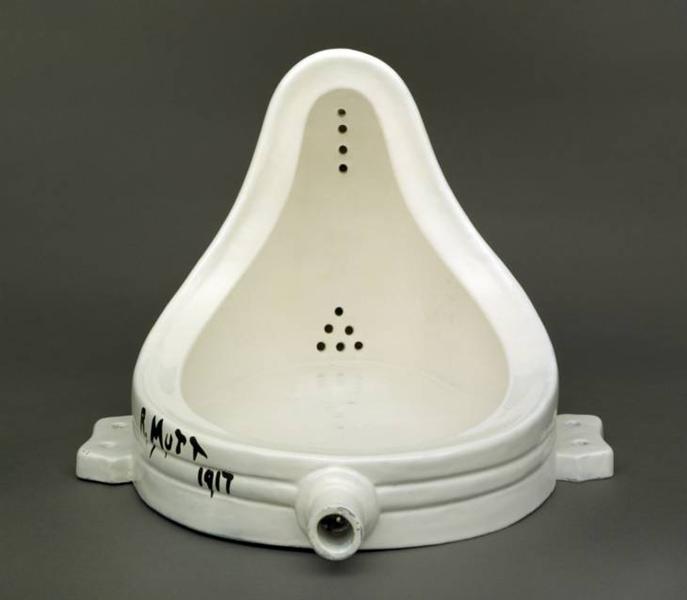
Fountain (1917), signed R. Mutt. The work that made Duchamp famous to the public, and the work that misrepresents him most completely. The readymades section below explains why.
Marcel Duchamp. Perhaps best known as "yes, the urinal guy."
Most people know Duchamp as the man who put a urinal in a gallery and called it art. That is the least interesting thing about him, and as we will see when we get to the readymades, it may not even be true in the way it has been reported for the last century. What matters here is the work Duchamp spent twenty years of his life building: a nine-foot-tall, six-foot-wide glass tableau titled The Bride Stripped Bare by Her Bachelors, Even.
A note, before we begin, on the subject matter. The work you are about to be introduced to is frankly sexual in its underlying content. Duchamp's notes describe a process of frustrated desire between two zones, one male and one female, with diagrams and vocabulary that do not shy away from bodily specificity. The title itself, The Bride Stripped Bare by Her Bachelors, Even, is only the politest framing of what is underneath. I will do my best throughout this document to treat the material with the courtesy Duchamp did not always extend to it, and to use the clinical vocabulary of his own notes where the alternative would be coy. If I quote Duchamp or his scholars on a particular mechanism using language that reads as startling, the reason is that the work is startling, and no honest treatment can soften it without losing what makes it what it is.
The twenty years did not start from an empty canvas. In the decade before Duchamp began work on the glass itself, he built the piece's components as standalone works, each one a study for a mechanism that would later appear in the final assembly. The order is chronological and the movement is cumulative: early figure studies give way to mechanical ones, mechanical ones give way to chance operations, and each piece is itself part of the case that Elden Ring is the finished machine.
Duchamp's Preliminary Works#
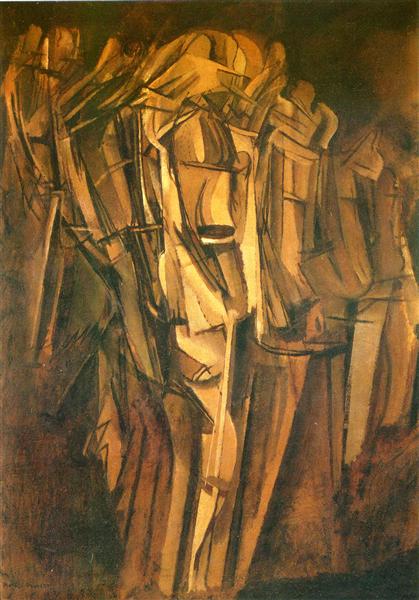
Sad Young Man on a Train (1911). A chronophotographic self-portrait: one figure rendered at several overlapping positions, present in motion but unable to resolve into a single pose.
Sad Young Man on a Train (1911). A fractured, cubist self-portrait of a figure in motion, arms close, body immobilized by the train's frame even as the train propels him forward. This is the first appearance of the Malic Mould: the stripped-identity Bachelor, going nowhere despite all the motion.
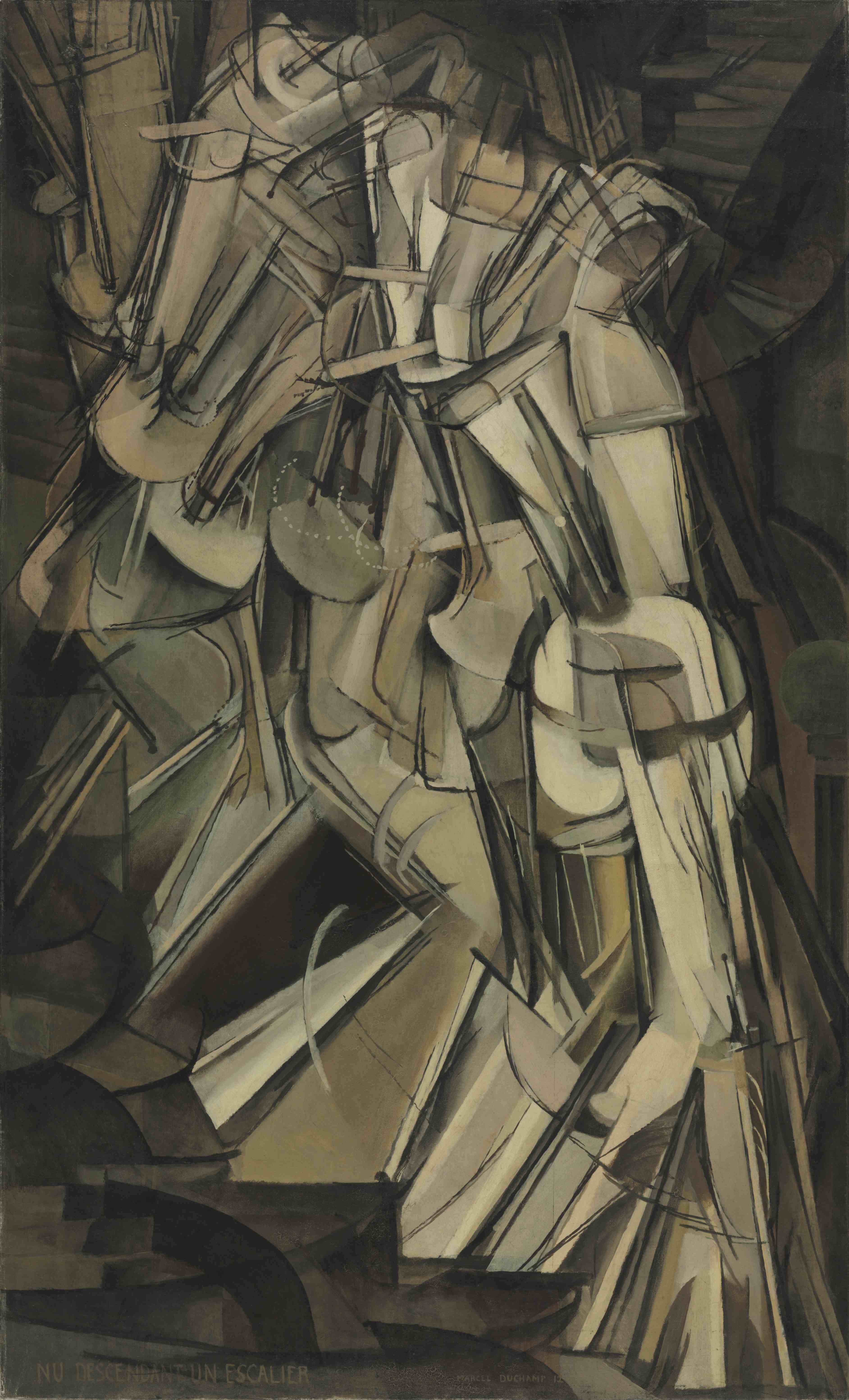
Nude Descending a Staircase, No. 2 (1912). The four-dimensional figure rendered as a composite of its three-dimensional shadows at successive instants.
Nude Descending a Staircase, No. 2 (1912). Duchamp submitted this work to the Salon des Indépendants in Paris in 1912, where the cubist hanging committee (his own brothers among them) rejected it for being "too futurist" and asked him to change the title, which he refused to do. He withdrew the painting in silence and showed it the following year at the Armory Show in New York, where it became the scandal of the exhibition. Critics called it "an explosion in a shingle factory." Visitors queued to see it. The scandal made Duchamp briefly famous in America and, by his own account, also convinced him that painting as an audience-pleasing enterprise was a trap he wanted no further part of. What the painting actually shows is the Bride: a figure rendered in multiple simultaneous positions across several dimensions at once, the three-dimensional composite of a four-dimensional body in motion. The scandal was that the painting did what Duchamp said it did. It showed a being who cannot be seen all at once.
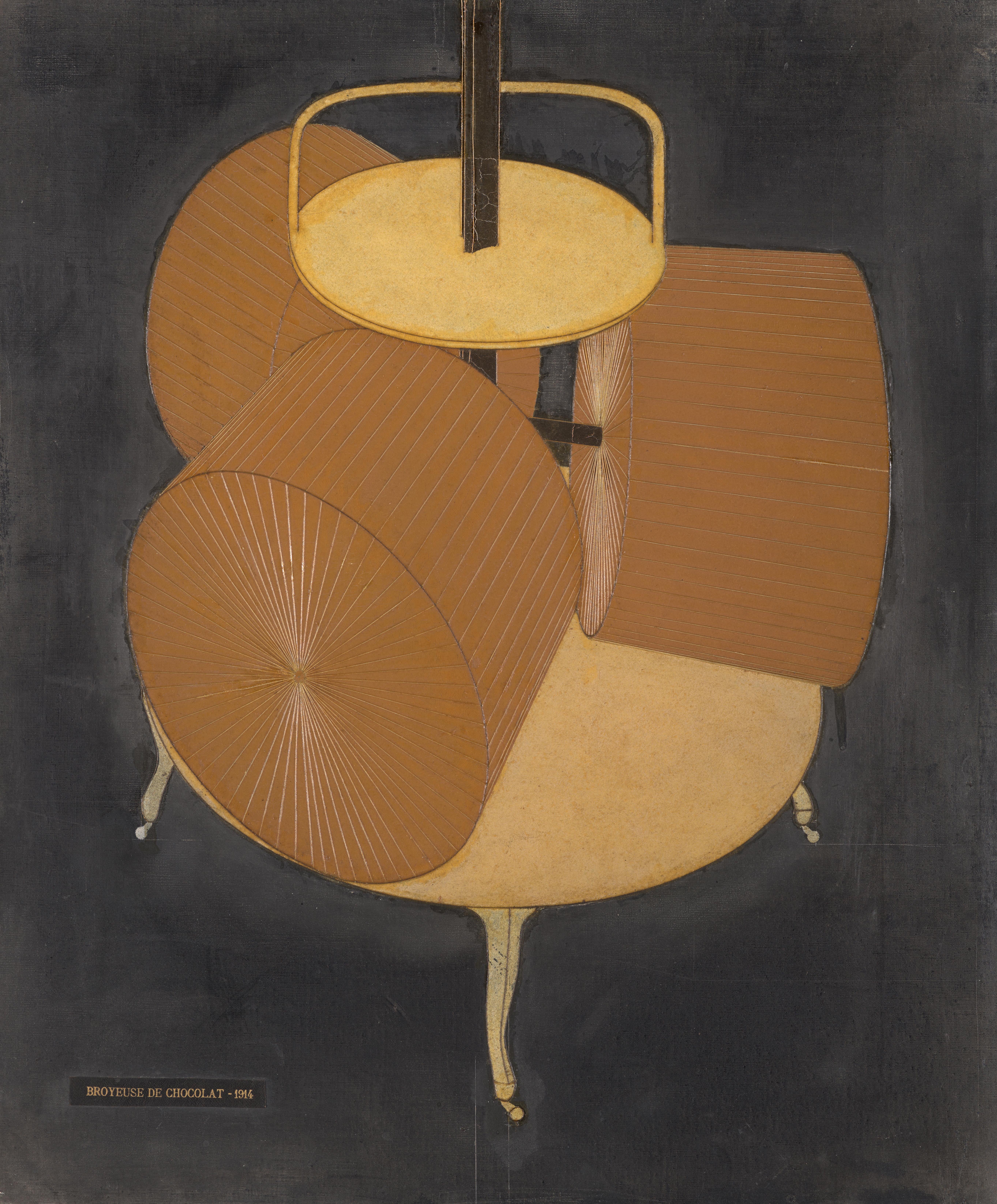
Chocolate Grinder, No. 2 (1914). Three cylindrical rollers mounted on a four-legged Louis XV chassis. Duchamp saw the original machine in a Rouen chocolate shop window and painted it twice as a standalone work before installing it as the central mechanism of the Bachelor's Apparatus.
Chocolate Grinder, No. 1 and No. 2 (1913, 1914). Duchamp became fascinated by a chocolate grinder he saw in a Rouen shop window. He painted it as a standalone study twice. The motion is circular, repetitive, and fruitless: the rollers turn in their cradle and produce nothing except more ground chocolate. In The Large Glass this becomes the central mechanism of the Bachelors' Apparatus, and in Elden Ring it becomes the Elden Ring itself.
Look at the Elden Ring symbol on the cover of the game. It is the Chocolate Grinder viewed from above: three circles overlapping, anchored top and bottom by cross-shapes that correspond to the Louis XV Chassis (the four-legged table the rollers rest on) and the Necktie (the disc that caps them). Godrick's Great Rune shows this most cleanly. Look closely and you can see three overlapping cylinders intersecting at their central axis. That is a top-down projection of the Chocolate Grinder, rendered as a single piece of jewelry.
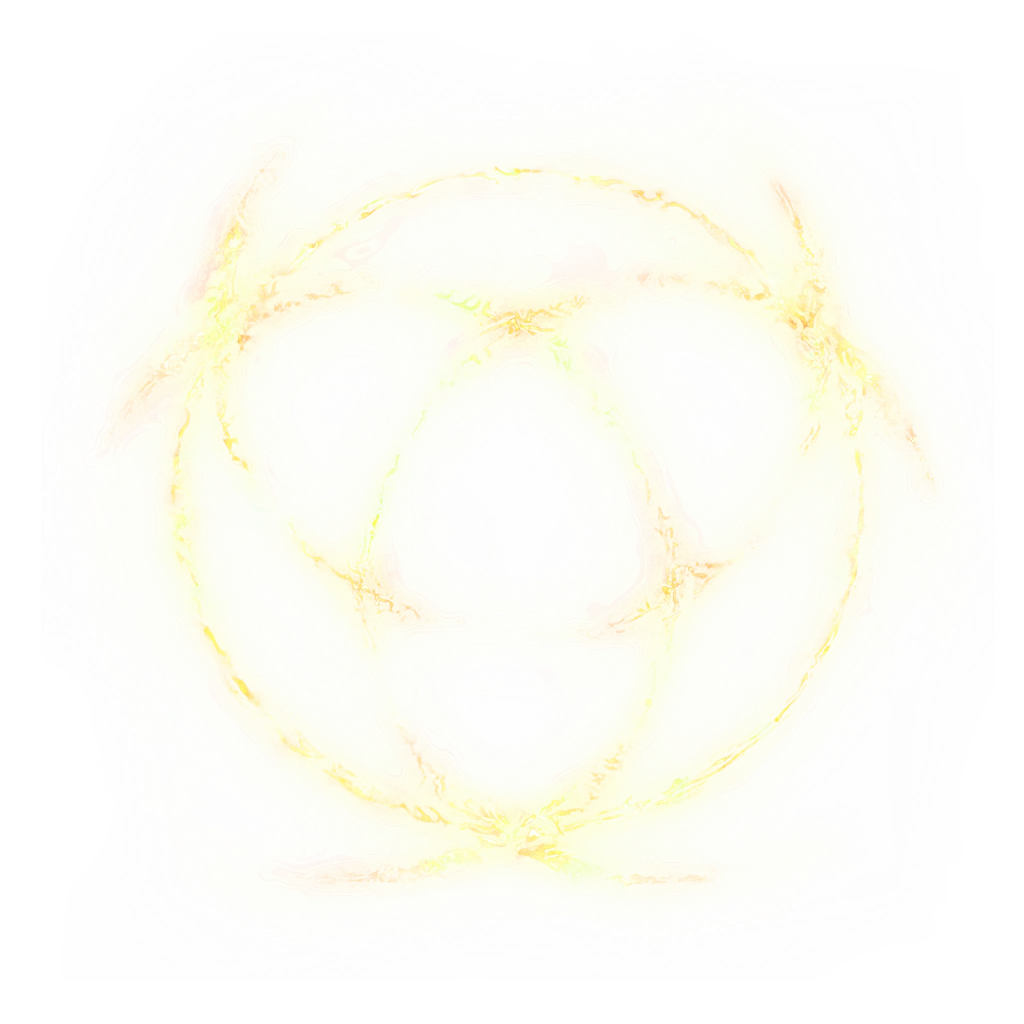
Godrick's Great Rune. Three cylinders overlapping at the central axis, anchored top and bottom. Compare with Chocolate Grinder, No. 2 above.
The same visual logic governs the rest of the Great Runes. The Elden Ring in Marika's world was a single artifact until the Shattering broke it, after which the fragments were distributed to her demigod children. Each fragment retained a piece of the original's mechanism. Each surviving Great Rune corresponds to a named part of the Chocolate Grinder:
- Radahn's, Malenia's, and Rykard's Great Runes: the three rollers of the grinder.
- Godrick's and Morgott's Great Runes: the anchor runes, explicitly named as such in the game's lore, that hold the structure together from top and bottom. Godrick's is the Louis XV Chassis. Morgott's is the Necktie.
- Miquella's Great Rune: shaped as a cross and semicircle that does not overlay cleanly onto the other five. It corresponds to the Scissors and Sieves, which sit beside the Chocolate Grinder in The Large Glass rather than forming part of its core cylinder.
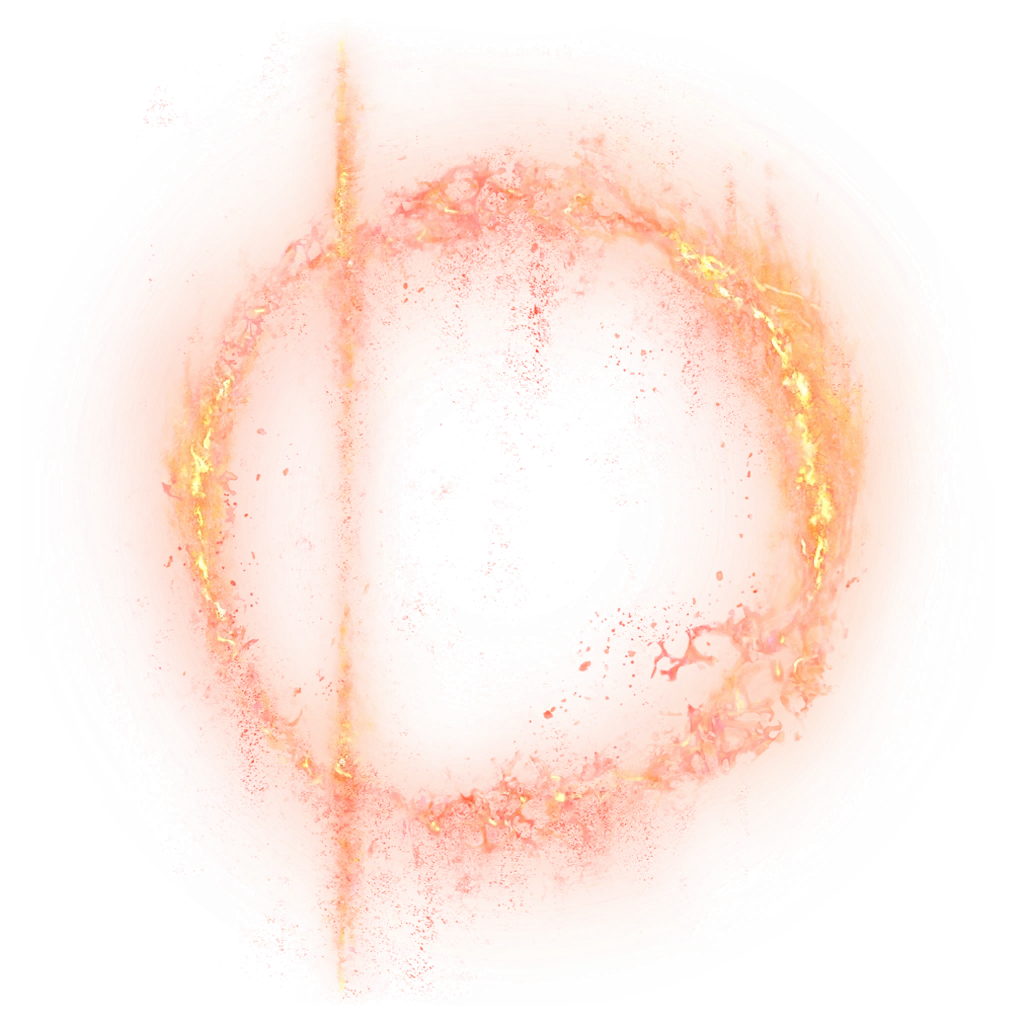
Radahn — roller
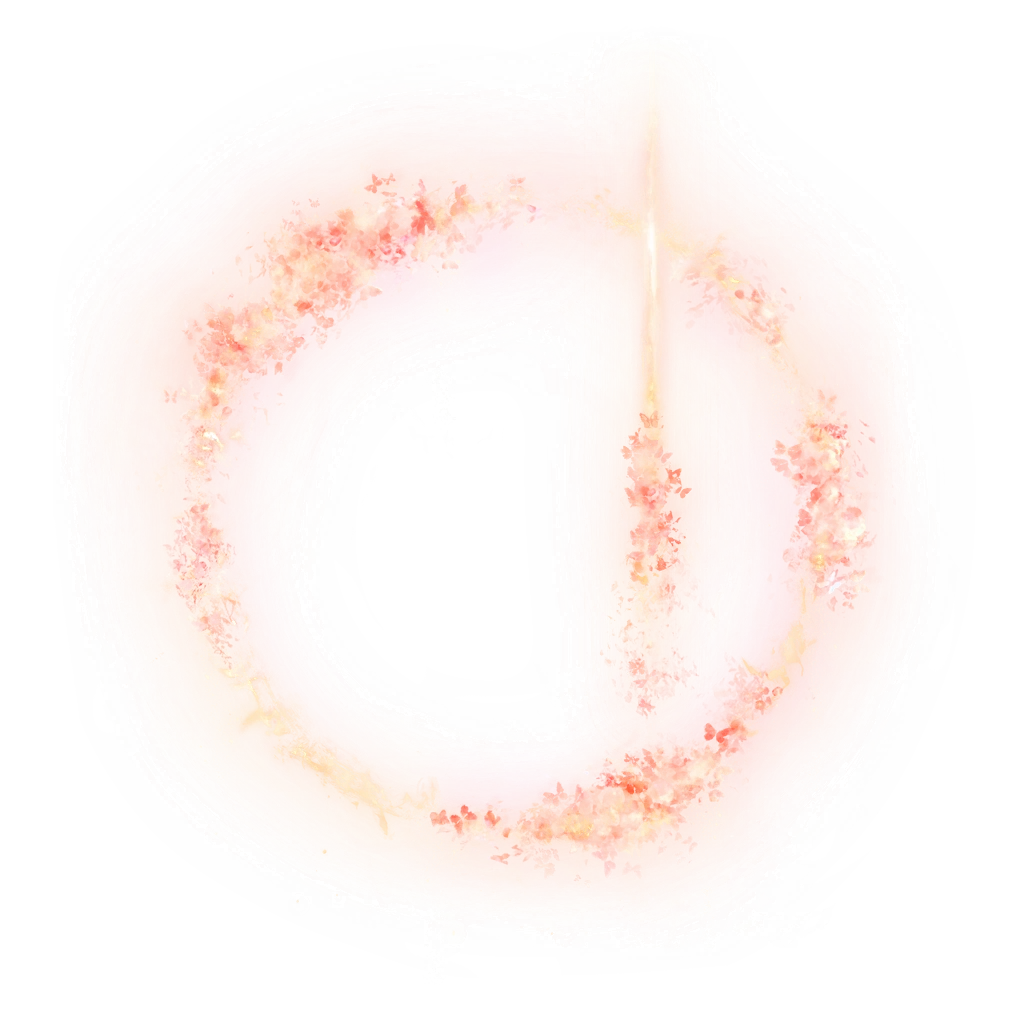
Malenia — roller
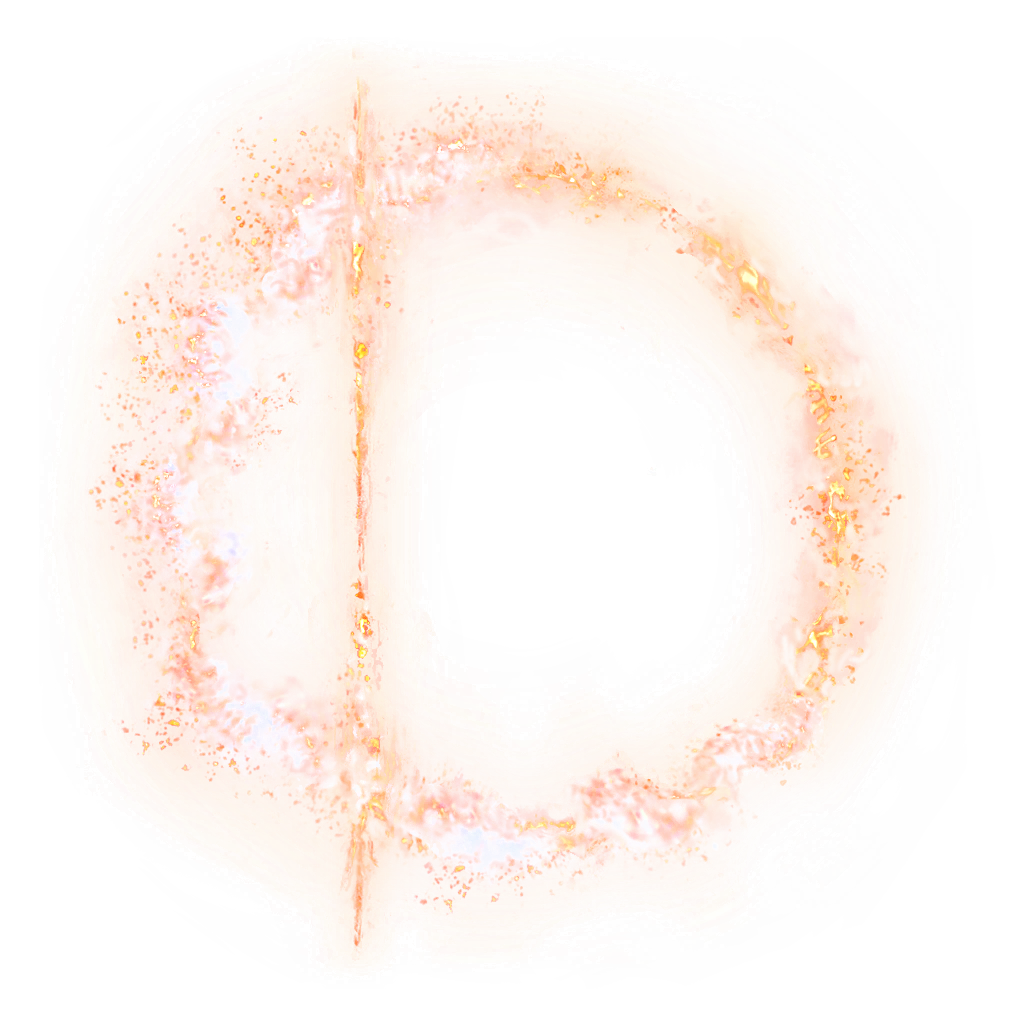
Rykard — roller
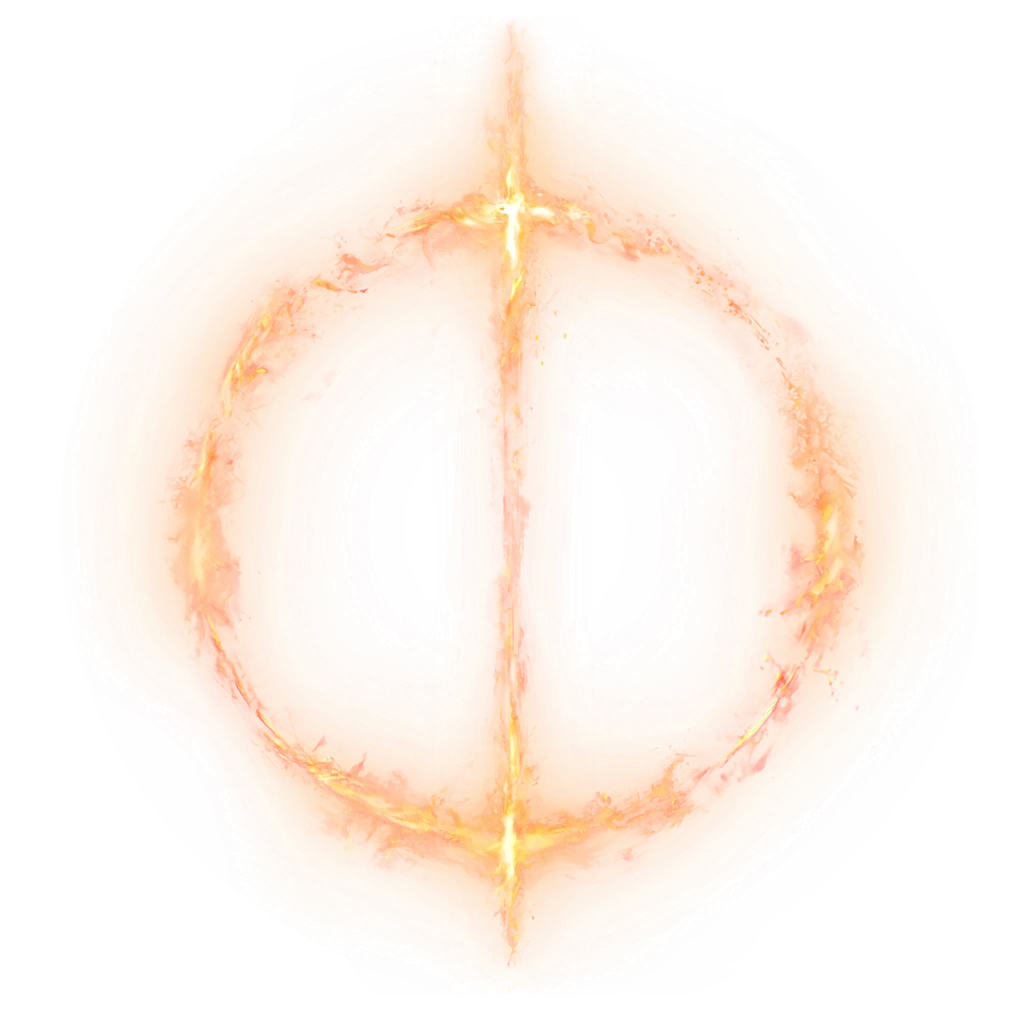
Morgott — Necktie (anchor)
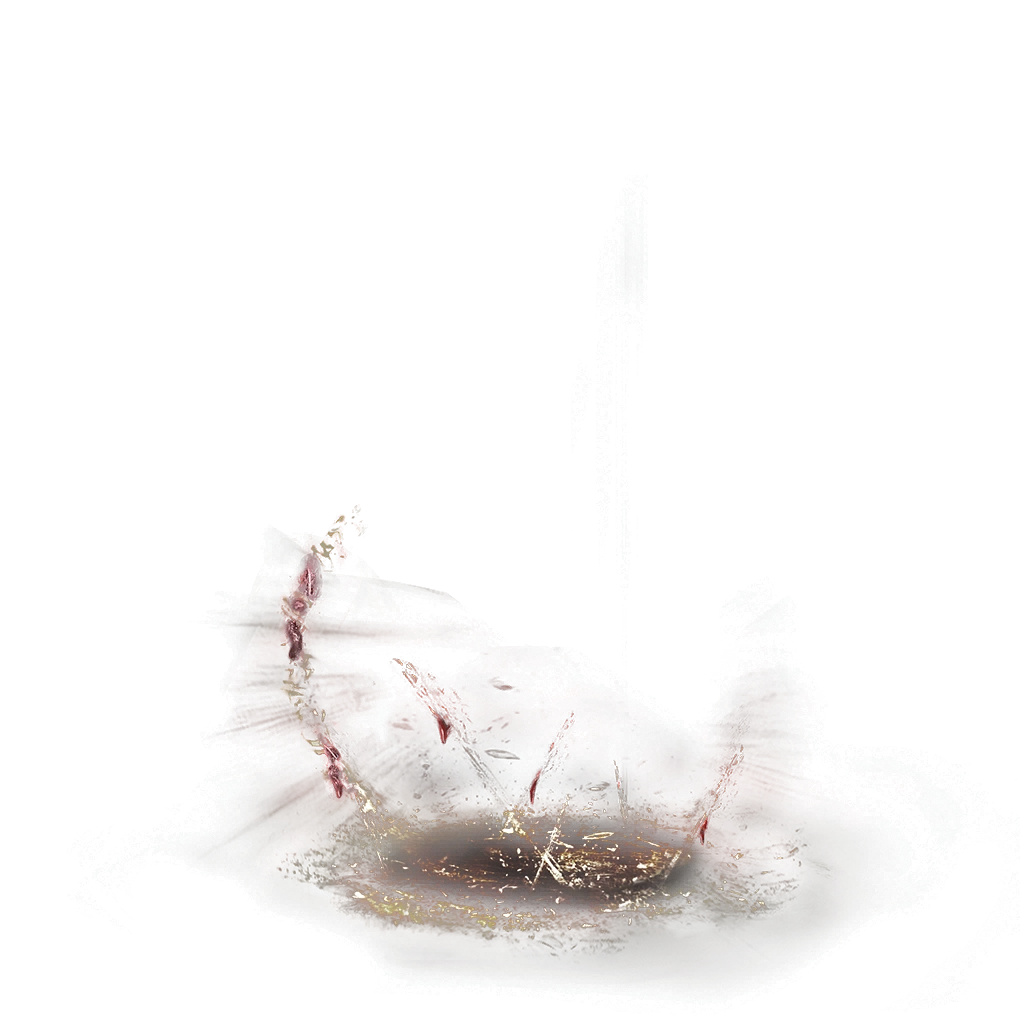
Miquella — scissors & sieves
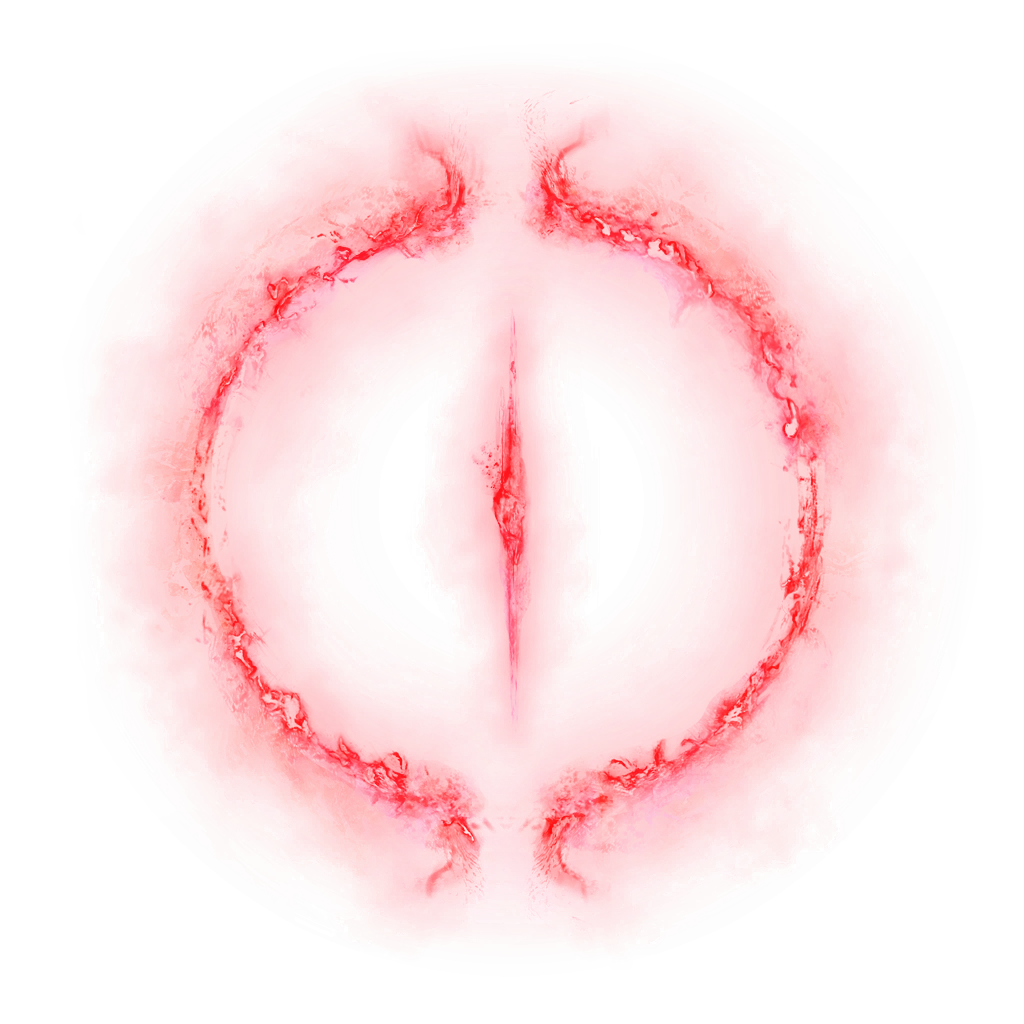
Mohg — unmapped
Two Great Runes do not fit the core mechanism cleanly. Mohg's Great Rune (Mohg is Morgott's twin brother, cursed with the blood of the Omen) and Rennala's Great Rune of the Unborn (Rennala is Radagon's former wife, whose rune governs respawning rather than the politics of the Shattering) stand slightly outside the main identification. I classify them the same way Duchamp classifies the Butterfly Pump and the Boxing Match in his own notes: as components that exist in the framework but resist the clean one-to-one mapping the rest of the runes allow. For the purposes of this document I am listing them here for completeness, and setting them aside.
The three Mending Runes carry the correspondence into a different part of Duchamp's apparatus. Recall that the three Mending Runes are forged by three named Tarnished (Goldmask, the Dung Eater, and Fia), each of whom has stepped outside the normal Tarnished-becomes-Elden-Lord cycle to produce a rune that changes the terms of the repair rather than simply enabling it. These three Tarnished are the Three Nets of The Large Glass. Each Net, in Duchamp's scheme, captures and processes information from the Bachelors and feeds transformed data to the Bride. Each Mending Rune does the same thing in the game's vocabulary: it takes lived experience (the philosophical commitment of the Tarnished who forged it) and transforms it into a structural modification to the Elden Ring when it is placed inside the reassembled Ring at the foot of the Erdtree. The Nets are where the Bachelor machine receives a message back from its lower half, and the Mending Runes are where the Elden Ring receives one.
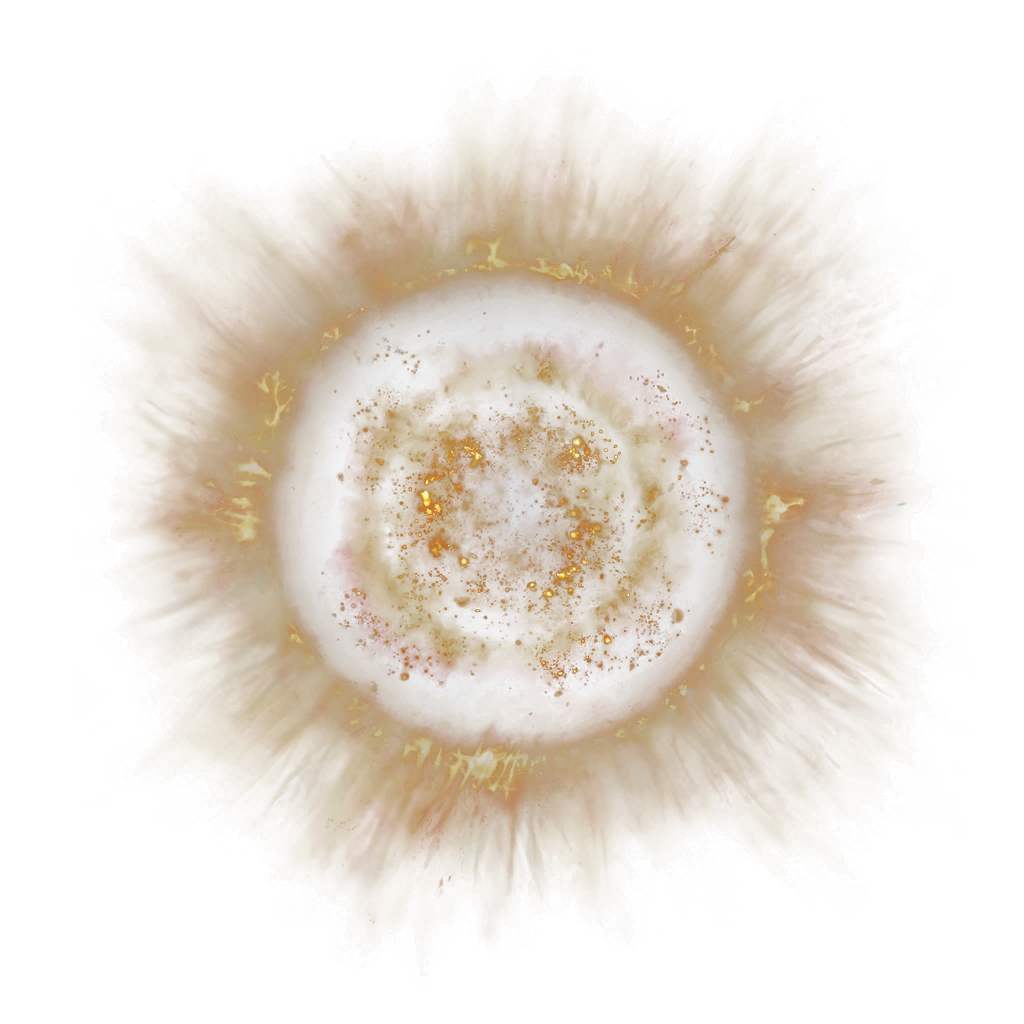
Goldmask — Mending Rune of Perfect Order
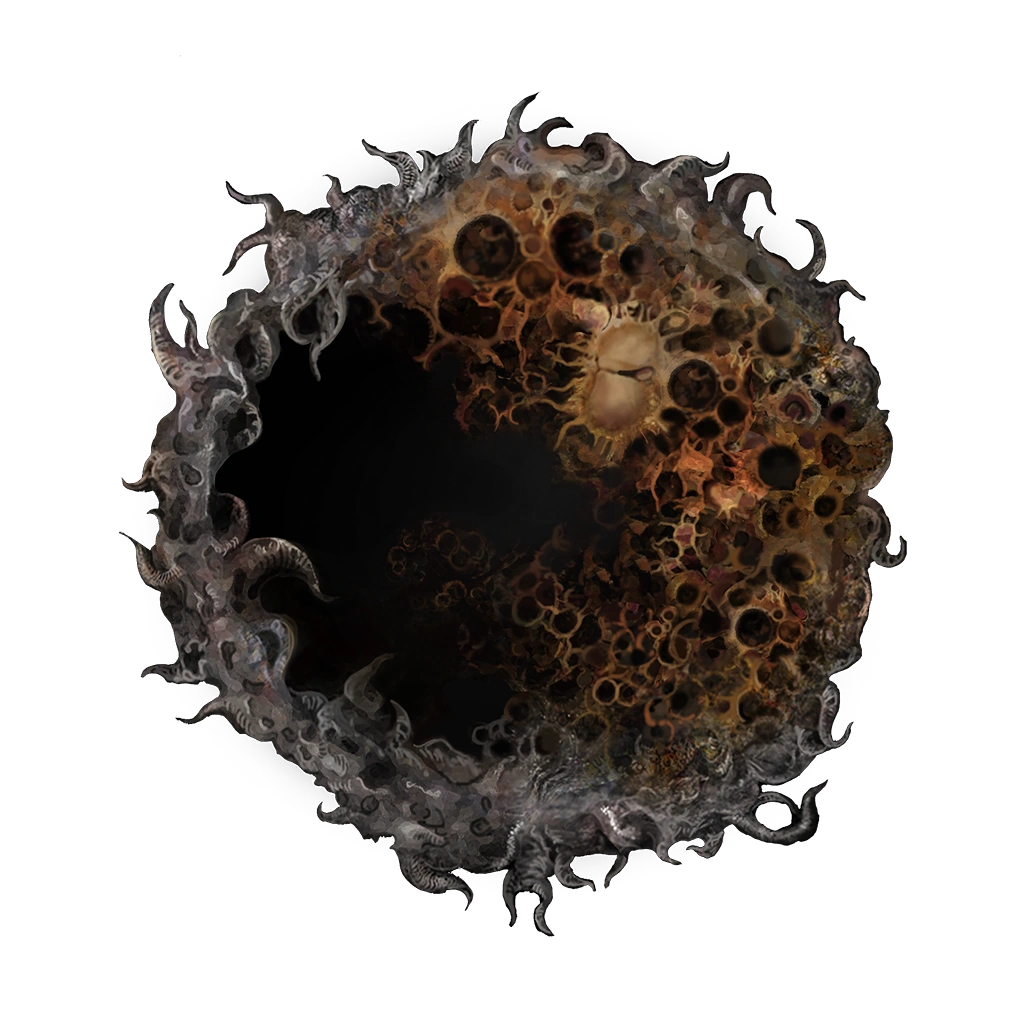
Dung Eater — Mending Rune of the Fell Curse
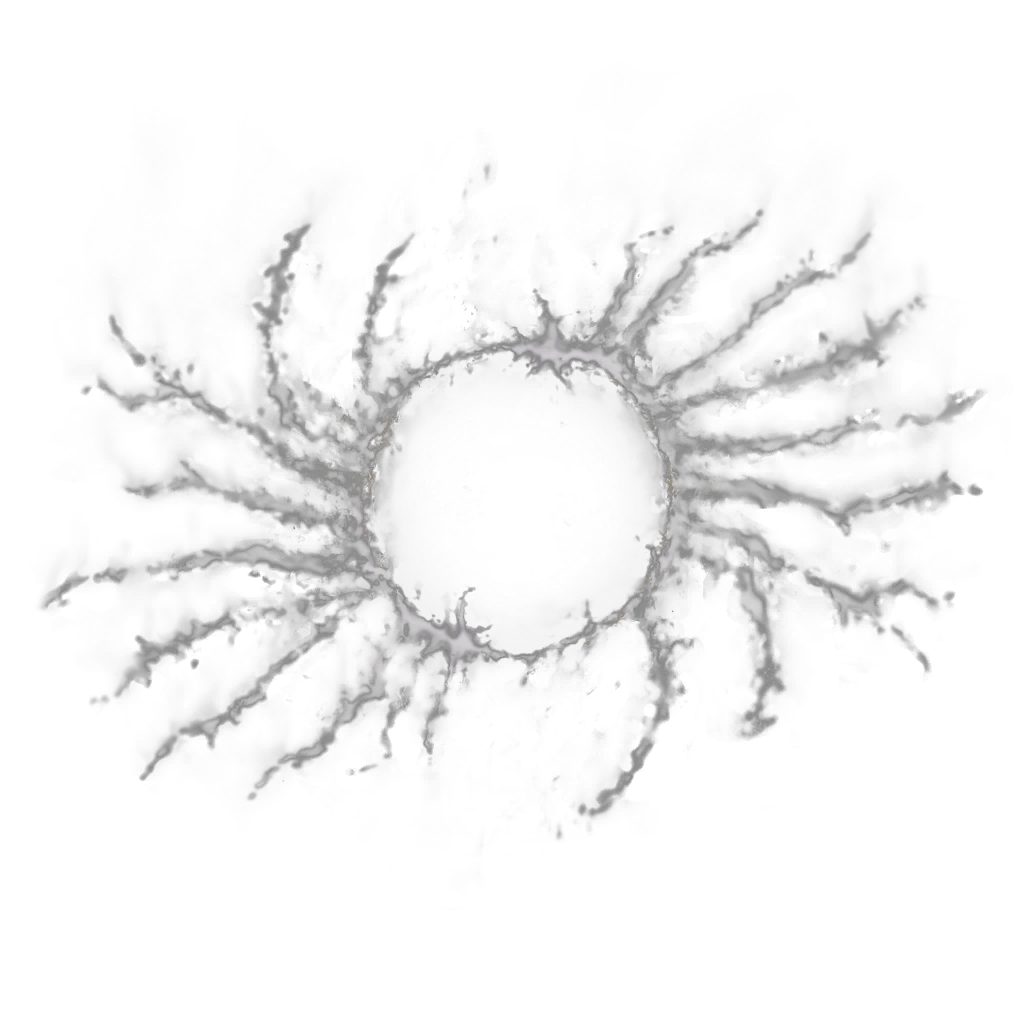
Fia — Mending Rune of the Death Prince
Note the mechanism the game describes for the player's endgame. After slaying the demigods, the Tarnished collects their Great Runes and carries them, along with one of the three Mending Runes, to the foot of the Erdtree. There, the runes are reassembled into the Elden Ring, which the new Elden Lord then repairs with the chosen Mending Rune's addition. This is the game saying out loud what the thesis of this document is arguing: the Great Runes are pieces of a broken machine, and reassembling them is the literal goal of the game. The machine they reassemble into is the Chocolate Grinder.
This is not ornamentation. It is the central identification of the entire thesis, and the visual correspondence is exact enough that once you see it, you will not be able to unsee it. The Elden Ring is the Chocolate Grinder. The full unpacking arrives in the correspondences section below.
Three Standard Stoppages (1913). You have already met the Stoppages in the pataphysics section above. To recap briefly: Duchamp dropped three one-meter strings from a height of one meter onto prepared canvas and preserved the random curves they made, calling the result "canned chance." The French word stoppage refers to the method of invisible mending used to repair tears in fabric so that the tear can no longer be seen. Stoppage is mending. Duchamp preserved three stoppages. In Elden Ring, three Tarnished can create three Mending Runes.
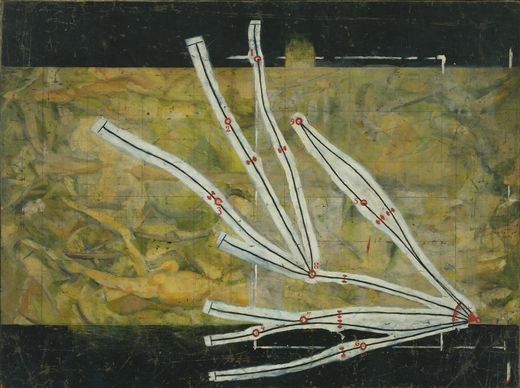
Network of Stoppages (1914). A map of chance-preserved curves laid across an earlier painting. These curves will become the Capillary Tubes of The Large Glass.
Network of Stoppages (1914). An expansion of the Three Standard Stoppages project: a map of chance-preserved curves laid across a painting. The curves that would eventually become the Capillary Tubes of The Large Glass are derived from the templates of the stoppages.
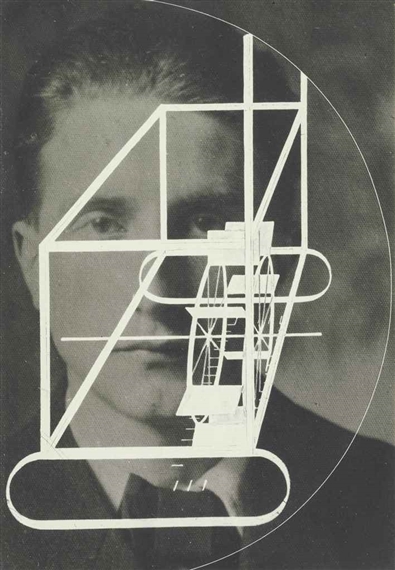
Glider Containing a Water Mill in Neighboring Metals (1913-15). A preliminary study, on glass, of the mechanism that would power the Bachelor's Apparatus.
The Water Mill Within Glider (1913-15). A preliminary sketch, made on a glass panel, of the powering mechanism for the Bachelor's Apparatus. A literal study for The Large Glass, and a rehearsal of the glass-as-substrate technique Duchamp would use for the main work.
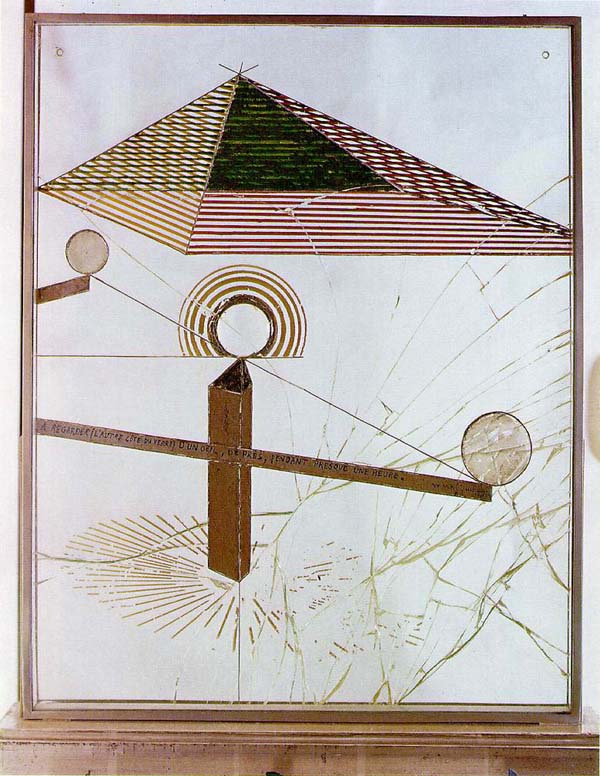
To Be Looked at (from the Other Side of the Glass) with One Eye, Close to, for Almost an Hour (1918). The title is the instruction. See it in action on YouTube.
To Be Looked at (from the Other Side of the Glass) with One Eye, Close to, for Almost an Hour (1918). The title is the instruction. The viewer must stand in a specific physical position, close one eye, and sustain attention for an hour. The piece cannot be glanced at. It demands to be pondered. These are the Occult Witnesses: the viewer becomes a witness only by the act of prolonged, deliberate looking.
Each of these pieces is a component of the machine Duchamp was building. Beginning in 1915, he set about assembling them into the final work itself.
The Glass Itself#
The Bride Stripped Bare by Her Bachelors, Even is not self-contained, as we saw in the pataphysics section. The glass and the Green Box form a single work, and anyone who tries to read the tableau without the notes (or, for that matter, the notes without the tableau) is missing half of what is in front of them. Duchamp was explicit on this point. "Only an initiate," he wrote, "could understand The Large Glass." He meant that. This is not a piece you look at and appreciate. This is a piece you read, and then contemplate, and then look at again from the other side of the glass, as it were, considering the frozen apparatus on its own terms as a mechanism suspended between two panes for the duration of its inspection.
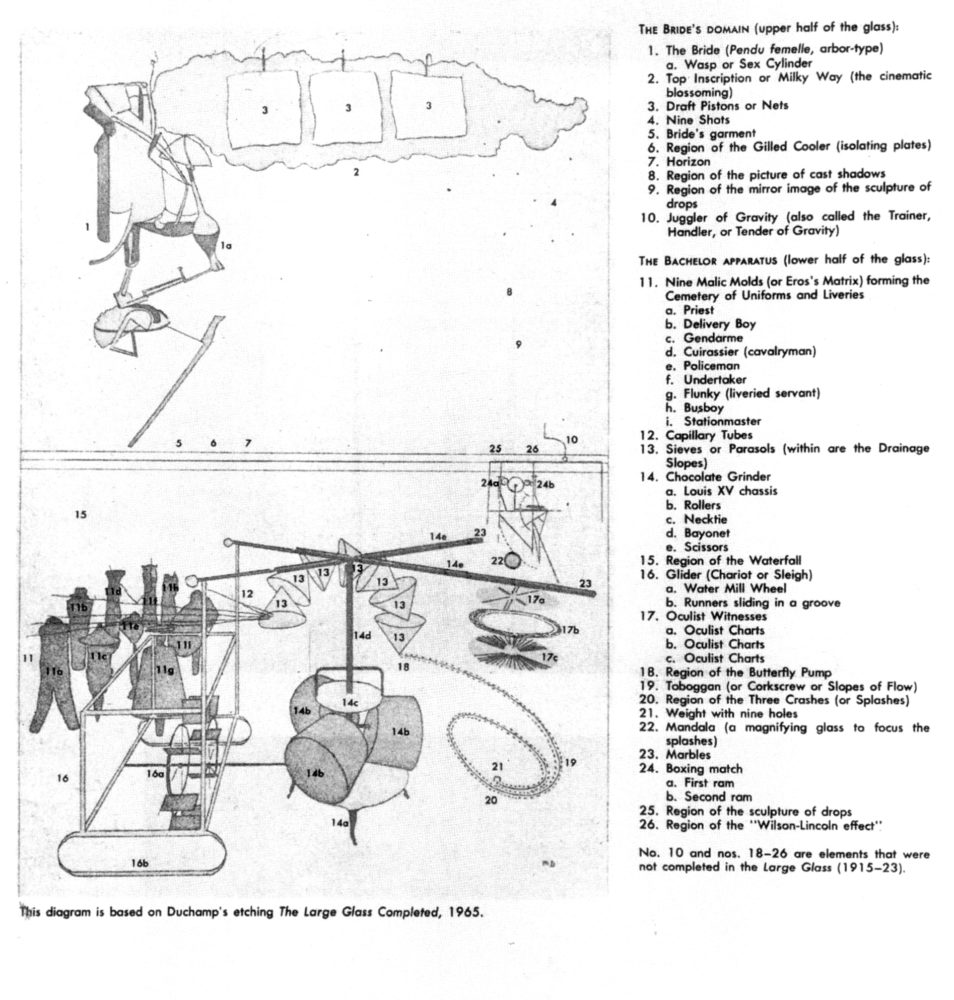
The tableau is divided into two halves, each populated by named mechanisms whose interactions Duchamp spelled out in granular detail. Superscript numbers correspond to the callouts in the diagram above. Items marked "undepicted" are absent from the physical glass (Duchamp planned but never painted them), but they are present in the diagram above because the diagram is reconstructed from the Green Box notes, which document the full planned apparatus including the unfinished portions.
Upper Half: Domain of the Bride
The Bride [1] (Pendu femelle, arbor-type): crucified on an apparatus
Top Inscription or Milky Way [2]: flesh-colored, the "skin, or mortal remains, of the Bride"
Draft Pistons or Nets [3]: three targets cut into the Milky Way
The Nine Shots [4]: matchsticks fired from a toy cannon at the glass. None land in the Nets.
Juggler of Gravity [10]: the small curved line above the Occult Witnesses, visible on the glass but intended for much fuller integration into the planned additions that were never completed after the 1926 breakage
Undepicted: unintelligible messages from the Bride to the Bachelors
Lower Half: Bachelor's Apparatus
The Malic Moulds [11a-i]: nine sets of clothing, an infinite "cemetery of uniforms and liveries"
Capillary Tubes [12]: strip the Bachelors of individual identity
Sieves [13]: unify the Bachelors in their desire to reach the Bride
Chocolate Grinder [14a,b]: three cylindrical rollers on the Louis XV Chassis, connected via [14c,d] to…
Scissors [14e]: can, by chance, interrupt the Bachelors' ascent
Water Mill [16a]: powers the entire apparatus with futile, endlessly cycling labor
Occult Witnesses [17a-c]: the Bachelors pass through these on their upward journey
Butterfly Pump [18]: part of the planned machinery, never fully drawn on the glass
Toboggan [19]: a descending spiral from the last of the Sieves, undepicted
Boxing Match [24a,b]: undepicted, "causes distance to collapse"
The Process#
The Bride "rains down Love Gasoline" on the Bachelors, animating them. Their essence passes through the Capillary Tubes, which strips them of their individual identities. They descend through the Sieves, which unifies them in their desire to reach the Bride. (In the words of Andrew Stafford's reference work Making Sense of Marcel Duchamp: "what began as an infinite variety of responses to the Bride has devolved into a uniform potential to squirt.") The homogenized Bachelors fire upward through the Occult Witnesses, pass between the Scissors (which can, by chance, interrupt their travel), through the Boxing Match (which "causes distance to collapse"), past the Juggler of Gravity (who acts in response to impulses from the Bride), and land at last in the Bride's Domain in an attempt to strike one of the three Nets.
None of the nine shots land within the Nets. The process is frustrated by design. The Bachelors, in Stafford's phrase, "grind their chocolate alone": a frank onanistic image which is, in case anyone reading this has decided to be coy about it, the whole point of the lower half of the glass. One shot, however, lands closer to the Nets than the other eight: the shot that got closest. Remember that detail. The Nine Shots are supposedly the traces left on the glass by matchsticks Duchamp fired from a toy cannon, a production story that I personally do not entirely believe (Duchamp was a compulsive liar about his own methods, and none of his production notes should be taken at face value), but the shot that got closest has a specific role later in this document, and the Tarnished named Vyke is the reason to keep track of it now.
Duchamp's framing terminology for this process is a Delay in Glass. The work does not depict a moment. It depicts a suspension, a process that IS postponement, that IS the failure to reach. An undead process: the Bachelors' desire continues, the machinery continues, the Bride remains unreachable, and the whole apparatus cycles through its states forever.
The Shattering#
One more fact about The Large Glass, and one that matters as much as anything else in this section. The glass panel was shattered in 1926 during transportation, or so the story goes. Duchamp reassembled the fragments years later, re-encased them in more glass, and declared the work "definitively unfinished." He said the symmetrical cracking pattern was a feature he had never planned but preferred to his original vision. The piece, after the break, became art about its own incompleteness, and the brokenness became part of the statement.
Editor's note: my own suspicion, for what it is worth, is that Duchamp broke The Large Glass intentionally. The symmetry of the cracks is suspicious. So is his response. So is his entire practice, which as you are about to see in the readymades section was built around concealed authorship and plausibly deniable authorial hand. A man who had spent the previous two decades hiding the fact that his found objects were not found is exactly the kind of man who would report as an accident a breakage whose aesthetic outcome he had already designed. The author is not necessarily committed to this reading. It is, I think, the only story that is consistent with everything else Duchamp ever did.
The Readymades and the Shape of the Joke#
Before continuing, a detour through the part of Duchamp's work most people have heard of.
In the 1910s and 1920s, Duchamp began submitting ordinary objects to art exhibitions as art. A bicycle wheel mounted upside-down on a stool. A bottle rack. A snow shovel, titled In Advance of the Broken Arm. A urinal, submitted under the pseudonym R. Mutt in 1917, titled Fountain. The standard version of the story is that Duchamp elevated these everyday objects into art by the act of declaration. The readymades became the foundational gesture of conceptual art, taught in every survey course, reproduced in every textbook, and given as the answer when anyone asks what Duchamp's contribution to art was.
The standard version is wrong.
Rhonda Roland Shearer, an art historian and one of the foremost Duchamp scholars in the world, published research beginning in the 1990s demonstrating that the readymades were not ready-made. The proportions of Fountain do not match any urinal manufactured by the J. L. Mott Iron Works, the supplier Duchamp claimed to have used. The bottle rack appears to have custom modifications. The perfume bottle Duchamp presented as Belle Haleine: Eau de Voilette came in a size that was not commercially available at the time, suggesting that Duchamp had the bottle made rather than finding one.
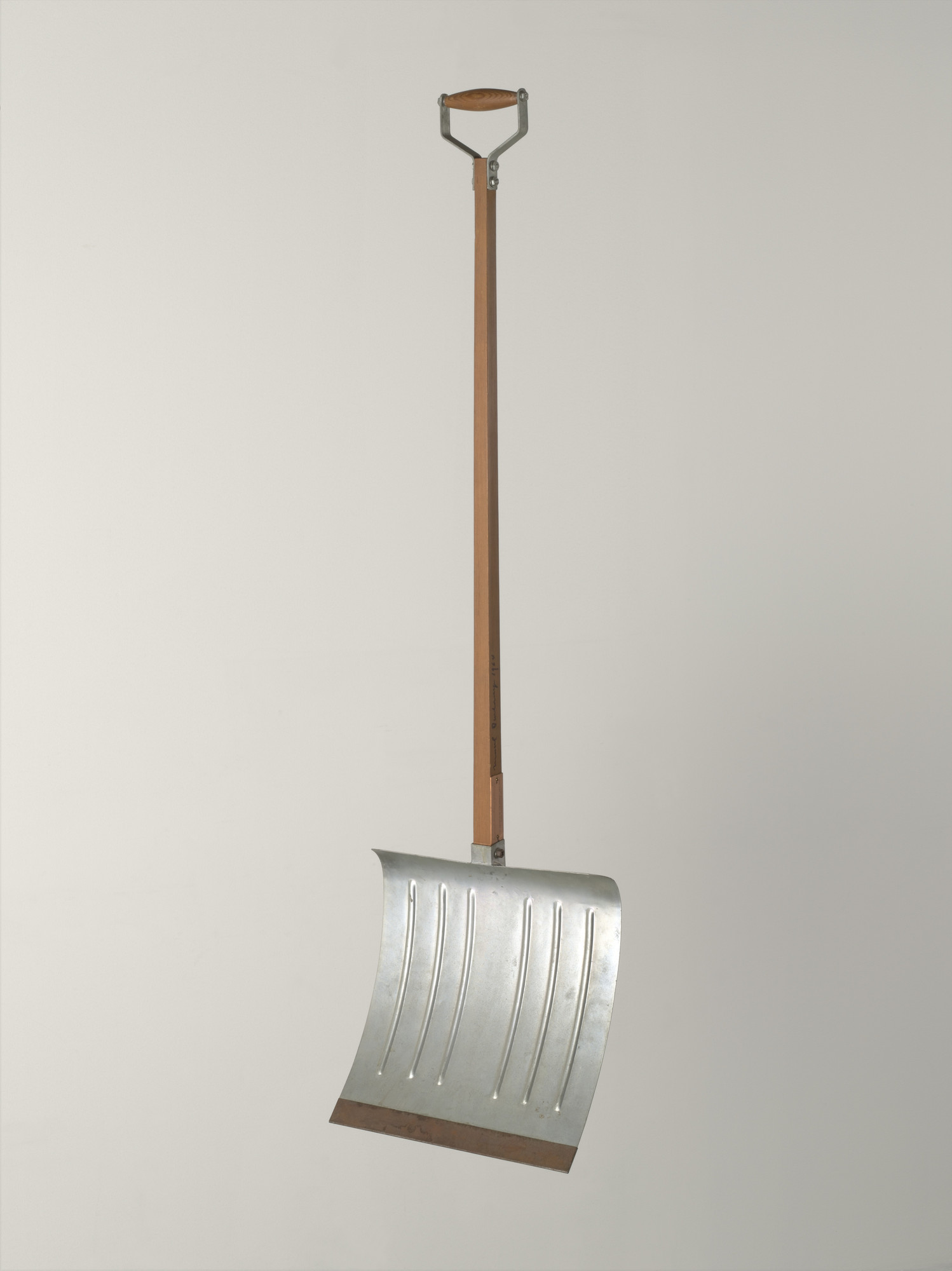
In Advance of the Broken Arm (1915, replica 1964), from the MoMA collection. Note the square-section handle visible in the cast shadow: no consumer snow shovel ever made was built that way, because it would hurt to hold.
And the snow shovel in In Advance of the Broken Arm has a handle with a square cross-section. Not a rounded one. A square one, which is an impossibility as a consumer product, because a square handle would be physically unpleasant to grip for more than about thirty seconds of actual shoveling. No manufacturer ever made a snow shovel that way. Duchamp's shovel was built to be presented as a snow shovel by someone who did not especially care whether the snow shovel functioned as one, and who was possibly also mocking the art world audience that would not notice: people who, on the whole, probably had not shoveled their own snow in a very long time and would not have recognized a non-functional shovel if one had been handed to them. The objects Duchamp presented as "found" were, in many cases, altered or fabricated by Duchamp himself, and a century of art history that took the readymades as ready-made was, strictly speaking, wrong about what the readymades were.
The readymades were fake readymades. Duchamp was making a joke that took eighty years to land.
Shearer's discovery matters for two reasons, and they are the same reason stated twice.
First: It is the methodological template for the discovery you are currently reading. Duchamp hid something in plain sight, and the art world did not see it, for two reasons: first, because the accepted narrative was easier than the looking, and second, because the accepted method of looking was not one that would yield to the secret. One had to disbelieve the story before one could see the object. In exactly the same way, Elden Ring hid something in plain sight, and players did not see it because the accepted framework of "video game lore" was easier than the looking, and because the accepted method of looking (data-mining, build optimization, speedrun analysis) was the wrong tool for the kind of secret that was actually in the game. Shearer's phrase for what the readymades turned out to be was "a century-long observational experiment." That is what Elden Ring is.
Second: It proves that Duchamp's entire practice was built around the idea of works whose real content would only be visible to the viewer who stopped trusting the accepted interpretation and started paying attention to the object itself. This was not a bug in the readymades. This was the point of them. Sometimes when you know what you are looking at, everything becomes clear.
Understanding Elden Ring#
For the uninitiated:
is a 2022 action role-playing game about ambition in a world that has already ended. It is the seventh and largest entry in a series of games by the Japanese studio FromSoftware, following Demon's Souls, the Dark Souls trilogy, Bloodborne, and Sekiro. Hidetaka Miyazaki, the studio's president, directed it. Elden Ring was a cultural event on release, has sold more than thirty million copies to date, and is by general consensus treated as the medium's most important contribution to date to the argument that video games can be art. (Whether or not they have succeeded in that argument is a separate question, and this document is in large part an answer to it.)
The story the game tells, as a player pieces it together from item descriptions and NPC dialogue and the architecture of the world itself, is this.
Thousands of years before the game begins, , God-Queen of the Lands Between and vessel for a cosmic entity called the Greater Will, conquered the world and established a new order centered on the worship of the Erdtree, a massive golden tree that dominates the landscape. She animated her warriors with a force called Grace, which turned their eyes gold and gave them the strength to fight in her name. After the wars were won, Marika stripped her warriors of Grace, sent them off to die in foreign lands, and promised that one day they would be called back.
Then Marika shattered the Elden Ring.
The Elden Ring was the construct that bound together the physical and metaphysical laws of the world: souls, fate, the cycle of life and death. Without it, everything fell apart. Marika's consort tried to repair the Ring at the same moment Marika was destroying it. The result is a world in both states at once, destruction and repair, neither condition able to finish resolving into the other. (Editor: perhaps intentionally, on the part of both parties.)
Ring a bell?
As punishment for the Shattering, the Greater Will crucified Marika within the Erdtree. Her demigod children, each of whom claimed one fragment of the broken Elden Ring (now called a Great Rune), went to war with one another for control of what was left, and the war did not end so much as exhaust itself. No clear winner emerged.
At the point the game begins, the Tarnished are called back. "The Dead who yet Live," stripped of Grace centuries ago and dying in foreign lands, are returned to the Lands Between by renewed Grace and charged with finishing what the demigods could not. The player embodies one of them. You arrive in the Lands Between without memory, without rank, without any identity beyond the profession you are assigned as a character class at the start of the game. There are nine of these classes: Vagabond, Warrior, Hero, Bandit, Astrologer, Prophet, Samurai, Prisoner, and Confessor. A tenth option, the Wretch, exists only as a deliberately defective starting state, a naked zero-level character with no equipment, the joke of the character-select screen for players who want a harder challenge. You cannot play as anyone who is not one of those nine jobs. You have no name beyond what the player assigns, no face the game remembers, and no history the world acknowledges. Your one directive is to collect the Great Runes from the demigods who hold them, reassemble the Elden Ring at the foot of the Erdtree, and become Marika's new consort, the new Elden Lord.
Millions of players have attempted this. All of them are Tarnished. All of them are one of nine professions. All of them are marching toward the same Erdtree at the foot of which the same crucified woman hangs waiting. Most of them will fail.
The ones who do not fail arrive at a choice. The game offers six distinct endings, and this is where the structure of the work becomes important to observe closely. Four of the endings are straight continuations of the Bachelor machine. In the default Age of Fracture, the Tarnished mends the Elden Ring with no additional modification and becomes Elden Lord on the existing terms; the cycle perpetuates unchanged. In the Age of Perfect Order (Goldmask's Mending Rune), the Age of the Duskborn (Fia's Mending Rune of the Death-Prince), and the Blessing of Despair (the Dung Eater's Mending Rune of the Fell Curse), the Tarnished modifies the terms of the Ring's repair but nevertheless repairs it, becomes Elden Lord, and takes Marika's position as consort. The machine runs in a slightly different register, but it runs. The fifth ending, Lord of the Frenzied Flame, has the Tarnished burn the Erdtree and the Lands Between to the ground in an act of terminal nihilism; this ends the current iteration but does not exit the structure that produced it.
The sixth ending is Ranni's Age of the Stars. In this ending alone, the Tarnished refuses to become Elden Lord in the standard sense. Ranni, an Empyrean who has been plotting against the Greater Will from before the player arrived, takes the Tarnished as her consort and removes the Erdtree's influence from the Lands Between entirely. She and the Tarnished depart on what she describes as a thousand-year journey under the Dark Moon. This is, as far as I can tell, the one ending in Elden Ring that constitutes an exit from the Bachelor machine rather than a perpetuation of it. It is worth noting, because the thesis of this document is not that Elden Ring is a closed loop with no way out, but rather that the game is a Bachelor machine with a single exit hatch labeled "leave entirely," and that the existence of that hatch does not make the rest of the apparatus any less of a Bachelor machine.
The three positions I have just described (preserve the broken forms, burn the whole thing down, or leave entirely) are not a neutral trichotomy. They are the exact three choices a generation of postwar Japanese artists spent their careers turning over. Shuji Terayama, a mid-century Japanese avant-garde playwright whose influence on Miyazaki's generation I will return to in the next section, built his body of work around these three postures. Terayama's generation grew up in a country whose inherited culture had been shattered by an outside force, specifically the American occupation and the cultural transformations that followed it, and could not, after the break, be honestly restored. The choices the situation left them were to pretend the restoration was possible and keep the forms of the old order going as if nothing had happened (the dishonest option, and the one Terayama watched his own country overwhelmingly take); to refuse the pretense and burn what remained (honest, nihilist, and occasionally lethal to his protagonists); or to leave the inheritance entirely and go somewhere else, under a different light, to begin something new (the option his clearest-sighted characters took when they took anything at all). The Age of Fracture and its Mending Rune variants are the first option. The Lord of the Frenzied Flame is the second. Ranni's Age of the Stars is the third.
I am not claiming Miyazaki read Terayama. I am claiming that the choice Elden Ring offers its player at the ending is the same choice a specific lineage of postwar Japanese art has been asking its audience to confront for seventy years, and that Miyazaki's generation inherited the question whether or not the specific plays ever crossed their desks.
That structure, of a delayed process with one narrow escape, is the link between this description and the one you read a few pages ago.
How I Found It#
I began studying FromSoftware games seriously around 2020. The original project was an essay about the fifth wall in Dark Souls, and the research put me in contact with Mónica Belevan and the pataphysics framework described earlier. Once pataphysical thinking became visible to me, it was impossible to stop seeing it in the Soulsborne games. For the next two years I read everything I could find on the subject, from Jarry's Ubu plays to the work of Shuji Terayama, the mid-century Japanese avant-garde artist whose influence on Miyazaki's generation is, I think, more significant than has been acknowledged. I held myself during this period to a standard I took from Terayama: to write the kind of thing that could still be read and understood a hundred years from now.
When Shadow of the Erdtree was announced and I saw the trailer, I began to suspect that a pet theory I had been nursing was right. When Miyazaki publicly said there was a final undiscovered element in the game, I began to entertain the idea that the theory was not just right but important, and that other people might want to hear it.
By August of 2024 I had been studying pataphysics and Elden Ring for about two years and had gotten the work to the point that I was satisfied with it, or at least did not have any desire to continue working on it if no one was ever going to see it. I decided I might as well see if I could get it published.
So on the last day of the summer of 2024 I found myself attending a White Party hosted by the Mars Review of Books. I brought my laptop to the event to show my work to people, as much an icebreaker as anything else. If you want to read about the party itself, Nick Dove, the New York-based writer, photographer, and literally (editor: not literally) the world's tallest man, wrote an excellent substack writeup of the event, in which the moment I am about to describe is mentioned in passing.
A woman walked up to me while I was showing Nick Dove my work. She looked over my laptop and said: "What are you guys looking at? Oh, it's a Duchamp!"
I said to her, "Yes it is," pleasantly surprised, and asked whether she was familiar with Duchamp's work.
To which she responded, with a slightly patronizing tone she could not quite keep out of her voice, that yes, in fact, "I actually work for the woman organizing the first Duchamp retrospective in New York in fifty years."
I asked her to repeat what she had just said. She repeated it. I asked her whether she was serious. She was. I turned the laptop toward her, and for something between twenty minutes and an hour I walked her through the thesis. By the end of it she had told me we could do an entire panel on the discovery at the retrospective, and asked whether my travel plans could get me to New York in the next few days to present my work to Rhonda Shearer, the foremost Duchamp scholar in the world and the art historian whose work on the readymades had established that they were not the found objects they had long been assumed to be.
Four days later I was in Shearer's apartment. She spent three hours listening to me talk about video games.
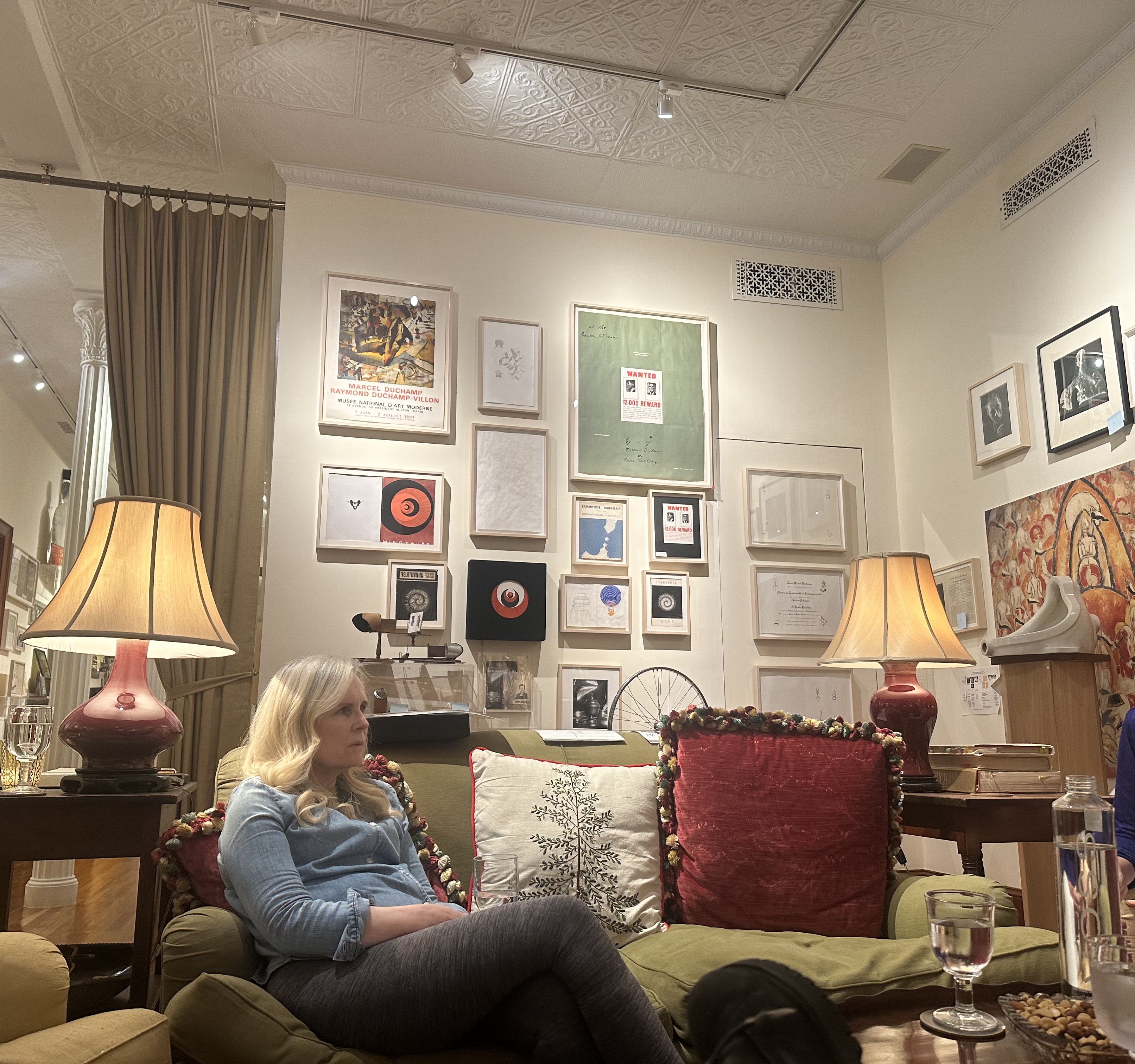
A photograph from the three-hour conversation in Rhonda Shearer's apartment, September 2024.
Her apartment was a museum. It held, among other things, the world's largest private collection of Duchamp's works and personal effects, including what I had assumed were replicas of the White Box notes and which turned out to be originals. At one point in the conversation she took me aside and explained, in her own words, that The Large Glass was a work "only an initiate could understand." Earlier in the conversation she had said something else, in a phrase I did not fully appreciate at the time and have spent the year since trying to do justice to. She said that Duchamp had "set out to win Art." I took that to mean, as I eventually understood it, that the man whose public reputation is as the prankster who put a urinal in a gallery had produced the single most intricate and densely structured work of art in human history and had designed it specifically to go unnoticed for as long as possible.
That is the context for everything that follows. The thesis of this document is that the payoff to Duchamp's joke is Elden Ring.
The Correspondences#
The game itself, as the player experiences it, is one cycle of the process shown within The Large Glass. The rest of this section is the mapping.
The C-Shape#
The crack pattern in The Large Glass, caused by the 1926 transportation accident (or whatever it actually was) and preserved in the reassembly, traces a rough C-shape across the lower half of the tableau. The main landmass of the Lands Between traces the same rough C-shape, opening to the sea on the same side. The geography of the game is the fracture pattern of the glass. (If you are not familiar with the shape of the Lands Between, the interactive overworld map on the Elden Ring wiki is the clearest way to see it.)
A Delay in Glass#
Duchamp subtitled The Large Glass "a Delay in Glass" and insisted in his notes that the work belonged to the category delay. Elden Ring takes place in the Lands Between, a world in a state of suspended incompletion after the Shattering. The game's opening cinematic calls it a world "where death has been robbed from us." Nothing finishes. The demigods do not die permanently, the Tarnished respawn, the cycle does not close. The Lands Between are not a world that has ended. They are a world that is delayed. In Duchamp's exact terminology, they are a Delay in Glass.
Consider the literal object here, too. The Large Glass is a process suspended between two physical panes of glass, held flat for the viewer's inspection in the way a biologist holds a specimen flat on a microscope slide for observation. The nine-foot-tall apparatus is not a free-standing sculpture and not a painting hung on a wall. It is a slide, a prepared specimen of a process, observed simultaneously from both sides through transparent material that is itself part of the work. A sphere intersecting a flat plane is perceived, from inside the plane, as a circle that grows and shrinks. A four-dimensional process intersecting a two-dimensional glass plane is perceived, from the glass's side of the cut, as The Large Glass. The Lands Between is the same kind of slide. Its namesake is the state of being in between: caught between destruction and repair, between death and life, between the fourth dimension of the Greater Will's intentions and the three-dimensional world in which the player walks around. The game-world is a prepared specimen of a process, observed through interactive gameplay the way Duchamp's specimen is observed through prolonged looking.
Marika Is the Bride#
is the Bride. She is crucified within the Erdtree as the Bride is crucified on the arbor-type apparatus. Arbor is Latin for tree; the Erdtree is the arbor.
Duchamp borrowed the term "arbor-type" from Girard Desargues' seventeenth-century projective geometry, where it describes a branching, tree-like structure built from axes and nodes. (Duchamp himself was not only an artist but a serious amateur mathematician. His interest in Desargues and in Henri Poincaré's writings on non-Euclidean geometry and the fourth dimension were not ornamental; they were the technical foundation on which he designed The Large Glass.) In the Desargues framework, the arbor-type is the shape of the fourth-dimensional figure whose three-dimensional shadow the viewer perceives.
Editor's note: if projective shadows of higher-dimensional objects are hard to picture, I recommend Edwin Abbott's 1884 novella Flatland, in which a two-dimensional square is visited by a three-dimensional sphere and learns to see his own world as the cross-section of a larger one. The leap Duchamp is asking the viewer of The Large Glass to make, from three to four dimensions, is the same leap Flatland's square makes from two to three. The difficulty is of the same kind and the payoff has the same flavor.
Duchamp used "arbor-type" to describe the Bride because the Bride is meant to exist in four dimensions and to be only partially visible from three. Marika and inhabit one body as two genders in a single form. This is the arbor-type in its biological reading as well as its geometric one: the pre-fertilized egg, the bisexual or asexual potentiality of a being before it has committed to a form, the tree of possibilities before it has branched.
When you reach Marika at the end of the game, she drops from her crucified position before the final boss fight begins. Duchamp's notes describe a parallel moment in the Bride's arc: after the Bachelors' process has run its course, the Bride "strips herself" and descends partway toward the lower domain, a ritual transition from her crucified state in the Milky Way toward the waiting Bachelors below, which of course never completes, because the Nine Shots miss the Nets and the Bachelors do not reach her. Marika's drop at the end of Elden Ring is this gesture, rendered in gameplay.
One more note on Marika and Radagon. The game's lore carefully separates them visually through the rune each one bears. Marika's rune is a crucifix-like shape, structural and fixed, with the silhouette of a needle about to pierce fabric.

Marika's Rune.
Radagon's rune, by contrast, is a passing and binding form: a thread worked through the weave rather than the needle that pierces it. I do not have a clean image of Radagon's rune to place alongside Marika's here, so I will simply assert the identification and trust that anyone who has played the game knows the two sigils I am talking about. Marika's rune is the needle. Radagon's rune is the weave. They are the same being because the needle and the weave are the two halves of any woven thing. This is a load-bearing point we will return to when we get to the magic system, because the warp-and-weft relationship between Marika and Radagon is the same relationship as the one between the Law of Causality and the Law of Regression that govern all sympathetic magic in the Lands Between.
The Tarnished Are the Bachelors#
Duchamp called the Bachelors "a cemetery of liveries." Michel Carrouges, the critic who in 1954 first identified the bachelor machine as a category spanning Duchamp and Kafka and others, elaborated: the bachelors are "the nine malic moulds as social types frozen in their roles," inflatable skins for categories of dead man (a gendarme, a priest, a flunkey, an undertaker). The cemetery is Duchamp's own word, and death reigns over the male Bachelor's zone.
The Tarnished are literally undead warriors in armor, perpetually dying and resurrecting. The nine starting classes correspond to the nine Malic Moulds Duchamp painted into the lower half of the glass. They are frozen in their categories (Vagabond, Warrior, Samurai, Prophet, Bandit, Astrologer, Prisoner, Hero, Confessor), which are literally jobs and social types.
Elden Ring does something no other medium could: because it is a multiplayer video game with more than 30 million copies sold, it makes the infinite Bachelor machine actually infinite. Duchamp could only gesture at the idea of a cemetery of liveries. Elden Ring built one and populated it with 30 million simultaneous bachelors.
The thirty million are not a player base in the conventional sense. In the logic this essay has been insisting on, they are all canonical, and they are canonical at the same time. I have been saying the Lands Between is a daisugi cosmology in which many vertical trunks rise from a single base; the thirty million players are the trunks. Each player's Tarnished is an upright shoot off the same Yggdrasil, branching from the one shared base of the world, living a full Elden Ring-shaped life above the canopy and then being felled and regrown as another. The multiplayer architecture makes this explicit in a way the game should not, strictly, be allowed to: other players can step into your run as cooperators or invaders, and when they do, the events of their world and yours interleave without either world being demoted to a simulation of the other. The same Malenia is being fought by a million Tarnished, each of whom is the one Tarnished, none of whom are the same Tarnished, and all of whose fights are happening under the same unbroken conditions while also being distinctly their own — the same people who are different people, set in conflict with one another because their Love Gasoline carries partly conflicting instructions. The correspondence is incomplete, because the transmission is imperfect, because the machine is broken.
The bloodstains and phantom messages scattered across the world are the cemetery made visible and interactive, and they deserve a closer look. Since Demon's Souls in 2009, every FromSoftware game has allowed players to drop short messages on the ground that other players see on their own copies of the game, and to leave bloodstains at the places where they died that other players can replay as ghostly loops. Elden Ring continues the mechanic. It is, more pointedly than players tend to notice, what the Nine Shots were supposed to accomplish if they had landed in the Nets: information transmitted out of the Bachelors' zone and fed upward into the machinery. Duchamp's Bachelors cannot send anything upward because the shots miss. Miyazaki's Bachelors succeed in sending signals to each other across the multiplayer architecture, but the signals are usually trivial: warnings, jokes, lies, marks left where they died. The transmission channel exists. The content is still cemetery.
The Elden Ring Is the Chocolate Grinder#
The core visual identification has already been made in the preliminary works section: the Elden Ring symbol is the Chocolate Grinder viewed from above, each Great Rune maps to a named part, the Mending Runes are top-down sections through the cylinders. What is worth adding here is the structural point that follows from the identification. The Grinder is the central mechanism of the Bachelor's Apparatus in The Large Glass. Everything else (the Capillary Tubes, the Sieves, the Scissors, the Water Mill) is in the lower half of the glass specifically to drive, constrain, or route around the Grinder's operation. The Elden Ring is the same thing in Miyazaki's world. The entire game is organized around it. Shattering it broke the world. Fragments of it became the demigods' Great Runes. Reassembling it is the nominal goal of the player. The grinder, in both works, is the piece that has to turn for anything else to matter, and in both works it is broken.
The Shattering#
Marika shattered the Elden Ring. Duchamp's glass was shattered in 1926. Both acts of shattering bear the indicia of intent. Both remain broken after the repair, and in both cases the repair became part of the work.
Editor's note: either by literal intent or by retcon, for Duchamp at least. Whether Duchamp set up the 1926 transportation accident is impossible to prove. What is not disputed is that he accepted the cracks when they came, incorporated them into the reassembly, declared the work "definitively unfinished" in 1923 and then in 1936 rebuilt it around the damage, and in his later writings consistently treated the break as part of the piece. The intention, if it was post hoc, was at least thorough.
Radagon tried to reassemble the Elden Ring and failed, landing the world in permanent stagnation. Duchamp reassembled the glass and declared it "definitively unfinished." The fracture lines became part of the piece. The brokenness is the statement, in both works.
Grace Is Love Gasoline#
The Bride rains down Love Gasoline on the Bachelors. Without it they are inert uniforms in a cemetery. Marika dispenses Grace to the Tarnished, and without Grace the Tarnished are just dead. Sites of Grace are the dispensing points. Grace is what keeps the Tarnished moving, dying, respawning, trying again. Anyone who has played the game recognizes the force I am describing. It is what gets you off the bonfire for your thirtieth attempt at Malenia.
Capillary Tubes and the Hair of the Bride#
The Capillary Tubes in The Large Glass are the wire-like lines that connect the Bachelors' zone to the Sieves, stripping the Bachelors of their differentiated identities as they flow through. The name is from the Latin capillus, meaning hair, and in the Green Box notes Duchamp describes the tubes as hair-like in form.
Marika forged the Elden Ring, in the game's lore, out of gossamer strands of her own hair. The Capillary Tubes are literally made from the Bride's hair in both works. Anyone who has carried the Scarseal, a talisman that grants holy protection because it is described as a braid of Marika's hair, has been carrying a piece of this correspondence the entire time.
Red Fading to Gold#
The Malic Moulds in the lower half of The Large Glass were originally painted red. Over the decades, the pigments oxidized and faded to gold. What Duchamp painted as red is, today, what we see as yellow.
Elden Ring's visual aesthetic is famously a world in yellow, but the game's lore carefully establishes that red was once the dominant color of the world and was suppressed from the Golden Order by political force. The Giants' Flame is red. The Crucible is red. Radagon's hair is red. The Frenzied Flame is red-orange. Red lightning exists as its own separate and suppressed lineage. The ruling Golden Order is still trying to strip all traces of red from the world. The oxidation of The Large Glass is the political history of Elden Ring, mapped one-to-one.
, the Shot That Got Closest#
Duchamp told people he had produced the Nine Shots by firing paint-dipped matchsticks from a toy cannon at the lower half of The Large Glass. None of them, he said, landed in the Nets. One came closer than the rest.
Editor's note: like hell he did. Shearer's lifelong project was showing that Duchamp's public accounts of his own working methods were almost uniformly stories he made up after the fact, and her work on the readymades in particular established that almost none of them were the found objects he claimed. The toy-cannon story is in the same register. The Nine Shots are almost certainly placed exactly where Duchamp wanted them and the fiction of the random cannon is a cover. The thing that matters, for purposes of the mapping to Elden Ring, is not whether the shots were aimed, it is that Duchamp wrote into the notes that one of them came closer to landing in the Nets than the others.
Vyke is a minor character in Elden Ring with no speaking lines. He collected two Great Runes. He made it to the foot of the Erdtree. He got closer to becoming Elden Lord than any other Tarnished in the history of the Lands Between, and then he failed. He has no questline worth following, no boss fight that matters to the story. The only reason he appears on the cover of the game is this: Vyke is the shot that got closest.
, the Juggler of Gravity#
The Juggler of Gravity is a literal, named component in The Large Glass. Duchamp planned it but never added it to the glass as it exists in Philadelphia. It survives only in the notes and in the diagrams that accompany the Green Box.
Radahn is a demigod who manipulates gravity magic and holds the stars in place. He is, literally, the Juggler of Gravity. His moveset drives the identification home. He pulls enemies toward him by creating localized gravity wells. He slams his swords into the ground to emit shockwaves of purple gravitational energy that propagate outward in waves. And in the second phase of his fight in the base game, once his health drops below fifty percent, he reverses gravity on himself: he charges his blades with purple energy and launches upward out of the arena, holds himself suspended in the sky long enough to choose his trajectory, and then comes back down as a meteor, crashing into the ground with enough force to kill most players in a single hit. This is not a visual flourish. Juggling gravity is exactly what a juggler of gravity does, and the fight is telling you what he is.
In the base game he is fought once, in Caelid, in a boss battle that is more about the spectacle of a mounted charge than about a position in the main narrative. That fight is not the one that matters for this mapping.
The fight that matters is the one he is given in Shadow of the Erdtree, the 2024 DLC. In the DLC, Radahn returns as the final boss. Fans were baffled by the choice; he had already died in Caelid, and resurrecting him to kill him again looked, on its face, like fan-service or franchise padding. It is neither. The DLC is the completed version of The Large Glass (the state the work would have been in if Duchamp had finished every component he planned and had not suffered the 1926 crack), and Radahn, the Juggler of Gravity, is one of the components Duchamp planned but never added. Putting him in the DLC is not franchise padding. It is finishing the glass.
This is worth pausing on. The base game of Elden Ring corresponds to The Large Glass as the world has it: shattered, reassembled, definitively unfinished, missing the components Duchamp never got around to drawing. The DLC corresponds to what the glass was supposed to become. If you want to know what The Large Glass would look like complete, unbroken, with the Juggler of Gravity and the Boxing Match and the rest of the apparatus in place, you do not look at Philadelphia. You look at Shadow of the Erdtree.
And you can look at something else, too.
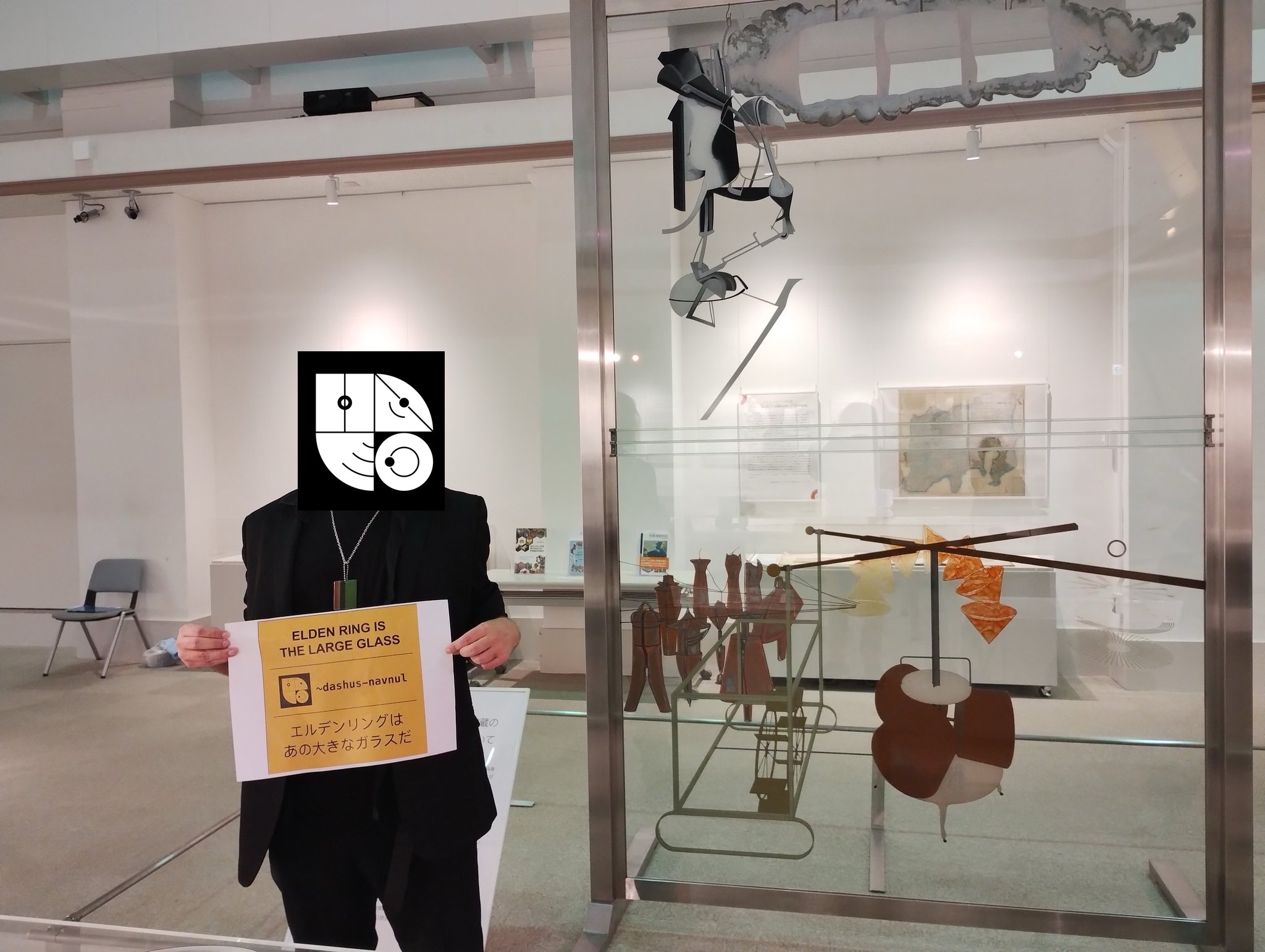
The last of the three reproductions of The Large Glass that Duchamp personally authorized, completed in Tokyo in the 1980s. It is the only one of the three made whole: not as a reproduction of the cracked Philadelphia version, but as The Large Glass as Duchamp drew it in the Green Box.
The DLC is the completed Glass. The Tokyo reproduction is the completed Glass that was available to the person who made the DLC. They are one of the strongest circumstantial pieces of evidence in this document for the claim that Elden Ring is a deliberate transcription and not a coincidental echo.
The Is the Milky Way#
The Milky Way in The Large Glass is the cloud-like apparatus the Bride is suspended beneath. The Szeemann exhibition catalog describes it precisely: "the milky way is flesh coloured, in other words, the skin, or mortal remains, of the Bride." The Bride is suspended inside her own mortal remains, crucified on the cosmic apparatus that holds her.
The Elden Beast is the cosmic entity that holds Marika prisoner. Its form is organic and serpentine, the body of a long-necked fleshy creature with humanoid arms, but its skin is not flesh-colored. It is colored like a starscape: a shimmering translucent silhouette full of moving points of light and gold veins, so that looking at the creature is looking through a piece of the night sky shaped like a body. Fighting the Elden Beast in the final moments of the game is attacking the mechanism that imprisons the Bride, which is also, in the literal visual sense that Duchamp's collaborator described the Milky Way, her mortal remains.
The Waterwheel#
The Large Glass's Bachelor Apparatus is powered by a Water Mill. The mill's motion is futile labor: it turns, the mechanism cycles, the Bachelors grind their chocolate, nothing is ever completed. Duchamp's preliminary piece The Water Mill Within Glider (1917) was an explicit study of this mechanism.
In Elden Ring, the Tarnished gameplay loop is the waterwheel. Die, respawn, try again. Lose your runes, recover your runes, lose them again. Accept no final resolution. The struggle itself is the machine. Thirty million players turning the waterwheel simultaneously through their deaths and their attempts, powering a machine that has no output.
The Three Nets#
Three Tarnished (, the , and ) each create a , and only they can. These correspond to the three Nets in The Large Glass. The Nets, in Duchamp's scheme, capture and process information from the Bachelors and feed transformed data back to the Bride. The Mending Runes do the same thing in different language: they take philosophy and lived experience and transform them into something that can reshape the Elden Ring, and with it the world.
Recall from earlier: stoppage in French is invisible mending, the reweaving of a tear in fabric so that the tear can no longer be seen. Duchamp preserved three standard stoppages. Three Tarnished create three Mending Runes. The vocabulary lines up even before you get to the function.
Remembrance of Grace#
The first Remembrance you can acquire in the game is the Remembrance of Grace. Its item description contains the line "it is just a cycle." The thesis statement of the entire work is placed into the hands of the player near the beginning of the game, on an item the player will trade for a reward without reading twice.
The whole argument is already on a tutorial-area pickup. The game tells you immediately what it is.
The Roundtable Hold as Paradise of Bachelors#
Herman Melville's 1855 diptych The Paradise of Bachelors and the Tartarus of Maids describes, in its first half, a London gentleman's club of retired warriors and lawyers gathering around a round table to drink wine, tell stories, and celebrate a freedom from responsibility that is, on closer inspection, impotence. The second half of the diptych describes a bleak paper mill where women's labor produces the blank pages that the bachelors in London will eventually fill with their self-congratulatory correspondence.
The Roundtable Hold is the gentleman's club of retired warriors gathering around a round table in the hub, telling stories, and celebrating a freedom from responsibility that is, on closer inspection, impotence. The structural duality in Melville's story (bachelors above, women imprisoned below) is the same structural duality as The Large Glass, which is the same structural duality as Elden Ring's upper and lower realms. Melville was doing this in 1855. Duchamp was doing it in 1915. Miyazaki did it in 2022. All three are variations on a single mythic pattern, which is precisely what Michel Carrouges argued in Les Machines célibataires (1954) when he first identified the bachelor machine as a recurring structure across literature.
Storytelling as Method#
Duchamp documented The Large Glass through the Green Box, a collection of fragmentary, cryptic notes requiring the audience to piece together meaning from scattered sources. Elden Ring tells its story the same way: item descriptions, one-line NPC dialogue, lore hidden in flavor text most players never read. Both works demand that the audience assemble the meaning rather than receive it. Recall Duchamp's own verdict on The Large Glass, recorded earlier in this document: only an initiate could understand it. That is the same bar Elden Ring sets for its players. In neither case is the work withholding itself to be coy; it is withholding itself because the act of assembly is the work. The reader who walks away from the Green Box without doing the reading, or from Elden Ring without reading the items, has not been excluded by the artist. They have declined to become an initiate.
This is not a stylistic coincidence. It is the same artistic decision, made a century apart, for the same reason. The notes are part of The Large Glass. The item descriptions are part of Elden Ring. Neither work exists independently of the apparatus the audience uses to parse it.
Editor's note: this is where data miners and lore completionists get it right. The thing they miss, unfortunately, is mistaking myopic perusal for evaluation. The item descriptions and the notes are load-bearing, yes, but reading them one at a time and cataloguing them is not the same as reading the structure they collectively describe.
The Magic System Is the Golden Bough#
The correspondences above map Elden Ring to The Large Glass at the level of surface elements: characters, items, geography, mechanisms. But the mapping runs deeper than that. The operating physics of the Lands Between, the rules by which magic and causality and meaning work in the game world, is itself a pataphysical transcription of another foundational text.
Sir James Frazer's The Golden Bough, published in multiple volumes between 1890 and 1915 (the same year Duchamp began The Large Glass), is an anthropological study of magic and religion across cultures. Frazer catalogued what he called "sympathetic magic": beliefs in which objects and forces act on each other at a distance through secret correspondences. He divided sympathetic magic into two branches. Homoeopathic magic operates on the principle that like produces like: dancing the motion of rain produces rain. Contagious magic operates on the principle that things once in contact remain connected: a lock of hair keeps influencing the person it came from. Frazer presented the whole framework as a catalogue of beliefs that were, of course, not literally true.
Elden Ring's magic system is Frazer's sympathetic magic treated as literally true. This is the pataphysical move in its clearest form: taking a system Frazer described as imaginary and treating it as if it were already the operating physics of a world.
The Golden Order's two foundational Laws state the framework outright, and each one maps directly onto one of Frazer's two branches.
The Law of Regression is described in-game as "the pull of meaning; that all things yearn eternally to converge." This is a verbatim description of contagious magic. Things that were once part of a whole remain connected across any distance, and the connection is experienced as a pull back toward origin. The lock of hair yearns toward the body it came from; the fragment yearns toward the object it was broken off of; the Scarseal, a braid of Marika's hair, grants holy protection because the braid is still, at a metaphysical level, Marika. Every Great Rune fragment yearns toward the Elden Ring it was broken off of. Every remembrance retains the power of the demigod it was taken from. The entire logic of relics, remembrances, and physical keepsakes in the game runs on contagious magic, and the Law of Regression is the formal statement of it.
The Law of Causality is described as "the pull between meanings; that which links all things in a chain of relation." This is homoeopathic magic, which operates on the principle that like produces like along a structured chain of resemblance and ritual repetition. Bloodgrease applied to a weapon causes enemies to bleed more: in physical reality blood applied to a wound helps it clot, but in Frazer's system blood produces blood. Fire Grease produces fire. Poison produces poison. The entire crafting system is a homoeopathic magic manual, and the Law of Causality is the formal statement of the principle it runs on. The "chain of relation" is the causal chain by which one meaning produces another of the same kind.
Together the two Laws describe a physical universe governed by Frazer's framework, with both branches of sympathetic magic given explicit statutory form and folded into the world's operating physics.
The Frenzied Flame, whose stated goal is to melt all life into one, is contagious magic taken to its terminal point: pure Regression unchecked by the structuring force of Causality. If everything that was once part of a whole yearns to converge, and nothing is holding the distinctions between things in place, the endpoint is literal convergence: all life melted into one undifferentiated mass. It is what happens when The Golden Bough's imaginary physics runs without brakes.
Frazer proposed that human thought had historically moved through three ages: the Age of Magic (commanding nature through hidden laws), the Age of Religion (petitioning higher powers), and the Age of Science (the return to knowable law). These correspond to the three damage types of Elden Ring's magic system: Magic (sorcery, commanding nature through hidden laws), Faith (incantations, petitioning higher powers), and Arcane (forbidden knowledge, the return to law that operates outside the conventional Order).
In the village of Windmill Heights, a group of women in white dresses dance endlessly while a Godskin Apostle armed with a hooked weapon stands at the village's apex. Frazer documented exactly this ritual: among the Thompson Indians, during the absence of husbands at war, the wives would dance with hooked sticks to symbolically pull their men back from danger. At Windmill Heights, the dance never ends because the war never ends. The ritual is in the game. So is its anthropological source.
Return, briefly, to the Warp and the Weave of the Golden Order. The Law of Causality is the warp thread, the structural fixed line. The Law of Regression is the weft, the pulling force that binds. Marika's rune is the needle, fixed and piercing. Radagon's rune is the weave, passing and binding. The entire Golden Order is a weaving operation, and the metaphor is exact, because the operating physics of the world is sympathetic magic, which Frazer described as a web of secret correspondences. The world of Elden Ring is a woven world. That is why the Mending Runes, which repair the world by stopping the fabric, are the mechanism by which anything can be changed at all.
None of this is subtext. It is the declared physics of the game, made legible to anyone who has read Frazer. Miyazaki built a world in which The Golden Bough's catalogue of sympathetic magic is as real as gravity, and then placed it inside a larger work in which the whole apparatus serves as the setting for The Large Glass's process. This is pataphysics inside pataphysics. It is also how you know you are looking at the right thing.
The DLC: The Completed Process#
The base game of Elden Ring represents The Large Glass as we find it today: shattered, incomplete, reassembled but forever unfinished. Shadow of the Erdtree, the 2024 DLC, represents what the completed process would look like if Duchamp had lived long enough to add all of the intended components.
In the DLC, wanders the Land of Shadow stripping himself bare. At each of the Crosses of Miquella, which the player finds scattered across the map, Miquella has discarded a piece of himself, marked in the item descriptions as his flesh, his lineage, his love, his fears, his Golden bearing. He is preparing to become the new Vessel of the Greater Will and to replace Marika as the Bride. The Bride Stripped Bare is not a quest title in the DLC; it is the process the DLC is showing you happening. A figure the game has already identified with the Bride, on the cusp of becoming the new Bride, is stripping himself piece by piece across the map while the player watches. Duchamp's title is the narrative spine of the DLC.
His chosen consort for the new Golden Order is the demigod of gravity: Radahn, the Juggler of Gravity, who serves as the final boss of the DLC. Fans were confused by the choice. Radahn had already been defeated in the base game. Why bring him back? Because the final boss fight is the Boxing Match, another component Duchamp planned for the unfinished portions of The Large Glass but never depicted. The Juggler of Gravity was supposed to participate in the Boxing Match. Duchamp described both in his notes. Miyazaki built both.
There is a further correspondence worth noting here. Romina, Saint of the Bud, is a mandatory boss in the DLC, fought in the Church of the Bud at the end of the Ancient Ruins of Rauh. Her entire moveset is butterflies. In her first phase she summons butterflies, and in her second phase she creates clouds of lingering rotten butterflies that detonate in chain reactions around the arena. Duchamp planned a component for the unfinished portions of The Large Glass called the Butterfly Pump, which was to deliver love gasoline through the Bachelor Apparatus. The Butterfly Pump was never drawn and survives only as a name and a description in the notes. I cannot prove the identification of Romina with the Butterfly Pump the way I can prove the identification of Radahn with the Juggler of Gravity, because Romina's location is not named after the mechanism the way Radahn's moveset is. But the correspondence is a lot more direct than I used to say it was: a saint of the bud (the unopened generative flower), whose whole combat identity is butterflies, fighting in a former cathedral to a procreative principle that has been corrupted into rot. That is the Butterfly Pump. I no longer think it is a tentative identification.
Duchamp declared The Large Glass "definitively unfinished" in 1923. A century later, somebody finished it.
Gideon the All-Knowing#
Gideon Ofnir is the first major NPC the player meets in the Roundtable Hold. He serves as the player's guide through much of the game's main story. Late in the main campaign, Gideon turns hostile and attempts to stop the player from becoming Elden Lord. His stated reason is that he has realized the Tarnished can never truly succeed, that the cycle is designed to perpetuate itself, and that the attempt is therefore fundamentally futile.
Gideon is not wrong. He has understood the Bachelor machine. He has seen that the cycle is the point. The reason he has to stop the player is that his own identity, as the All-Knowing, depends on the world remaining static. If the player changes the world, Gideon stops being all-knowing, which means Gideon stops being Gideon. He is trapped by the fact that the system cannot be resolved without destroying his place in it.
The parallel to Ernest Cline's Ready Player One, in which the godlike in-game AI Anorak the All-Knowing attempts to stop the protagonist from completing a puzzle hunt hidden inside a video game by the game's creator, is close enough to be deliberate. Anorak is the copy of the creator Halliday's consciousness; he exists only within the game; Halliday programmed him to stop the winner. The role of Anorak the All-Knowing in Ready Player One is the role of Gideon the All-Knowing in Elden Ring. Both books are about puzzle hunts in games, solved by an outsider whose only advantage is deep familiarity with the creator's influences.
Either the parallel is an accident, or Miyazaki is telling the player through the structure of the game itself that this is what kind of story they are in.
The Final Clue#
In the first Dark Souls, Miyazaki told players that The Pendant was the most important item in the game. The Pendant does nothing. It has no use, no crafting function, no quest attached. Players spent years trying to crack the secret. Miyazaki eventually admitted it was a joke: the most important item in the game was the one that did nothing.
Applying the same logic to Elden Ring. What is the one item in the game that does nothing?
It cannot be consumed. It cannot be sold. It cannot be crafted with. It serves no purpose in any quest, any build, any storyline. It is among the most common items in the game, found everywhere in the Lands Between. The item description says it is "not unusual." The game tells you, explicitly, to dismiss it.
Glass Shards.
Literal fragments of The Large Glass, scattered throughout the world.
Thirty million players walked past the evidence every day and did not see it. The most common, most worthless, most ignored item in the entire game, found everywhere, doing nothing, meaning everything.
The Unsolvable Game#
Duchamp was a serious chess player. He competed internationally, represented France in four Chess Olympiads, and reached a level of play sufficient to earn the title of master. He wrote a book on endgames (L'Opposition et les cases conjuguées sont réconciliées, 1932) that is still in print, and he once said, "while all artists are not chess players, all chess players are artists." Chess, for Duchamp, was the form he retired into when he nominally retired from art, and the reasons he gave for that retreat make it clear that he did not see the two as separate.
Late in his career, Duchamp composed a chess puzzle titled White to Play and Win. To this day there is no known sequence of moves that allows white to win. Duchamp's comment on his own puzzle: "There is no solution, therefore there is no problem."
Editor's note: I am struggling not to say "oh brother."
This was a claim about games, not about chess.
A game with one correct solution is a problem, and a problem is utilitarian. A game with no solution is art. This was Duchamp's objection to chess as a fine art form, and it is the objection most critics have historically held against video games: the requirement of a win condition. A solvable game is a tool. An unsolvable game is a mirror.
Every ending in Elden Ring perpetuates the cycle. The Bride remains unreachable. The delay continues. Becoming Elden Lord just restarts the Bachelor machine. You cannot win Elden Ring the way you win chess, and the impossibility of winning is not a flaw in the design. It is the thesis of the work.
By encoding The Large Glass into the structure of a video game, Miyazaki proved something Duchamp could only theorize: that games, when they abandon the requirement of solution, are not merely capable of being art but are among the most powerful artistic media available.
The Large Glass is a four-dimensional concept compressed to two dimensions. Elden Ring is the same concept in three. Only through interactive media can the player experience the delay rather than merely observe it. Only through multiplayer can the infinite cemetery of Bachelors become actually infinite. Only through gameplay can the waterwheel actually turn.
I want to refine the claim I have just made, because the easy version of it is easier to state than to defend, and the refinement matters for the rest of what I want to say.
The easy version runs like this. The Large Glass is a four-dimensional process compressed to two dimensions of glass. Elden Ring renders the same process in three dimensions of space plus a fourth dimension supplied by gameplay, and the player's trajectory through the world is a four-dimensional path through an object that would otherwise sit still. The medium's contribution is the fourth dimension. I believed this for a long time. I no longer think it is quite right.
Elden Ring's relationship to time is stranger than that. Five out of the six endings described earlier do not move time forward in the way a fourth dimension ordinarily does. The Age of Fracture and its three Mending Rune variants all reseat the Tarnished into Marika's old position and resume the cycle under modified terms. The Lord of the Frenzied Flame burns the current iteration of the world to the ground but does not exit the apparatus that produced the iteration. Only Ranni's Age of the Stars actually leaves. The game is, in its stable state, never ending and also never not ending, which is a way of saying that time in Elden Ring passes without producing the accumulation that time is supposed to produce.
This is exactly what Duchamp meant by "delay." In the Green Box notes he is explicit that delay is not a synonym for postponement. It is a category of time in its own right: time held against its normal flow. The French retarder, the same word used in musical notation for a passage pulled back from the tempo, is the root he drew on. The Large Glass is a delay, not a description of one. Elden Ring, I now think, is the same category of object rendered in a medium that appears to let time run freely and then, through the design of its endings, withholds the accumulation that free-running time would ordinarily produce.
Return for a moment to Terayama. Terayama's generation grew up in a country whose traditional culture had been shattered by an outside force and could not honestly be restored, and whose dominant response to the situation was to pretend the break had not happened. Japan after the war maintained the forms of the old order as though the war and the occupation had not occurred, and Terayama's work returns again and again to the posture of a culture that refuses to let time move forward. The break had happened. The culture was acting as if the moment of the break had been suspended. Generations passed without producing the accumulation that generations are supposed to produce, because the culture would not acknowledge the break and therefore could not acknowledge what came after it. What Duchamp had named delay, Terayama's Japan was living, and the country in the condition is the country that produced the game.
Elden Ring is that condition rendered in code. The player runs around in a world whose break has already happened, the Shattering, and whose inhabitants are all pretending, in one way or another, that it has not. The endings almost all restore the pretense. Miyazaki's game is not just a bachelor machine in Duchamp's abstract sense. It is a bachelor machine with the specific historical content of postwar Japan embedded in the structure of its endings.
So the better version of the dimensionality claim runs like this. The world of Elden Ring is three-dimensional at any instant. Gameplay appears to add a fourth dimension. But the fourth dimension does not do the work a fourth dimension is supposed to do. It does not produce outcomes; it produces more delay, which is what the fourth dimension in a bachelor machine exists to produce in the first place. The player experiences a four-dimensional object whose fourth dimension has been held against its own motion. The medium's unique contribution to the mapping is not that it adds a fourth dimension to The Large Glass. It is that it stages the suspension of the fourth dimension, a trick The Large Glass could only point at from two panes of still silvered glass and a set of notes, and a trick that is also, as it happens, the posture of the culture that produced the game.
Video games were the only medium in which what Duchamp started could be completed.
Video Games as Bachelor Machines#
By encoding The Large Glass as Elden Ring, Miyazaki makes a meta-statement about the medium he works in. All video games, the argument runs, are already bachelor machines. Elden Ring is the first to make the fact explicit.
Consider the shape of the form. The player is animated by an external force (the narrative, the reward structure, the player's own desire) and propelled through an environment toward a goal that is almost always, in practice, a princess or a macguffin or a boss or some combination of all three. The player dies, respawns, tries again. The player's effort is not conserved between attempts. The satisfaction of reaching the goal never equals the satisfaction the player was promised. The game ends, and the player starts a new one, and the new one is the same shape as the last.
The Bachelor is the player. The Bride is the goal. The machinery between them is the medium itself.
Every video game operates this way, because the form demands it. The closer a game gets to honesty about the shape of the medium, the closer it gets to being a bachelor machine made explicit. Elden Ring is the most explicit version yet made. Its Bride is unreachable because the medium's brides are always unreachable in any meaningful sense. The player's attempts perpetuate the cycle because the player's attempts in any video game perpetuate the cycle. The impossibility of winning is not a design choice specific to Elden Ring. It is the truth of the form, dragged into the open.
Michel Carrouges argued in 1954 that the bachelor machine was not one work but a mythic pattern appearing across literature: Duchamp's Large Glass, Kafka's In the Penal Colony, Raymond Roussel's machines, Jarry's Supermale, others. The structural constant across these works is a two-tier apparatus in which an upper zone inscribes a message on a lower zone through some mechanical drawing device, and the lower zone cycles endlessly without ever being able to send a message back. Video games, considered as a form, fit this pattern almost perfectly. The game designer inscribes meaning on the player from above, through the mechanical apparatus of the game, and the player's input, however frantic, however skillful, cannot alter the design. The player is always the lower zone.
This is the largest claim the discovery makes. Elden Ring is a bachelor machine about video games being bachelor machines. It is the medium's moment of self-awareness, delivered a century after Duchamp identified the pattern and named it.
A Note on Discovery#
The puzzle is self-proving in the cleanest possible way. You can only discover that Elden Ring is art by first treating it as art. Anyone unwilling to view games as art will never look for this, which means they will never find the proof. The discovery validates the discoverer. I suspect this is exactly what Miyazaki intended, and it is how Duchamp designed The Large Glass to function a century ago: a work that filters for its own audience by rewarding only the kind of engagement it requires.
The Large Glass is a four-dimensional concept in two dimensions, delayed on glass. Elden Ring is the same concept in three, delayed in play. Both works are about the same unreachable woman, the same frustrated machinery, the same cycle that cannot be closed. Both are unfinished by intention. Both were made by artists whose public reputations underestimate them by an order of magnitude.
Sometimes when you know what you are looking at, everything becomes clear.