TL;DRtldr
TL;DR
The discovery in about 3,000 words, timestamped on Bitcoin before publication
Updated
11/21/2025
Reading Time
18 min
Status
Timestamped on Bitcoin
Cryptographic Proof
The TL;DR was sealed on Bitcoin on November 21, 2025, before any public disclosure of the discovery.
SHA-256 Hash
5d8e88e20ea4fd62ca6b6b3d603a2ace321e42c8208685c95b4f36640a921db3
Verify it yourself
Two steps. Either one is enough to confirm the TL;DR has not been altered since it was sealed.
1. Confirm the hash matches the file
Download the hashable file and compute its SHA-256 hash. The result must match the hash above.
curl -O https://eldenringisthelargeglass.com/proofs/EldenRingSecretOriginal.md
shasum -a 256 EldenRingSecretOriginal.md
2. Verify the Bitcoin timestamp
Download the OpenTimestamps proof file and verify it against the hashable file with the ots client. This proves the document existed at the Bitcoin block height recorded in the proof, which cannot be backdated.
pip install opentimestamps-client
curl -O https://eldenringisthelargeglass.com/proofs/5d8e88e20ea4fd62ca6b6b3d603a2ace321e42c8208685c95b4f36640a921db3.ots
ots verify -f EldenRingSecretOriginal.md 5d8e88e20ea4fd62ca6b6b3d603a2ace321e42c8208685c95b4f36640a921db3.ots
Or upload the .ots file at opentimestamps.org for browser-based verification.
On this page (9)
Elden Ring's Final Secret#
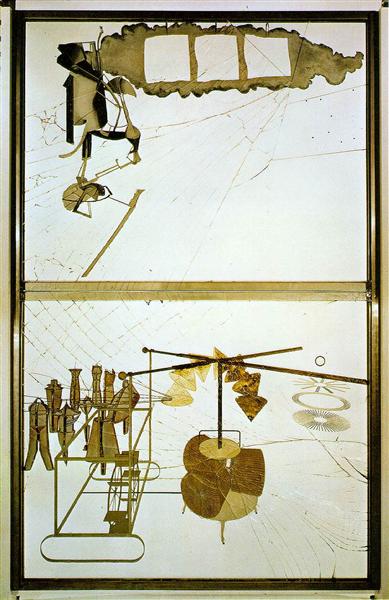
Elden Ring is Marcel Duchamp's "The Bride Stripped Bare by Her Bachelors, Even."
The Mystery#
Hidetaka Miyazaki, the creator of Elden Ring, announced that there was a final secret hidden within the game that no one had found. While there were initially several articles written claiming that the secret was a minor lore detail contained on an obscure shield, the general consensus was that this idea of a "final secret" was a hoax perpetrated by Miyazaki to fuel entertaining speculation about the game, something he had done in the first Dark Souls game. This was because despite the combined efforts of the army of data miners and lore hunters that make up the game's fanbase digging through the very code of Elden Ring since its release, no one had been able to find anything notable enough to be considered THE final secret. Until now.
The Discovery#
The final secret is that Elden Ring is the process captured within Marcel Duchamp's "The Bride Stripped Bare by Her Bachelors, Even", referred to hereafter as "The Large Glass". Whereas Duchamp created the Large Glass to be a four dimensional process (the fourth dimension being time) represented two dimensionally, the game is the three dimensional interpretation of the events as they occur within the work of art itself. The entirety of The Large Glass is transcribed into the game, down to the smallest details. Duchamp documented his vision for The Large Glass in The Green Box, a collection of notes and sketches published in 1934.
Understanding The Large Glass#
The Large Glass tells a story of unrequited love within two planes of shattered glass, the lower Realm of the Bachelors and the higher Realm of the Bride. Duchamp described The Large Glass as "a delay in glass" in the same way one would say "a poem in prose", with the events happening in "a world of yellow" repeating themselves over and over in a never ending cycle.
The nine Malic Moulds (i.e. the Bachelors) are described as representing an infinite "cemetery" of "uniforms or liveries" which are animated by the Love Gasoline rained down on them by the Bride who is crucified beneath the cloud-like Milky Way. The Milky Way contains three "Nets" which the Bachelors, after having their desires shaped to fit the will of the Bride by traveling through the Capillary Tubes, the Sieves and the Chocolate Grinder, are then shot up to the Realm of the Bride to try to land in one of the three nets and consummate their relationship with the Bride.
Alas, as evidenced by the nine matchsticks that Duchamp fired through a toy cannon at the upper glass, none of the bachelors manage to land in the nets (though notably one does get close) and so in Duchamp's words "the bachelors grind their chocolate alone."
Unseen in the glass are the Juggler of Gravity and the Boxing match that it participates in. These are the least understood aspects of The Large Glass as Duchamp never had the chance to include them before the glass was accidentally shattered during transportation in 1926. Duchamp, after he had put all the pieces back together some 10 years later, was surprised with how much he liked the added feature of the now finished work, stating that there was a ready-made intention to the symmetrical cracking that he had never planned to include.
Understanding Elden Ring's Lore#
Elden Ring tells a story of ambition in a world of fracture and gold. Thousands of years before the game began, Marika the Eternal, God-Queen of the Golden Order and Vessel of the Lovecraftian Outer-God known as The Greater Will, conquered the Lands Between and established a new order based on the worship of the Erdtree, a massive golden tree that dominates the landscape of the in-game world.
After her victory she stripped her warriors of the Grace of Gold they had used to fight in her name and sent them off to fight and die in foreign lands, with the promise that one day, after they had died, that Grace would be restored to them and they would return to their home, guided by rays of gold. Among these warriors was Hoarah Loux, who would later be known as Godfrey, Marika's first consort and Elden Lord.
Later, when Marika's son Godwyn the Golden was assassinated, in her grief Marika would shatter the Elden Ring, a pataphysical construct that makes up both the world's physical laws such as gravity and life as well as metaphysical concepts like souls and fate. At the same time Marika was shattering the Elden Ring, her consort Radagon attempted to put the pieces back together, creating the fractured world the game takes place in.
As punishment for her crime, The Greater Will crucified Marika within the Erdtree which led her various inbred demigod children to war amongst themselves to see who would fill the power vacuum left in her absence. Among these demigods were Rennala, Radagon's former wife and mother to Ranni, who plotted the Night of the Black Knives. Also among the key figures were Mohg, twin brother to Morgott, and Maliketh, guardian of Destined Death. In the Shadow Lands, hidden from view, Messmer the Impaler carried out Marika's brutal campaign of conquest.
No clear winner emerged from the war, resulting in the abandonment of The Greater Will and the recalling of the Tarnished, those stripped of the Grace of Gold, to the Lands Between. The player embodies the role of one of "the Dead, who yet Live" brought back to life by Grace, guided by the mysterious Melina, to slay the demigods, claim the title of Elden Lord, and become Marika's new consort.
The Correspondences#
The game itself, as the player experiences it, is one cycle of the process shown within The Large Glass.
Queen Marika (the Bride) originally forged the Elden Ring by using gossamer strands of hair (the Capillary Tubes, with Capillary deriving from the Latin capillus meaning to be like or resemble hair). The Elden Ring itself is a Chocolate Grinder with the individual Great Runes that make it up, each claimed by one of Marika's demigod children after its shattering, perfectly corresponding to the named parts of Duchamp's Chocolate Grinder in the middle of The Large Glass. Godrick's (Louis XV Chassis) and Morgott's (Necktie) runes are explicitly said to be the "anchor runes" that hold the structure together from the top and bottom. Malenia's, Radahn's, and Rykard's runes are the Rollers within the Chocolate Grinder. Notably, Miquella's rune, which is the form of a cross and semi-circle and does not cleanly overlay onto the rest of the Elden Ring, bears a striking similarity to the Scissors and the Sieves connected to the Chocolate Grinder.
In the same way that The Large Glass was shattered then later put back together by Duchamp, Marika shattered the Elden Ring which was then put back together by her consort Radagon, both events leading to the creation of the shattered world that the events of the game, and the glass, take place in.
The shattering of the Elden Ring led to Marika (the Bride) being crucified within the Erdtree by the Greater Will (Milky Way). Marika then rains down Grace (Love Gasoline) that animates the Tarnished (Malic Moulds) and gives them life. The Tarnished like the Malic Moulds are from an infinite cemetery of uniforms and liveries, who have no memory of who they are outside of the professions. While there are both only nine named Moulds as well as nine starting classes, the infinite number of potential players, and therefore infinite number of potential games, that Elden Ring can have due to its nature as a video game encapsulates the infinite nature of The Large Glass better than any other possible medium for its interpretation.
The Tarnished are literally Bachelors setting out to become the consort of Marika (The Bride) and while none ever succeed until the player's arrival, just as one matchstick got closer than all the others to hitting the nets, one Tarnished got closer than any of the others, Vyke, and he is on the cover of Elden Ring's box.

The Erdtree as Cinematic Blossoming#
There are several parts of both Elden Ring and The Large Glass that seem to correlate with one another, but either from lack of detail within Duchamp's notes or through deliberate obfuscation on the part of Miyazaki or both, there is not enough evidence to conclusively point to a one-to-one correlation between them. A minor example of this would be Duchamp's "Realm of the Butterfly Pump" within The Large Glass and Romina, Saint of the Bud in Elden Ring's DLC. First seen in its launch trailer, the character is similar to Vyke in that it has a disproportionate amount of visibility in promotional material relative to its importance in the world. It is possible that Romina, whose boss fight is required to finish the game, corresponds to the "Realm of the Butterfly Pump", one of the mechanisms that Duchamp was unable to include in The Large Glass before the shattering. This would be appropriate for the DLC as it takes place within the hidden unseen parts of The Lands Between, and all of the parts of The Large Glass that correspond with the DLC can only be seen within Duchamp's notes. Further, Duchamp's diagram for The Butterfly Pump bears a striking resemblance to Romina, Saint of the Bud's in-game form. Unlike the self-evident example of the Elden Ring being a chocolate grinder viewed from the top down, without more information about the character's purpose, it's impossible to know for sure.
However, the most important example of a correlation that can't be proven to have causation is the concept of the "Flower Crucible" in Elden Ring and Duchamp's description of the Bride's Cinematic Blossoming. The Flower Crucible is one of the most controversial aspects of Elden Ring's lore as all mention of it was removed from the game. We only know of its implied existence from descriptions in items that ended up being cut from the game but were left, purposely or otherwise, visible in the game's code. From what little can be gleaned, the Flower Crucible was the "primordial form of the Erdtree", possibly as can be interpreted from the in-game art of the Miranda Flower and from various murals found on the world's ruins. It would also explain the early association of red with the Golden Order before becoming taboo and replaced with gold, in the same way that Duchamp's bachelors over the years have faded from red to gold. Why this was cut from the game is not clear, though it may have been an attempt to streamline the narrative. Without more information, we can't tell if the Bride's Cinematic Blossoming, which creates the very Milky Way she ends up crucified beneath, correlates to the Flower Crucible that created the Erdtree that Marika is crucified within. It may be enough information for speculation, but not enough to prove correlation.
The Three Nets#
While the player character is a Tarnished (Malic Moulds) of no renown, there are several named Tarnished in the game that play important roles in the world's history and the game's endings. Notably, three of the five Tarnished mentioned by name in the game's opening scene each have quest lines that can determine the game's ending.
These three tarnished, Fia the Deathbed Companion, The Ever-brilliant GoldMask, and the Loathsome DungEater, each represents aspects that exist outside of the Golden Order, and therefore the natural state of the world. Fia represents Those-Who-Live-in-Death, Undead who are not animated by Grace like the Tarnished. The DungEater represents the misbegotten beings who have been born with attributes which during the time before the Golden Order were considered Divine Blessings. The Goldmask, who is modeled after Archimedes, represents those who believe the Golden Order can be perfected, a deeply heretical belief.
While all Tarnished (Bachelors) are called to The Lands Between to slay the Demigods, become Marika's (The Bride) new consort and Elden Lord, these three Tarnished forgo their purpose to create mending runes that allow for the shattered Elden Ring, and the shattered world, to be repaired. Fia creates the Mending Rune of the Death-Prince, The DungEater creates the Mending Rune of the Fell Curse, while the GoldMask creates the Mending Rune of Perfect Order. Each of these Mending Runes can be placed within the Elden Ring at the end of the game, but only one can be chosen, and the Elden Ring, and therefore the world becomes defined by its new addition. Each of these mending runes corresponds to each of the three nets, and even serves the same purpose conceived by Duchamp for The Large Glass, which is for the Bride and the Milky Way to receive feedback from the world around them and to change accordingly. It is notable that one of the two other named Tarnished, Sir Gideon, The All Knowing, is the only Tarnished that not only does not want to become Elden Lord, but believes that no one should. In his words "Marika has high hopes for us to struggle onwards towards eternity". He does not want the world to change, because only in a static unchanging world can he be "All-Knowing".
The DLC: The Completed Process#
One of the most impressive acts of transubstantiation that Miyazaki pulls off in rendering The Large Glass into the format of a video game is that the base game of Elden Ring is a representation of the shattered, incomplete process of The Large Glass as we find it to be today, while the DLC (The Shadow of the Erdtree expansion pack) is the representation of what the now completed process would look like if Duchamp had been able to add all the intended parts to his work.
In the DLC, the Tarnished who is now recognized as the lord of the Golden Order, follows in the footsteps of Miquella, the only one of the demigods not seen in the base game, as he wanders the world "stripping himself of his flesh, his lineage, and of all things Golden," in anticipation of becoming the new Vessel of the Greater Will and replacing Marika as the new Bride in The Large Glass mechanism. Miquella, and his chosen Consort Radahn, the demigod of gravity, serve as the final boss of the DLC.
This explains why Radahn was chosen to be the final boss despite the confusion and mixed response from the fanbase, so that he could be the literal Juggler of Gravity that participates in The Boxing match that serves as the final challenge for the bachelor (the player) before completing the cycle.
The Final Clue: Shards of Glass#
There are many other clues and points of reference that point to Elden Ring being the three dimensional representation of Duchamp's "The Bride Stripped Bare by her Bachelors, Even" but perhaps the most important clue of all lies in the practical joke that Miyazaki played all those years ago in the first Dark Souls game. He stated in an interview that The Pendant starting gift was the most important item to take at the beginning of the game, "to choose that or nothing", and players at the time of this writing are still trying to figure out what it does, even after he had admitted it was a practical joke and that The Pendant does nothing.
Following that same logic, that the item that does nothing is the most important in the game, there is one item in the game that does nothing. It can't be consumed, sold, or crafted with nor does it serve any purpose in the game's story, yet it can be found everywhere in The Lands Between.
Shards of Glass.